Calc Exam 1
 Call Kai
 Learn
Learn Practice Test
 Spaced Repetition
 Match
Match Flashcards
 Knowt Play
1/44

There's no tags or description
Looks like no tags are added yet.
Name | Mastery | Learn | Test | Matching | Spaced | Call with Kai | Chat |
|---|
No analytics yet
Send a link to your students to track their progress
45 Terms
Unit Circle

Speed
distance/time
Velocity
displacement/time
Average Speed
change in distance / change in time
Average velocity
Change in position / change in time
Slope of a secant line
Instantaneous velocity
Slope of the tangent line
f’(x)
Instantaneous speed
|instantaneous velocity|
f’(x)
Limit exists if
A limit exists from the positive direction
Limit exists from the negative direction
Lim f(x)- = Lim f(x)+
(both left and right sides approach same point)
Limit does not exist if
Both sides (+,-) lead to a different point
Line increases/decreases without bound (infinite)
If f(x) increases without bound as x approaches a, the limit of f(x) as x approaches a is infinity.
If f(x) decreases without bound as x approaches a, the limit of f(x) as x approaches a is negative infinity.
When finding lim f(x) / g(x)
Find the pos and neg limits of the ENTIRE limits, not just each function individually

A function is continuous at c if
f(c) is defined
Lim F(x) exists
Lim f(x) = f(c)
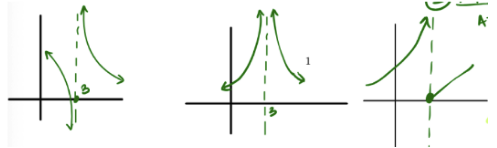
Different types of discontinuity
Removable discontinuity, jump discontinuity, vertical asymptote
Removable Discontinuity
This occurs when lim x→a of f (x) does not equal f(a).
For the function: x = a makes f(a) und, but it can be canceled out

Jump Discontinuity
Lim f(x) as x approaches a+ does not equal Lim f(x) as x approaches a- (one sided lim are different)

Vertical Asymptote
At least one of lim f(x) as x approaches a+ or a- = ∞ or -∞
For the function: the function is discontinious/und at a and that cant be canceled out
IVT says that
given f is continuous on the closed interval [a,b], and N is any number between f(a) and f(b) where f(a) does not equal f(b). Then there exists at least one number c in [a,] such that f(c) = N
For IVT have to show:
f(a)
f(b)
f(a) < f(c) <f (b)
Concluding statement:
IVT says that there is a number c in (a,b) such that f(c) = z
Steps to compute limit
Try to plug in x-value, if you get a real number that is the limit.
If you get 0/0 then do more work.
If you do work and still left with 0, then lim DNE
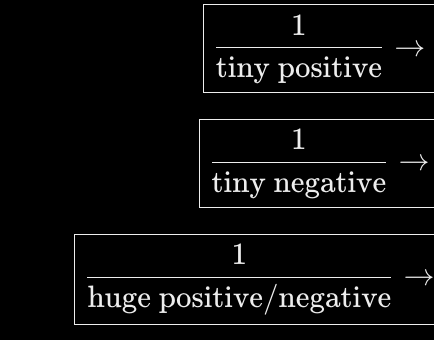
Nonzero / 0 limit
The strategy here is to look at signs of numerator and denominator
We know the limit dne already but we’re trying to see if it can be negative or positive infinity
Split up into negative and positive limit
See and think: as x approaches a from the neg/pos direction, are he values above the x axis?
If so, pos infinity
If no, neg infinity
Interpret:
If they match, it’s that infinity (neg or pos)
If not, it’s simply DNE
Ln1, ln <1, ln>1, ln<0
Ln 1 = 0
Ln < 1 = negative
Ln >1 = positive
Ln<0 = und
x²-y² =
(x-y)(x+y)


1
Squeeze Theorem
Squeeze Theorem
If a function is trapped between two functions that both approach the same value, the middle function must also approach that value.
g(x)f(x)h(x)
If g(x)=h(x)=L, then f(x)=L.
When to Use It
Try direct substitution first.
If it doesn't work, look for a function approaching 0 × a weird/oscillating sin or cos.
Plug the limit value into the function outside sin/cos. If it equals 0, think Squeeze Theorem.
Remember: -1(x)1 and -1(x)1.
Steps
Try direct substitution.
Find the bounds: -1(x)1 or -1(x)1.
Multiply all three parts by the function outside the sin/cos.
Simplify to get: lower bound ≤ original function ≤ upper bound.
Take the limits of the lower and upper bounds.
If both approach the same number L, the original function also approaches L.
Example: lim x→0 of x²cos(1/x)
Direct substitution does not work because cos(1/x) oscillates as x approaches 0.
We know that -1 ≤ cos(1/x) ≤ 1.
Multiply everything by x²: -x² ≤ x²cos(1/x) ≤ x².
Find the limits of the outside functions: lim x→0 of -x² = 0 and lim x→0 of x² = 0.
Since both outside functions approach 0, the function in the middle is squeezed to 0.
Therefore, lim x→0 of x²cos(1/x) = 0.
What are limits approaching infinity representing
They represent end behavior, which also means a horizontal asymptote.
Basically, as my x value gets infinitely large/small, what value is it approaching?
Domination rules for Horizontal Asymptote
Numerator dominates: limit = neg or pos infinity and no HA
Neither dominates: Ratio of leading coefficient for lim and HA
Denominator dominates: always = 0 for lim and HA
With limits to infinity, if you have an infinity/infinity function
The lim will equal ratio of leading coefficents but to prove:
Divide by leading in term in denominator
Or you can also simply reason it out and plug your inf/neg inf into x as seen here

A function can have at most ___ HA
2
How many VAs can a function have
infinitely many
Relationships between and f(x), f’(x), f”(x)
If f’(x) > 0 for all x in (a,b), then f is increasing on (a,b)
If f’(x) < 0 for all x in (a,b), then f is decreasing on (a,b)
If f’(x) = 0 for all x in (a,b), then f is constant on (a,b)
If f’’(x) > 0, f’(x) increasing, f(x) concave up
If f’’(x) < 0, f’(x) increasing, f(x) concave down
Position, velocity, acceleration functions
Position function: gives position s(t)
Units: m
Velocity function: gives instantaneous velocity/rate of change in position
v(t) = s’(t) - so velocity = derivative of position function
Units: m/s
Acceleration function: gives instantaneous acceleration/rate of change of velocity
a(t) = v’(t) = s’’(t): so velocity = derivative of velocity function and second derivative of position function
Units = m/s2
If a function is differentiable at x, is it continuous?
If a function is continuous at x, is it differentiable?
If a function is differentiable at x, it means it is also continuous at x, but not vice versa.
Types of Non-Differentiabilty
Corner, Cusp, Vertical Tangent, Discontinuity
Corner
The one sided derivatives are different

Cusp
Extreme case of a corner; slopes of the secant lines approach infinity from one side and negative infinity from the other side

Vertical Tangent
Slopes of the secant lines approach either infinity or negative infinity from both sides

Discontinuity
causes one or both of the one-sided derivatives to be nonexistent

Limit definition of derivative

Steps for tangent line
Find the derivative f’(x)
Find f’(a) = slope (m) (instantaneous rate of change)
f(a) = y1
Plug into point slope: y-y1= m(x-x1)
Derivative of a constant
0
Derivative of A linear (y = mx + b) function
m (slope)
Power Rule
(xn) = nxn-1or (axn) = (an)xn-1
Sum and difference rule
The derivative of f + or - g = the sum/diff of the derivative of f and g.
Derivative of ex
ex
Product Rule
[f(x)g(x)] = f’(x)g(x) + f(x)g’(x)
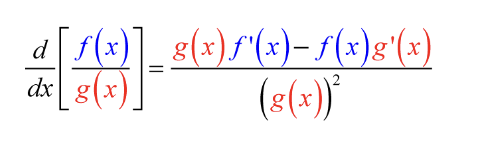
Quotient Rule
(Low)(Dee High) - (high)(dee low) all dived by (low) squared
Use when functions being divided by each other