Cross-presentation, dendritic cell subsets and tumor immunology
 Call Kai
 Learn
Learn Practice Test
 Spaced Repetition
 Match
Match Flashcards
 Knowt Play
1/18

There's no tags or description
Looks like no tags are added yet.
Name | Mastery | Learn | Test | Matching | Spaced | Call with Kai | Chat |
|---|
No analytics yet
Send a link to your students to track their progress
19 Terms
Immunosurveillance is lost with 2 factors? what are they?
Age 2. Immunodeficiency
What is paraneoplastic syndromes?
Tumour expresses an antigen which is also a normal physiological cell of some other part of body. The immune cells is triggered to attack the antigen and the normal cell gets affected too. This leads to autoimmunity. This gives rise to a rare group of diseases known as Paraneoplastic syndrome.
Name the broad categories of tumour antigens. Which is the most immunogenic/high affinity and why? Which one is the low affinity/tolerant antigen
Tumour specific, tumour associated, testis antigen. High- Tumour specific- neoantigens, Low- Tumour associated
Tumour specific antigen- how do they arise? Give an example
Only seen in tumour cells. Neoantigen through aberrant transcription and translation. HPV, KRAS Mutation
Tumour associated antigen- how do they arise? Give an example
Low levels of expression in normal cells and disproportionately expressed in tumour cells. Because of genetic amplification and post translational modification. CD19 on B cell malignancies
testis antigen- what are they and an eg
Absent in normal adult cells excpet in reproductive cells. MAGE.
Only DC can stimulate naive t cells. Explain the 3 signals
MHC 1 complex 2. Costimulation 3. Cytokines
How does tumor antigen INSIDE tumour cell get onto MHC I of the dendritic cell?
Cross presentation
What are the 2 pathways for cross presentation and explain how it works
Cytosolic pathway- External antigen is taken into a vesicle and transferred into the cytosol. Then it joins the normal MHC-I processing machinery:
antigen → cytosol → proteasome → peptides → TAP → MHC I
(proteosome and tap dependent pathway)
Vacuolar pathway- The antigen stays inside the endosomal/phagosomal compartment. Proteases such as cathepsins generate peptides there, and they are loaded onto MHC I.
(cathepsin-dependent)
What is cross dressing? How is it different from cross presentation?
In DC cross-dressing, the dendritic cell acquires an already assembled peptide–MHC complex from another cell and displays that intact complex on its own surface. Whereas a cross presentation mechanism is to acquire a protein from an infected/tumour cell and then break it down. make an MHC I complex and load it in
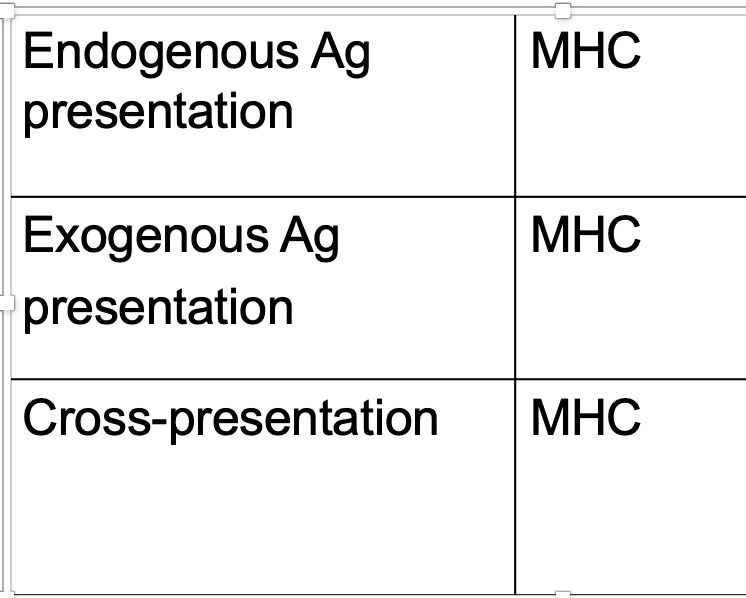
What is the MHC complex

Are CD4 T cells important for anti tumor immune responses? Explain why? Why cancer vaccines can benefit from including both MHC-I epitopes (CD8) and MHC-II epitopes (CD4 help).
Tumors are often poorly inflammatory → tumor antigens alone may not sufficiently activate/mature DCs.
CD4 T cells recognize tumor antigen presented on MHC class II by DCs.
Activated CD4 T cells express CD40L, which binds CD40 on the DC.
CD40L–CD40 interaction “licenses” the DC → the DC becomes a stronger antigen-presenting cell.
Licensed DCs provide better costimulation and cytokine signals.
This improves the DC’s ability to prime tumor-specific CD8⁺ cytotoxic T cells through MHC-I.
Stronger CD8 responses → better killing of tumor cells.
What is the derievative for conventional/classical DC development
What is the derievative for monocyte lineage
Flt3L → conventional/classical DC development
M-CSF → monocyte lineage
Specialized functions of DC subsets in immunity: cDC1? cDC2
cDC1 for intracellular infections and cancer and involved in cross presentation (CTL, Th1)
cDC2 for extracellular pathogens and allergy (Th2, Th17
Why cdc1 better at cross presentation?
Presence of CLEC9A / DNGR-1 receptor exclusive to cDC1 and recognizes material associated with dead/necrotic cells.
dead tumor cell → DNGR-1 recognition by cDC1 → tumor antigen acquisition → cross-presentation
slower endosomal acidification/degradation
If a DC digests everything extremely rapidly inside lysosomes, antigen gets destroyed before it can enter the cross-presentation pathway. cDC1 preserve antigen longer:
slower degradation → antigen remains available → better cross-presentation
WH stronger MHC-I processing machinery: cDC1 have increased expression/capacity of components used for the MHC-I antigen-processing pathway.
What defiency leads to cd1 defieciency leading to impaired immune based tumour rejection
BATF3
Checkpoint blockade doesn't replace antigen presentation. EXPLAIN
Checkpoint blockade does not replace antigen presentation because T cells must first recognize tumor antigens presented on MHC molecules to become tumor-specific and activated. Checkpoint molecules such as PD-1 normally inhibit these activated T cells. Blocking PD-1/PD-L1 removes this inhibitory signal and restores or enhances T-cell activity, but it does not provide the tumor antigen or initiate antigen-specific recognition. Therefore, effective anti-tumor immunity still requires antigen presentation and T-cell priming, while checkpoint blockade mainly removes the brakes from an existing tumor-specific T-cell response.
Type I interferon-activated cDC2 can undergo efficient cross-dressing- true or false
True
cdc1 and cdc2 both enhance CD8 T cell priming. How
Cross-presentation (cdc1) and cross-dressing (cdc2)