Ch. 3: Communication
 Call Kai
 Learn
Learn Practice Test
 Spaced Repetition
 Match
Match Flashcards
 Knowt Play
1/53

There's no tags or description
Looks like no tags are added yet.
Name | Mastery | Learn | Test | Matching | Spaced | Call with Kai | Chat |
|---|
No analytics yet
Send a link to your students to track their progress
54 Terms
Referent
Event or thought that initiates the communication
-Includes sensation or observation
ex: body language
Tasting a strange flavor in medication and questioning the nurse about it
Referent Example
Referent Example
A patient feeling pain initiates communication by calling for the nurse or pressing the call button
Sender
Person who initiated and encodes the communication
-Can decide which mode of communication (verbal, written, or nonverbal) can most effectively convey the intended meaning of the message
A nurse calling a physician to report a change in condition on a patient
Sender
Message
Information that is communicated
-Factors that influence communication:
timing of conversation
educational levels of the people involved
modes of communication used
physical and emotional factors
Message example
Patient education handouts about diabetes management
Channel
Method of communication
-Can include the 5 senses
Channel Example
Feeling skin temperature to assess for fever
Receiver
Person who receives and decodes, or interprets, the communication
-Needs to:
actively listen
observe
engage in conversation
Feedback
Response of the receiver
asking to restate their message
The communication process
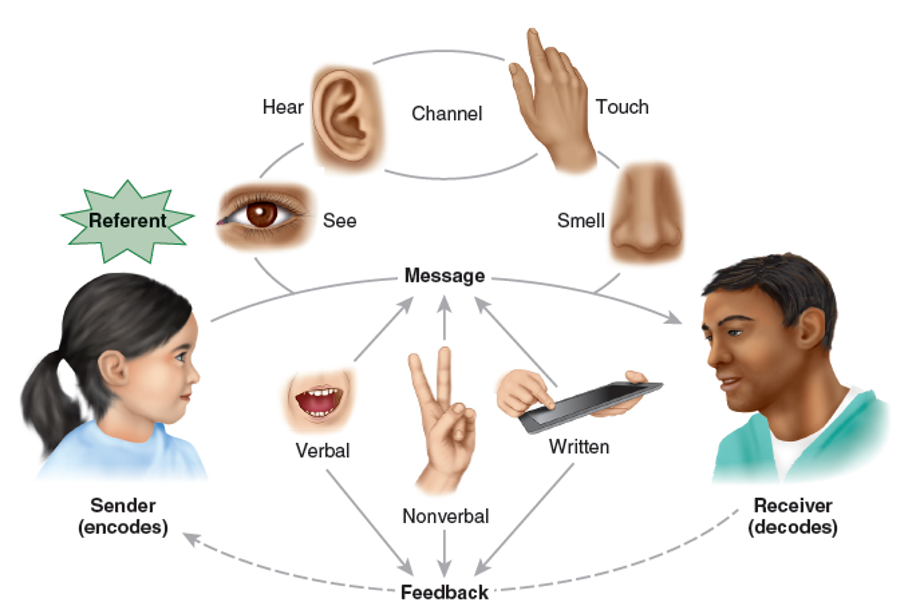
Nonverbal communication
wordless transmission of information
- 93% of communication is nonverbal
Body language
Makes up 55% of communication
- Posture, stance, and gait
- Facial expressions and eye movements
- Touch, gestures, and symbolic expressions
Proxemics
The study of spatial requirements of humans and animals
In nursing, it is important because it:
Establish patient comfort
Build trust
Ensuring effective interactions
Theory of proxemics/ Edward Hall
4 distances that people interact with:
Intimate (0-1.5 ft)
Personal (1.5 to 4 ft)
Social (4-12 ft)
Public (12-+ ft)
Voice inflection
38%
Second most significant form of nonverbal communication
Emphasized through tone, volume, and the rhythm or rate of speech
Avoid sounding condescending
Verbal communication
Albert Mehrabian said that only 7% is verbal communication
- Setting, context, and content
- Setting influences what is or what can be shared
- Monitor context and content to avoid misinterpretation
- Written communication
- Effective at providing details and legal documentation; lacks nuance
ex: it may be difficult to perceive urgency when reading progress notes
- Electronic communication
- Can provide information quickly; validate and verify shared information
Intrapersonal communication
Positive self-talk
Negative self-talk
Meditation
Prayer
Positive self-talk
is internal conversation that provides motivation and encouragement
Builds self-esteem and confidence
Negative self-talk
damage one’s ability to reach their greatest potential or overcome adversity
May increase a patient’s perception of:
Pain
Anxiety
Inability to meet challenges of a poor prognosis
Interpersonal communication
Takes place b/t two or more people
it can be formal or informal
Miscommunication contributes to:
- 82% of sentinel events or near misses
-is the cause of 60% of adverse patient events
Interprofessional communication
Ethical implications
HIPAA
SBAR Model
Situation: What is happening rn?
Background: What led to the current situation?
Assessment: What is the identified problem, concern, or need?
Recommendation: What actions or interventions should be initiated to alleviate the problem?
The CUS tool
State their Concern
State why they are Uncomfortable
identify the Safety issue
Small-group communication
- Small-group dynamics
Forming: group members rely on the leader to identify the mission and goals of the group
Gound rules are identified, trust is established
Storming: may involve some personality conflicts among the group participant
The group leader needs to work with members to resolve conflicts and build cohesion
Norming: the group leader encourages participants of all group members, avoid sharing too much of their own thoughts or feelings, sharing accomplishments
Increased trust and openness, productivity and meaningful sharing info.
Performing: Interdependence emerges, problem-solving occurs,
Adjourning: takes place as the small group disperses, having achieved the group’s goals
Public communication
nurses educate on health care issues/wellness,
-Requires:
Education
Preparation
Openness to diverse opinions
communication skills
Nurse-patient relationship
Building trust
Demonstrating empathy
Establishing boundaries
Recognizing and respecting cultural influences
Developing a comprehensive plan of care
Phases of the helping relationship
Orientation: gathering assessment and diagnostic data can help you with your initial interaction with your patient
Working: implement the plan of care
Termination: concludes the relationship as you pass off to another caregiver
Nursing process in the helping relationship/ SHARE Model
The five steps of the nursing process are used in each phase of the helping relationship
Seek your patient’s participation
Help your patient explore and compare treatment options
Assess your patient’s values and preferences
Reach a decision with your patient
Evaluate your patient’s decision
Pain or anxiety
Direct empathic communication is most effective
Use short questions or specific instructions
Extensive patient education or preoperative teaching should be provided at an earlier or different time
Location and distractions
Provide privacy and confidentiality
Minimize distractions
e.g. technology
Respect
for patients and their families is conveyed by nurses verbally and nonverbally
Ensuring privacy, providing necessary health care information, fostering autonomy in decision making
Controlling facial expressions and body language
Assertiveness
is the ability to express ideas and concerns clearly while respecting the thoughts of others
-communicate w/o hesitation
Collaboration
with other health care professionals is a key factor in communicating necessary health care information and providing comprehensive care
Delegation
is a multifaceted responsibility of the registered nurse
*important to be precise and assertive
-Communicating therapeutically with colleagues during the delegation process shows respect and recognizes the many stressors with which all members of the health care team cope while providing patient care
Advocacy
involves defending the rights of others, especially those who are vulnerable or unable to make decisions independently
-Nurse must be:
knowledgeable
organized
able to communicate in a caring manner
Social Communication
Occurs among individuals who know each other or who are getting to know each other informally
- Involves mutual sharing of ideas, give advice, verbalize opinions, or make judgements on the behavior of others
Therapeutic Communication
Primary focus is b/t a patient and nurse is the patient
- Engaged in therapeutic conversation set their own opinions and judgements aside to listen more fully to their patients
such as:
active listening
open posture
reflection
SOLER may appear on test
S- encourages the listener to sit (if possible) facing the patient
O- reminds the nurse to maintain an open stance or posture while listening
L- suggests that the listener lean toward the speaker, positioning the body in an open stance
E- refers to maintaining eye contact without staring
R- reminds the nurse to relax
Non-therapeutic communication
can be hurtful and potentially damaging to interaction
Changing the subject
sharing personal opinion
Compensation
Using personal strengths or abilities to overcome feeling of inadequacy
Compensation Example
A student who struggles academically becomes an excellent althelte
Displacement
Transferring emotional energy away from an actual source of stress to an unrelated person or object
Displacement Example
After being criticized by a boss, a worker goes home and yells at a family member
Introjection
Taking on certain characteristics of another individual’s personality
Introjection Example
A child starts acting and speaking like her favorite teacher
Projection
Attributing undesirable feelings to another person
Projection Example
A person who is angry accuses others of being hostile
Regression
Reverting to behaviors consistent with earlier stages of development
Regression Example
A toilet-trained child starts wetting the bed after a new sibling is born
Sublimation
Rechanneling unacceptable impulses into socially acceptable activites
Sublimation
A person with aggressive feelings becomes a boxer or martial artist
Supression
Choosing not to think consciously about unpleasant feelings
Suppression Example
A student worries about a family problem but decides to focus on studying until after the exam