Anatomy of Hearing Lecture 11
 Call Kai
 Learn
 Practice Test
 Spaced Repetition
 Match
 Flashcards
 Knowt Play
1/96

There's no tags or description
Looks like no tags are added yet.
97 Terms
Outer Ear: What is the pinna (auricle)?
The prominence we refer to as “the ear.”

Outer Ear: What is the function of the pinna?
Collects sound that is processed in the middle ear and cochlea.

Outer Ear:How does the pinna help us?
Aids in the localization of sound.

Outer Ear: What are the five landmarks of the pinna?
Helix
Antihelix
Concha
Tragus
Lobe
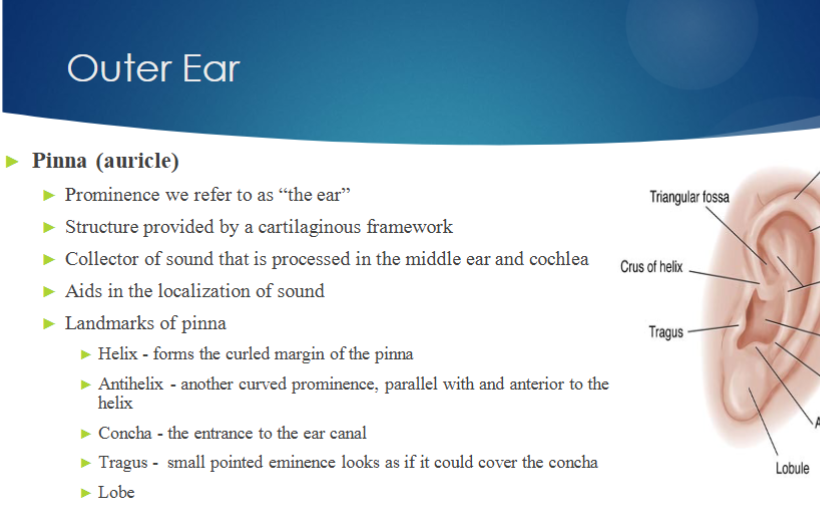
Outer Ear: What is the helix?
Forms the curled margin of the pinna.

Outer Ear: What is the antihelix?
Another curved prominence, parallel with and anterior to the helix.

Outer Ear: What is the concha?
: The entrance to the ear canal.

Outer Ear: What is the tragus?
A small pointed eminence that looks as if it could cover the concha.

Outer Ear: What is the lobe?
The lower, soft part of the pinna.
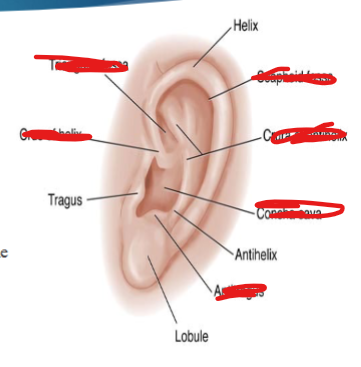
Outer Ear: What is the External Auditory Meatus (EAM)?
The external ear canal.

Outer Ear: What is the approximate diameter of the EAM?
7 mm.

Outer Ear: What is the lateral third (8 mm) of the EAM(External Auditory Meatus) composed of? What lines the cartilaginous meatus? What is the function of hairs and cerumen in the cartilaginous meatus?
Cartilage (cartilaginous meatus).
Hairs and cerumen (earwax).
To trap foreign substances.

Outer Ear: Why is the EAM(External Auditory Meatus) considered a resonating cavity? Where does the EAM terminate?
Vibrations in the ear canal set up vibrations in the eardrum.
At the tympanic membrane (eardrum).

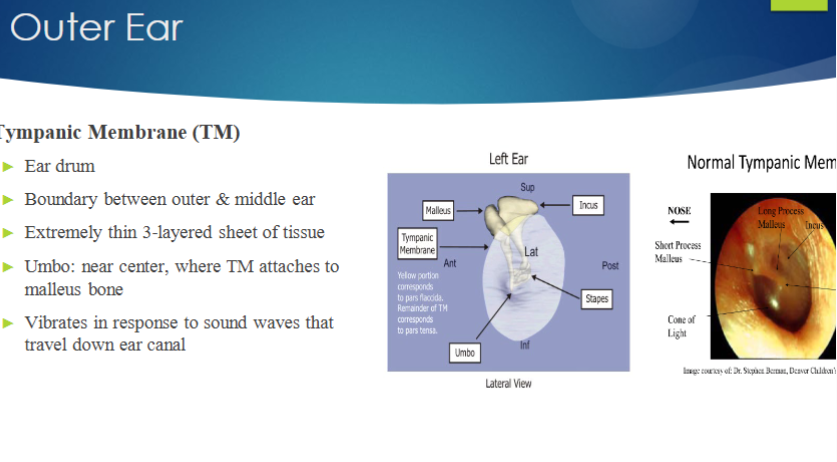
Outer Ear: What is another name for the tympanic membrane (TM)?
Eardrum

Outer Ear: What does the tympanic membrane separate?
The outer ear and middle ear.

Outer Ear:What is the structure of the tympanic membrane?
An extremely thin, 3-layered sheet of tissue.

Outer Ear: What is the umbo?
The area near the center of the TM where it attaches to the malleus bone.

Outer Ear: What causes the tympanic membrane to vibrate?
Sound waves traveling down the ear canal.
Middle Ear: What is the ossicular chain?
A chain formed by three small bones of the ear known as the ossicles.
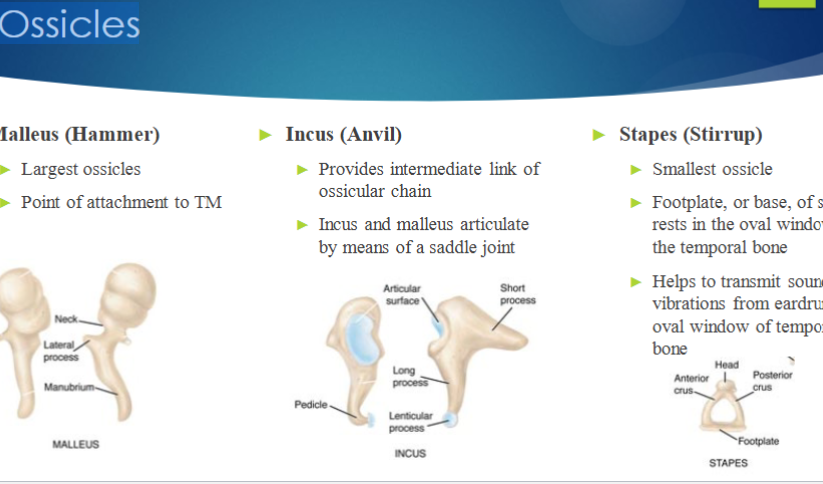
Middle Ear: What are the three bones of the ossicular chain?
Malleus (Hammer)
Incus (Anvil)
Stapes (Stirrup)

Middle Ear: What is the function of the ossicular chain?
Transfers sound to the inner ear.
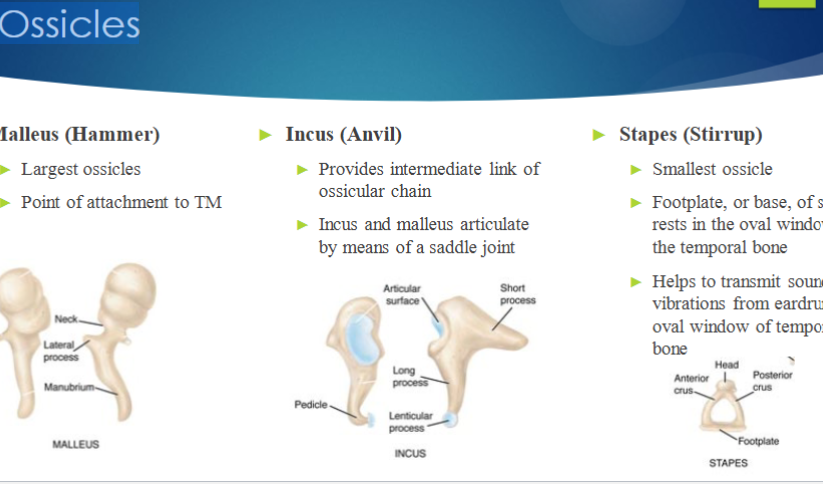
Ossicles: Which ossicle is the largest?
Malleus (Hammer).

Ossicles: What is the point of attachment of the malleus?
: Tympanic membrane (TM).

Ossicles: What is the function of the incus?
Provides the intermediate link of the ossicular chain.

Ossicles: How do the incus and malleus articulate?
By means of a saddle joint.

Ossicles: Which ossicle is the smallest?
Stapes (Stirrup).

Ossicles: Where does the footplate (base) of the stapes rest?
In the oval window of the temporal bone.
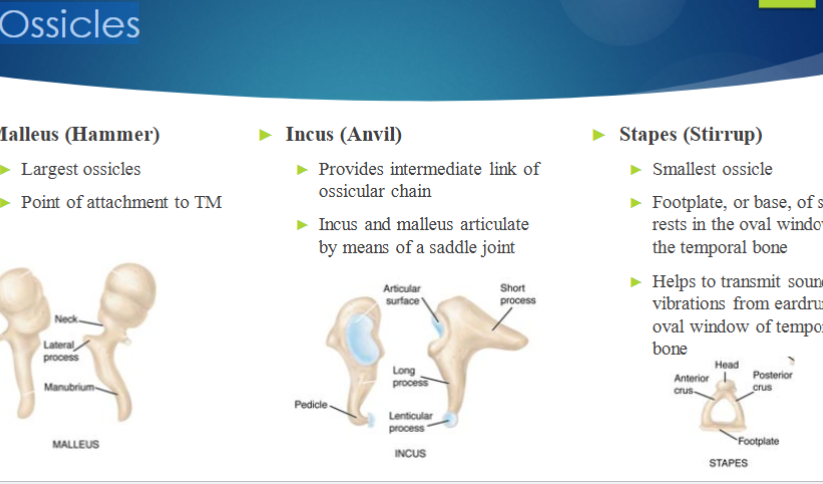
Ossicles: What is the function of the stapes?
Transmits sound vibrations from the eardrum to the oval window of the temporal bone.

Tympanic Muscles: What are the tympanic muscles?
Muscles of the middle ear attached to the ossicles.

Tympanic Muscles: What is special about the tympanic muscles?
They are the smallest muscles of the human body.

Tympanic Muscles: Where is the stapedius muscle located?
Embedded in the posterior wall of the middle ear.

Tympanic Muscles:What does the stapedius muscle do?
Contracts to rotate the stapes posteriorly.
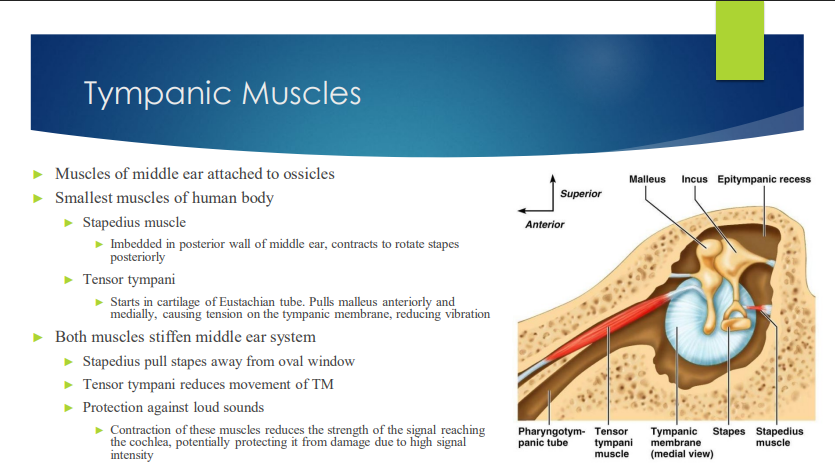
Tympanic Muscles: Where does the tensor tympani start?
In the cartilage of the Eustachian tube.
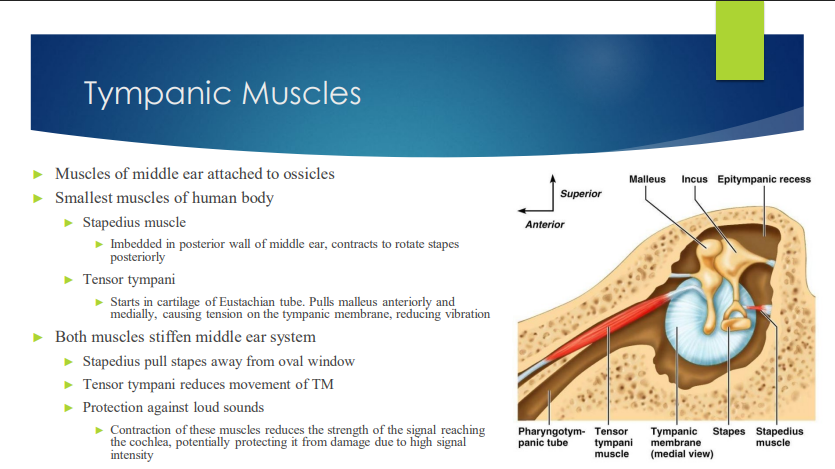
Tympanic Muscles: What does the tensor tympani muscle do?
What happens when the tensor tympani pulls the malleus?
Pulls the malleus anteriorly and medially.
It causes tension on the tympanic membrane, reducing vibration.
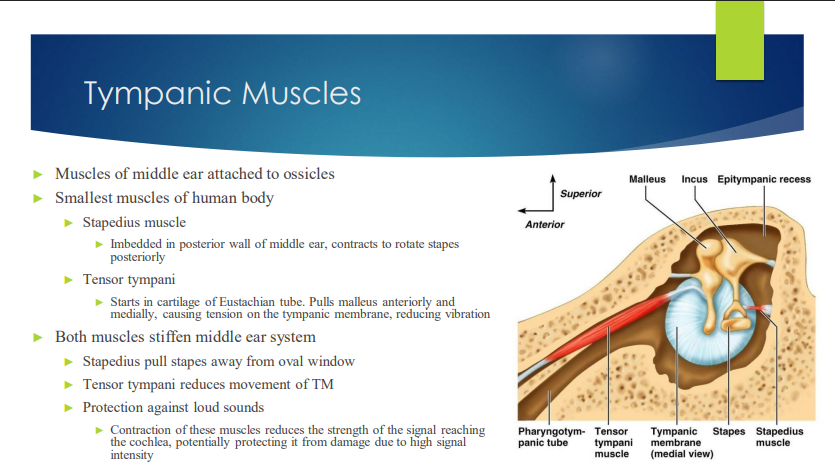
Tympanic Muscles: What do both tympanic muscles do to the middle ear system?
How do the stapedius and tensor tympani protect against loud sounds?
Stiffen the middle ear system.
Their contraction reduces the strength of the signal reaching the cochlea, potentially protecting it from damage.

Landmarks of the Middle Ear: What is the oval window?
What bone is connected to the oval window?
The location where the footplate of the stapes is embedded and transfers energy to the cochlea.
Stapes (footplate).

Landmarks of the Middle Ear: Where is the round window located?
What is the function of the round window?
Below the oval window.
Provides an entrance into the scala tympani of the cochlea.

Landmarks of the Middle Ear: Where is the promontory located? What is the promontory?
Between the oval and round windows.
A bulge created by the basal turn of the cochlea.

Landmarks of the Middle Ear: What is another name for the auditory tube?
What does the Eustachian tube bring to the middle ear?
Eustachian tube.
Oxygen (aeration).

Landmarks of the Middle Ear: What does the Eustachian tube help maintain?
What happens when the Eustachian tube helps equalize pressure?
Equilibrium between middle ear pressure and atmospheric pressure.
Your ears may pop.


Label them
Letter
Structure
A - Pinna
B - External auditory meatus
C - Tympanic membrane
D - Stapes
E - Round window
F - Eustachian tube
G - Cochlea
H - Semicircular canals
I - Incus
J - Malleus

What is the primary function of the pinna?
C. Collection of sound and sound localization.

What is cerumen?
B. Another name for earwax.

What is the purpose of the ossicles?
A.provide an impedance matching device
B. are the smallest bones of the body
C. provide the means of communicating sound from the outer ear to the inner ear
D. All are true of the ossicles

What acts as a boundary between the outer and middle ears?
Tympanic membrane.
Which of the following is NOT true of the tympanic membrane?
It forms the boundary between the middle and inner ear.

The stapedius and tensor tympani muscles help protect us from loud sounds by
Stiffening the middle ear system.

What bone of the ear articulates with the tympanic membrane?
A. Malleus.
What bone articulates with the inner ear?
C. Stapes.

Inner Ear: What does the inner ear contain sensors for?
The inner ear contains sensors for:
Balance → Vestibular system
Hearing → Cochlea

Inner Ear: What is the vestibular system responsible for?
The vestibular system contains the sensors for balance.

Inner Ear: What part of the inner ear contains sensors for hearing?
The cochlea contains the sensors for hearing.

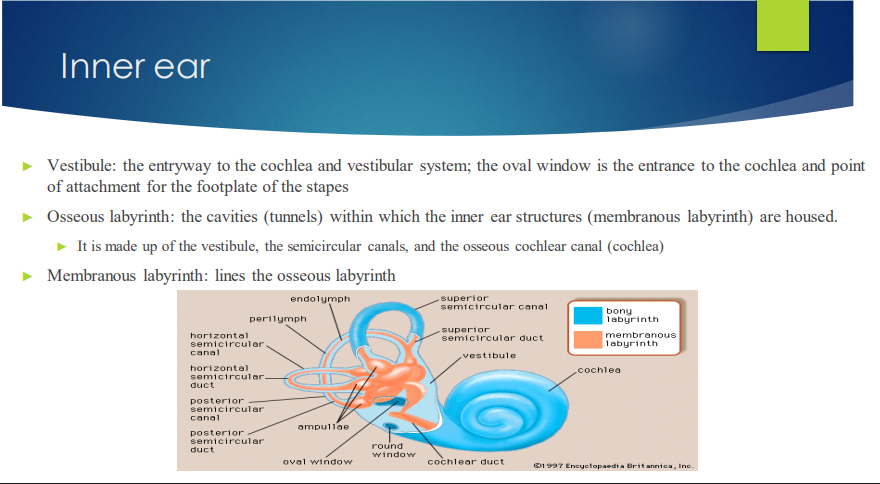
Inner ear: What is the vestibule?
The vestibule is the entryway to the cochlea and vestibular system.

Inner ear: What is the oval window?
The oval window is the entrance to the cochlea and the point of attachment for the footplate of the stapes.

Inner ear: What is the osseous labyrinth?
The osseous labyrinth is the cavities (tunnels) within which the inner ear structures (membranous labyrinth) are housed.

Inner ear: What structures make up the osseous labyrinth?
Vestibule
Semicircular canals
Osseous cochlear canal (cochlea)
Cochlea: What is the appearance of the cochlea?
The cochlea has the appearance of a coiled snail shell.

Cochlea: How does the cochlea coil?
The cochlea coils out from its base near the vestibule, wrapping around itself before reaching its apex (at the center of the coil).

Cochlea: What is the modiolus?
The modiolus is the core of the osseous labyrinth. It is finely perforated bone that allows passage of the auditory nerve fibers that innervate the sensory end organs of hearing.

Cochlea: How is the cochlea divided?
The cochlea is a tube divided into 3 sections lengthwise and rolled up.

Cochlea: What are the three sections of the cochlea?
Scala vestibuli
Scala tympani
Scala media (cochlear duct)

Cochlea: What is the scala vestibuli?
The scala vestibuli is one of the three sections of the cochlea. The oval window permits communication between the scala vestibuli and the middle ear space.
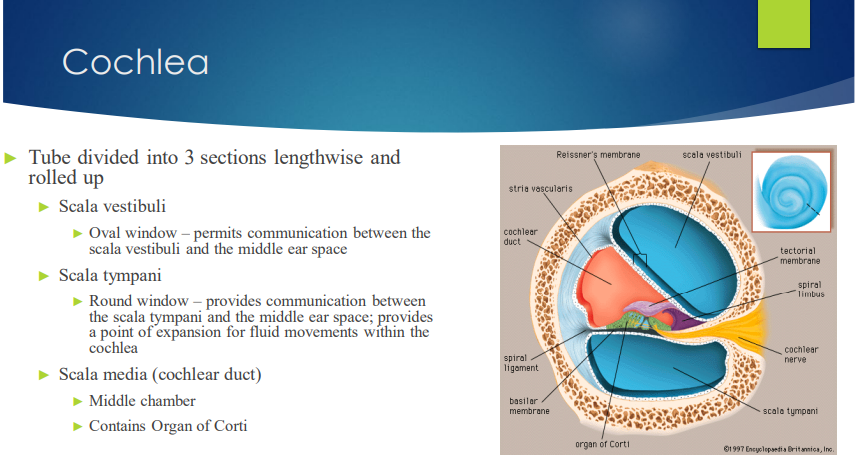
Cochlea: What is the function of the oval window?
It permits communication between the scala vestibuli and the middle ear space.

Cochlea: What is the scala tympani?
The scala tympani is one of the three sections of the cochlea. The round window provides communication between the scala tympani and the middle ear space.

Cochlea: What is the function of the round window?
It provides communication between the scala tympani and the middle ear space and provides a point of expansion for fluid movements within the cochlea.
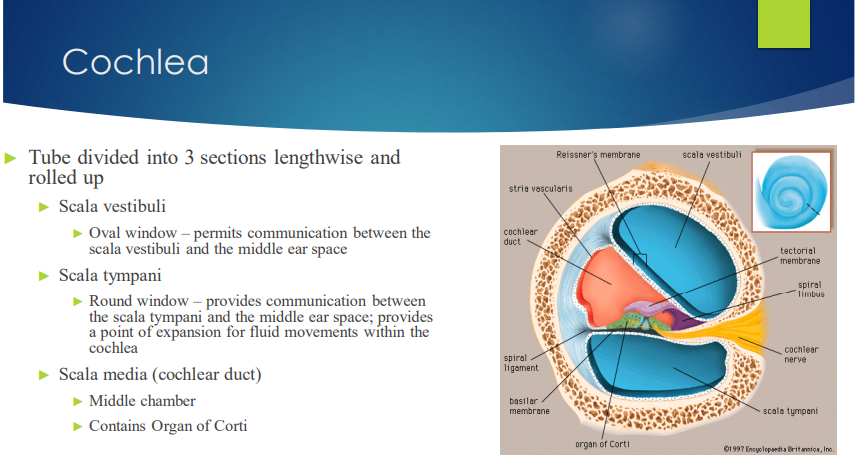
Cochlea: What is the scala media (cochlear duct)?
The scala media is the middle chamber of the cochlea.

Cochlea: What does the scala media contain?
It contains the Organ of Corti.
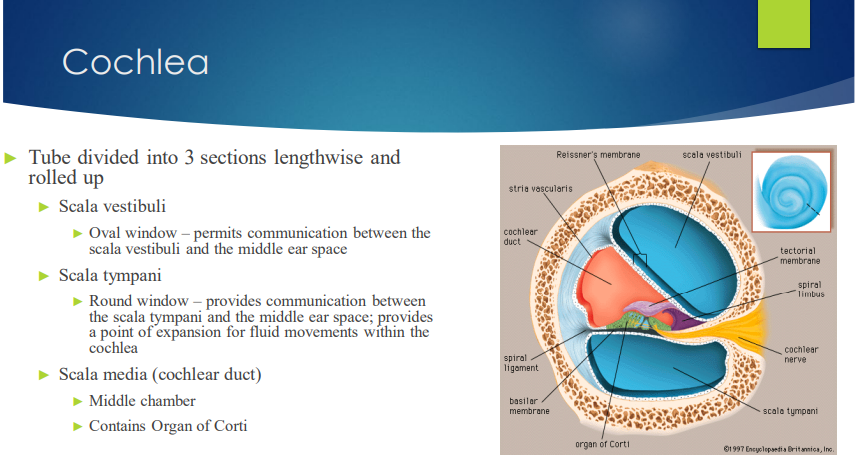
Cochlea: What is perilymph?
Perilymph is the fluid found in the scala vestibuli and scala tympani.
Cochlea: What is the ion concentration of perilymph?
High concentration of sodium ions
Low concentration of potassium ions
Cochlea: Where is endolymph found?
Endolymph is found in the scala media (cochlear duct).
Cochlea: What is the ion concentration of endolymph?
Endolymph is higher in potassium, not sodium.
Cochlea: What does Reissner's membrane divide?
Reissner's membrane divides the scala vestibuli and scala media.
Cochlea: What does the basilar membrane divide? What does the basilar membrane form?
What does the basilar membrane support?
It forms the floor of the scala media.
It moves in response to sound energy transferred through the perilymph of the scala vestibuli.
It supports the Organ of Corti.
Organ of Corti: Where is the Organ of Corti located?
What is the Organ of Corti?
It is located on the basilar membrane.
It is the sensory organ of hearing within the inner ear.
Organ of Corti: What does the Organ of Corti do?
How many rows of hair cells does the Organ of Corti have?
It contains specialized sensory epithelium that allows for the transduction of sound vibrations into neural signals.
It has four rows of hair cells that rest on a bed of Deiter's cells, which help anchor the hair cells to the basilar membrane.
Organ of Corti: How many rows of outer hair cells are there?
How many rows of inner hair cells are there?
What separates the outer and inner hair cells?
There are three rows of outer hair cells.
There is a single row of inner hair cells.
The tunnel of Corti separates the outer and inner hair cells.
Innervation of Hair Cells: Which cranial nerve provides innervation to the hair cells?
What types of connections does the VIII vestibulocochlear nerve have?
The VIII vestibulocochlear nerve.
It has both afferent and efferent connections.
Innervation of Hair Cells: What does it mean that the cochlea can receive signals from the CNS?
The cochlea can receive signals from the central nervous system (CNS) through its nerve connections.
Innervation of Hair Cells: How are inner hair cells innervated?
Each inner hair cell is connected to as many as 10 VIII vestibulocochlear nerve fibers.
Innervation of Hair Cells: What is many-to-one innervation?
Many nerve fibers connect to one inner hair cell.
Innervation of Hair Cells: How are outer hair cells innervated?
What is one-to-many innervation?
Each outer hair cell shares its innervation with 10 other outer hair cells, being innervated by the same VIII nerve fiber.
One nerve fiber connects to multiple outer hair cells.

How many rows of inner hair cells are there?
There is one row of inner hair cells (IHCs) and three rows of outer hair cells (OHCs).

What structure(s) help your body sense position in space?
B.semicircular canals

The basilar membrane separates the scala tympani from the …
B. Scala media

Reissner’s membrane separates the
C. Scala vestibuli from the scala media

Scala vestibuli and scala tympani are filled with _______, and scala media is filled with ________.
A. Perilymph; endolymph
Types of Hearing Loss: What are the three types of hearing loss?
Conductive hearing loss
Sensorineural hearing loss
Mixed hearing loss
Types of Hearing Loss: What causes conductive hearing loss?
Problems affecting sound transmission through the outer or middle ear.
Types of Hearing Loss: Can conductive hearing loss be temporary or permanent?
Yes. It may be either temporary (transient) or permanent.
Types of Hearing Loss: What are some causes of conductive hearing loss?
Ear wax
Fluid
Malformation of the outer and/or middle ear
Types of Hearing Loss: What causes sensorineural hearing loss?
Damage to the inner ear or to the nerve pathways from the inner ear leading toward the brain.
Types of Hearing Loss:Is sensorineural hearing loss usually temporary or permanent?
It is almost always permanent.
Types of Hearing Loss: What are some causes of sensorineural hearing loss?
Genetic or syndromic causes
Some medications
Infections
High fevers
Head trauma
Types of Hearing Loss: What is mixed hearing loss?
It includes both a conductive and sensorineural component.
Disorders of the Outer Ear?
Atresia
Ear canal obstruction
Otitis externa
Disorders of the Middle Ear?
Perforated ear drum
Otitis media
Ossicular Discontinuity
Disorders of the Inner Ear?
Aplasia/dysplasia
Viral Infections
Meniere’s disease
Noise-induced hearing loss
Presbycusis