orgo 2 exam 3
 Call Kai
 Learn
 Practice Test
 Spaced Repetition
 Match
 Flashcards
 Knowt Play
1/262

There's no tags or description
Looks like no tags are added yet.
263 Terms
Which are more acidic in carbonyl compounds? alpha hydrogens or similar hydrogens bonded to sp3 carbons?
Alpha hydrogens
Where do alpha substitution reactions occur and what is required for the substitution?
alpha position
substitution of an alpha hydrogen by an electrophile through an enol or enolate ion intermediate
What can enolate formation be catalyzed by?
Protic acids or bases
A carbonyl compound with a hydrogen atom on its alpha carbon atom is in equilibrium with what?
its corresponding enol isomer
How does acid catalysis of keto-enol tautomerism occur?
The protonation of the carbonyl oxygen to give an intermediate cation that loses H+ from its alpha carbon to yield a neutral enol
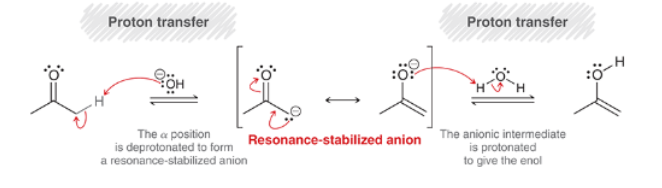
How does the base-catalyzed enol formation occur?
The carbonyl group makes the alpha hydrogens weakly acidic. This allows the carbonyl compound to act as an acid and donate one of its alpha hydrogens to a sufficiently strong base. The resultant enolate ion is resonance stabilized
Mechanism for Acid-Catalyzed Tautomerization

Mechanism for Base- Catalyzed tautomerization

Why would the enol of the this ketone be more favored at equilibrium?
The enol is stabilized by conjugation and intramolecular hydrogen bonding and is more stable
In a phenol would the enol or keto be more favored?
Phenol
What are the requirements for the equilibrium to shift to the enol form?
Resonance and delocalization and intramolecular hydrogen bonding
What is an enolate formed in the presence of?
a strong base
Mechanism for the formation of an enolate under basic conditions?

Why is the enolate more nucleophilic than the enol?
Because it carries a negative charge
Which will interact with electrophiles? enolates or enols?
Both

What is the enolate form of acetone?

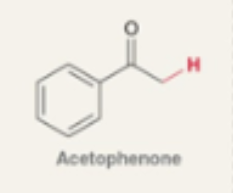
What is the enolate form of Acetophenone?


What is the enolate form of Acetaldehyde

What is the pKa of acetone?
19.2
What is the pKa of Acetophenone?
18.3
What is the pKa of Acetaldehyde?
16.7
What does it mean when the pKa values of the conjugate acid and the carbonyl compound are similar?
The products and reactants are present in significant amounts
In order to irreversibly and completely form an enolate, what needs to be used?
a very strong base such as NaH or LDA
Is LDA basic (and/or) nucleophilic
It is basic
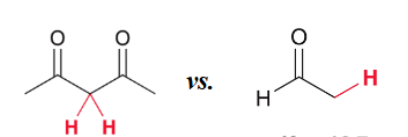
Which is more acidic and why?
The one to the left because the it is between two carbonyl groups . The increased stability is due to the stability of the resulting enolate
What will be present (enol/ketone/enolate) if a ketone is reacted with NaOH or NaOEt?
Both the enolate and ketone will be present at equilibrium
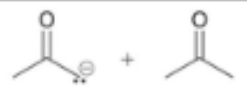
What will be present (enol/ketone/enolate) if a ketone is reacted with NaH or LDA?
irreversible enolate formation

What will be present (enol/ketone/enolate) if a ketone is reacted with NaH or LDA?
Nearly complete enolate formation

Under acidic conditions where will ketones and aldehydes undergo halogenation?
The alpha position
Which elements work for alpha halogenation?
Cl2, Br2, I2 but not F2
what is the reactive intermediate in halogenation under acidic-conditions?
an enol
Mechanism for alpha halogenation under acidic conditions

Where does halogenation occur for asymmetrical ketones?
It occurs faster for the more substituted carbon but since two enolates form there will be two products

Which product of halogenation will occur for the more substituted position?
major
What happens when a halogenated product is treated with a base?
It will undergo an elimination reaction and will reach an a, b unsaturated ketone
What bases can be used for the elimination of an alpha halogenation reaction?
(h3o+, br2/ pyridine), t-ButOK, Li2CO3
What is another name for an alpha halogenation reaction that occurs undergo basic conditions?
Haloform reactions
Mechanism for haloform reactions
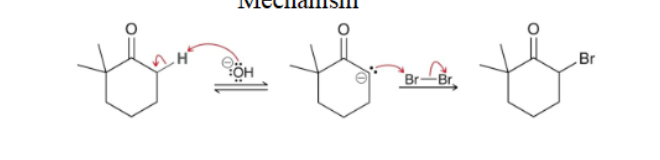
Under what conditions does poly halogenation typically occur?
Basic
after the first halogenation the alpha position is more acidic so the second halogenation occurs rapidly

What happens to methyl ketones under basic conditions? (Haloform rxn)
They are converted to carboxylic acids using halogen and hydroxide
What is the reaction mechanism for halogen reactions?

Why is CBr3 a suitable leaving group?
Because the negative charge is stabilized by electron withdrawing effects of the three bromine atoms
In order to produce carboxylic acids what is required?
Br2, Cl2, or I2 can be used
under basic conditions methyl ketones are converted to carboxylic acids using xs halogen and hydroxide
works best if the other alpha carbon has no alpha protons
How can the alpha position of a ketone or aldehyde be alkylated?
formation of an enolate
treating the enolate with an alkyl halide for an sn 2 rxn

in this step R-X must be a primary a carbon (SN2 attack)and the carbon performs the nucleophilic attack instead of the oxygen
the R-X functions as a base instead of a nucleophile and undergoes elimination
What is used to attain a kinetic enolate?
LDA at low temp, -78 degrees
When the thermodynamic enolate is preferred what is used?
NaH
What happens when an aldehyde of ketone is treated with hydroxide or alkoxide?
an equilibrium forms where the significant amount of enolate and aldehyde/ketone is present
What occurs if the enolate (nucleophile) attacks the aldehyde?
An aldol rxn
Aldol addition rxn mechanism
there are 3 steps:
deprotonation
nucleophilic attack
protonation

What prefers the aldol product? Aldehydes or Ketones?
Aldehydes
What forms an α, β-unsaturated carbonyl?
Heating the aldol product under basic or acidic conditions
When aldol condensation occur?
When an aldol reaction is performed at elevated temperatures
Is aldol condensation a one or two step process?
two
Which loses water (forms a byproduct of water and loses an alcohol from the initial starting product)
Aldol condensations
What is the driving force of an aldol group?
The conjugated system
Which isomer is the most stable and majority?
The trans isomer
Is the yield for aldol condensation higher or for addition
condensation

How many different aldol products can be formed when a mixture of acetaldehyde and propionaldehyde is treated with a base?
four
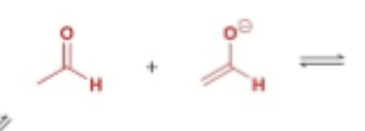


When are crossed aldol reaction only practical?
When the number of products are minimized
How can the products be minimized in crossed aldol reactions?
if the substrate is relatively unhindered and without alpha protons
if LDA is used as a base to form the desired enolate in large yield (directed aldol addition)
When benzaldehyde is used in a crossed aldol rxn what happens?
The dehydration step is spontaneous and the equilibrium favors the condensation product rather than the addition product, because the condensation product is highly conjugated. The stability of the pi system is the driving force.
What happens in crossed aldol reactions when LDA is used as a base?
one compound is completely converted to enolate with LDA
The other carbonyl compound is then slowly added to the enolate
What type of reaction can form cyclic compounds?
Intramolecular aldol reactions
How do intramolecular aldol reactions occur?
One group forms an enolate that attacks the other group
only 5 and 6 membered ring will form this way. smaller rings are possible but not observed
What is it called when an ester with an alpha hydrogen is treated with one equivalent of a base such as sodium ethoxide?
Claisen condensation reaction
What does a Claisen condensation reaction produce?
a B-keto ester
Claisen condensation is a ____ _____ substitution reaction
nucleophilic acyl
What happens in the last step of a Claisen condensation reaction?
The deprotonation of the B-ketoester
What is required for the equilibrium in a Claisen condensation reaction for the equilibrium to favor the formation of the B-ketoester?
two hydrogens
The first two steps of the the Claisen Condensation reaction are similar to which other reaction?
aldol addition reaction
What is the difference between the aldol reaction and Claisen condensation reaction?
The fate of the tetrahedral intermediate.
In Claisen condensation, the tetrahedral expels a leaving group to reform the carbonyl as is always the case for acyl derivatives
The Claisen condensation reaction is simply a nucleophilic acyl substitution reaction where the nucleophile is the ester enolate and the electrophile is the ester
What are the limitations of the Claisen Condensation Reaction?
The starting ester must have 2 alpha protons because removal of the second proton by the alkoxide ion is what drives the equilibrium forward
Hydroxide cannot be used as the base to promote Claisen condensations because ester hydrolysis occurs
An alkoxide that matches the —OR group of the ester is needed, otherwise transesterification will occur
What happens if Hydroxide is used as the base to promote claisen condensation reactions?

What happens if an alkoxide that doesn’t match the ester is used in a Claisen condensation reaction?

What is a Crossed Claisen Condensation?
A reaction that occurs between two different esters
What are the conditions for crossed Claisen Condensation reactions are useful?
one ester has no alpha protons
Directed claisen condensation with LDA as the base with prior prep of desired ester enolate, which is then treated with a different ester
Dieckmann Cyclization
Intramolecular claisen condensation reactions
Dieckmann cyclization prefers the formation of thermodynamically stable _ and _- membered rings
5 and 6
What is acetoacetic ester synthesis used for?
Most reliable method for the preparation of substituted derivatives of acetone
What does acetoacetic ester synthesis begin with?
Ethyl acetoacetate
What are the steps of acetoacetic ester synthesis
Ethyl acetoacetate is mildly acidic so treatment with a strong base will result in deprotonation to give a highly stabilized enolate (in which the negative charge is delocalized over two oxygen atoms instead of one
If the enolate is treated with an alkyl halide, the result is an alkylation reaction via an SN2 process (so need to use a primary alkyl halide)
The synthesis then requires that an alkylated product is treated with aqueous acid which results in the hydrolysis of the ester group
If the hydrolysis is performed at an elevated tempurature, the resulting carboxylic acid will undergo a rxn in which a carboxyl group is removed (decarboxylation) to produce a monosubstituted derivative of acetone as well as carbon dioxide
Why does decarboxylation occur in acetoacetic ester synthesis?
The carboxylic acid has a carboxyl group in the beta position which enable a pericyclic rxn
Acetoacetic ester synthesis can also be used to prepare what
disubstituted derivatives of acetone in which there are two alkyl groups present on the same alpha carbon. This can be achieved if start with ethyl acetoacetate and perform two successive SN2 alkylation rxns

Malonic ester synthesis process
Starts with diethyl malonate which is very similar to ethyl acetoacetate, and it is deprotonated to give a highly destabilized enolate
The enolate is then treated with an alkyl halide, the result is an alkylation rxn via SN2
When a primary RX is used, the alkylated product can then be treated with aqueous acid, which then results in hydrolysis of both ester groups to give a diacid
If this hydrolysis step is performed at elevated temperatures, the resulting diacid will undergo decarboxylation to produce a derivative of acetic acid, as well as carbon dioxide
Malonic ester synthesis can also be used to prepare what
disubstituted derivatives of acetone in which there are two alkyl groups present on the same alpha carbon. This can be achieved if start with diethyl malonate and perform two successive SN2 alkylation rxns followed by heating with aqueous acid
Aldehydes and ketones that possess a, B unsaturation exhibit unique reactivity at the B position. Why is the b carbon so reactive?
The resonance structures leave those positions with a positive charge which allows them to be attacked
Grinard will attack the carbonyl b carbon whereas R2CuLi will attack the other beta carbon
Enolates are typically more reactive/ less reactive with grignard reagents vs Lithium dialkyl cuprates?
More reactive with lithium dialkyl cuprates and less reactive with Grignard reagents

What is this called
Michael reaction

Michael donors

Michael acceptors
What does stork enamine synthesis do?
Derivatize a ketone to transform it into a good michael donor. The ketone is converted into an enamine and requires a secondary amine
Why are enamines less reactive than enolates?
The enamines are nucleophilic at the alpha position but enamines do not possess a net negative charge which is why they are less reactive but make for good michael donors
What are the three steps of stork enamine synthesis?
formation of an enamine
michael addition
hydrolysis
What is the robinson annulation reaction
two step method for forming a ring in which michael addition is followed by an intramoleculat aldol condensation
Hell- Volhard- Zelinksi Reaction
Carboxylic acids undergo alpha halogenation when treated with Br2 in the presence of phosphorus tribromide