Agri 32 Lecture Exam
 Call Kai
 Learn
 Practice Test
 Spaced Repetition
 Match
 Flashcards
 Knowt Play
1/149

There's no tags or description
Looks like no tags are added yet.
150 Terms
Pests
are living organisms that affect
plant thereby reducing yield and/or
quality of the harvested product.
35%
FAO estimated that crop losses due
to pests reached an average of
Citrus Industry
leaf mottling or greening
disease – remains a serious problem
Papaya
papaya ringspot virus (particularly in
Cavite and Laguna) – partly recovered
Banana
(in Central America) – Panama wilt or Fusarium wilt
Banana corporations had to change variety (Gros Michel to Cavendish) and relocate plantations to Philippines and other countries
Seriously threatens the local banana industry as of now..
Mango
Mango Hoppers
Highly destructive to mango flowers
Manageable only with the use of effective and expensive insecticides.
Coconut
coconut scale insect (CSI) Aspidiotus rigidus
affected more than 1.2 M trees in CALABARZON
Aspidiotus destructor – in Mindanao
Pathogens
fungi, bacteria, viruses, viroids, mycoplasma, nematodes
organisms that causes diseases or abnormalities in plants
Vertebrate Pests
rodents, bats, birds, animals
Ways by which pathogens infect and spread in plants
1. Entry through the wounds and natural openings;
2. Direct penetration of the host cells;
3. By mere contact or through vectors/carriers; and
4. Use of infected planting materials.
Insect Pest and Mites
Nature of damage
1. Tearing and eating plant parts (chewing insects) Ex. larvae of butterflies and moth
2. Sucking the cell sap (sucking insects) Ex. thrips, aphids, mealybugs, mites, scale insects
3. Boring and feeding Ex. larvae of various insects such as the banana corm borer, bark borer of lanzones, rind borer of citrus, tip borer of mango; and
4. Spreading the pathogens (insect vectors)
Ex. aphids, wasps, bees, psyllid
Weeds
Plants that grow where they are unwanted
Vertebrate Pests
Mammals which include rats, birds, man, animals, etc
Damage is by eating the plant parts particularly fruits and leaves
Rice
Leaf hopper
Tungro
Corn
Corn borer
Downy mildew
Coconut
Rhinoceros beetle
Budrot
Mango
Hopper
Anthracnose
Coffee
Berry borer
Rust
Abaca
Aphids vector
Bunchy-top
Pineapple
Mealy bug
Heart rot
Papaya
Mites
Ringspot virus
Citrus
Psylla (vector)
Leaf mottling
Tomato and eggplant
Fruit worm
Bacterial wilt
Sitao
Bean fly
Bean mosaic
Integrated Pest Management
An approach that employs the combination of techniques and strategies to control wide variety of pests that threaten the crop with no significant adverse effect on the environment.
Varietal Resistance
development of resistant/tolerant varieties/cultivars through
hybridization and selection
Biological Control
involves deliberate introduction and establishment of natural enemies of pests
natural or artificial suppression of pest population by living organism e.g. parasites, predators and pathogens
there is permanence in control, no toxic residues and less disrupting to non-target or other organisms
involves the introduction of natural enemies; augmentation of existing organism and conservation of those existing agents
Physical Methods
a. Quarantine
b. Use of physical irritants/ statues / scarecrow/ sound waves
c. Use of chemical attractants
d. Use of artificial light
e. Use of physical barriers
f. Trapping
g. use of sterile male technique
Cultural methods
a. sanitation/roguing
b. proper spacing
c. proper drainage and improve land preparation
d. organic farming
e. balanced nutrition/fertilization
f. planting mixed
g. crop rotation
h. planting plants with anti-microbial properties
Integrated Weed Management
Use of combination of strategies to reduce damage caused by weeds with no significant adverse effect on the environment.
Methods of controlling weeds
Physical/mechanical
Cultural
Chemical
Physical/mechanical
a. Pulling
b. Slashing/mowing
Cultural
Optimum plant spacing
Thorough land preparation
Covercropping/intercropping
Mulching
Cultivation/hoeing
Flooding
Chemical
Use of herbicides e.g. glyphosate
Efficient and effective but
Residue problem and pollution
• Undesirable shift in weed composition
• Need high degree of precision (concentration, stage of weed
growth)
Acceptable pest levels
The emphasis is on control, not
eradication.
Monitoring
Regular observation is critically important.] Visual inspection, insect and spore traps, and other methods are used to monitor pest levels. Many insects have had their development cycles modeled in terms of degree-days. The degree days of an environment determines the optimal time for a specific insect outbreak.
Mechanical Controls
Should a pest reach an unacceptable level, mechanical methods are the first options. They include simple hand- picking, barriers, traps, vacuuming and tillage to disrupt breeding.
Biological Controls
Natural biological processes and materials can provide control, with acceptable environmental impact, and often at lower cost.
Responsible Use
Synthetic pesticides are used as required and often only at specific times in a pest's life cycle. Applications of pesticides must reach their intended targets. The use of low-volume spray equipment reduces overall pesticide use and labor cost.
HARVESTING
process of separating the fruit or economic product from the plant
Priming
only mature or ripe fruits or pods are
harvested, leaving others for subsequent harvesting
Stripping
all fruits in the cluster are harvested once few fruits
become ripe or mature
Tapping
extraction of latex from the tree or fruit
Maturity index
sign or indication of the readiness of
the crop for harvest based on purpose or intended use
Visual
Methods of determining maturity
change in color, shape, size, drying of plant part (onion, garlic)
Physical
Methods of determining maturity

COMPOSITIONAL
Methods of determining maturity
total soluble solids content; TSS (indication of sweetness using a refractometer
titratable acidity (TA)
starch content (iodine test)
oil content (avocado)
Iodine test - More intense blue color indicates high
starch content
PHENOLOGICAL/ COMPUTATIONAL
Methods of determining maturity
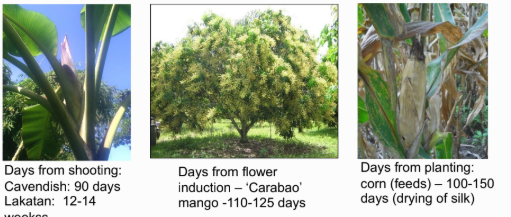
Computational/Visual
Methods of determining maturity

Manual
- pulling, twisting, bending, shaking
- use of harvesting tools or aids (knife, shears,
bolo, picking pole with net at the end, ladder)
Manual with the aid of conveyor

Mechanical
in developed countries with big
orchards and where labor is expensive

POSTPRODUCTION TECHNOLOGY
encompasses all practices and operations from harvesting
to consumption
Postharvest handling
procedures to which crops are subjected after harvest including all the technological aspects of distribution
Primary processing
activities that involve handling of crops to make them suitable to manufacturers
Secondary processing
involves conversion of the crop into more stable form
Perishable crops (perishables)
- utilized in fresh form
- has high moisture content that needs to be maintained
- short shelf life
- fruits, vegetables, herbs, spices,
ornamental crops (cutflowers, cutfoliage,
potted flowering plants), medicinal crops,
fresh-cuts
Durable crops (durables)
- can be processed into a primary product (ex. coffee berries into coffee beans)
- has low moisture content that needs to be maintained
- can be stored for reasonably long period (months to one year)
- agronomic crops, plantation crops, orthodox seeds
POSTHARVEST HORTICULTURE
science and technology that deals with harvested perishable
crops in their fresh form prior to cooking or food processing
Biological processes that need to be controlled
Ø respiration
Ø transpiration
Ø ethylene production
Ø senescence
Main objective in postharvest technology
Ø Maintain the quality and safety of fresh produce from the farm until it reaches the consumer
TRIMMING
removal of unwanted parts or those likely to be rejected by consumers
CLEANING
to remove dirt and adhering foreign matter; to
make the commodity more appealing; to reduce microbial load
Sorting
classifying commodities based on the criteria
established by the person doing the
classification
Grading
classifying commodities based on the criteria
established and accepted by the industry
- follows the Philippine National Standards
(PNS); Extra Class, Class 1 and Class 2
WAXING/EDIBLE COATING
Ø Application of thin film of wax for the
following
purposes:
- reduce moisture loss
- enhance gloss
- reduce the rate of respiration (modify internal
atmosphere of the fruit)
- prevents chilling injury (pineapple for export)
Ø Coatings used: carboxymethyl cellulose-based waxes
natural sources
(chitosan, vegetable
oil, carnauba) polyethylene-based waxes
RIPENING
Ø series of biochemical and physical processes that
transform a relatively unpalatable fruit to one
possessing all the desirable characteristics of a ripe
fruit
Ripening methods
Use of ethylene gas
Use of ethylene-releasing compounds such as ethephon (brand name: Etherel)
Acetylene from calcium carbide
Bioethylene
Increase in temperature and use of smoke
Application of stress to enhance ethylene production
PACKAGING
technology or process that ensures adequate
protection and safe delivery of the commodity from the producer to
the consumer
Flexible
plastic bag, plastic sack, mesh or net sack, jute sack
Advantages: cheap, readily available
Disadvantage: does not provide protection to its contents
Semi-rigid containers
bamboo and rattan baskets, cartons
Advantage: readily available
Disadvantages: relatively expensive; does not provide adequate protection to its contents
Rigid packages
wooden crates, plastic crates, foamed plastic boxes
Advantages: rigid, provides protection to its contents;
returnable and long life span (plastic crates)
Disadvantage: relatively expensive
Low temperature storage or refrigerated
storage
Refrigeration – process of removing heat from an
object
- most perishable tropical crops store best at 12-15oC and high RH;
temperatures lower than 12oC will result in chilling injury
- crops of temperate origin can be stored at temperatures lower
than 10oC and high RH
Modified atmosphere (MA) storage

Controlled atmosphere (CA) storage
Ø different from MA in the manner of gas regulation;
controlled levels of O2 and CO2 are maintained in
a gas tight storage room
Ø used in combination with
low temperature storage
Ø allows long-term storage
of temperate fruits like
apples and pears
Non-refrigerated storage
Ø works on the principles of evaporative cooling
and ventilated cooling
§ in evaporative cooling, when the source of water is near the
commodity, heat given off during respiration is used in evaporating the
water resulting in a decrease in temperature and increase in RH
consequently retarding transpiration
§ evaporative cooling works best under hot and dry conditions
Examples of evaporative cooling techniques
burying produce in moist sawdust
intermittent sprinkling of produce with clean water
covering produce with wet cloth
wrapping produce in fresh leaves
Ventilated Cooling
Ø Principle: cooler air moves at the bottom and rises as it is being
warmed
Ø appropriate in places where day and night temperatures vary
significantly
PRIMARY PROCESSING
Series of steps required in converting raw farm
produce into marketable or “storable” forms
THRESHING
- separating/extracting the grains from straw
(rice and wheat) or hay (mungbean); applicable
also to black pepper
SHELLING
- process of extracting corn kernel from cob or seeds from pods of
legumes
- applicable also to separating coconut kernel (meat) from the shell
DECORTICATION
- a method of extracting fiber (jute and ramie) using a
machine that crushes the wood and strips of fibers
from the bark; also applicable in abaca
RETTING
- an alternative method of
extracting fiber from ramie
and jute plants; done by
soaking the stalks in water
to loosen the bark and
facilitate removal of non-
fibrous tissues
TUXYING: Abaca
- process of extracting the fiber from the abaca leaf sheath using
tuxy knives
“HAGUTAN” METHOD: Abaca
- manual method of extracting abaca fibers from the
tuxy
GINNING: Cotton
- process of separating cotton fibers (lint) from the
cotton seeds
WET METHOD: Coffee
- method of coffee processing in which ripe berries
are depulped and then dried to produce parchment
coffee
DRY METHOD: Coffee
- method of processing coffee in
which strip-harvested berries
are immediately dried to produce
dried berries
HULLING: Coffee
- process of removing the hulls
from dried berries or parchment
coffee to produce green coffee
beans
COPRA: Coconut
- dried kernel extracted from mature coconut
WHITE PEPPER
- dried pepper without pulp; ripe berries of pepper
are used
BLACK PEPPER
- dried whole pepper berries where both green
mature and partly ripe berries are used
DRYING
- process of reducing the moisture content of
primary product to:
a. prevent or minimize attack
of pathogens or insects
particularly during storage
b. reduce rate of respiration in
the case of orthodox seeds
c. minimize broken grains
during milling (ex. rice)
Recommended moisture level
rice - 14% or lower
corn – 12-13%
mungbean – 10%
soybean – 10%
copra – 6%
coffee – 12%
cacao – 7%
black/white pepper – 10%
fermentation
-some crops require _________ during primary processing to:
a. facilitate removal of mucilage from beans
(coffee and cacao)
b. facilitate extraction of fiber from jute and
ramie
c. enhance the development of chocolate flavor
and destroy the bitter substance in cacao
Heat sterilization
SECONDARY PROCESSING OF FRUITS AND VEGETABLES
§ inactivates the enzymes that may alter the quality of
the product and kill the microorganisms that can grow
during storage
§ used in canning, juice and
puree processing