Acid Base, ABGs, Respiratory Disorders Part 1
 Call Kai
 Learn
Learn Practice Test
 Spaced Repetition
 Match
Match Flashcards
 Knowt Play
1/55

There's no tags or description
Looks like no tags are added yet.
Name | Mastery | Learn | Test | Matching | Spaced | Call with Kai | Chat |
|---|
No analytics yet
Send a link to your students to track their progress
56 Terms
What is the normal pH range?
7.35-7.45
____ excrete or retain H+/HCO3
Kidneys

CO2 is a continuous byproduct of metabolism AKA cellular respiration. How is it circulated?
Dissolved gas
Bicarbonate (70%)
Carbaminohemoglobin
T/F: Chemical buffers can’t correct large pH changes or act long-term.
T
T/F: Chemical buffers are a moment-by-moment regulation to prevent large pH changes. This means they act very fast (immediately).
T
T/F: Chemical buffers are used to manage long-term large pH changes.
F, chemical buffers are a moment-by-moment regulation to prevent large pH changes. They act very fast (immediately).
There are 3 chemical buffer systems for acid/base balance. Which one is the largest buffer system?
Protein Chemical Buffer System
There are 3 chemical buffer systems for acid/base balance. Which one is the most powerful ECF buffer?
Bicarbonate Chemical Buffer System
Unlike other chemical buffers that have a fixed, finite capacity, the bicarbonate system is directly coupled to both the respiratory system (lungs) and the renal system (kidneys). If excess hydrogen ions build up in the ECF, they bind to bicarbonate to form carbonic acid which quickly breaks down into water and carbon dioxide The lungs can then instantly exhale the excess Conversely, the kidneys can alter the excretion or reabsorption of to match long-term metabolic demands
What does it mean to be amphoteric?
Can bind to both acid OR base. They accept anything.
In the bicarbonate chemical buffer system, what can H2CO3 (carbonic acid) dissociate to?
can dissosciate to H+ and HCO3 to meet pH needs.
The H+/K+ exchange is a chemical buffer system. What is the effect of both acidosis and alkalosis on this system?
Acidosis: H+ binds to Hgb, K+ leaves the cell to cause hyperkalemia.
Alkalosis: Ionized or free Ca2+ binds with albumin, causing hypocalcemia.
When excess \[H^{+}\] ions build up in the blood plasma, the body shifts \[H^{+}\] into the body's cells to help buffer and balance the pH. To maintain electrical neutrality across the cell membrane, positively charged potassium (\[K^{+}\]) ions are pushed out of the cells and into the bloodstream, raising blood potassium levels.
What is the normal value for PaCO2?
35-45mmHg
What is the normal value for PaO2?
80-100mmHg
What is the normal value of HCO3?
22-26 mEq/L
What are normal SaO2 levels?
94-100%
What does ROME stand for in the context of analyzing ABGs?
Respiratory Opposite, Metabolism Equal
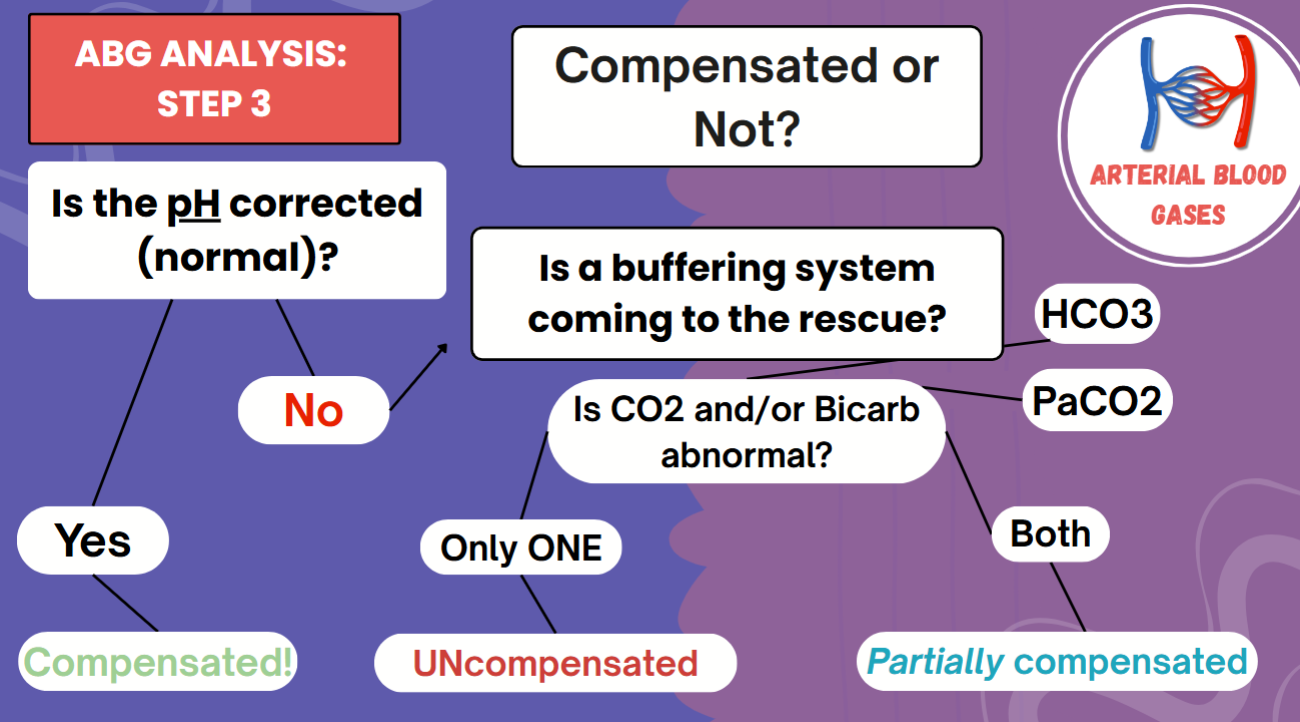
What are the steps to ABG Analysis? (What are the questions you need to ask?)
Is the pH corrected (normal)?
Is CO2 and/or Bicarb abnormal?

pH 7.18
PaCO2 68
HCO3 24
Explain your thought process
pH is low, meaning acidic
PaCO2 is high
HCO3 is normal
pH is low, PaCO2 is high, opposite, therefore this is a respiratory problem
pH is abnormal, so uncompensated
pH is low, meaning acidic, so this is uncompensated respiratory acidosis

pH 7.52
PaCO2 36
HCO3 34
Explain your thought process
pH is high, meaning basic
PaCO2 is normal
HCO3 is high
pH is high, HCO3 is high, therefore metabolic issue
pH is abnormal, so uncompensated
pH is high, meaning uncompensated metabolic alkalosis

pH 7.08
PaCO2 22
HCO3 10
Explain your thought process
pH is low, acidic
PaCO2 is low
HCO3 is low
pH and PaCO2 are not opposite, therefore metabolic problem
pH is abnormal, but PaCO2 and HCO3 are both abnormal, so partially compensated
pH is low, acidic, therefore partially compensated metabolic acidosis
T/F: Hypoxia is decreased arterial blood O2.
F, this is hypoxemia
What is the etiology (cause of) hypoxemia lung wise?
Hypoventilation (not breathing in enough O2 means there is a build-up of CO2, which takes up more space in the alveoli and fresh O2 is not able to be exchanged).
T/F: The brain is really sensitive to O2, therefore neurologic symptoms are affected initially.
T
How can you remember that hypoxemia leads to CNS changes, like personality changes, delirium, and poor judgment?
The brain is really sensitive to O2, therefore neurologic symptoms are affected initially.
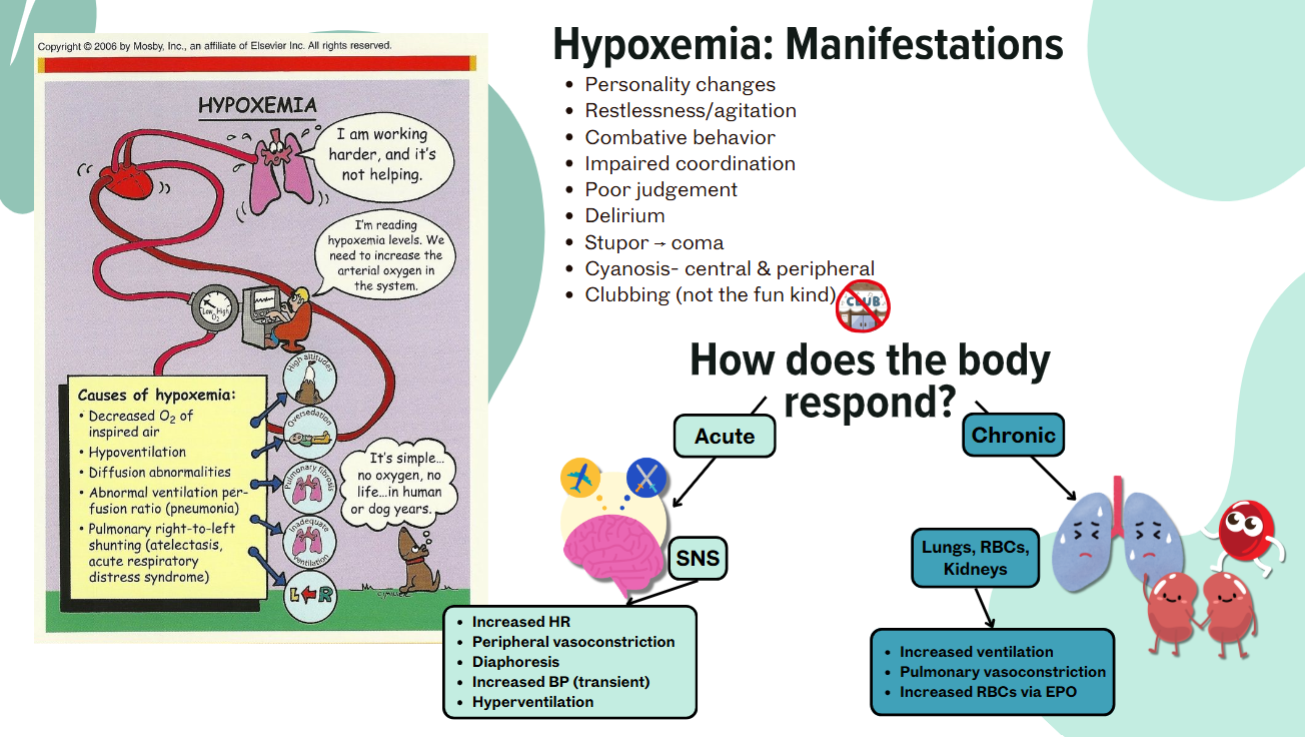
What is the difference in how the body responds to acute hypoxemia vs chronic hypoxemia?
Acute hypoxemia leads to SNS problems, like increased HR, peripheral vasoconstriction, increased BP, hyperventilation, but chronic hypoxemia leads to pulmonary vasoconstriction, increased ventilation, and increased RBC thanks to EPO
ngl i dont rlly get this

What are the causes of clubbing?
Smoking & COPD

T/F: A lack of cyanosis means normal oxygenation.
F, a lack of cyanosis does not always mean normal oxygenation is present.

What is central vs peripheral cyanosis?
Central: Increased deoxygenated arterial blood (high altitude, CNS disorders, CV disease)
Peripheral: Slowing of blood flow to areas; vasoconstriction
What respiratory rate is considered hypoventilation?
<12
What respiratory rate is considered hyperventilation?
>20
Inadequate alveolar ventilation is (hyper/hypoventilation), and excessive alveolar ventilation is (hyper/hypoventilation).
Hypoventilation because there is not enough O2 and too much CO2 which causes hypercapnia and leads to respiratory acidosis. This means the alveoli cannot get properly ventilated.
Hyperventilation because there too much CO2 is being breathed out and there is too much O2 in the lungs, leading to hypocapnia (respiratory alkalosis)
How does hypercapnia affect the vessels?
Vasodilation
Hypercapnia (high carbon dioxide levels in the blood) causes cerebral vasodilation primarily because a rise in carbon dioxide (CO₂) increases extracellular hydrogen ions (H⁺), creating an acidic environment that relaxes the smooth muscle of blood vessels. Acidosis causes vasodilation by opening potassium channels to compensate which hyperpolarizes the cell and keeps it relaxed. And in acidic environments vessels can’t contract as well.
How does hypocapnia affect the vessels?
Cerebral vasoconstriction. Carbon dioxide is a potent vasodilator (it relaxes blood vessels). When CO₂ levels drop, that relaxing effect disappears, causing vessels to narrow.
In states of alkalosis, calcium (Ca²⁺) binds more to albumin due to the lack of H+ and goes inside smooth muscle cells, triggering contraction.
Acute respiratory failure can occur hypoxemically or hypercapnically. ARF is simply a failure in gas exchange. Describe the difference between hypoxemic RF and hypercapnic RF
Hypoxemic RF means there is a lack of oxygen in the blood, so the exchange in alveoli is not adequate. This affects the perfusion of blood and impairs the diffusion of oxygen.
Hypercapnic RF means too much CO2 is being breathed in and not enough oxygen, so alveoli cannot be adequately ventilated, leading to a lack of ventilation but adequate perfusion (ventilatory failure).
What is dysphagia?
The inability to swallow properly
What is pulmonary edema?
The movement of capillary fluid into the alveoli. This causes lung stiffness, impairs expansion, and gas exchange. (Fluid moves from capillaries to alveoli, making lungs stiff, impairing expansion and gas exchange.)
The movement of capillary fluid into the alveoli, causing lung stiffness, impaired expansion and gas exchange, is known as what respiratory condition?
Pulmonary edema
What are the 3 disorders of lung inflation?
Pleural Effusion
Pneumothorax
Atelectasis

Describe pleural effusion.
The abnormal collection of fluid in the pleural cavity.
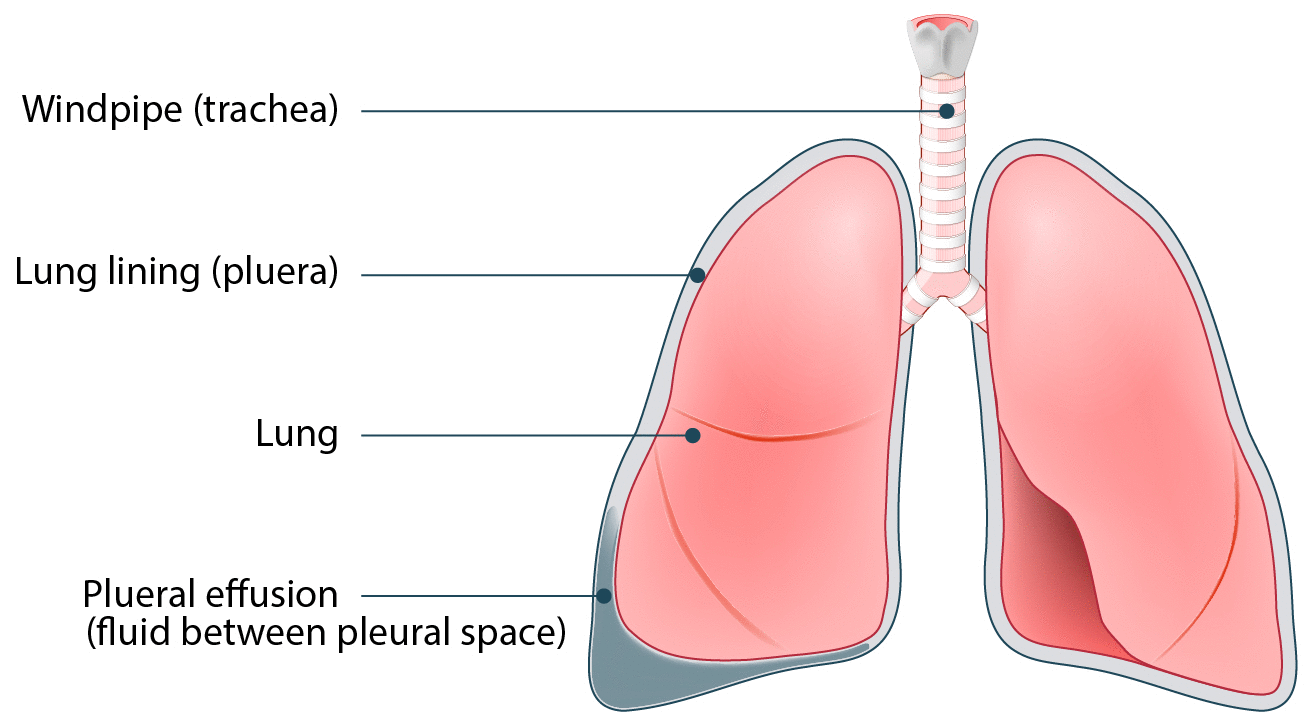
What is the common intervention for pleural effusion?
Chest tube or drain.
Describe pneumothorax.

Gas/air in the pleural space. When air builds up in this space, it puts pressure on the outside of the lung. The lungs cannot expand fully when you breathe when this happens.

Describe atelectasis. Which group is this a major concern for?
The incomplete expansion of a lung or portion of a lung. The tiny air sacs (alveoli) deflate or fill with fluid instead of holding air. This is a major concern in post-op patients, opioid use, immobility, and pain.
What device can post-op patients, people with opioid use, immobility, and pain use to “exercise” their lungs?
Incentive spirometer.
T/F: A patient can have pneumothorax and atelectasis at the same time.
T, pneumothorax can cause atelectasis
What are the disorders of pulmonary circulation?
Pulmonary embolism
Pulmonary hypertension
Cor Pulmonale

Describe pulmonary embolism.
A blood-borne object originates in the venous system leading to the right heart, leading to pulmonary circulation. This can be fat, a foreign body, air, amniotic fluid, thrombus, etc.

A spiral CTA (Spiral computed tomographic angiography) is a key test to diagnose what respiratory disease?
Pulmonary embolism

What is virchow’s triad?
Virchow's triad outlines the three broad categories of factors that contribute to thrombosis (blood clot formation): endothelial injury, stasis or turbulent blood flow, and hypercoagulability.

The three broad categories of factors that contribute to thrombosis (blood clot formation) are endothelial injury, stasis or turbulent blood flow, and hypercoagulability. This is called
Virchow’s Triad

Clotting disorders, immobility, surgery, and oral contraceptives can put a person at risk for what respiratory condition?
PE (Pulmonary Embolism)

How does a PE affect vessels?
Hypoxemic vasoconstriction.

Describen pulmonary hypertension.
The elevation of pressure in the pulmonary vascular system (acute or chronic).

What is the average pulmonary artery pressure and in which disease is this average number helpful to know?
The average PAP (Pulmonary artery pressure) is > 25 mmHg. This is important to compare for pulmonary hypertension, the elevation of pressure in the pulmonary vascular system (acute or chronic).

How does hypoxemia affect pulmonary vasculature?
Vasoconstriction of pulmonary vasculature.

Describe cor pulmonale.
Right heart failure resulting from a primary lung disease or pulmonary HTN.
Right heart failure resulting from a primary lung disease or pulmonary HTN is known as
Cor pulmonale