ch. 37 neurons, synapses, & signals
 Call Kai
 Learn
 Practice Test
 Spaced Repetition
 Match
 Flashcards
 Knowt Play
1/36

There's no tags or description
Looks like no tags are added yet.
37 Terms


Membrane potential depends on differences in ion (1) _____ and selective membrane (2) _____. The concentration of K⁺ is higher (3) _____ the neuron, while Na⁺ concentration is higher (4) _____.
1) concentrations; 2) permeability; 3) inside; 4) outside

Resting potential forms partly because K⁺ diffuses (1) _____ of the neuron, making the inside more (2) _____. K⁺ movement alone would approach (3) _____ mV, but slight Na⁺ movement inward contributes to a resting potential of about (4) _____ mV.
1) out; 2) negative; 3) −90; 4) −70

The sodium-potassium pump maintains ion concentration (1) _____ by moving (2) _____ Na⁺ ions OUT of the neuron and (3) _____ K⁺ ions INTO the neuron. This movement occurs (4) _____ their concentration gradients.
1) gradients; 2) 3; 3) 2; 4) against

Neurons send electrical signals when there is a significant change in their (1) _____ membrane potential. This allows neurons to (2) _____ information.
1) resting; 2) transmit

Voltage-gated ion channels respond to changes in membrane (1) _____. Two important types are voltage-gated (2) _____ channels and voltage-gated (3) _____ channels.
1) potential (voltage); 2) Na⁺; 3) K⁺

During depolarization, membrane potential becomes (1) _____ negative because Na⁺ permeability (2) _____. During hyperpolarization, membrane potential becomes (3) _____ negative, often because K⁺ permeability (4) _____.
1) less; 2) increases; 3) more; 4) increases

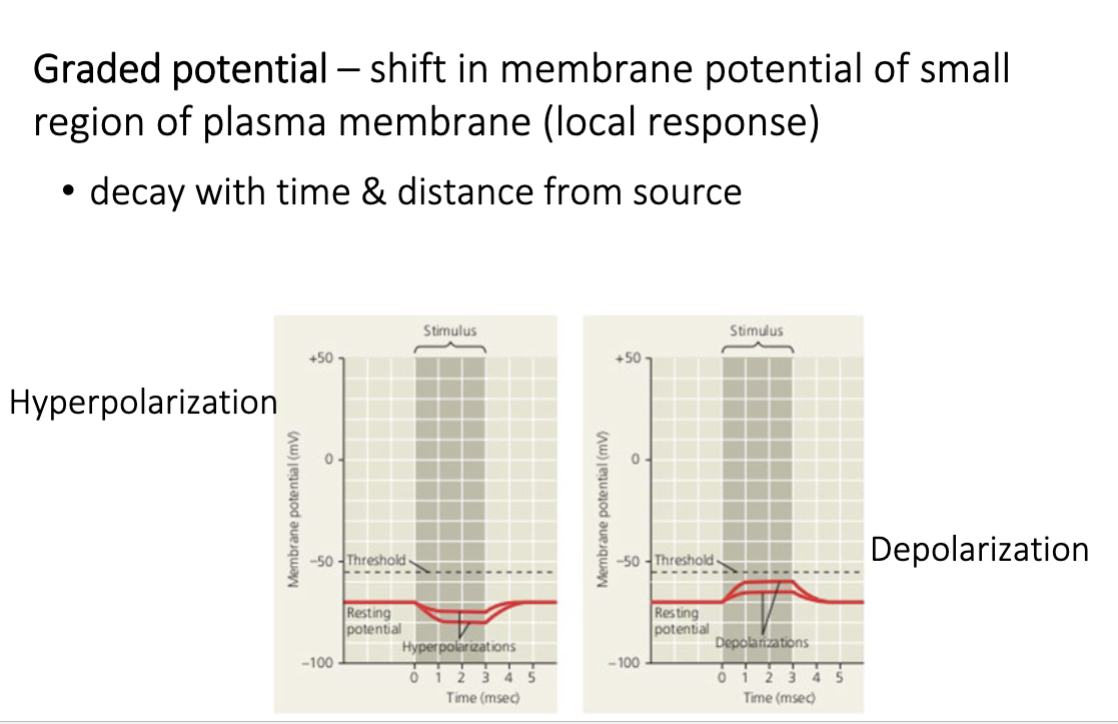
A graded potential is a (1) _____ change in membrane potential. Unlike an action potential, a graded potential decreases in strength with (2) _____ and (3) _____ from its source.
1) local; 2) time; 3) distance
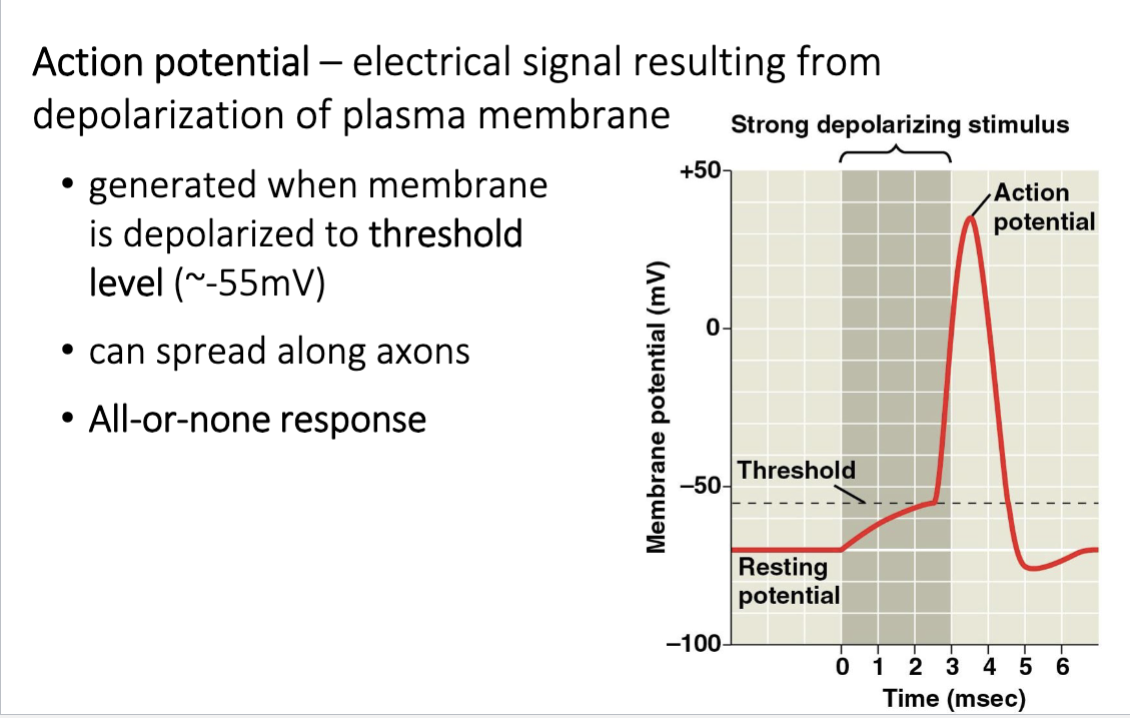
An action potential occurs when membrane depolarization reaches the (1) _____ of approximately (2) _____ mV. Action potentials are (3) _____-or-_____ responses that travel along the (4) _____.
1) threshold; 2) −55; 3) all-or-none; 4) axon
During the resting state, voltage-gated (1) _____ channels and voltage-gated (2) _____ channels are closed. However, ion (3) _____ channels remain open.
1) Na⁺; 2) K⁺; 3) leak

During initial depolarization, a stimulus causes voltage-gated (1) _____ channels to open, allowing (2) _____ to enter the neuron. Once the membrane reaches (3) _____, an action potential is triggered.
1) Na⁺; 2) Na⁺; 3) threshold

During the rising phase of an action potential, more voltage-gated (1) _____ channels open. These allow positive ions to move (2) _____ the neuron, causing further (3) _____. Voltage-gated K⁺ channels remain (4) _____.
1) Na⁺; 2) into; 3) depolarization; 4) closed

During repolarization, voltage-gated Na⁺ channels become (1) _____ while voltage-gated (2) _____ channels open. This allows K⁺ to move (3) _____ the neuron, making membrane potential more (4) _____.
1) inactivated; 2) K⁺; 3) out of; 4) negative

During the undershoot, also called (1) _____, the membrane becomes more (2) _____ than resting potential. Voltage-gated (3) _____ channels eventually close, allowing the neuron to return to its (4) _____ state.
1) hyperpolarization; 2) negative; 3) K⁺; 4) resting

The main stages of an action potential occur in this order: (1) _____ state, (2) _____, (3) _____ phase, (4) _____, and (5) _____ before returning to rest.
1) resting; 2) depolarization; 3) rising; 4) repolarization; 5) undershoot

An action potential is self-(1) _____, meaning a wave of (2) _____ travels along the length of the (3) _____.
1) propagating; 2) depolarization; 3) axon

During the (1) _____ refractory period, another action potential cannot occur. During the (2) _____ refractory period, another action potential is possible, but a (3) _____ stimulus is required.
1) absolute; 2) relative; 3) stronger

Continuous conduction occurs in (1) _____ axons. The electrical impulse travels progressively along the entire membrane. Increasing axon (2) _____ increases the (3) _____ of transmission.
1) unmyelinated; 2) diameter; 3) speed

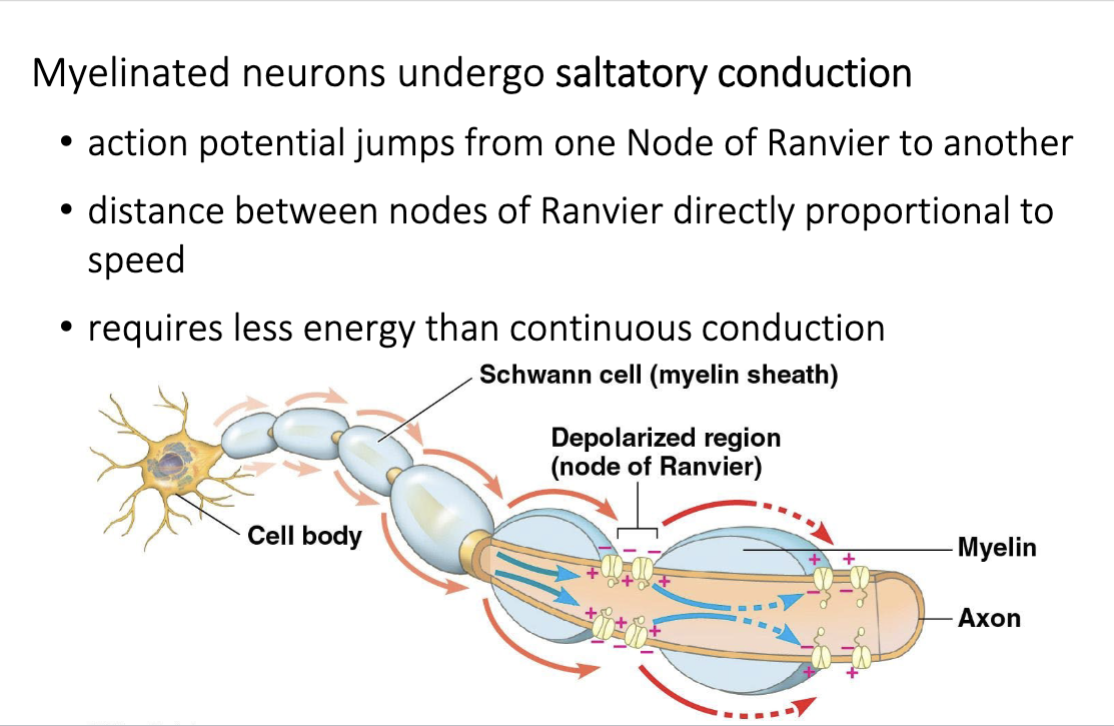
Myelin acts as an electrical (1) _____ surrounding the axon. The gaps between myelin segments are called nodes of (2) _____. These gaps contain ion channels important for movement of (3) _____ and (4) _____.
1) insulator; 2) Ranvier; 3) Na⁺; 4) K⁺

Saltatory conduction occurs in (1) _____ axons. The action potential appears to jump between nodes of (2) _____. This type of conduction is (3) _____ and requires (4) _____ energy than continuous conduction.
1) myelinated; 2) Ranvier; 3) faster; 4) less
Multiple sclerosis (MS) is an (1) _____ disease affecting the (2) _____ nervous system. The immune system attacks (3) _____ sheaths, leading to inflammation and disrupted nerve (4) _____.
1) autoimmune; 2) central; 3) myelin; 4) signaling

There are two major types of synapses: (1) _____ synapses, which transmit signals through direct ion movement, and (2) _____ synapses, which transmit signals using (3) _____.
1) electrical; 2) chemical; 3) neurotransmitters
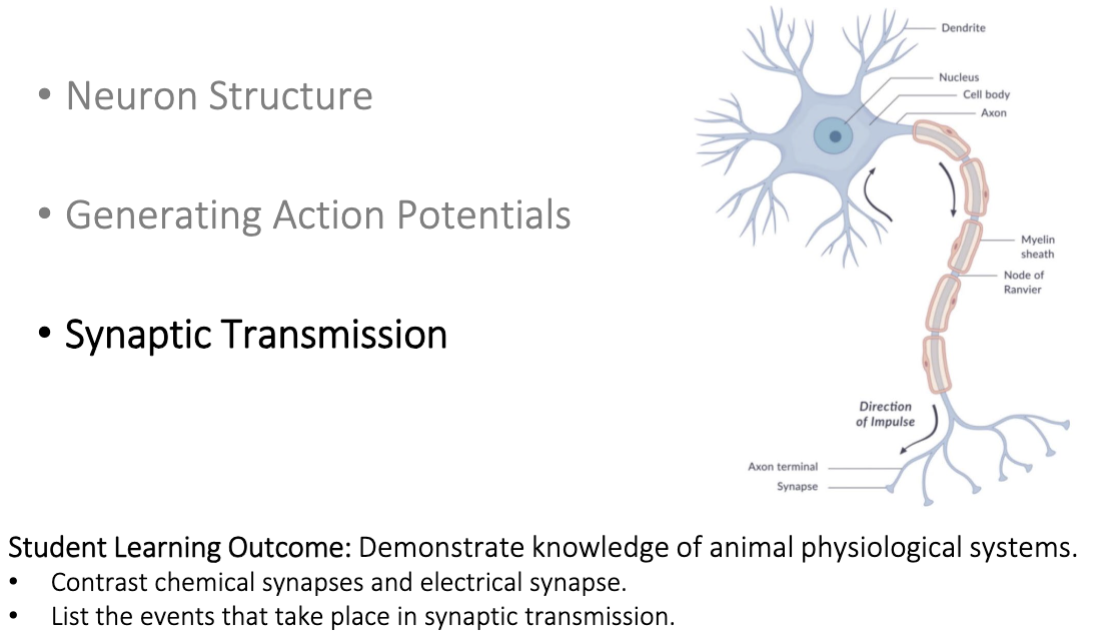
A synapse is a junction between two (1) _____ or between a neuron and an (2) _____, such as a muscle or gland. The (3) _____ cell sends the signal, while the (4) _____ cell receives it.
1) neurons; 2) effector; 3) presynaptic; 4) postsynaptic

In electrical synapses, neighboring cells are connected by protein channels called (1) _____ junctions. These allow (2) _____ to pass directly between cells, resulting in (3) _____ signal transmission.
1) gap; 2) ions; 3) rapid

Most synapses are (1) _____ synapses. The two cells are separated by a space called the synaptic (2) _____. Chemical messengers called (3) _____ are stored in synaptic (4) _____ before release.
1) chemical; 2) cleft; 3) neurotransmitters; 4) vesicles

During synaptic transmission, an (1) _____ potential reaches the presynaptic terminal. Voltage-gated (2) _____ channels open, allowing (3) _____ to enter. This causes synaptic (4) _____ to fuse with the membrane and release neurotransmitters.
1) action; 2) Ca²⁺; 3) Ca²⁺; 4) vesicles

After neurotransmitters are released, they bind to (1) _____ on the postsynaptic membrane. This causes ion channels to open or (2) _____, producing either (3) _____ or (4) _____ of the postsynaptic cell.
1) receptors; 2) close; 3) depolarization; 4) hyperpolarization

Neurotransmitters are signaling (1) _____ released by neurons. A single neurotransmitter can interact with many different (2) _____. Examples include (3) _____, which is listed among amino acid neurotransmitters, and (4) _____, which is listed among biogenic amines.
1) molecules; 2) receptors; 3) glutamate (or GABA/glycine); 4) dopamine (or serotonin/norepinephrine)
