Joint movements
 Call Kai
 Learn
Learn Practice Test
 Spaced Repetition
 Match
Match Flashcards
 Knowt Play
1/12

There's no tags or description
Looks like no tags are added yet.
Name | Mastery | Learn | Test | Matching | Spaced | Call with Kai | Chat |
|---|
No analytics yet
Send a link to your students to track their progress
13 Terms
Flexion vs. Extension
flexion does not maintain anatomical position
extension maintains anatomical position

Hyperextension
extension of a joint past anatomical position

Abduction vs. adduction
abduction is movement away from midline
adduction is movement toward midline

Elevation vs. depression
elevation raises a body part vertically
depression lowers a body part vertically

Protraction vs. retraction
horizontal plane
protraction is movement anteriorly
retraction is movement posteriorly


Rotation vs. circumduction
rotation is movement where bone spins on longitudinal axis
circumduction is movement where one end of appendage remains stationary while other end makes circular motion
ex. rotation includes both medial and lateral

Supination vs. pronation
supination turns palm anteriorly or upward
pronation turns palm posteriorly or backwards
What are the special movements of the head?
flexion
extension
hyperextension
lateral flexion

Lateral and medial excursion (mandible)
lateral excursion is movement towards the sides
medial excursion is movement towards the midline

Protraction vs. retraction (mandible)

Radial vs. ulnar flexion (hands)
radial flexion tilts hands towards thumb
ulnar flexion tilts hands towards little finger

Dorsiflexion vs. plantar flexion
dorsiflexion is elevating toes like walking on your heel
plantar flexion is pointing toes downwards and walking on toes
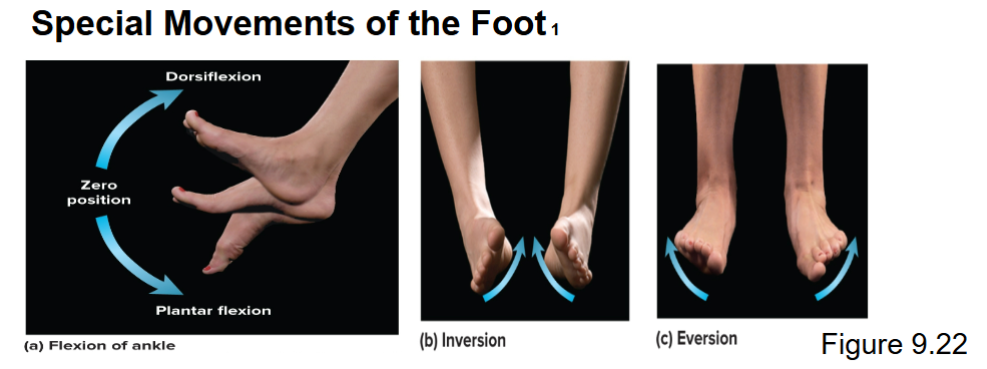
Inversion vs. eversion (feet)
inversion is movement of soles turned medially
eversion is movement of soles tuned laterally
