ANP 206 #1
 Call Kai
 Learn
Learn Practice Test
 Spaced Repetition
 Match
Match Flashcards
 Knowt Play
1/93

There's no tags or description
Looks like no tags are added yet.
Name | Mastery | Learn | Test | Matching | Spaced | Call with Kai | Chat |
|---|
No analytics yet
Send a link to your students to track their progress
94 Terms
Adaptation
The process of successful interaction
between a population and an
environment
We do this in a number of ways, both
culturally and biologically, and all of
these decisions mutually affect one
another
Biocultural evolution
The interaction between biology and culture in shaping human evolution and variation.
Comparative approach
Comparing human populations to determine common and unique behaviors or biological traits (i.e., variation).
How and why do human groups differ from one another?
Holistic approach
takes into consideration all aspects of
human existence” to understand human
variation and evolution (Relethford p. 5). A
holistic approach to anthropology includes
all four major subfields (linguistic,
biological, cultural, and archaeological
anthropology
List and define the five subfields of Anthropology
Cultural, Medical, Linguistic, Archaeological, and Biological
Cultural Anthropology

Medical Anthropology

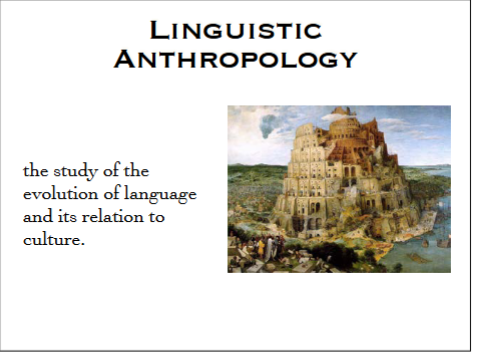
Linguistic Anthropology
Archaeological Anthropology

Biological / Physical Anthropology

Anthropology is..

List and define the examples of different (sub-)subfields of Biological Anthropology
Primatology, Paleoanthropology, Molecular, Morphological
Primatology
Uses primates to investigate:
- Variation
- Our place in nature
- Models
- Ecology
- Behavior
- Morphology
Paleoanthropology
Uses fossil remains to:
Reconstruct behavior
Understand evolution of human form
Ask how, when and why human evolution occurred
Molecular human variation
Examines human variation at the molecular/genetic level
Morphological human variation
Examines variation in physical form and structure.
List and describe the four steps of science
Fact
A verifiable truth.
Scientific facts must be observable in nature.
Hypothesis
An explanation of observed facts that must be testable.
Theory
A set of hypotheses that have been tested repeatedly and have not been rejected.
Important Wrobel point:
You do NOT prove a theory—you fail to reject it.
Testability
A hypothesis must be falsifiable

Redi's Maggot Experiment
Step 1 — Observation
Maggots were commonly observed on rotting meat.
Question: Where did they come from?
At the time, spontaneous generation was an explanation. ANP206_Part 1 Lecture 1
Step 2 — Hypothesis
Redi proposed:
IF maggots come from eggs laid by flies,
THEN maggots should not form on rotting meat untouched by flies. ANP206_Part 1 Lecture 1
Step 3 — Test
He compared meat under conditions that differed in whether flies could access it.
Conclusion
Redi's conclusion was deliberately narrow:
Spontaneous generation occurs only in some circumstances.
He did not conclude that all spontaneous generation was impossible because his experiment only tested a particular situation involving maggots. The hypothesis continued to be tested and refined for roughly two centuries as new evidence—including microscopy—became available. ANP206_Part 1 Lecture 1
Step 4 — Theory
The lecture connects the later theoretical development to Louis Pasteur in 1859
Cultural context before Darwin
The lecture emphasizes that European thought was strongly influenced by classical ideas, folklore, resistance to change and essentialism.
The example of Giordano Bruno illustrates how challenging accepted explanations could be dangerous; the lecture summarizes the attitude toward change as:
“Change? Bad. Very very Bad.”
Essentialism
Everything is reducible to fundamental “types.” This conflicts with evolution because evolution requires populations/species to change through time rather than representing permanently fixed types
Plato's Allegory of the Cave (Essentialism)
The underlying idea is that observed variation can be viewed as imperfect versions of an underlying ideal or essential form
Great Chain of Being (Essentialism)
Nature was conceptualized as a fixed hierarchy.
Rather than organisms representing populations capable of evolutionary change, each type occupied a particular position in an ordered chain.
Binomial nomenclature
A naming system using:
Genus + species
Example:
Homo sapiens
Type specimen
The specimen serving as the reference example for a named biological type/species
Killing feature
A distinctive characteristic used to distinguish one species or taxonomic group from another.
EX The Bone of Contention
Nested hierarchy
Organisms are placed inside progressively broader categories.
Evolution gives this structure meaning because nested similarities can represent shared ancestry: organisms sharing more recent common ancestry should be nested more closely together.
Wrobel notes that Linnaeus was the first to classify humans with other animals and specifically with primates

Evidence that challenged essentialism
Fossils
Fossils included familiar animals AND surprising animals no longer living.
This suggested:
The world was not always as it is today → things change.
Dodo/extinction
Extinction itself demonstrated change.
If species can disappear, the Great Chain cannot be completely immutable
Explain Buffon’s and Lamarck’s proposals about how variations occurred in nature
Buffon
Proposed microevolution, although not creation of new species; species remained connected within a chain.
Lamarck
Proposed inheritance of acquired characteristics.
His mechanism involved use and disuse of body parts.
Traditional example: giraffes.
An organism changes a structure through its use during life → that acquired change is inherited by offspring.
Explain how each of the following ultimately influenced Darwin in constructing his
Theory of Evolution:
-his journey on the Beagle
-Lyell’s Geological Principles
-Breeding programs
-Malthus
Beagle — 1831–1836
Darwin observed intraspecies variation.
His major conclusion:
Variation is the norm in nature.
Lyell's Geological Principles
Three ideas:
- Earth is very old
- Change is constant
- The rules stay the same
Conclusion:
Change occurs over vast time scales.
Breeding programs
Breeders deliberately select desirable traits.
Humans = selection agents
Conclusions:
- Variations are inherited.
- Individuals don't evolve or change in the Darwinian population sense.
Malthus
Observation:
More young are born than reach adulthood.
Darwin's takeaway:
Nature selects by killing.
These observations provided Darwin with the pieces needed for natural selection.
Define:
-Selection
-Adaptation

the Darwinian Evolution
Change in the genetic composition of a population during successive generations, resulting from natural selection acting on genetic variation among individuals and potentially resulting in new species.
The key sequence:
Variation → selection → differential reproduction → population changes → adaptation/evolution
Not every biological variation is an adaptation. For something to be an adaptation in the Darwinian sense, it must relate to selection, not merely be a difference that exists.
Define the “comparative approach” and describe how it can provide explanations of
why specific biological differences and similarities between groups evolved

List the four primary sources of evidence for evolution, and be able to explain how
each provides evidence that evolution has occurred (or is occurring).
1. Fossil record of change in earlier species
Shows sequential change through time/stratigraphy.
2. Chemical and structural similarities of related life forms
3. Recorded genetic changes in living organisms over many generations
4. Geographic distribution of related species
DNA
The genetic material serving as the blueprint for development of the individual. Its molecular code controls protein synthesis.
Gene
The sequence of DNA that codes for one protein—this is the lecture's wording. ANP206_Part 1 Lecture 2
Chromosome
DNA is organized into 23 paired chromosomes, located in the cell nucleus. ANP206_Part 1 Lecture 2
RNA
The intermediate molecule used to transmit information from DNA toward protein production.
Central Dogma
DNA → RNA → protein
DNA serves as the template for transcription of RNA, which is then translated into protein.
PROTEINS
Amino acids
The smaller molecules composing proteins
Codon
Three bases coding for an amino acid.
There are four bases and therefore:
4 × 4 × 4 = 64 possible three-base combinations, allowing redundancy. ANP206_Part 1 Lecture 2
Transcription
Transcription = production of mRNA from DNA.
Basic concept:
DNA opens → DNA sequence serves as template → corresponding mRNA is produced → mRNA information can be translated into protein.
The sequence matters because DNA codes for the sequence of amino acids, which determines proteins
Translation
The ribosome reads mRNA codons and attaches corresponding amino acids to the growing protein chain.
When the ribosome reaches the end, the protein is finished
Noncoding DNA
About 98% of DNA is noncoding, meaning it is not directly translated into protein.
Know all five:
Regulatory regions: Control when and where genes are turned on/off.
Structural functions: Maintain chromosome stability and organization, including centromeres and telomeres.
Transposable elements: Mobile DNA sequences that can affect genome evolution and gene regulation.
Noncoding RNAs: Functional RNAs that regulate gene expression.
Evolutionary raw material: Sequences without an obvious current function can provide material for evolutionary innovation
Replication
DNA:
Unzips between bases.
Each strand acts as a template.
Complementary bases reconstruct the missing half.
DNA can therefore copy itself because of base complementarity.
Mitosis
Division of body cells into daughter cells.
In humans:
46 chromosomes → copied to 92 → separated → two cells containing 46 chromosomes each.
Meiosis

Mutations
Mistakes in DNA copying.
Substitution
One base substituted for another.
Insertion
Addition of one or more nucleotide bases.
Deletion
Loss of one or more nucleotide bases.
Frameshift
Insertion/deletion changes the reading frame unless the number of bases involved is a multiple of 3.
This makes subsequent codons incorrect and can produce a protein that is:
Too short
Too long
Made with incorrect amino acids
Explain the reasons why mutations (relatively) rarely lead to a serious problem.
1. Redundancy
There are 64 possible codes but only 20 amino acids, so different codons can produce the same amino acid. ANP206_Part 1 Lecture 2
2. Noncoding DNA
About 98% of DNA is noncoding, making it likely that mutations occur outside protein-coding sequences.
3. Neutral inheritance
Many noncoding sequences (Like introns) don't strongly affect survival/reproduction, so they can be inherited neutrally. 
Define and know the listed attributes of mitochondrial DNA (mtDNA)
Located in mitochondria, not nuclear chromosomes
Circular
37 genes
Little noncoding DNA
Maternally inherited
Mutates about 10× faster than nuclear DNA
Haploid, Diploid, Zygote, Genome
Diploid
A full set of 23 pairs of chromosomes.
Haploid
Half set: 23 chromosomes.
Eggs and sperm are haploid.
Zygote
The fertilized egg cell formed when two haploid genomes merge into one diploid cell.
Genome
A complete complement of genetic material from an individual
Alleles
Allele
Different versions/copies of genetic information at the same location. Dominant
An allele whose effect appears when present with another allele. Recessive
An allele whose effect is masked in a heterozygote by a dominant allele.
Mendel's pea experiments allowed recognition of dominant and recessive alleles
Mendel's Two Laws
1st “Law” = Segregation
–Based on monohybrid crosses (looking at inheritance of one trait)
–During reproduction, the two copies of a gene segregate from one another and only one is passed on
–Model crosses with Punnett Squares
2nd “Law” = Independent Assortment
–Based on dihybrid crosses (looking at inheritance of 2 traits at once)
–Segregation of one trait is not dependent/contingent on the segregation of another (they are independently assorted)
–Can model with Punnett Square
Define and explain the ways in which variation is created in offspring:
Random segregation
Which maternal/paternal copy of each chromosome enters a gamete is random.
Independent assortment
Different chromosome/allele combinations are independently distributed.
Crossing over
Before chromosomes separate during meiosis—not mitosis, chromosome pairs line up and exchange genetic material.
This further increases genetic diversity.
Simple vs. Complex Traits
Simple trait
Follows relatively straightforward Mendelian inheritance.
Complex trait
Affected by more than one gene (polygenic).
Most traits are complex.
Lecture examples:
Eyes
Skin color
Height
Regulatory & Homeobox Genes
Regulatory genes
Control expression of other genes.
Instead of simply coding for structural proteins, their products can:
Turn genes on
Turn genes off
Fine-tune how much genes are expressed
Homeobox/Hox genes
Produce proteins that bind DNA and switch transcription on/off.
They act as master switches, determining:
Cell fate
Growth
Development
They can control:
Concentration
Location
Timing
Target-gene specificity
Because they organize the body plan, mutations in Hox genes can have huge phenotypic effects.
Continuous Variation
Most complex traits aren't discrete; they're continuous.
Produced through interaction between:
Genes + environment
→ often produces a normal distribution.
The more loci involved, the more the trait resembles a normal curve, while environmental influences blur distinctions between categories.
Pleiotropy
A single gene influences multiple traits.
Wrobel's example: SHH (Sonic Hedgehog), which affects multiple aspects of development.
Heritability
An estimate of the total variance of a trait caused by genetic variance rather than environmental variance.
Critical point:
Heritability is not inherent to the trait. It applies to a particular population in a particular environment.

Microevolution
Change in allele frequency in a population from one generation to the next
Population genetics
Study of the total pattern of genetic variation within a biological population.
Breeding population
The proportion of a population that chooses mates from within that group
Census population
The actual total population. It is always larger than the breeding population
Genotype frequency
Number of individuals with a particular genotype divided by the total number of individuals.
Example:
AA = 0.49
AB = 0.42
BB = 0.09
These are genotype frequencies because AA, AB, and BB are combinations of alleles
Allele frequency
Relative proportion of each allele in the population.
Example:
A = 0.70
B = 0.30
These are allele frequencies because A and B are individual alleles, not genotypes. ANP206_Part 1 Lecture 3
Phenotype frequency: An indirect measure of genotype based on observable traits. ANP206_Part 1 Lecture 3
Easy recognition
AA, AB, BB → genotype frequencies
A, B → allele frequencies
Phenotype frequency
An indirect measure of genotype based on observable traits
Hardy-Weinberg Equilibrium
Hardy-Weinberg equilibrium is a method for determining the expected genotype frequencies in the offspring generation based on the allele frequencies of the parent population. The equation is:
p² + 2pq + q² = 1
Where:
p and q = allele frequencies
p² = AA
2pq = AB
q² = BB
Five Hardy-Weinberg assumptions
H-W assumption | If broken... |
|---|---|
No mutation | Mutation introduces new alleles |
No selection | Natural selection changes reproductive success of alleles/genotypes |
No migration | Gene flow moves alleles between populations |
Large population | Small populations experience stronger genetic drift |
Random mating | Mate choice changes genotype frequencies |
Wild type allele (vs. mutant allele)
Mutation: Introduces new alleles into a population.
Wild-type allele: Original, common, or "normal" version of a gene.
Mutant allele: New or "abnormal" version of the gene
Natural Selection generally does not affect mtDNA. How do anthropologists use that to their advantage?
According to your lecture, mutations in mtDNA used for ancestry tracing do not affect phenotype and therefore are not subject to natural selection in the example presented. This makes mtDNA useful for tracing ancestry because changes can accumulate without being strongly filtered by natural selection.
Natural Selection
Natural selection: Filters existing genetic variation by changing the likelihood that different alleles are passed to the next generation.
Important:
Natural selection does NOT create variation.
It changes the relative frequencies of existing alleles
Fitness
An organism's probability of survival and reproduction, measured by the relative contribution of a genotype to the next generation
Heat Stress
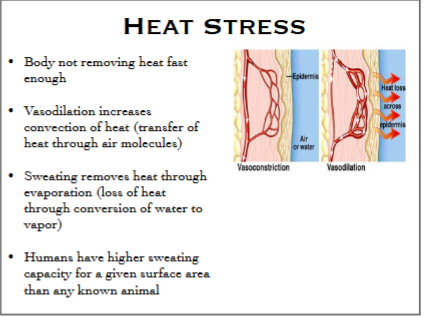
Heat stress: Occurs when the body isn't removing heat quickly enough.
Vasodilation: Expansion of blood vessels, which increases heat loss through convection.
Vasoconstriction: Narrowing of blood vessels, which reduces blood flow near the body's surface and helps conserve heat.
Evaporation: Heat loss when water/sweat changes into vapor.
Convection: Transfer of heat through surrounding air molecules. ANP206_Part 1 Lecture 3
Bergmann's Rule
When two mammals have similar shapes but different sizes:
Smaller body → higher surface-area-to-mass ratio → loses heat faster
Larger body → lower surface-area-to-mass ratio → retains heat better
Therefore:
Warm climate → smaller body advantageous
Cold climate → larger body advantageous
The lecture emphasizes that population weight, rather than height, shows the clearer relationship with mean annual temperature
Allen's Rule
Allen's Rule
This is about shape/appendages.
A more elongated body has a higher surface-area-to-mass ratio and therefore loses heat more easily.
Thus:
Warm climate → longer appendages
Cold climate → shorter appendages
The lecture specifically mentions tails, limbs, ears, and noses tending to be shorter in cold regions. ANP206_Part 1 Lecture 3
Don't confuse them
Bergmann = Body SIZE
Allen = Appendage SHAPE
Molecular Mimicry
Molecular mimicry: A disease organism possesses surface molecules that mimic molecules found on the host's cells, making it harder for the immune system to recognize the organism as foreign. ANP206_Part 1 Lecture 3
Smallpox example
The lecture says smallpox has surface molecules that mimic A antigens on red blood cells.
Therefore:
Blood type A or AB → more difficulty recognizing the virus as foreign
Greater susceptibility/severity in the lecture example
Smallpox existed in Asia and Africa for thousands of years, and these regions show a lower frequency of the A allele, which the lecture presents as evidence of natural selection affecting ABO frequencies. ANP206_Part 1 Lecture 3
Lactase Deficiency
Lactase deficiency/lactose intolerance: An older child or adult lacks the ability to produce sufficient lactase, the enzyme needed to digest lactose.
Humans normally produce lactase as infants. The lecture describes turning lactase production off around age four after nursing as the wild-type condition. ANP206_Part 1 Lecture 3
Without lactase, consuming milk can cause:
Diarrhea
Cramps
Intestinal problems
Reduced caloric absorption
But some populations continue producing lactase throughout life.
Why natural selection?
The lecture associates adult lactase production with dairy farming:
Populations with a history of dairy farming → lower lactase deficiency.
Milk provided nutrition/calories, so the ability to digest it could provide an advantage in dairy-farming populations. ANP206_Part 1 Lecture 3
Skin Color
Melanin: Brown pigment responsible for most variation in skin lightness/darkness.
Melanocytes: Cells in the bottom layer of skin that produce/secrete melanin.
The lecture notes that people have the same number of melanin-producing cells but differ in the amount and clustering of melanin produced. ANP206_Part 1 Lecture 3
UV damage
High UV exposure can:
Cause tanning
Cause sunburn
Damage DNA
Increase skin-cancer risk
Higher melanin levels block more UV. ANP206_Part 1 Lecture 3
However, your lecture emphasizes an important limitation: skin cancer often occurs after reproductive age, meaning it may not exert a strong selective disadvantage. Severe sunburn and infection can affect fitness, though. ANP206_Part 1 Lecture 3
Vitamin D hypothesis
UV radiation is required for the skin to synthesize vitamin D, which is needed for proper bone growth. ANP206_Part 1 Lecture 3
Rickets: Disease resulting from insufficient vitamin D that causes poor bone development and bone deformation.
In women, pelvic deformation could interfere with childbirth and therefore affect reproductive fitness. ANP206_Part 1 Lecture 3
Selective pressures on skin color
Near equator/high UV:
More melanin can protect against:
UV damage
Sunburn
Skin cancer
Excess vitamin D in the lecture's hypothesis
Higher latitudes/low UV:
Lighter skin allows more UV penetration, helping produce sufficient vitamin D and reducing vitamin-D deficiency
Gene Flow
Gene flow: Movement of genes from one population to another.
Over time, gene flow tends to make populations more similar in allele frequencies. ANP206_Part 1 Lecture 3
Isolation by distance: Gene flow decreases as geographic distance increases.
Genetic distance: Measure of how genetically different populations are; smaller genetic distance means greater genetic similarity.
Irish Midlands example
Researchers examined 31 Irish counties. Four genetically distinctive counties were in the Irish Midlands.
Those counties had a small genetic distance from Scandinavian populations, suggesting historical admixture/gene flow with Vikings.
So:
Vikings entered Ireland → interbred with local populations → Viking alleles entered Irish populations → gene flow
Genetic drift
Random change in allele frequency from one generation to the next.
The smaller the population, the stronger the effect of drift.
Small populations can have alleles reach fixation quickly
Fixation
An allele reaches a frequency of 100%, so it is the only allele at that locus in the population
Founder effect
Occurs when a small number of individuals start a new population, with descendants derived from those founders. ANP206_Part 1 Lecture 3
The new population may have very different allele frequencies simply because the founders carried only a sample of the original population's variation.
Population bottleneck
major reduction in population size causes a reduction in genetic variation.
The lecture gives causes such as:
Disease
War
The Florida panther is shown as an example
Founder vs bottleneck
Founder → few leave and start a population
Bottleneck → existing population suddenly becomes very small
Both involve genetic drift.
Founder vs bottleneck
Founder vs bottleneck
Founder → few leave and start a population
Bottleneck → existing population suddenly becomes very small
Both involve genetic drift.
Non-Random Mating
Assortative mating: Mating based on phenotypic similarity or dissimilarity.
Inbreeding: Mating between biologically related individuals. This produces consanguinity and can be deliberate or random. ANP206_Part 1 Lecture 3
Demonstrations of Population Genetics:
1. Tay-Sachs disease
Explain how the specific circumstances of Ashkenazi Jews in Europe led to natural selection favoring the Tay-Sachs allele.
Explain why this is an example of Natural Selection.
Tay-Sachs is a genetic disease caused by the lack of an enzyme, resulting in accumulation of a fatty substance in nerve cells.
The homozygous recessive genotype is lethal, usually before age four in the lecture. ANP206_Part 1 Lecture 3
Why was the allele maintained among Ashkenazi Jews?
Your lecture considers several possibilities:
Mutation? No — required mutation rate would be unrealistically high.
Gene flow? Could explain introduction but not continued high frequency.
Genetic drift/founder effect? Considered, but lecture argues population size/distribution doesn't adequately explain continued high frequency.
Natural selection? Lecture's proposed explanation: heterozygotes received some protection against tuberculosis (TB). ANP206_Part 1 Lecture 3
Historically, Ashkenazi Jews were confined to urban ghettos, where they experienced particular TB exposure/selective pressure. The lecture notes relatively low TB rates compared with other European ethnic groups. ANP206_Part 1 Lecture 3
Why is this natural selection?
Because carrying one Tay-Sachs allele is presented as providing a fitness advantage under that historical environmental pressure.
Heterozygote → TB protection → greater survival/reproduction → allele maintained
Sickle Cell Anemia
Define:
Directional selection
Balancing selection (*note: does NOT mean 50/50 ratio!)
Infectious disease
Non-infectious disease
Relative fitness
HbS/HbS (SS) causes sickle cell anemia in the lecture.
Normally, because HbS is harmful in homozygotes, natural selection should reduce its frequency. Yet HbS reaches frequencies around 10–20% in certain environments, particularly those associated with falciparum malaria. ANP206_Part 1 Lecture 3
Definitions
Directional selection: Selection pushes allele frequencies primarily in one direction by favoring one genotype/allele over another.
Balancing selection: Selection maintains multiple alleles within the population.
Important:
Balancing does NOT mean 50/50.
Your lecture specifically gives approximately:
S allele = 10–20%
A allele = 80–90% ANP206_Part 1 Lecture 3
Infectious disease: Disease caused by an organic foreign agent such as a bacterium, parasite, or virus.
Non-infectious disease: Not caused by an organic foreign substance.
Therefore:
Malaria = infectious
Sickle cell anemia = non-infectious/genetic ANP206_Part 1 Lecture 3
Relative fitness: How successfully one genotype survives and reproduces relative to other genotypes in that particular environment.
Compare the relative fitnesses of each genotype in malarial vs. non-malarial environments Sickle Cell Anemia
Fitness in a malarial environmentAS
Highest relative fitness
Doesn't develop sickle cell anemia
Resistant to malaria
AA
Lower fitness than AS because:
No sickle cell anemia
But susceptible to malaria
SS
Very low fitness because:
Develops sickle cell anemia
The lecture gives a striking example:
For every 100 AS individuals surviving to adulthood, about 88 AA and only 14 SS survived to adulthood in the cited African study. ANP206_Part 1 Lecture 3
So in malaria:
AS > AA > SS
That's heterozygote advantage/balancing selection.
In a non-malarial environment
The advantage of AS largely disappears because malaria isn't exerting selection.
But selection against SS remains because sickle cell anemia is still harmful.
Therefore, the S allele tends to decrease.
Environment changes fitness
This is one of the most important concepts:
A genotype isn't universally "fit."
Fitness depends on the environment.
Malaria present → AS advantage → HbS maintained
Malaria absent → AS advantage disappears + SS still disadvantaged → HbS decreases
How has culture acted to shift allele frequencies of Sickle cell
The lecture calls this a biocultural interaction.
Human habitation and agriculture changed environments in ways that favored the mosquitoes transmitting malaria.
So:
Cultural/agricultural change → mosquito habitat changes → malaria pressure changes → relative fitness changes → HbS allele frequency changes.
Using a case example, how and why is the rate of sickle cell anemia different
among African Americans vs. European Americans and Africans?
Explain why this is an example of Natural Selection
15. African Americans, Africans & HbS
Many enslaved Africans brought to the Americas came from African regions with relatively high HbS frequencies.
However, the lecture says HbS became 50–75% less frequent among African Americans. ANP206_Part 1 Lecture 3
Why?
1. Less malaria selection
Malaria-carrying mosquitoes survive best in tropical regions. Much of North America therefore had less selection favoring AS heterozygotes. ANP206_Part 1 Lecture 3
2. Selection against SS continued
Sickle cell anemia remained harmful even without malaria.
So:
Benefit of AS decreases + cost of SS remains → HbS frequency decreases.
The lecture notes HbS frequencies among African Americans are highest in the Southeast, where historical malaria exposure was greater. ANP206_Part 1 Lecture 3
3. Gene flow
Gene flow from European-derived populations, which had very low HbS frequencies, further reduced HbS frequency among African Americans.
African American populations with historically less non-African admixture tend to have higher HbS frequencies
16. Yanomami — Gene Flow vs Genetic Drift
This example shows how social structure can influence microevolution.
Fission
Fission: When an area becomes too populated, groups split up and spread out.
Yanomami villages tend to split along family lines.
Because the resulting groups are small, genetic drift becomes stronger.
The lecture describes fission as similar to a founder event. ANP206_Part 1 Lecture 3 ANP206_Part 1 Lecture 3
Fission → smaller population → more drift
Fusion
Fusion: Two groups merge when populations become too small or outside pressures such as warfare/famine become too strong.
Fusion → larger population → reduced effect of drift
Exogamy
Exogamy: Tendency to choose mates from outside the local population.
This produces:
Exogamy → mating between villages → gene flow → populations become more genetically similar
It also counteracts genetic drift. ANP206_Part 1 Lecture 3
Polygyny
Polygyny: Marriage system in which one male has multiple wives.
The lecture explains that this means some males contribute much more genetically to the next generation than other males. ANP206_Part 1 Lecture 3
That effectively reduces the number of individuals contributing genes to the next generation, making random changes in allele frequencies more consequential.
Fst
Fst: A statistic measuring the amount of genetic differentiation between populations.
For your exam, know the scale:
Fst = 0 → populations have the same alleles at the same frequencies.
Fst = 1 → populations are completely differentiated: individuals within each population are homozygous for the same alleles, but different populations are homozygous for different alleles.
Standard criterion used for a "race" in some nonhuman literature: Fst = 0.25–0.30
Human sample in your lecture: Fst = 0.156. ANP206_Part 1 Lecture 4
Easy way to remember
Fst 0 = same
Fst increases = populations increasingly genetically differentiated
Fst 1 = completely differentiated
Your lecture uses the human Fst value as part of its discussion of why the population definition of race does not fit humans well.
Discordance
Discordance: The non-agreement in the distribution of genetic traits.
Different traits have different geographic distributions because traits can vary independently of one another. ANP206_Part 1 Lecture 4
Why does this matter for race?
Suppose you try to divide humans into races using:
Skin color
Blood type
Hair characteristics
Facial characteristics
The geographic boundary you draw using skin color may not match the boundary you get using blood type.
So:
Trait A's distribution ≠ Trait B's distribution
That's discordance.
The diagram on page 3 illustrates this with multiple overlapping boundaries: depending on which trait you select, you would divide the population differently.
Trait Definition of Race
The lecture defines it as:
A race is a division of a species that differs from other divisions by the frequency with which certain hereditary traits occur among its members. ANP206_Part 1 Lecture 4
In simpler terms:
Choose hereditary traits → compare their frequencies → divide humans into groups based on those traits.
Why doesn't it work?
There are two major problems.
1. Which traits should you use?
There are almost endless possibilities.
2. How many traits should you use?
Different combinations and numbers of traits produce different racial classifications.
And this leads directly to discordance: different traits have different distributions because they vary independently. ANP206_Part 1 Lecture 4
Exam answer
The trait definition fails because the choice and number of traits used are arbitrary, and different traits have discordant distributions. Therefore, different traits produce different racial boundaries