Bio 156- Complex Histology: Connective tissue
 Call Kai
 Learn
 Practice Test
 Spaced Repetition
 Match
 Flashcards
 Knowt Play
1/63

There's no tags or description
Looks like no tags are added yet.
64 Terms
what is one of the major functions of connective tissue
to connect and support tissues and organs
how are connective tissue cells arranged compared to epithelial cells?
they are spread out within a matrix, while epithelial cells are tightly packed together.
what is the matrix of connective tissue?
the material surrounding the cells, made up of ground substance and protein fibers.
what are 3 main components of connective tissue?
cells, ground substance, and protein fibers
what is ground substance?
the material that fills the space between connective tissue cells and fibers. it is usually fluid but can also be mineralized as a solid like in bones.
what produces most of the extracellular material in connective tissue?
the connective tissue cells
how does the matrix help connective tissue perform it's functions?
its structure and compositions provide different functions, such as support, depending on the tissue type.
what is the function of a phagocytic cell in connective tissue?
it engulfs pathogens and removes cellular debris.
in what ways does connective tissue support and connect other tissues?
the connective tissue sheath that surrounds muscle cells, the tendons that attach muscle to bones, and the skeleton that supports bones,
how does connective tissue protect the body?
fibrous capsules and bones protect delicate organs, while specialized cells defend against microorganisms.
what is the function of fluid connective tissues, such as blood and lymph?
they transport fluids, nutrients, waste, and chemical messengers throughout the body.
what are 2 functions of adipose cells?
they store excess energy as fat and provide thermal insulation to help keep the body warm.
how is connective tissue categorized?
by the characteristics of ground substance and types of fibers
what is the core connective tissue which all connective tissue develop from?
Mesenchyme
what is mesenchyme
an embryonic tissue containing immature cells that can be specialized connective tissue cells.
what are the 4 subclasses of connective tissue proper?
Loose connective tissue, Dense connective tissue, cartilage connective tissue and special connective tissue.
what is the difference between dense and loose connective tissue?
Dense connective are reinforced by fibers that provide strength, elasticity and protection. loose connective has fibers than are loosely organized and spread out.

what are the functions of cartilage connective tissue and special connective tissue?
cartilage provides structure, strength and flexibility to the body . Special connective tissues like bone also fulfills these roles but using different features. Blood is also a special connective tissue and plays a part in transportation.
why is bone matrix described as calcified?
because calcium salts are deposited in the matrix, making it rigid and hard.
what makes up the matrix of fluid connective tissues, such as blood and lymph?
a watery fluid containing salts, nutrients, dissolved proteins, and specialized cells.
what is the most abundant cell in connective tissue proper?
Fibroblast: they make the materials needed to build and maintain the tissue around them.
Fibrocytes
less active fibroblasts that mainly maintain the connective tissue rather than produce large amounts of new material.
what is the "life cycle of a fibroblast cell's purpose in creating the extracellular matrix?
fibroblasts SECRETE polysaccharides and proteins
those then COMBINE with extracellular fluids
this PRODUCES ground substance
the ground substance COMBINES with fibrous proteins
and that is the extracellular matrix
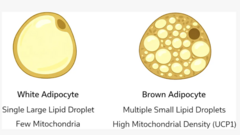
what is the purpose of Adipocyte cells in connective tissue?
storing lipids as droplets that fill lost of the cytoplasm
what are the 2 types of adipocyte cells and their functions?
there is white and brown. brown adipocytes store lipids as many droplets and have high metabolic activity. white adipocytes store lipids as a single large drop and are metabolically less active.
mesenchymal cell
embryonic connective tissue cell (gives rise to all other CT)
Macrophage cell
a disease fighting cell, it enters the connective tissue matrix from the blood vessels. found in connective tissue proper but are part of the immune system protecting the body
Mast cell
Cells that release chemicals (such as histamine) that promote inflammation.
what are the 3 main types of fibers secreted by fibroblasts
collagen fibers, elastic fibers, and reticular fibers
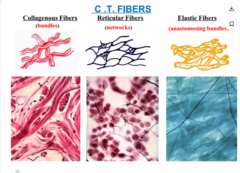
collagen fiber
flexible fibrous proteins that give connective tissue tensile strength. they give ligaments and tendons their resilience and strength.
elastic fiber
fibrous protein within connective tissue that contains a high percentage of the protein elastin that allows the fibers to stretch and return to original size. found in skin and elastic ligaments
reticular fiber
fine fibrous protein, made of collagen subunits, which cross-link to form supporting "nets". found throughout the body but mostly in soft organs like the liver and spleen
where does all connective tissue derive from?
the mesodermal layer of the embryo, the first connective tissue to develop in the embryo is mesenchyme, the stem cell from which all connective tissue are formed from.
what are the 3 subclasses of Loose Connective tissue?
areolar, adipose and reticular
areolar connective tissue
Function: wraps and cushions organs
characteristics: fibers distributed randomly
Location: widely distributed under epithelia of body

adipose connective tissue
acts as a storage depot for fat, has little extracellular matrix. white adipose is the most abundant type.

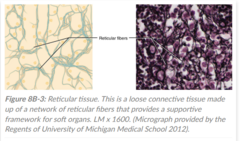
reticular connective tissue
forms supporting tissue in walls of liver and spleen
what are the 3 subclasses of dense connective tissue?
Dense regular connective tissue, Dense irregular connective and Dense elastic connective.
what makes dense tissue more dense than loose connective tissue?
dense connective tissue contains more collagen fibers so they have more resistance to stretching.
Dense regular connective tissue
the fibers are parallel to each other, enhancing strength and resistance to stretching in the direction of the fibers. ligaments and tendons are made of dense regular connective tissue, but not all the fibers in ligaments are parallel.

Dense irregular connective tissue
the direction of fibers is random, giving the tissue more strength. gives arterial walls the strength and ability to regain original shape after stretching.

Dense elastic connective tissue
contains elastin fibers and collagen fibers, allowing the ligament to return to its original length after stretching.
Cartilage connective tissue function
allows the body to maintain its posture and protect internal organs
what are the 3 types of cartilage tissue
Hyaline cartilage, Elastic Cartilage, and fibrocartilage
Hyaline cartilage
most common type, appear clear under microscope, the surface is smooth. found in the rib cage and nose and covers bones where they meet to form moveable joints.

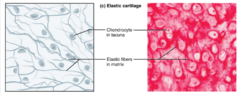
elastic cartilage
contains elastic fibers and collagen fibers. provides support and elasticity. an example is earlobes.
Fibrocartilage
a thick type of cartilage because of the thick bundles of collagen fibers. Menisci in the knee joint and the intervertebral discs are examples.

what are the 2 subclasses of special connective tissues?
bone and blood
Osseous tissue (bone) function
provides protection to internal organs and supports the body
what is extracellular matrix of bone made of
collagen fibers embedded in a mineralized ground substance containing hydroxyapatite, a form of calcium phosphate.
what are osteocytes and where are they located?
Osteocytes are mature bone cells located in small spaces called lacunae.
how are Osteocytes arranged in compact bone?
they are arranged in concentric circles around a central canal
what does it mean that bone is highly vascularized?
Bone contains many blood vessels that supply nutrients and oxygen to its cells.
why does bone heal faster than cartilage?
bone has a rich blood supply, which helps it heal and recover from injuries quicker.
what is cancellous bone and where is it found?
cancellous bone is lightweight, spongy bone with spaces between structures called trabeculae. it is found inside some bones and at the ends of long bones.
how does compact bone differ from cancellous bone?
compact bone is solid and provides greater structural strength, while cancellous bone is lighter and contains many spaces.
why is blood considered a fluid connective tissue?
because its cells are suspended in a liquid extracellular matrix called plasma
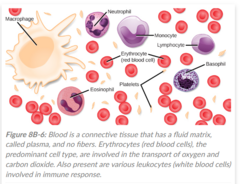
where do the formed elements of blood come from?
they develop from hematopoietic stem cells located in the bone marrow.
what is the function of erythrocytes (red blood cells)
they transport oxygen and some carbon dioxide
what is the function of leukocytes (white blood cells)
they defend the body against harmful microorganisms and molecules
what is the function of platelets
they help blood clot to prevent excessive bleeding
what is lymph and what does it contain?
lymph is a fluid connective tissue containing a liquid matrix and white blood cells
what is the function of lymphatic capillaries?
they collect excess fluid and larger molecules from the spaces between tissues and transport them into the lymphatic vessels
how does the lymphatic system help transport absorbed fats
specialized lymphatic capillaries absorb fats from the intestine and carry them through the lymphatic system until they drain into the bloodstream.