Physical Therapy's Role in Compliant Healthcare Payment
 Call Kai
 Learn
Learn Practice Test
 Spaced Repetition
 Match
Match Flashcards
 Knowt Play
1/130

There's no tags or description
Looks like no tags are added yet.
Name | Mastery | Learn | Test | Matching | Spaced | Call with Kai | Chat |
|---|
No analytics yet
Send a link to your students to track their progress
131 Terms
6 drivers of healthcare reimbursement =
- cost control
- quality improvement
- access to care
- technological advances
- regulatory changes
- patient-centered care
what is cost control?
shift from fee-for-service to value
what is quality improvement?
reducing medical errors and evidence-based practice
what is access to care?
expanding insurance services and addressing SDOH
what are examples of technological advances?
telehealth, RTMs, AI, electronic health records, interoperability
what are regulatory changes?
understanding federal and state government and licensing board policies and regulations with CMS setting standards
what is patient-centered care?
focus on meeting individuals needs and preferences
what was the original triple aim?
1. Improving the patient experience of care
2. Improving the health of populations
3. Reducing the per capita cost of healthcare
triple aim cost containment initial strategy included what 6 things?
-Value-Based Care added
- Preventive Care expanded
- Care Coordination emphasized - prior authorization
- Patient Engagement
- Reducing Re-hospitalizations
- Technology Advances
triple aim bottom line outcome (3) =
- Increased Documentation Requirements
- Health IT and EHRs not interoperable and not streamlining processes consistently
- Federal and State regulatory compliance complex, not synchronous, and everchanging
what 4 things are a part of the quadruple aim?
- lower cost for care
- improved access and overall experience
- remove administrative burdens and meaningful work
- better health outcomes
federal entitlement payment programs: what is part A?
Known as hospital insurance covering inpatient hospital stays, care in skilled nursing facilities, hospice care, and some home health care (HHA)
federal entitlement payment programs: what is part B?
Covers outpatient care, doctor visits, preventive services, and durable medical equipment. PTs can provide these Part B services in private practice (clinic or home based), hospital-based, physician owned practices (POPTS), SNFs, HHAs, or specialty hospitals as allowed by regulation. Typically follow fee-for-service payment
federal entitlement payment programs: what is part C?
Known as advantage/managed plans and is an alternative to traditional fee-for-service payment plans
what are federal entitlement programs in medicare?
part A and B
what are federal entitlement programs in medicaid?
- aged, blind and disabled (ABD)
- home and community-based services (HCBS)
- long term care (LTC)
- children's health insurance program (CHIP)
- pregnant women
- foster care
- cancer
- transportation
- dually eligible qualified medicare beneficiary (QMB) program
federal entitlement programs: part c - medicare advantage, what is it?
- Alternates to traditional Medicare plans
- Medicare + Choice (2026 - 55%)
- Can be higher premiums but less co-payment/patient responsibility, no cost annual screens, no deductibles, improved prescription coverage, and health promotion programs such as fitness reimbursements.
managed care health plans (photo)

what are the VA federal entitlement program healthcare departments =
Department of Veterans Affairs
1. VA Medical Care
2. Mental Health Care
3. Caregiver Support
4. Homeless Veterans Programs
5. Women Veterans Health Care
6. Geriatrics and Extended Care
7. Telehealth Services
8. Medical and Prosthetic Research
what is a part of the VA federal entitlement program Part A and B?
1. Veteran Health Care Program
2. VA Civilian Health and Medical Program (CHAMPVA)
3. Spina Bifida Health Care Benefits Program
4. Tricare
5. VA Dental Insurance Program (VADIP)
6. VA Vision Care
7. VA Blind and Low-Vision Services
what is the CMS 8-minute rule?
Medicare requires 8 minutes of care to bill at least 1 unit
the 8 minute rule allows billing to be based on the ____ ____ spent providing ____ services to determine the ____ ______ that may be billed
total time ; timed ; total units
equation: total treatment time =
1:1 timed procedures + untimed procedures
the medicare 8 minute rule chart

6 payers following CMS 8 minute rule =
- Medicare & Medicare Railroad
- Traditional Medicaid
- Managed Medicaid
- Most if not all Medicare Advantage Plans
- Tricare, Veterans Administration, ChampVA
- Many Commercial Carriers - unique to contract (humana, aetna, highmark western PA, UHC)
what is AMA substantive portion billing?
does not calculate the total time or cumulative time of a treatment session.
- considers 8 minutes as allowable to bill a unit.
in order to charge for a unit of service in AMA, you must have performed that service for what amount of time?
"substantial portion" of 15 minutes (at least 8 minutes)
in AMA, leftover minutes from a combination of services cannot be bill for any of them unless one individual service totals at what amount of time?
at least 8 minutes
4 other contract specific payment types =
1. Per Visit
2. Hourly
3. Capitated: PMPM (Per Member Per Month)
4. On-site Space - rental agreements
7 typical partners payment types =
1. School Pediatrics
2. School ATC services
3. School Conditioning services
4. Employer On-Site Therapy treatment services
5. Ergonomics On-Site
6. Self-Insured Employers
7. CASH Patients/Clients
what is a service-based CPT code?
billed 1 time independent of time meeting mid-point
- 97161/97162/97163 (IE)
- 97164 (re-eval)
what is a time-based CPT code?
- billed per the CMS 8-minute rule
- direct or face-to-face time
- 97110 (TE)
- 97530 (TA)
what are constant attendance modalities CPT codes?
- require DIRECT (one on one) patient contact
- time based billing applies with 8 minutes required
- AMA or CMS 8-minute rule may apply
** 97032 - 97036 (ultrasound, attended ES)
what are supervised modalities CPT codes?
- do NOT require direct (one on one) patient contact
- billed 1 time regardless of number of applications
** 97010 - 97028 (hot/cold pack, ES unattended)
what are therapeutic procedures CPT codes?
- Represents effective change through the application of clinical skills and/or services that attempt to improve function.
- Direct one-on-one patient contact required
- Time-based CPT codes
- Time-based billing applies with 8 minutes being required and typically 15 minutes
** • 97110 - 97546
when do you select therapeutic activities as the CPT code?
- Direct 1:1 code
- Focus on function or task: reaching, standing, dynamic postures, bending, lifting or carrying
- Strategies to improve something FUNCTIONAL
when do you select neuromuscular re-education as a CPT code?
- Direct 1:1
- Multi focal treatment
- Activities and strategies to improve posture, proprioception, balance, coordination, motor control and kinesthetic sense
when do you select therapeutic exercise as a CPT code?
- Direct 1:1
- Direct/Simple focus
- Activities and strategies to increase strength, ROM, flexibility endurance, and ROM
when do you select manual therapy as a CPT code?
- Direct 1:1
- Joint mobs
- Manual Lymphatic Drainage
- Manual Traction
- STM for what purpose?
- End Feel Assessment
- Includes Grades and Directions
what is the CMS multiple procedure payment reductions (MPPR)?
CMS devised process to implement 50% payment reduction to the practice expense value of certain CPT codes when more than one code is billed because believe that otherwise practice payment is redundant
what is practice expense?
the cost of healthcare for non-clinical staff, medical supplies, equipment, and other overhead expenses
CMS multiple procedure payment reduction applies to who?
private practice, CORFs, SNFs Part B, Home Health Part B, OPT Hospital, and Rehab Agencies

MPPR applied (scenario chart)

what is group therapy billing?
consists of all therapeutic services provided to a group of 2 or more people at the same time. These techniques may include water therapy, conditioning therapy, or exercise therapy with the constant presence of a doctor or licensed therapist, but not in individual contact with an individual patient
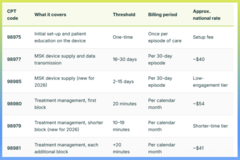
remote therapeutic monitoring chart
what are therapy modifiers?
Must apply these with billing submission because multiple disciplines use the same CPT codes so identifies which discipline provided the care
what is the GP modifier?
physical therapy
what is the GO modifier?
occupational therapy
what is the GN modifier?
speech language pathology
CMS annual therapy threshold process Part B requires _____ modifier for services about the therapy threshold to indicate services are medically necessary
KX
what is the assistant modifier CQ?
OP PT services furnished in whole or in part by a PTA
what is the assistant modifier CO?
OP OT services furnished in whole or in part by a OTA
when is an assistant modifier used?
treatment minutes provided above 10% by a PTA/COTA
how are assistant modifiers used?
To be appended on same claim line as GP or GO modifiers
APTA had strongly urged CMS to move to _____ supervision for the PTA in all settings and CMS adopted the ______ supervision in private practice
general; general
what is modifier 95?
synchronous telemedicine rendered via a real-time interactive audio and video communication system (HIPAA Compliant)
what is the medicare national correct coding initiative edits (NCCI)?
- CMS Owns this program and process
- Promotes national correct coding for Medicare Part B claims
- Updated quarterly
- -59 Modifier is used when permitted
3 types of medicare national correct coding initiative edits (NCCI) =
- Procedure Edit Pairings (PTPs)
- Medically Unlikely Edits (MUEs)
- Add-on code edits
what are medically unlikely edits?
Places a limit on number of units allowed on the same Date of Service (DOS) for timed services

2 types of CMS claim forms =
- CMS 1500 form
- CMS - 1450 (UB-04) form
what is the CMS 1500 form?
• Part B Medicare - NPI of the credentialed provider who assigns benefits to practice by submitting a 855R Form is reported on the claim form
- Back of form Signature Attestation of Physician or Supplier is
important:
- Certifies to medical necessity of the services to support the billing
what is the CMS-1450 (UB-04) form?
- Medicare A/Institutional Form
- Submitted by Certified Rehab Agencies
- NPI of the practice goes on claim
where is the CMS-1450 (UB-04) used?
hospitals (outpatient or inpatient observation patients and other institutional providers (CORFs, SNFs, HHA) for outpatient services
- HPI number of the PRACTICE goes on the claim
where is the CMS-1500 used?
private practice therapists, physician offices, and other professional providers
- NPI number of the credentialed provider goes on the 64 claim
types of high level insurance plans: what is primary?
main insurance paying a claim first
types of high level insurance plans: what is secondary?
pays remainder once the primary has paid their portion
types of high level insurance plans: what is tertiary?
pays remainder once primary and secondary have paid their portion
types of high level insurance plans: what is supplemental?
plans that cover gaps in primary coverage, such as the 20% co-payment gap for Medicare Part B
(AARP/UnitedHealthcare, Mutual of Omaha, Cigna, Anthem)
3 ways PT services are initiated =
- prescription from allowable practitioner
- referral
- direct access (DA)
4 things payers will do when it comes to referrals =
1. Some payers require authorization upon IE completion
2. Some payers allow the referral with a visit limit to stand alone upon the initial phase the PT
3. Some payers manage all visits on a set frequency/basis
4. Many set date timelines as well regardless of visit limits having been met
what is automobile insurer payment?
- Part B payer type
- State-specific payment rates
- Auto Third Party Insurances
- AMA Substantive and CMS 8-Minute Rule (payer and state specific)
- Provided across the continuum until benefit exhaustion then converts to primary insurance
provider burdens of automobile insurer payment =
1. Documentation typically requested with each claims
2. Claims Adjusters
3. Case Managers
4. High Legal/Letters of Protection
all about PT and commercial/private insurer payments =
- part B payer type
- thousands across the country with each being contractually unique
- typically AMA substantive but some follow CMS 8-minute rule
- provided across the continuum
- create unique clinical practice guidelines
- coverage dependent upon the subscriber's plan type and level
provider burden of commercial/private insurer payment =
- prior authorization processes
- utilization management
- higher patient co-payments
- contractual changes and tiering of providers
- administrative costs
- reimbursement delays and denials
- clinical and billing policies behind provider portals and not easily found
- communication and ability to contract for questions not easily accessible
all about PT and workers compensation insurance payment =
- Employer required (state specific)
- Part B payer type
- State-specific payment rates (typically percentage of CMS)
- WC Third Party Insurances
- AMA Substantive and CMS 8-Minute Rule (payer and state specific)
- Provided across the continuum
services provided for workers comp =
1. Medical Benefits
2. Wage Replacement
3. Disability Benefits
4. Rehabilitation
5. Death Benefits
provider burden of workers comp =
1. Documentation typically requested with each claims
2. Claims Adjusters
3. Case Managers
4. High Legal
what does it mean if someone is uninsured/underinsured?
No insurance
- High co-payments and/or out-of-pocket expense
- Coverage limitations per individual
results of being uninsured/underinsured =
1. Skip therapy sessions, medications, etc.
2. Choose to not seek healthcare
3. Increases health risks by not managing conditions
what are medicare part A settings/payment?
- Acute Care Hospital
- Critical Access Hospital
- Emergency Rural Hospital
- Long-Term Care Hospital
- Skilled Nursing Facility
- Home Health Agencies
- Hospice
part A prospective payment system (PPS) for acute care hospitals =
- Acute admissions paid via Diagnosis-Related Groups (DRGs) based upon patient diagnosis, services provided, and severity of illness. DRGs paid at set, weighted payment
- Capitation: pre-paid fixed amount per patient
- Value-Based Care: reimbursement based upon patient outcomes
- Commercial payer payment rates are contract and payer specific
part B physician fee schedule for acute care hospitals =
- Fee-for-Service or contracted rates: payment for individual services (labs, radiology, therapy services in observation unit, etc.)
- Commercial payer payment rates are contract and payer specific
part C medicare advantage plans for acute care hospitals =
- Typically contracted rates
- Possibly bundled-payments (ACOs and VPMs)77
in ACH, therapy is a ____-_____ service, with part A (acute care) DRG reimbursement (cost center only, no revenue)
value-added
in ACH, therapy value is in reducing complications and lessoning impacts of comorbidities by what?
promoting increased mobility and positional tolerances
therapy in ACH contribute to preventing ____-day re-hospitalization
30
in ACH, therapy clearance typically required to support what?
discharge disposition
what is a critical access hospital?
- Emergency services provided 24/7 and can offer swing beds, allowing for inpatient beds to be utilized as acute care or skilled nursing beds.
- 25 or fewer acute care inpatient beds, located > 35 miles from another hospital or > 15 miles in areas with mountainous terrains or had obtained CAH prior to 1/1/2006 listed in the State as a "necessary provider"
how is a critical access hospital paid?
cost-based reimbursement model paying for inpatient and outpatient services at 101% of reasonable costs
critical access hospitals are exempt from what payment system?
ACH inpatient prospective
in CAH, therapy is a ____-_____ service and may be needed with swing-beds and SNF beds
value-added
in CAH, therapy value is in reducing complications and lessoning impacts of comorbidities by what?
promoting increased mobility and positional tolerances
what is a rural emergency hospital?
Provide emergency services, observation care, and additional medical and health outpatient services with annual per patient average of 24 hours.
- Don't provide acute care inpatient services
in both a CAH and a RHE, therapy may provide outpatient CMS part B services under the medicare physician fee services although the facility is a ___ ____ provider
part A
a RHE provides therapy services under ___ ____ , ____ ____ , and _____ in a designated SNF area
part A ; part B ; medicaid
section GG is submitted to CMS by who?
LTCH, IRFs, SNFs, and home health agencies
section GG assesses functional abilities and standardizes teh reporting criteria across what?
the post-acute continuum
section GG impacts reimbursement in all settings based upon what?
patient assistance required for care
section GG items (photo)

how is an LTCH paid?
PPS LTCH DRGs