Chapter 02 — Argand Diagrams
 Call Kai
 Learn
 Practice Test
 Spaced Repetition
 Match
 Flashcards
 Knowt Play
1/23

There's no tags or description
Looks like no tags are added yet.
24 Terms
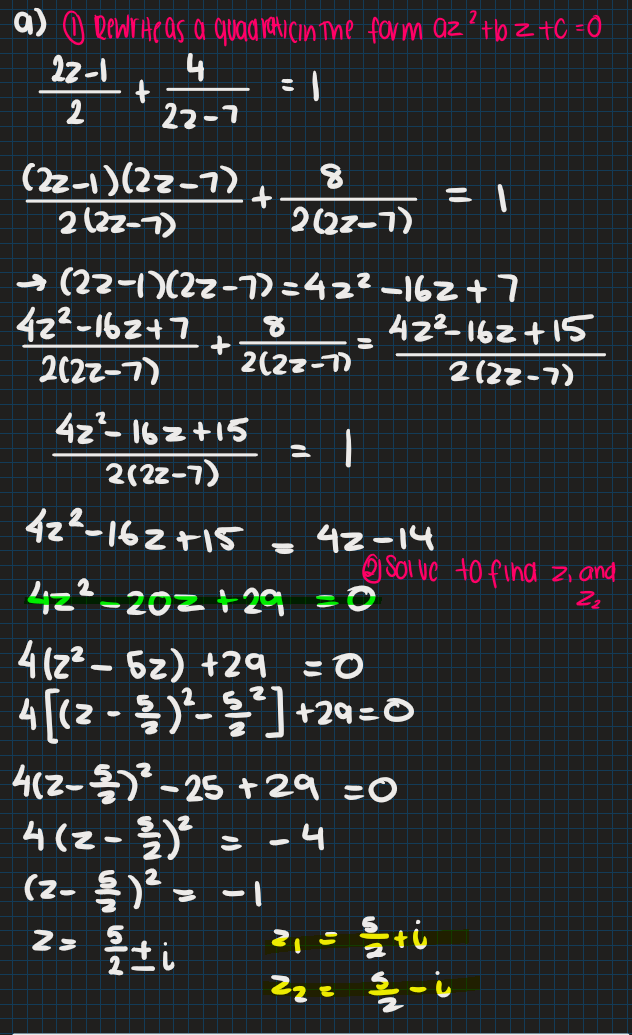
The solutions to the quadratic equation 22z−1+2z−74=1 are z1 and z2.
a) Find z1 and z2, giving your answers in the form p±qi, where p and q are real numbers.
b) Show, on an Argand diagram, the points representing the complex numbers z1, z2, and z1+z2.

What is the formula for calculating the modulus of a complex number?
∣z∣=x2+y2
What is the formulae for calculating the argument of a complex number?
arg(z)=tan−1(xy)

What are the rules for arguments on the axis?
positive real axis — arg(z)=0
x>0
y=0
positive imaginary axis — arg(z)=2π
x=0
y>0
negative real axis — arg(z)=π
x<0
y=0
negative imaginary axis — arg(z)=−2π
x=0
y<0

What is the formula for calculating the distance between a complex number (z) and a fixed point (w)?
∣z−w∣
For the complex number z=x+iy, what are the related complex conjugate identities?

z∗=x−iy
zz∗=(x+iy)(x−iy)=x2+y2=∣z∣2
Re(z)=21(z+z∗)
Im(z)=2i1(z−z∗)
How do you convert between radians and degrees?
Radians → degrees: ×π180
Degrees → radians: ×180π
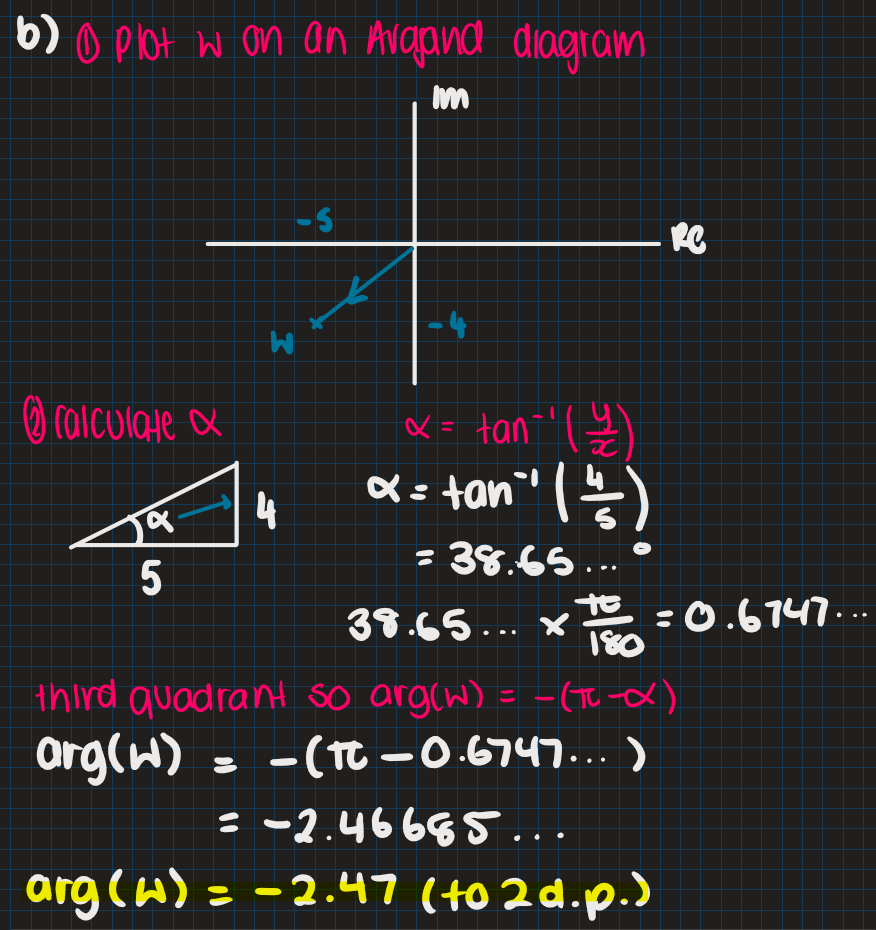
The complex number w is given by w=−5−4i.
a) Find ∣w∣, giving your answer in exact form.
b) Find arg(w), giving your answer in radians to 2 decimal places.
Given that arg(λ+7i+w)=43π, where λ is a real constant.
c) Find the value of λ.


Given that
w=λ−3i
where λ is a real constant, and arg(4−5i+3w)=−2π, find the value of λ.

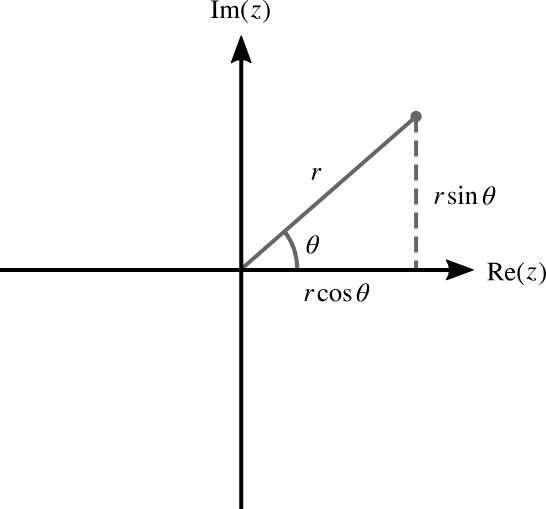
Write the complex number z=x+iy in modulus-argument form.
∣z∣=r
arg(z)=θ
r(cosθ+isinθ)
x=rcosθ
y=rsinθ
x+iy=rcosθ+irsinθ=r(cosθ+isinθ)
What are the formulae for multiplying the complex numbers z1 and z2 in modulus-argument form?
∣z1z2∣=∣z1∣∣z2∣
arg(z1z2)=arg(z1)+arg(z2)
What is the proof for multiplying the complex numbers z1 and z2 in modulus-argument form?
z1=r1(cosθ1+isinθ1)
z2=r2(cosθ2+isinθ2)
1. Multiply z1 and z2 and simplify
z1z2=r1(cosθ1+isinθ1)×r2(cosθ2+isinθ2)
r1r2(cosθ1+isinθ1)(cosθ2+isinθ2)
r1r2(cosθ1cosθ2+icosθ1sinθ2+isinθ1cosθ2+i2sinθ1sinθ2)
r1r2(cosθ1cosθ2+icosθ1sinθ2+isinθ1cosθ2−sinθ1sinθ2)
2. Group real parts and imaginary parts
r1r2((cosθ1cosθ2−sinθ1sinθ2)+i(sinθ1cosθ2+cosθ1+sinθ2))
3. Use trigonometric addition formulae
sin(A±B)=sinA cosB±cosA sinB
cos(A±B)=cosA cosB∓sinA sinB
r1r2(cos(θ1+θ2)+isin(θ1+θ2))
∣z1z2∣=r1r2
arg(z1z2)=θ1+θ2
What are the formulae for dividing the complex numbers z1 and z2 in modulus-argument form?
z2z1=∣z2∣∣z1∣
arg(z2z1)=arg(z1)−arg(z2)
What is the proof for dividing the complex numbers z1 and z2 in modulus-argument form?
z1=r1(cosθ1+isinθ1)
z2=r2(cosθ2+isinθ2)
1. Divide z1 by z2 and simplify
z2z1=r2(cosθ2+isinθ2)r1(cosθ1+isinθ1)
z2z1=r2(cosθ2+isinθ2)r1(cosθ1+isinθ1)×(cosθ2−isinθ2)(cosθ2−isinθ2)
z2z1=r2(cosθ2cosθ2−icosθ2sinθ2+isinθ2cosθ2−i2sinθ2sinθ2)r1(cosθ1cosθ2−icosθ1sinθ2+isinθ1cosθ2−i2sinθ1sinθ2)
2. Group real parts and imaginary parts
z2z1=r2(cos2θ2+sin2θ2)r1((cosθ1cosθ2+sinθ1sinθ2)+i(sinθ1cosθ2−cosθ1sinθ2))
3. Use trigonometric addition formulae and trigonometric identities
sin(A±B)=sinA cosB±cosA sinB
cos(A±B)=cosA cosB∓sinA sinB
sin2θ+cos2θ≡1
r2r1(cos(θ1−θ2)+isin(θ1−θ2))
z2z1=r2r1
arg(z2z1)=θ1−θ2
Given that
z1=−3−5i
∣z2∣=62
arg(z2)=43π
where z1 and z2 are complex numbers,
a) Write z1 in the form r(cosθ+isinθ). Give the exact value of r and give the value of θ in radians to 4 significant figures.
b) Find z1+z2 in the form a+ib, where a and b are integers.


What is the equation of the locus for a circle with centre (x1,y1) and radius r?
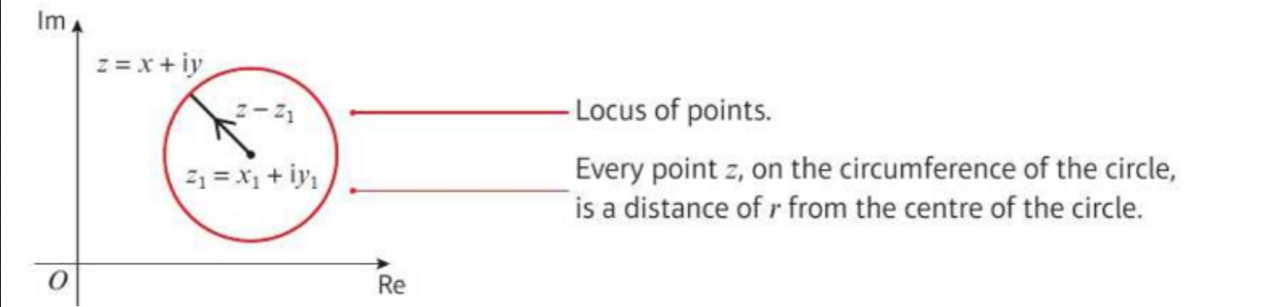
∣z−z1∣=r
What is the Cartesian equation of a circle with centre (a,b) and radius r?
(x−a)2+(y−b)2=r2
Derive the Cartesian equation of a circle from ∣z−z1∣=r .
∣(x−x1)+i(y−y1)∣=r
(x−x1)2+(y−y1)2=r2
since ∣p+qi∣=p2+q2
p=(x−x1)
q=(y−y1)
For the complex numbers:
z1=x1+iy1
z2=x2+iy2
What is the equation of the locus for the perpendicular bisector of the line segment joining z1 and z2?

∣z−z1∣=∣z−z2∣
What is the equation of the locus for a half-line starting at z1 making an angle θ with the positive real axis?

arg(z−z1)=θ
Derive the equation of a straight line from arg(z−z1)=θ.
arg((x−x1)+i(y−y1))=θ
x−x1y−y1=tanθ
θ is a fixed angle so tanθ is a constant
y−y1=tanθ(x−x1)
gradient — tanθ
passes through (x1,y1)
The loci C1 and C2 are given by ∣z∣=∣z−4i∣ and arg z=6π respectively.
a) Sketch the loci C1 and C2 on a single Argand diagram.
b) Hence find, in the form x+iy, the complex number represented by the point of intersection of C1 and C2, giving your answer in exact form.


Figure 1 shows an Argand diagram.
The set P, of points that lie within the shaded region including its boundaries, is defined by
P={z∈C:a≤∣z+b+ci∣≤d}
where a, b, c, and d are integers
a) Write down the values of a, b, c, and d. (3)
The set Q is defined by
Q={z∈C:a≤∣z+b+ci∣≤d}∩{z∈C:∣z−i∣≤∣z−3i∣}
b) Determine the exact area of the region defined by Q, giving your answer in simplest form.


The complex numbers z1 and z2 are given by
z1=p+2i
z2=1−2i
It can be shown that z2z1=5p−4+52p+2i
Given that ∣z2z1∣=13, find the possible values of p. [4 marks]

