Chapter 12 - Psychology 111
 Call Kai
 Learn
 Practice Test
 Spaced Repetition
 Match
 Flashcards
 Knowt Play
1/43

There's no tags or description
Looks like no tags are added yet.
44 Terms
Impression Formation
how we form opinions of others
First impressions are involuntary responses
Long lasting and difficult to change
Social Schema
Self fulfilling prophecy
your initial impression reflects in their personality
Attribution
Personal explanation for behavior
Dispositional causes
Internal causes
Situational causes
Environmental factors
Fritz Heider
people tend to focus more on behavior of others than on circumstances in which the behavior occurs
Fundamental attribution error - tendency to attribute behavior to internal or dispositional causes such as intelligence or laziness
ignore external circumstances that influence behavior of others
Actor Observer effect
Attribute ones own behavior to external factors
Cognitive dissonance theory
Inconsistencies between attitude and behavior lead to a state of dissonance or emotional discomfort
Elaboration Likelihood model
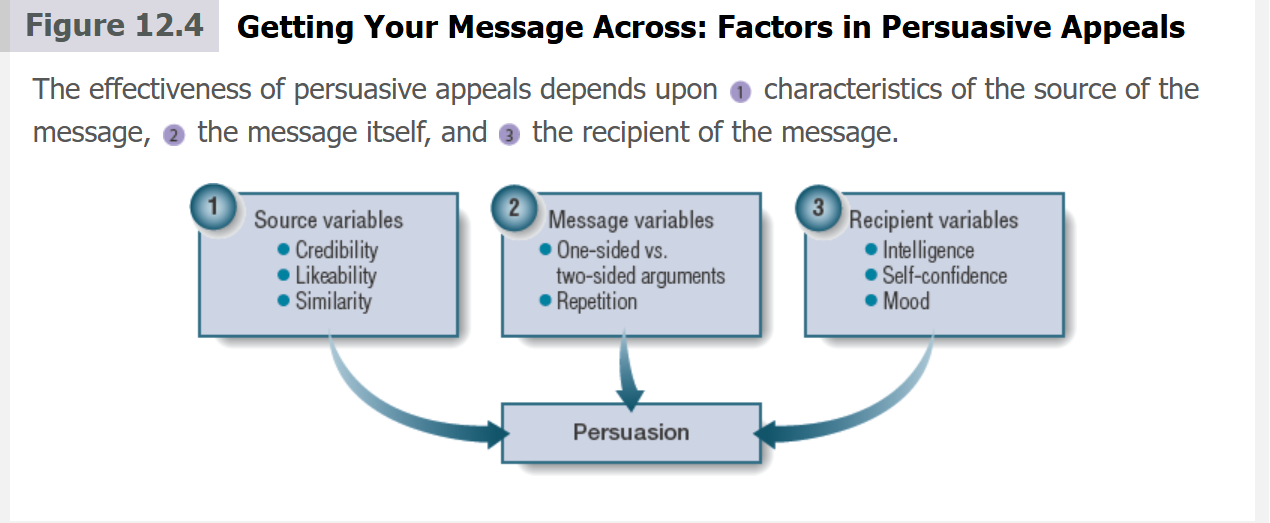
People are more likely to carefully evaluate a persuasive message when their motivational state is high
Characterizing Attraction
Similarity
Hold similar values and attitudes
physical appearance, social class, religious views, ethnicity, height, etc..
Physical attractiveness
“What is beautiful is also good.”
Matching hypothesis: people will seek partners similar to themselves in physical attractiveness and other characteristics
with less attractive people that one will somehow compensate through money
Steinberg’s Triangle
Steinberg proposes that relationships are balanced when the love triangles of both partners are overlapping
Altruistic motives
Unselfish motivations to help someone
Self centered motives
Helping in order to seek some sort of external or internal reward
Situational ambiguity
In an ambiguous situation where its not clear what happening, people are less likely to help
Also less likely in unfamiliar environments
If the perceived cost is low
Diffusion of responsibility - the number of people around the situation
Similarity - helping people who are like themselves
empathy
Facial features
Mood and gender
Social norms
In Groups
social, religious, ethnic, racial, and national groups
Out group
all other groups
Out group homogeneity
tendency to perceive members of other racial or ethnic groups as being alike in homogenous white preceding ones own group as being different
authoritarian personality is associated with prejudiced attitudes
Contact Hypothesis
Best way to reduce prejudice is bringing groups closer together in contact with each other
Conformity
people assume that the majority is correct
so concerned about being accepted by the group that they don’t care whether their judgement was correct
they feel its easier to go along with the group than to disagree
Legitimization of authority
obey authority figures
Social validation
people are generally more willing to comply with more extreme requests once they have shown willingness to comply with lesser requests
Social facilitation
tendency for people to work better or harder when they work in the presence of others
Groupthink
group of people to become so concerned with reaching a consensus that they lose the ability to critically evaluate the problem before them
the presence of conformity to the major opinion
members are strongly attached to the group
an external threat is present
strong minded leader directing the group
Encoding
Acoustically (sound) - auditory singal’s to recognizable sounds
Visually (mental pictures) - visual patterns
Semantically (meaning) -transforming visual images and sounds into meaningful words
Retrieval cues
Cues that help jog information back into awarneness
3 Stage Model #1 Sensory Memory
Strong sensory information for a short period of time (fraction of a second to 3-4 seconds)
Sensory Register - the sensory impression then disappears and is replaced by the next one and so on
Iconic Memory - almost all we see enter this sensory register
type of photographic memory for a fraction of a second
Eidetic imagery - photographic memory
recalling an image so accurately seeming as through they are still looking at this
this is very rare and is primarily in children
Echoic memory - auditory stimuli encoded as a mental representation (about 2-3 seconds longer than visual images)
3 Stage Model #2 Short Term Working Memory
Some sensory impressions don’t just fade away and get to be processed further
Can last 30 seconds, but you can expand the 30 second rule through maintenance rehearsal: repeating information over and over again to help succeed at short term memory but not processing it into deeper meaning
+- 7
Visual and acoustic but mainly acoustic
Chunking - grouping large number of bits of information
3 Stage Model #3 Long Term Memory
Can be days, weeks, or a lifetime
Is limitless of what it can hold
Consolidation: unstable fresh memories into stable long term memories
Semantic coding - meaning
Elaborative rehearsal - focus on the meaning of the material
Better than maintenance rehearsal because of the levels of processing theory: the level at which information is encoded or processed determines how well or how long information is stored in memory
Semantic Network Model - information is retained within network of interlinking concepts
Declarative Memory
Facts and personal information that requires a conscious effort to bring to mind
Semantic
Memory of facts
Episodic
Memory of a personal experiences that constitute the story of your life
Retrospective
Memory of past experiences
Prospective
process of remembering to remember
Procedural
memory of how to do things
Implicit
memory evolved without any conscious effort to remember
Explicit
requires conscious effort
Constructionist theory
memory is a process that stitched together bits and pieces of stored information and reconstructing personal memories
produced an interesting perspective on negative stereotyping - ascribing negative traits to people of certain groups that can influence perceptions and attitudes of stereotyping
Flashbulb memory
extremely stressful or emotionally arousing personal or historical events may leave which lasting, and highly detailed memories
Decay theory
memories consist of traces in the brain that gradually deteriorate and fade over time

Ebinghaus Forgetting curve
Employed a savings method to test retention
Interference theory
explains why some memories are easily forgotten and others are vivid
Retroactive interference : interference occurring after material is learned but before its recalled
Procedure interference: caused by the influence of previously learned material
Helps explain serial position effect
Primary : remember first thing you learned
Recency: remember the last thing you learned
Recall tasks
Free recall - asked to recall as much information you can
Serial - order
Paired - pairs
Recognition task - asked to pick out correct answer over a range of alternative answers