FW334 Exam 2
 Call Kai
 Learn
 Practice Test
 Spaced Repetition
 Match
 Flashcards
 Knowt Play
1/112

There's no tags or description
Looks like no tags are added yet.
113 Terms
Communication is imperative
Importance of communication
Complexity of goals
Extensive public participation
Public expects transparency
expect clear and complete agency communication about decisions and that we articulate views quickly and expressly
Opportunities for communication successes and failures
More diverse public interest
more governmental and non gov entities involved
changing media availability and types
Communication is fundamentally a social process
Source message channel receiver model
Source (who)
accepting the message depends on quality of sender
are they credible?
trustworthy? honest?
Message (says what)
quality of message
urgent? fear? vivid? (fear based can have opposite effects sometimes)
Channel (through what channel)
Effect of medium
audiovisual? website? print?
Receiver (to whom with what effect?)
nature of audience
socioeconomics, demographics, attitudinal, knowledge traits, communication habits, etc.
Informative Communication
Facts and ideas need to be communicated to public (simple and noncontroversial)
brochures, public meetings, etc
Becomes difficult with increased complexity and limited effectiveness when objectives are…
CUR
controversial
uncertain
req more than providing best information available
Involves media planning and message design
Informative Communication → Media Planning
Selecting the right channel
how can i best reach the audience
Should use multiple channels in parallel by paying attention to… (MA_ACT)
Message purpose and content
Audience characteristics
Available channels to reach audience
Channel vs effectiveness
Time constraint
Informative Communication → Message Design
Two traits of a message
Content → message must have meaning and relevancy
Clarity → message in simplest terms; simplify complex issues
Effective message is (ME_CAT)
Matched to audience (social, economic, physical capabilities)
Economically, socially, or culturally significant → needs, interests, or values of the audience
Concise
Timely
Applicable (info aud can use)
Ban on deer baiting
Social/physical match → hunters
Culturally/socially sig → hunter interests, needs, and value
concise → quick info for hunters
timely → when it is needed
applicable → can take out into field with them
SMCR Model Limitations
Linear and focused on simple transmission (which often is not reality)
Oversimplifies communication
Information deficit model
common attitude assumes that more information + more education is all that is needed to gain consensus among the public about an issue
Reality → communication is complex
public → varying interests and concerns
different publics → different kinds of information and approaches
Persuasive Communication
Communicate information to the public and get them to act on this info
seeks attitude or behavior change
Long term change induced through repetitive, consistent, extensive effort
often reqs
multi-way exchanges with stakeholders
a social context that rewards people for behavior change (norms)
FACTS ARE NOT ENOUGH
Facts are less important than they appear
We are not rational objective creatures
In contentious issues, beliefs > facts
Where do beliefs come from
personal experience
family upbringing
community
religion
education
personality
identity
interpersonal relationships
Does the fish know it swims through water?
Social influence is most profound when it shapes our most fundamental assumptions and beliefs about the world without our realizing it
Facts can make things worse - how/why?
Boomerang effect → backfiring of facts when attempts at persuasion trigger negative emotions
Confirmation bias
the tendency to search for, interpret, favor, and recall information in a way that confirms or supports your existing beliefs, expectations, or hypotheses while ignoring or downplaying contradictory evidence
Echo Chambers
Looking to be surrounded by ideas and people that support our beliefs
Study showing people “blocking out” messages they don’t want to hear
smokers and static example
so we should tailor messages to beliefs + values of audience
leverage points (clean water for ex)
Paradox of educating people
1950s → more educated non smokers more likely to accept smoking was hazardous for health
But → smokers with higher education → more likely to be skeptical of evidence
Motivated reasoning
"the psychological process of evaluating information in a biased way to reach a desired conclusion, rather than seeking an objective truth”
biased information processing → protect existing beliefs
Key Takeaway
More information → more we shape it to our beliefs or interpret it to confirm our own worldview
Why are we like this
Social bonding → thrive
Evolution of importance of cooperation and trust
Physiological response → dopamine rush from confirmation of beliefs
Complex behavior change messages need..
HRS
Social confirmation (hear message from trusted others)
Redundancy (hear same message from diff people in your network)
Hear new ideas from people they trust in their communities
All because knowledge is social!!
Giddens “access points”
Personal interactions between experts and lay people are essential → maintain trust in modern institutions
These interactions provide opportunities for experts to share values and character traits (warmth, integrity) → to build trust
First rule…
Need to listen and
Understand that people see facts according to their worldview
Starting with concerns and interests of end users → meaningful outcomes
Building relationships + respectful conversations
Importance of networks
People learn through each other
work within social networks → build social confirmation
use trusted messengers to convey controversial ideas
Psychological distance (construal level theory)
How psychologically close an issue is → influences whether someone will act on it
also influences attitudinal/behavioral responses
4 dimensions of distance (THSS)
spatial
social
temporal (immediate threat?)
hypothetical (how probable is this to happen?)
Framing theory
The way an issue is presented influences → attitudinal/behavioral response
Frames are organizing devices for delivering messages
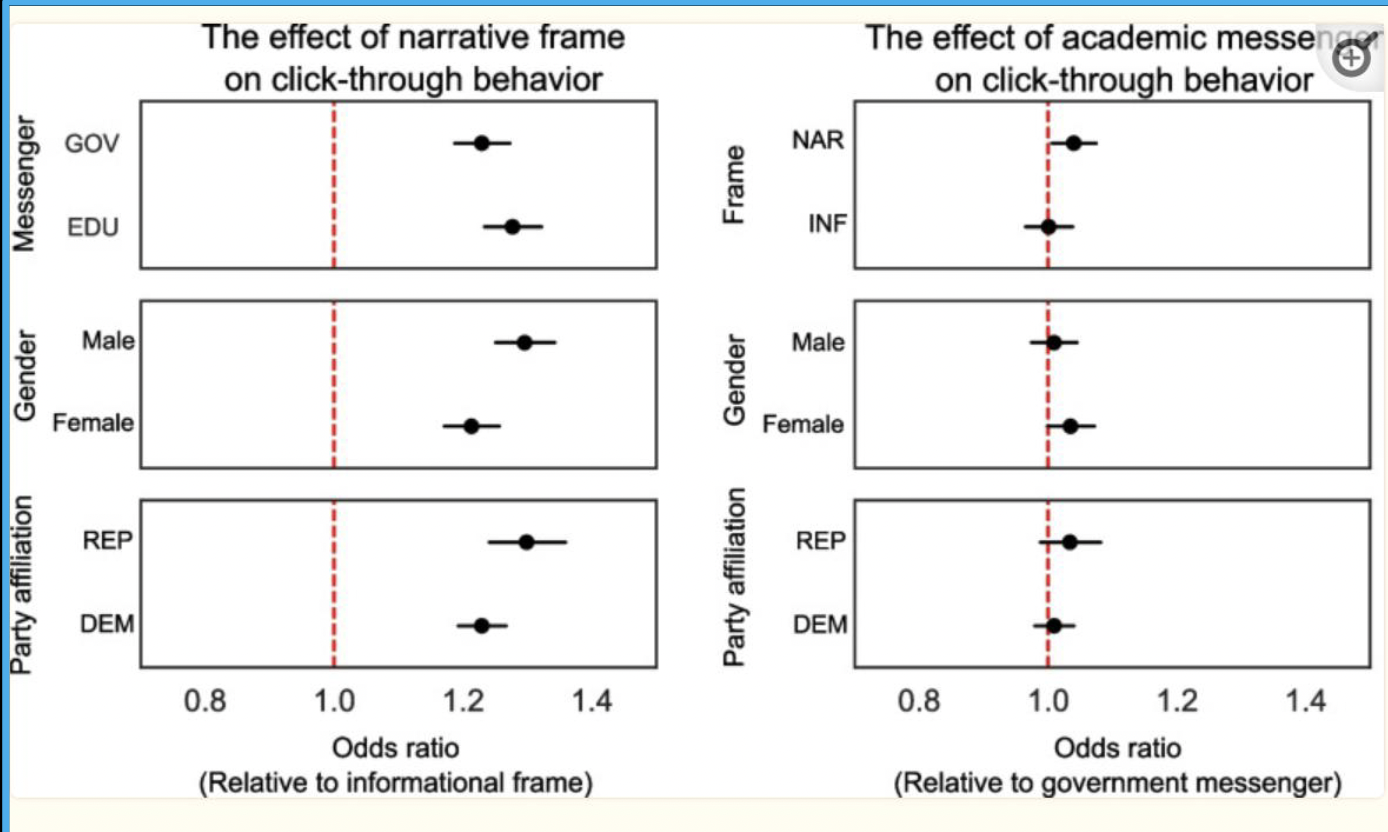
Shifting from a fact-based informational frame to a story-driven narrative frame substantially boosts engagement across the board, aligning with framing theory's claim that relatable, human-centered frames often capture attention and motivate action more effectively than pure facts alone.
Frames do not work uniformly on everyone; their impact is moderated by audience characteristics, prior beliefs, and context
frame type can outweigh messenger (narrative beats academic messaging whether its an informational or governmental frame)
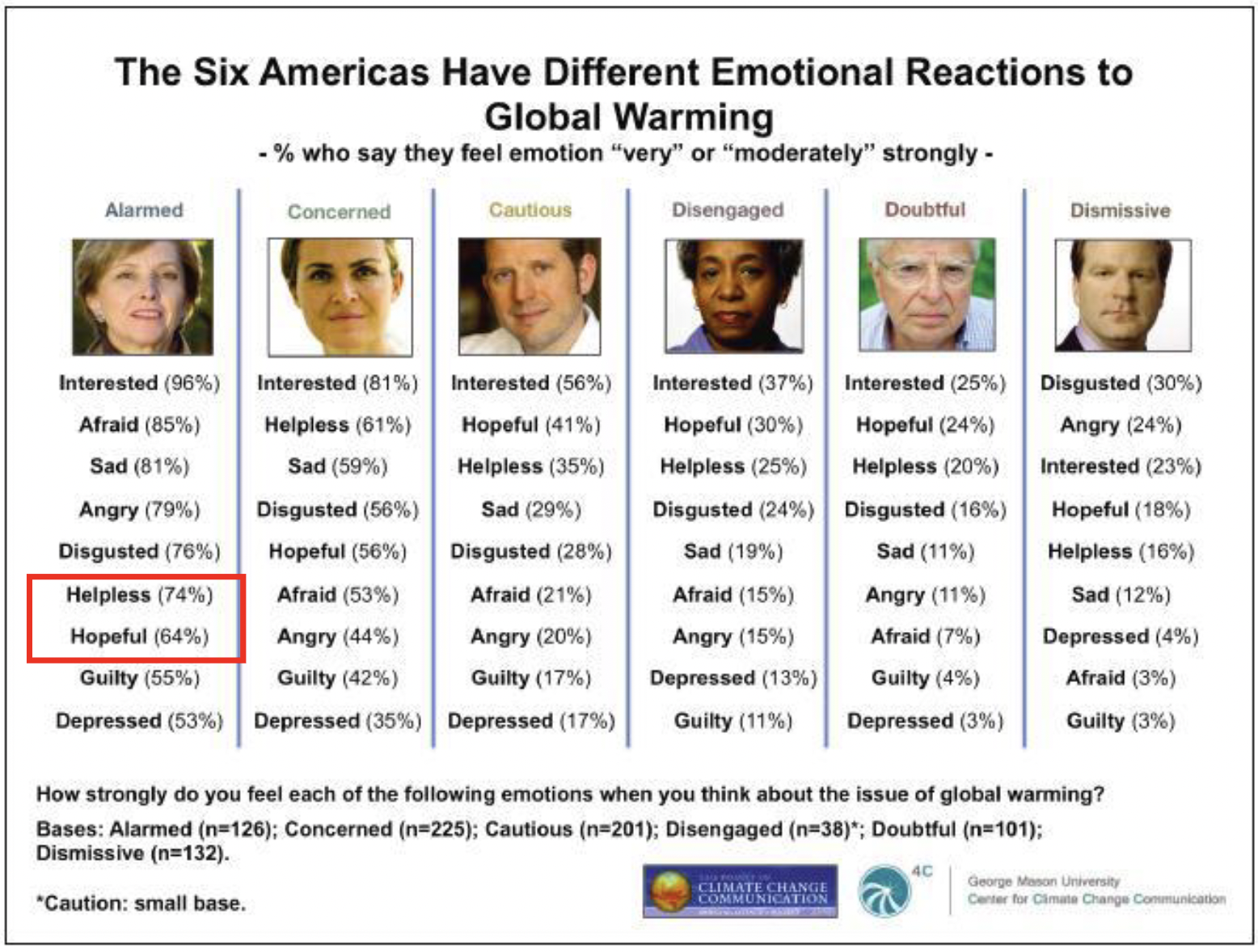
6 Americas study: audience segmentation
Alarmed → Convinced climate change is happening, human-caused, and an urgent threat.
dont focus on decreasing psych distance
Concerned → Accept that global warming is real and human-caused, but view impacts as more distant in time or place and are less personally active.
decrease psych distance
Cautious → Undecided on whether global warming is happening, human-caused, or serious, and less focused on the issue
not as open to facts, but give opportunities to ask questions
Disengaged → Have little awareness, knowledge, or thought about global warming and feel underinformed, making them open to learning and shifting views.
Doubtful → Question whether global warming is real or human-caused—often attributing changes to natural cycles—and see it as a low or distant risk
Dismissive → Firmly believe climate change is not happening, is a hoax, or is not a serious problem, and actively oppose climate action.

What this mean
Alarmed & Concerned (Left): Show very little interest in more information about evidence or causes (they already accept climate change is happening). Their overwhelming focus is on Solutions—what can be done to mitigate it.
Cautious & Disengaged (Middle): Have moderate, fairly evenly distributed interest across evidence, causes, consequences, and solutions.
Doubtful & Dismissive (Right): Have almost no interest in solutions. Instead, their interest is heavily concentrated on Evidence and Causes (debating whether climate change is real and what is driving it).
2. Strategic Reframing for the "Alarmed" Audience (The Blue Callout Box)
Because the Alarmed group is already convinced of the threat and wants solutions, continuing to send them fear- or alarm-based messages can lead to paralysis or burnout. The slide highlights a specific communication strategy for this group:
Shift from Alarm to Self-Efficacy: Reframe messaging so people feel capable of taking meaningful action rather than overwhelmed.
A "Helpless" to "Hopeful" Reframe: Move away from doomsday framing and emphasize actionable, solution-oriented framing that fosters agency and hope.
National Security Lens Frame
Frame climate change as a threat to freedom, public health, economy, etc.
This may backfire though!
Dual process persuasion models
A dual process persuasion model explains how people process persuasive messages and change their attitudes through two distinct modes of thinking: one deliberate and analytical, and the other fast and shortcut-driven
Elaboration likelihood model
Heuristic systematic
Both
central/systematic route → deep thinking, detailed, elaborate messages
peripheral/heuristic routes → superficial, icons and images
often difficult to attract/maintain attention (bulletin boards for ex)
low motivation/ability to process message
persuaded more by peripheral cues (source/message attractiveness)
But central routes create stronger attitude/behavior change
Central/Systematic
People need to be motivated and have the ability to pay a lot of cognitive effort to evaluate a central/sys message
Peripheral/Heuristic
People rely on cues based on whats accessible
a trust figure (communicator authority, communicators group affiliation, emotion, or an appealing image)
Who is a stakeholder
Anyone who significantly affects or is affected by wildlife or wildlife management
Stakehold engagement
A process of involving and interacting with stakeholders in the making, understanding, implementing, or evaluation of management decisions to improve wildlife management
Outreach vs Engagement
Outreach → one way communication
experts pass on their knowledge and skills
Engagement → two way communication
build connections and common understanding
Stakeholder engagement has evolved over time in FW
70s intuition → 70s-90s scientific but narrow focus → 90-2000 broadening HD research focus and public involvement → late 2000s public engagement → today integrating research and engagement
Increased emphasis on public participation in FW management due to…
External pressure
raised public expectations for involvement
law and policy directing agencies to engage the public in decisions
Agency Initiative (RIB)
broaden program reach
improve program effectiveness for all
relevancy
Why engage the public?
decision making
fairness
improving management environment
public trust thinking
relevancy
Perceptions of fairness enhance trust
Under the decision making and fairness umbrella: DIP
Interactional fairness → info given and interpersonal interactions
Distributive fairness → outcomes of decisions
Procedural fairness → processes by which decisions are made
The public trust in wildlife
Improving management environment and public trust thinking
think of the public trust doctrine and thinking
We rely on beneficiaries to communicate their interests/concerns and hold us accountable, while trustees and trust managers are responsible for considering public interests and stuff

Relevancy
Adapts to shifting demographics. As societal values and ways of interacting with nature evolve, agencies must engage new and underrepresented audiences to avoid becoming outdated or disconnected.
Secures long-term funding and political support. An agency that reflects the values of the broader public—not just a narrow user base—is far more likely to maintain public legitimacy, legislative backing, and funding
Key points regarding stakeholder engagement
Participation is increasing in frequency and quality, going from input → engagement
Motivated by desires internally/externally to
increase fairness
increase relevancy
increase effectiveness
increase sustainability of decision and management interventions
understand the public better and meet our public trust responsibilities
Models of engagement: Arnstein’s ladder of citizen participation
Measures how much decision-making power citizens hold across 8 rungs and 3 levels
Non-participation (no real power) (MT)
manipulation → Officials put people on fake committees just to take photos, get signatures, and pretend the public agrees with a decision that was already made
therapy → Blaming the victims. Instead of fixing a broken system or unfair rule, officials hold meetings to "fix" the citizens' attitudes, habits, or mindset.
Tokenism (have a voice but lack power) (PIC)
Informing → Officials tell citizens what is happening (through flyers, websites, or speeches) after decisions are already made, with no real way for citizens to push back.
Consultation → Officials ask for opinions through surveys or town halls, which looks good on paper, but they don’t actually have to use any of the feedback.
Placation → Officials invite a few hand-picked citizens onto a real planning committee to keep the public quiet, but the officials keep the majority vote so citizens can easily be overruled.
Citizen Power (hold genuine power) (CPD)
Partnerships → Citizens and officials work as equals, sharing votes, budgets, and veto power so neither side can make big changes alone.
Delegated power → Officials hand over real authority for a specific project or budget to citizens, meaning the citizens have the final say and officials have to negotiate with them.
citizen control → Citizens run the entire program, school, or neighborhood service from top to bottom—controlling the rules, money, and leadership with no middlemen.
IAP2’s Spectrum of Participation
ICICE
Inform (Authoritative/Passive receptive not reflected here)
goal → provide public with balanced and objective info to help them understand a problem, alternative, or solutions
Promise to public → we will keep you informed
Consult (Inquisitive)
Goal → obtain public feedback on analysis, alternatives, and decisions
Promise → keep you informed, listen and acknowledge concerns, and provide feedback as to how input influenced the decision
Basically “here are our options, what do you think?”
Involve (Intermediary)
Goal → work directly with public throughout process to ensure concerns are understood and considered
Promise → work with you to ensure concerns/aspirations are reflected in alternatives developed and provide feedback on how input influenced decision
Basically “lets work together to develop options that directly integrate your concerns”
Collaborate (Transactional)
Goal → partner with public in each aspect of decision including development of alternatives and identification of preferred solutions
Promise → look to you for advice and innovations in forming a solution, incorporate advice and recommendations into decisions to max extent possible
Basically “Partner with us to create and select the preferred solution.”
Empower (Co-management)
Goal → place final decision making in hands of public
Promise → We will implement what you decide

Authoritative
Decisions are top down, made unilaterally
Stakeholder input is not sought per se
Used to be the norm, now mostly used in emergency situations or when decisions were previously agreed upon
Where does inform in IAP2 fall on the graph?
Inform is the “happy medium”

Passive Receptive
Managers PASSIVELY keep eyes and ears open but do not actively seek stakeholder input
Any weighing of stakes is derived from managers interpretation
decide if it is important based on their own judgement
Consult
Used when managers actively seek information about stakeholders to inform decisions or policy
Questionnaires, surveys, focus groups
Involve
Managers weigh and balance stakeholder concerns
Participation, NOT ENGAGEMENT
Managers play role of intermediary
Public Meetings: Process with CWD
Example 2018 engagement strategy goals example of INVOLVE
Listen to concerns, ideas, priorities, visions of success → better understanding/connection with stakeholders
build trust and respect
foster environments for problem solving and creative ideas
be transparent
productive dialogue
Public meetings: process
Input solicitation packet
Q and A
Informal conversations with staff
These public meetings were one aspect of many that fed into CWD decision making
Collaborate
An approach to use when stakes must be “weighed” or prioritized in decisions, yet engagement is sought
Manatee forums in Florida
Ex of collaboration
22 stakeholder groups
met 10 times from 2004-2007
ID common ground, conflicts, and proposals to resolve conflicts
consensus-based
resulted in adoption of FWC management plan
Grand River grasslands, Iowa missouri cooperative (Empower)
Transcends iowamissouri border and mutliple ownerships
partnerships between states and other agencies
cost sharing
Key points
stakeholder participation is a process of involving stakeholders in making, understanding, implementing, and evaluating FW management
Approaches vary with levels of participation and responsibilities expected both from agencies and from the public
to know which approach to take and before you involve participants, articulate the goal of engagement
Stakeholder analysis
DIE
Define the context
What issue, decisions, or processes are you trying to inform
ID stakeholders, rightsholders, and interested parties
Who is affected by interested in or influential in the issue
Prioritize engagement
Whose perspectives are most important to include and how
Interest influence matrix
Maps stakeholders based on interest and influence

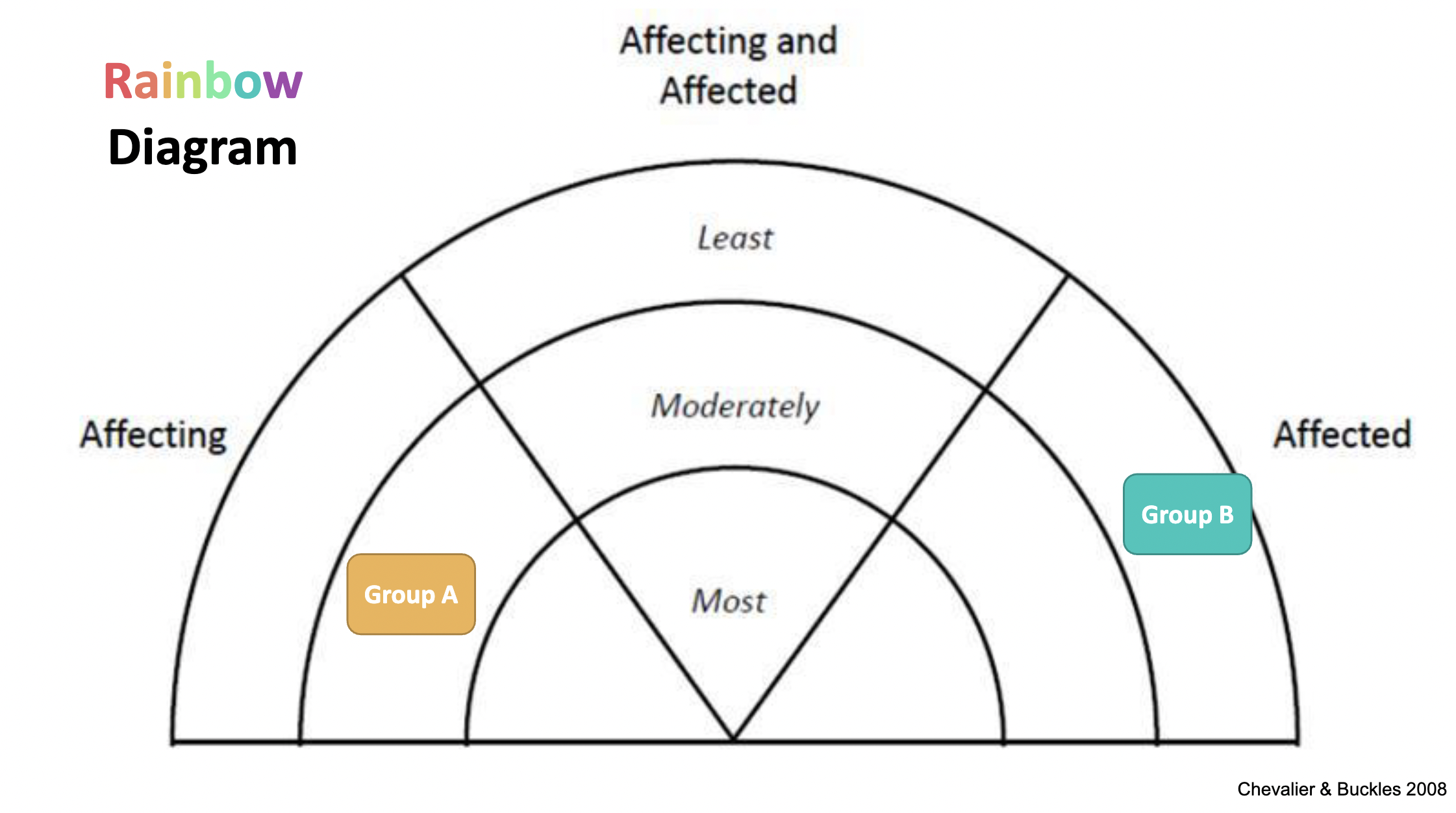
Rainbow diagram
Unlike simple 2×2 power/interest grids, the Rainbow Diagram explicitly separates those who hold power ("Affecting") from those who bear the consequences ("Affected"), helping facilitators spot power imbalances and ensure marginalized or heavily impacted groups aren't sidelined during engagement planning.
Stakeholder Engagement Definition
A process of involving and interacting with stakeholders in the
making
understanding
implementation or
evaluation
of management decisions for improved FW management
Stakeholder engagement
Making Decisions
Can look like input or directly helping determine objectives or a course of action
Understanding decisions
Helping stakeholders understand important factors → in a particular decision + how decision will be made
The most effective way to improve understanding is through involvement in the decision making process
Implementing decisions
Co-management and shared responsibilities
Evaluating decisions
Evaluate program and actions resulting from decisions
Ex: involving in data collection after, validate fairness, surface unintended consequences
How to engage stakeholders
no single strategy
Four step process (UDSC)
Understand the situation
define objectives
select stakeholder engagement approach
context specific strategy
Understand your goals/desired outcomes first!!
Stakeholder engagement approaches or techniques
Look at image

Good engagement is subject to roadblocks
Internal to agency (RAL)
Resistance (institutional disincentives, organizational culture)
Agency structure (bureaucracy)
Lack of time, money, expertise
External to agency (PCD)
Difficulty getting word out
complexity of weighing input
poor relationships
Process challenges
Inequitable representation
attrition (decrease in size?)
conflict over goals
dominant voices
two table problem
mismatch between promise, purpose, and approach
poor facilitation
What is a place?
Can be defined in many ways: physical, emotional, cultural, symbolic
Symbolic meaning → a way of understanding the world
Formed through meaning-making
A space becomes a place through personal, group, or cultural processes
Places vary by scale
A physical space becomes a place when it is vested with meaning
Sense of place
Meanings and attachments held by people or groups to a place
Expressed through narratives, not a short 2 word description
Place attachment
emotional bond between people and their environment
Place dependence
Functional or instrumental connection to a place
Based on how well a setting supports goals or satisfies needs (emotional or physical)
“This is the best place to do things i enjoy"
Place identity
Emotional and symbolic connection, place as a part of self-concept
Places help answer the questions “who am I” and shape personal identity
“This place really reflects the kind of person I am”
Place meaning vs attachment
Place meanings are descriptive or symbolic understandings of what a place is or represents
cognitive vs place attachment is more emotional
The making of places
Make places through social, ecological, and political processes shape places into being
Freq activities in places can be a form of place-making
Place-making
Environmental education and place-based learning
Community science
stewardship
Place disruption and place protective behaviors
Top down place making perceived by some as place breaking
trying to leverage a sense of place or force it
imposing a pre-packaged vision onto a neighborhood can erase its existing culture, social fabric, and community identity.
Efforts made to protect existing uses and meanings of place
Ex: revival, renewal, and reconnection for urban waterfronts, this is place protective language to restore public heritage in that area
many waterfronts were industrial or cut off from everyday residents. Using language like revival, renewal, and reconnection signals an effort to bring the public back into relationship with the water and restore public heritage—honoring historical uses and community access rather than turning the shoreline solely into an exclusive, commodified zone.
Why place matters for FW conservation
Public engagement and attachment are mutually reinforcing
Engaging people in local conservation → strengthen their attachment → promote environmentally responsible behaviors
Appealing to sense of place can motivate action
Agencies frame conservation issues through shared place meanings → encourage public involvement
Place-based framing helps people see their stake in environment
Understanding place meanings reveals conflict and diversity
Different groups hold distinct values and identities tied to the same landscape → why conservation decisions can be contentious
Recognizing these differences → more inclusive/relevant management
Caution: framing has power dynamics
Appealing to particular place meanings → reinforce existing inequities or dominant narratives
Awareness → avoid marginalizing less-represented voices
Behavior Change interventions
Tailored program/effort that targets a specific community to encourage different behaviors
Defining the behavior change problem
What who and what?
What is the behavior of interest
typically descriptive or observed to identify behaviors of interest affecting the conservation problem
Who is engaging in these behaviors
ID and understand main targets
What is the baseline behavior
ID what people are already doing and what you want to change
Understanding behavior to design conservation interventions
Why do actors in the population behave as they do?
which factors are most influential for this community and behavior
How can we design and implement behavior change interventions
ID interventions that are aligned with that you know and what influences them
REDDY intervention guidance
There are 3 primary pathways for changing human behavior (PIN)
promoting awareness and concern
incentivizing behavior
nudging behavior
promoting awareness and concern
education and communication programs
information deficit model
commonly used, weak evidence
Incentivize behavior
Cost/benefit evaluation
also could be expanded to social norms, identities, and personal values
not actually changing attitudes towards a behavior, just making the behavior more appealing
Nudging behavior
Changes the decision context that targets system 1 (instinctual thinking)
Placing recycling bins right next to trash cans
Make the behavior easier to do in small ways, relies on heuristics (mental shortcuts tied to system 1)
can be perceived by public as reducing autonomy
does not change attitudes
Previous avenues vs RARE
Previous avenues (3 fixes, REDDY) → build on rational actor thinking, economic approach (treats individuals are isolated decision makers)
makes good behavior appealing → people will do the behavior after thinking about it and weighing benefits/consequences
RARE → more in depth, depicts more connected, community informed processes as humans are not usually rational actors
humans are social and not logical → targets communities, their values, emotions, etc.
RARE Intervention Guide
RARE is a MES!
Motivate the change
Socialize the change
Ease the change
Motivate the change
Self interest can be a barrier to conservation efforts → If conservation effort feels like a personal sacrifice → blocks action.
problem with guilt based messaging
Beliefs/attitudes shaped by identities and personal exp → If a conservation message clashes with personal identity or feels like an attack on their culture → reject it.
All motivations influenced by biases, heuristics, and emotions → conservation efforts must work with these mental shortcuts
Intrinsic vs extrinsic motivations → aim to cultivate intrinsic motivation so that conservation becomes a self-sustaining community norm
(L. F., PHD)
Leverage positive emotions
frame messages to personal values, identities, or interests
personalize and humanize message
harness cognitive biases
design behaviorally informed incentives
Socialize the change
Types of norms
descriptive → what most people do
injunctive → what people should do
Social instincts
social proof → we do what we see other doings and believe its a good idea
peer pressure → conforming to a norm because you dont want to be an outsider, not changing my beliefs
Rational actor theory → does not account for human cooperation
small communities with shared identities
Social identity theory
in vs out group
desire to align with in group, shun-out group behavior
Who communicates is important
CHIEP Socialization
Promote desirable norm
harness reciprocity
increase behavioral observability and accountability
encourage public and peer communication
choose the right messenger
Ease the change
Relationship of motivation and ease
less mot → need more ease
removing barriers if low motivation
aim for already changing times
substitution behaviors as an option
nudging
RPSAU W EASE
Remove frictions, promote substitutes
provide support with planning/implementation of intentions
simplify messages/decisions
alter choice setting
use timely, moments, prompts, reminders
Conflict: Expect it
Many faces of conflict
boundaries
sector
agency jurisdiction
philosophical
Why is conflict to be expected when resources are shared?
Diffuse authority to manage (sovereignty)
Multiple independent players and agencies share the resource without a single overarching authority to compel cooperation. Each jurisdiction prioritizes its own sovereignty, autonomy, and independence.
Strong interest in outcome (fish harvest)
Both = conflict
Realities with shared resources
Ability to manage your water
autonomy
some degree of access
Resource is shared
diffuse authority
many players
Interest in independence
often asymmetries
Fish are in conflict
Malthusian and classic “realism”
Scarcity + Self-interest = conflict
Resource dependence = vulnerability
state centered interventionism
Vulnerability + Power = competition
Competition and cooperation
Competition → winners and losers
Collective action: cooperation to achieve shared goals
The literature on conflict
These individuals argue that self interest naturally leads to conflict and resource ruin without an outside source (an overarching authority) stepping in
Hobbes: Leviathan
without authority, life is solitary, poor, nasty, brutish, and short
Olson: Logic of collective action
people generally unwilling to cooperate
coercion or incentives are required
Hardin: Tragedy of the commons
rational people look out for their own interests
leads to irrational outcomes
everyone looking out for themselves → destroys resource for everyone
Literature on cooperation
Axelrod: Evolution of cooperation
cooperation can occur in game theory
positive function of ongoing relationships
enlarge the shadow of the future
future interactions critical
know you will work with that person again
trust
predictability
rebuts the idea that self interest and realism preclude cooperative behavior
Ostrom: Design elements for institutions
Shows that communities can govern shared resources themselves without a top-down ruler if they design institutions with clear rules, boundaries, monitoring, conflict resolution, and respect for sovereignty
clear boundaries
clear rules
monitoring and accountability
etc
HAAS: Importance of the epistemic community (relationships)
Epistemic community → a network of professionals who share common scientific expertise and build ongoing working relationships across different jurisdictions
increase understanding among members
increase trust/belief that decisions will be honored
make dishonesty/insincerity undesirable because of the threat to future relationships
make cooperation enjoyable
Dietz: drama of the commons
every situation is unique, sometimes cooperative sometimes not
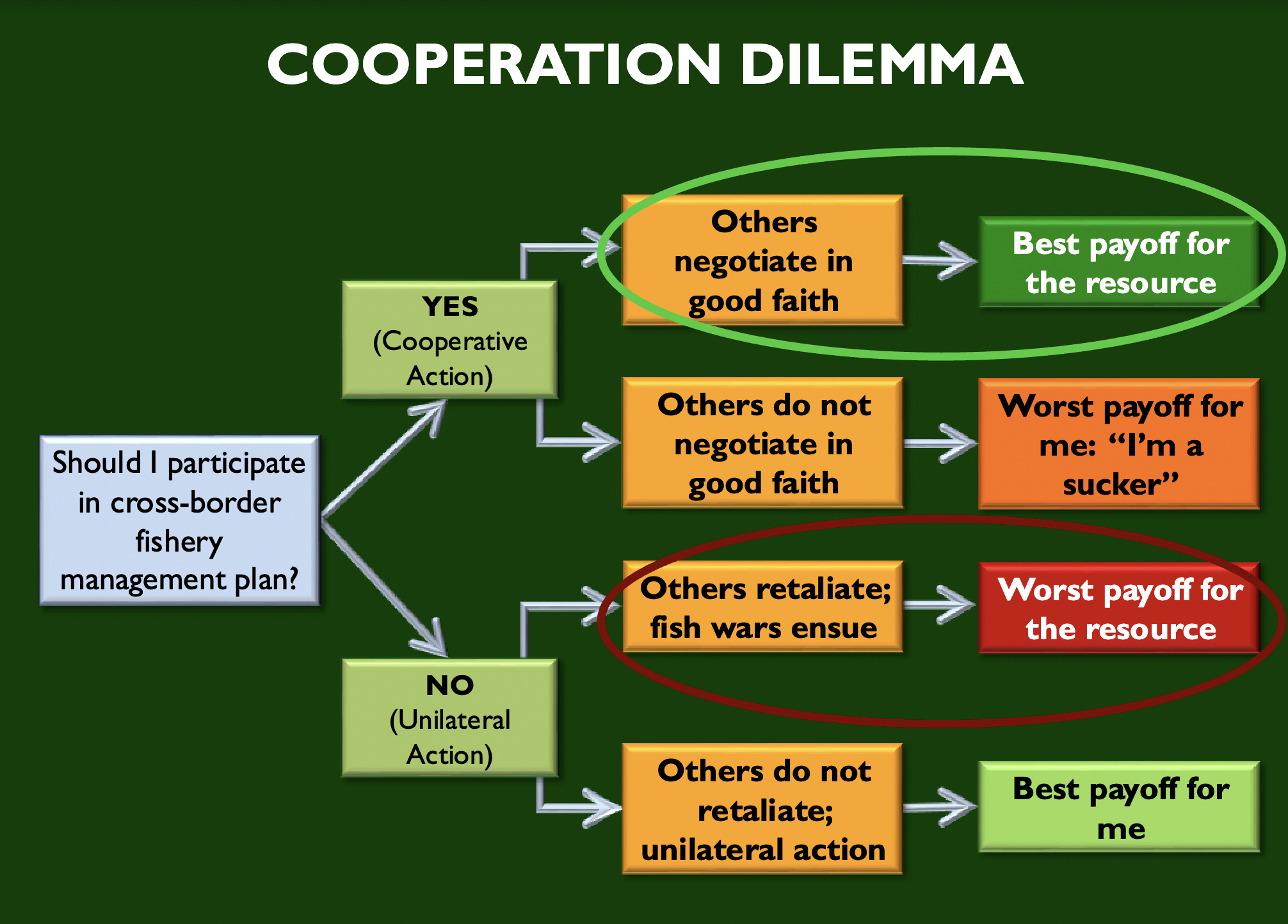
Cooperation dilemma
The dilemma shows why cooperation is hard to start: even though mutual cooperation is best for the fish, fear of looking like a "sucker" (or the temptation to grab the best short-term payoff for yourself) pushes managers toward unilateral action—which ultimately triggers destructive "fish wars"
1965
This 1965 structure put Elinor Ostrom's institutional design principles and Peter Haas's epistemic communities into practice. Instead of sporadic, ad-hoc meetings, it created a formal, ongoing forum where scientists and managers from different jurisdictions meet regularly, share information, and build the trust needed for the Joint Strategic Plan
Joint strategic plan
Non binding
non regulatory
consensus based
for collective action
focus on relationships and outcomes
Through this plan, fishery managers
meet regularly
balance science and politics
decide on tasks
collect and share info
develop shared policies, plans, and objectives
Which all leads a relationship between cooperative management and individual agency actions
When does conflict become competition vs cooperation?
Competition
lack of info
low interest in relationship
low interest in outcome
unequal power/position
Cooperation
interest in relationship
interest in outcome
regular interaction
predictability
trust
Is the joint strategic plan working in the great lakes?
Yes
Focuses on Relationships and Outcomes (Slides 22, 24–25): By bringing the same managers together regularly, they build friendships and realize they share the same headaches. Knowing they must work together for decades ("enlarging the shadow of the future") stops them from grabbing selfish short-term wins that would ruin trust.
Creates Peer Accountability (Slides 12–13): Because decisions rely on shared scientific data, ignoring the science carries a heavy social cost—managers have to "face those people around the table" and look themselves in the mirror.
Establishes a Regular, Ongoing Process (Slides 23, 27–28): Through the Lake Committees, managers meet consistently to share data, decide on tasks, balance science with politics, and recommend shared catch limits (such as Walleye and Yellow Perch TACs on Lake Erie).
Protects Sovereignty While Aligning Action (Slides 6, 11, 23): Because the plan is non-regulatory and consensus-based, jurisdictions do not feel their independence is threatened, making them willing participants in developing defensible, ecosystem-wide policies.
Engagement vs outreach
Outreach → one way communication where an expert passes on their knowledge and skills (low public participation)
Engagement → two way communication, build connections and common understanding
mutual benefits, relationship building, collaboration and co management
high public participation
Engagement is a process
Plan (purpose, who, timeline, communication, evaluation?) → implement → evaluate → informs your plan again
Step 1: Make an engagement plan
What are you objectives/desired outcomes
who is your priority or target audience
who participates at what stages
What strategy or approach will you use
Which techniques
what resources are needed
How will you know you met your goals?
what is your evaluation method?
Step 1: Audience matters
Different audiences have different
background knowledge
life experiences
interests
levels of concern
values
Identify and assess audience
what groups are involved
what do/should they care about
what do they already know
what do they want to know
what might they be interested in
how much time do they have
Step 2: What strategy or approach will you use
IAP2 techniques, what levels will you use?
what resources are needed?
Audience and message
For scientists we focus on the how and the why
methods, data collection, etc
little emphasis on the why because we typically understand the broader implications (the why)
For public, focus on the why
what is the real world impact
why should I care
dont get lost in the technicalities and the methodology
For scientists start with
background → supporting details → results/conclusions
For public start with
Bottom line → so what → supporting details

Community science
Public participation in scientific research
amateur or nonprofessional scientists
collaboration with scientists
different roles - contributors, collaborators, project leaders
Benefits of community science
Increases knowledge and understanding
informs decisions, actions, or policy
facilitates research on broader scale/timeframe
builds stronger connections between public and scientists
increases engagement with outside world and natural resource issues
fosters a sense of place within local community
provides youth examples of careers in science
Drawback
Data quality
loss of authority
resource intensive
Corey Marsh Bioblitz and frog walks example
Corey marsh
Effort to record as many species as possible within a designated location and time
naturalists and scientists engage with the public in identifying and recording species
Frog walks
listen for frogs big dog
how does a state agency intentionally develop capacity for engagement? → Fostering engagement capacity
Trainings and formalization