Health Promotion Exam #2
 Call Kai
 Learn
 Practice Test
 Spaced Repetition
 Match
 Flashcards
 Knowt Play
1/113

There's no tags or description
Looks like no tags are added yet.
114 Terms
What formula is used in Nägele's rule to calculate the estimated date of delivery (EDD)?
First day of last menstrual period + 7 days - 3 months
What is the difference between probable and positive signs of pregnancy?
Probable signs are objective maternal changes observed by an examiner (e.g., Hegar sign, Chadwick sign, hCG test), whereas positive signs are direct proof of a fetus (e.g., fetal heart tones, ultrasound visualization, fetal movement detected by examiner).

At approximately how many weeks of gestation does the uterine fundus reach the level of the umbilicus?
20 Weeks
What are the four stages of labor and birth?
Dilation stage (onset of labor to complete cervical dilation)
Pushing stage (complete dilation to birth)
Placental stage (birth to delivery of placenta)
Recovery stage (first 4 hours postpartum)
At what post-birth time intervals is the Apgar score evaluated in a newborn?
1 minute and 5 minutes after birth
APGAR (health evaluation on babies)
Appearance
Pulse
Grimace
Activity
Respiration
Environmental agents that cause spontaneous abortions or congenital defects in a developing fetus are known as
Teratogens
What severe fetal condition is caused by maternal infection with Zika virus during pregnancy?
Microcephaly (small head and underdeveloped brain)
What sleeping position is recommended by the Safe-To-Sleep campaign to reduce the risk of Sudden Infant Death Syndrome (SIDS)?
Supine position (placing the infant on their back)
Why is supervised awake 'Tummy Time' recommended for infants sleeping supine?
To prevent occipital flattening (positional plagiocephaly) and promote motor skill development.
According to Erikson's developmental theory, what psychosocial stage occurs during infancy?
Trust vs. Mistrust
According to Erikson's theory, what psychosocial task must a toddler master?
Autonomy vs. Shame and Doubt
What is the leading cause of hearing loss in toddlers?
Otitis media (middle ear infection)
What motor vehicle seating position is recommended for children under 13 years of age?
The back seat (to avoid deployment injuries from front airbags)
How does complementary therapy differ from alternative therapy?
Complementary therapy is used together with traditional allopathic medicine, whereas alternative therapy is used in place of standard medical treatment.
What is conventional biomedicine commonly called in complementary health literature?
Allopathy
What organization defines holistic nursing as practice that heals the whole person (body, mind, and spirit)?
American Holistic Nurses Association (AHNA)
What ancient medical system from India focuses on mind-body harmony through diet, herbs, and massage?
Ayurvedic medicine
What alternative medical system, founded by Samuel Hahnemann in 1807, administers tiny dilute amounts of substances to stimulate self-healing?
Homeopathy
In manipulative and body-based modalities, what does reflexology involve?
Applying pressure to mapped points on the hands and feet that correspond to specific body organs.
How does acupuncture balance energy flow in the body?
It manipulates vital energy (chi/qi) by stimulating mapped points on skin overlying channels called meridians.
Which nursing theorist conceptualized Therapeutic Touch based on human and environmental energy fields?
Martha Rogers
What concept describes a nurse being fully available with the wholeness of their being, characterized as 'being with' rather than 'doing to'?
Nursing Presence
Who developed the Functional Health Patterns framework used for individual, family, and community nursing assessment?
Marjory Gordon
How many functional health patterns are contained in Marjory Gordon's assessment framework?
11
What are the five stages of change in the Transtheoretical Model?
Precontemplation
Contemplation
Planning/Preparation
Action
Maintenance
What is the main structural difference between a Genogram and an Ecomap?
A Genogram depicts family membership and blood/hereditary connections across at least 3 generations, whereas an Ecomap depicts functional relationships and energy flows between the family and external community systems.
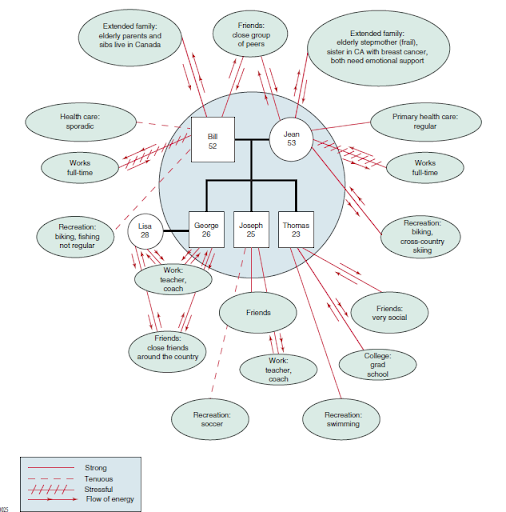
In an ecomap assessment diagram, what do the lines connecting the inner family circle to external systems represent?
The quality and strength of relationships (e.g., strong, tenuous, stressful) and the flow of energy between the family and outer resources.
What method of community assessment relies on using the nurse's senses while traveling through a neighborhood to observe physical appearance and environmental conditions?
Windshield survey
What are the two most common micronutrient deficiencies in the United States today?
Iron (causing anemia) and Calcium (causing osteoporosis)
What are the four leading diet-related causes of death in the United States?
Heart disease, Cancer, Stroke, and Type 2 Diabetes Mellitus
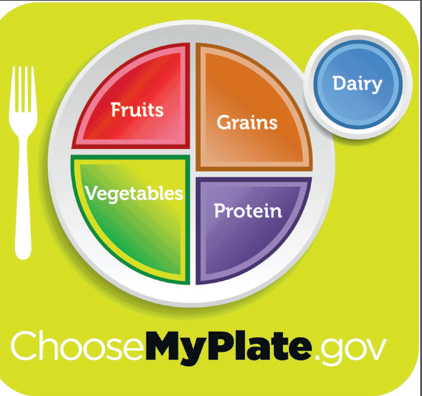
What are the five main food groups represented in the USDA MyPlate guide?
Fruits, Vegetables, Grains, Protein, and Dairy
Does the U.S. Food and Drug Administration (FDA) require dietary supplements to be proven safe or effective prior to marketing?
No. Unlike pharmaceutical medications, the FDA does not require dietary supplements to be proven safe or effective before they are sold.
What severe condition can result from food contamination with E. coli O157:H7?
Hemolytic uremic syndrome and hemorrhagic colitis
What federal nutrition program provides food assistance specifically to pregnant, postpartum, and breastfeeding women, infants, and young children under age 5?
WIC (Special Supplemental Nutrition Program for Women, Infants, and Children)
How is physical activity defined in health promotion?
Bodily movement produced by the contraction of skeletal muscles that substantially increases energy expenditure.
What weekly aerobic exercise duration is recommended by Healthy People guidelines for adults?
At least 75 minutes of vigorous-intensity physical activity (or 150 minutes of moderate-intensity activity) per week.
In exercise prescription, what does the FITT acronym stand for?
Frequency, Intensity, Time, and Type
Under which of Marjory Gordon's Functional Health Patterns is physical exercise and routine activity level evaluated?
Activity-Exercise Pattern
In Bandura's Social-Cognitive Theory, what three cognitive variables dynamically interact to drive health behaviors such as physical activity?
Self-efficacy, Goals, and Outcome expectations
In stress theory, how does eustress differ from distress?
Eustress is positive, challenging, and constructive stress that enhances function, whereas distress is chronic or excessive stress that exceeds adaptive capacity and threatens homeodynamics.
Who introduced the General Adaptation Syndrome (GAS) concept of stress?
Hans Selye
What is the difference between intrinsic and extrinsic stress factors?
Extrinsic factors are external stressors beyond individual control (e.g., weather, death of loved one), while intrinsic factors are created or exacerbated by internal responses (e.g., negative self-talk, procrastination).
What standard measurement inventory is frequently used to assess work-related burnout?
Maslach Burnout Inventory
Under which level of disease prevention does health screening fall?
Secondary prevention (detecting disease in early asymptomatic stages to initiate early treatment)
The preclinical period between biological disease onset and the initial appearance of clinical symptoms is known as
Asymptomatic pathogenesis (or latency period)
Based on the screening periods model, when must screening occur to alter the clinical course before symptoms appear?
During the detectable preclinical asymptomatic period
In epidemiology, how does incidence differ from prevalence?
Incidence measures the rate of NEW cases appearing in a population over a period, whereas prevalence measures ALL existing cases in a population at a specific point in time.
What epidemiologic term describes the diseased state or level of disability caused by an illness?
Morbidity
In evaluating a diagnostic screening tool, what does sensitivity measure?
The proportion of individuals WITH the disease who correctly test positive (a sensitive test minimizes false negatives).
What is the primary difference between cost-benefit analysis and cost-efficiency analysis in health care programs?
Cost-benefit analysis compares program costs and health outcomes entirely in monetary terms, whereas cost-efficiency analysis focuses on achieving the maximum health outcome within a fixed budget.
What independent panel provides evidence-based recommendations for clinical preventive screenings in the United States?
U.S. Preventive Services Task Force (USPSTF)
What health education evaluation strategy asks the learner to explain or demonstrate key concepts back in their own words?
Teach-back method
What are the three educational domains of learning?
Cognitive (knowledge and facts)
Psychomotor (physical skills)
Affective (values, attitudes, and feelings)
What health behavior paradigm uses perceived susceptibility, perceived severity, perceived benefits, and perceived barriers to explain individual actions?
Health Belief Model
What constitutes an effectively written learning objective in a teaching plan?
It must be observable and measurable, written using an action verb describing what the learner will perform (e.g., 'Patient will select low-sodium options from a menu').
What classic signs characterize Hegar, Chadwick, and Goodell signs of pregnancy?
Hegar sign: Softening of the uterine isthmus Chadwick sign: Bluish or cyanotic discoloration of cervix/vagina Goodell sign: Softening of the cervix
In adult body mass index (BMI) categories, what BMI range signifies overweight versus obesity?
Overweight is a BMI of 25 to 29.9, while Obesity is a BMI of 30 or greater.
What level of maternal weight gain is recommended during pregnancy for a woman starting with a normal baseline BMI?
25 to 35 pounds
In active immunization, what mechanism stimulates long-term immunity?
Exposure to a live, killed, or attenuated organism that prompts the body's immune system to produce its own antibodies.
How is passive immunity acquired in newborns?
By the transplacental transfer of maternal antibodies, providing temporary immunity.
What is the primary purpose of Gordon's Functional Health Patterns framework in nursing?
To provide a standardized holistic assessment structure consisting of 11 functional patterns to evaluate individuals, families, and communities.
In community health nursing, how is Gordon's framework applied across different client levels?
It systematically assesses functional health behaviors and lifestyle patterns within the individual, the family unit, and the broader community.
What defines holistic nursing practice?
Care that addresses the total person—integrating physical, mental, emotional, spiritual, and environmental health dimensions.
What is the primary objective of health promotion programs for individuals, families, and communities?
To empower clients to increase control over and improve their overall health, quality of life, and functional well-being.
In the Transtheoretical Model, what characterizes the Precontemplation stage?
The individual has no intention of taking action or changing behavior within the next 6 months, often due to lack of awareness or denial.
In the Transtheoretical Model, how does the Contemplation stage differ from Preparation?
Contemplation involves intending to change within 6 months with persistent ambivalence, whereas Preparation involves planning to take action within the next 30 days and taking small steps.
In the Transtheoretical Model, what defines the Action stage?
The individual has actively modified their lifestyle or behavior for less than 6 months.
In the Transtheoretical Model, what defines the Maintenance stage?
Sustained behavior change maintained for more than 6 months while actively preventing relapse.
In the Health Belief Model, what is perceived susceptibility?
An individual's subjective assessment of their personal risk of developing a particular health condition.
In the Health Belief Model, what is perceived severity?
An individual's evaluation of the medical, clinical, or social consequences of contracting an illness.
In the Health Belief Model, what are 'cues to action'?
Internal or external triggers (such as symptoms, media campaigns, or advice from a nurse) that prompt an individual to engage in health actions.
What is the primary objective of the Supplemental Nutrition Assistance Program (SNAP)?
To alleviate food insecurity and poverty by providing financial assistance to low-income individuals and families to purchase food.
Which target population is specifically served by the WIC program?
Low-income pregnant, postpartum, and breastfeeding women, infants, and children up to age 5 at nutritional risk.
What is resilience in health and coping contexts?
The capacity of an individual, family, or community to adapt positively, withstand stress, and recover effectively from adversity or trauma.
What is a genogram used for in family health assessment?
A visual structural diagram mapping family relationships, medical history, and hereditary health conditions across at least three generations.
What is a windshield survey in community nursing?
An observational assessment technique where nurses drive or walk through a community to systematically collect objective data on environmental and physical conditions.
What defines an independent nursing role in community health?
Actions and interventions initiated autonomously by the nurse based on clinical judgment without a healthcare provider's order (e.g., patient health teaching).
What defines a dependent nursing role?
Nursing actions executed under the direct prescription, instruction, or order of an authorized medical provider (e.g., administering prescribed medications).
What defines an interdependent nursing role?
Collaborative actions carried out in joint partnership with other members of the interprofessional healthcare team.
What does validity mean in health screening and research tools?
The accuracy of a measurement tool in measuring what it is specifically designed to measure.
What does reliability mean in health measurement?
The consistency or repeatability of test results when administered repeatedly under identical conditions.
How does morbidity differ from mortality?
Morbidity refers to the rate or state of illness and disease in a population, whereas mortality refers to the death rate.
How does incidence differ from prevalence?
Incidence measures the number of new cases developing in a specific timeframe, whereas prevalence measures all existing cases (new plus old) at a specific point or period in time.
What is asymptomatic pathogenesis?
The stage of disease progression where cellular, tissue, or structural changes occur without causing recognizable clinical symptoms or signs
What are two clinical examples of asymptomatic pathogenesis?
Early stage essential hypertension ('silent killer')
Early cervical dysplasia detected via Pap smear
What is Quality of Life (QoL) in health assessments?
An individual's or group's overall perception of physical, mental, emotional, and social well-being and life satisfaction.
What is the first stage of Selye's General Adaptation Syndrome (GAS), and what physiological response occurs?
Alarm Reaction stage: The body initiates the 'fight-or-flight' response via sympathetic nervous system activation and catecholamine release.
What occurs during the Resistance stage of the General Adaptation Syndrome (GAS)?
The body attempts to adapt to sustained stress, maintaining elevated hormone levels (such as cortisol) to cope with the stressor
What occurs during the Exhaustion stage of the General Adaptation Syndrome (GAS)?
Physiological and energy resources are depleted due to prolonged unmanaged stress, leading to organ vulnerability, illness, or collapse.
What is calculated in a Cost-Benefit Ratio for a healthcare intervention?
The comparison of total financial costs incurred against total monetary savings or economic benefits generated by the program.
What is cost efficiency in community health planning?
Achieving the maximum health outcome or goal for a given financial expenditure compared to alternative interventions.
What is the nurse's primary role in community health screening programs?
Identifying high-risk individuals, administering valid screening tests, providing health education, and ensuring appropriate diagnostic referrals and follow-up care.
How do intrinsic factors differ from extrinsic factors in health assessment?
Intrinsic factors are internal host variables (e.g., age, gender, genetics, immunity), whereas extrinsic factors are external environmental variables (e.g., climate, housing, pathogen exposure).
What Body Mass Index (BMI) threshold defines clinical obesity in adults?
A BMI≥30 kg/m2.
What health outcomes are associated with dietary excess?
Overconsumption of calories, saturated fats, sodium, or sugars leading to obesity, type 2 diabetes, hypertension, and cardiovascular disease
What health outcomes are associated with dietary inadequacy?
Deficient intake of essential nutrients leading to undernutrition, growth delay, impaired immunity, or specific nutritional deficiencies (e.g., iron-deficiency anemia).
How does problem-focused coping differ from emotion-focused coping?
Problem-focused coping directly targets and modifies the cause of stress, while emotion-focused coping manages the emotional distress associated with the stresso
What essential non-pharmacologic measures help prevent osteoporosis?
Adequate intake of Calcium and Vitamin D combined with regular weight-bearing physical exercises.
What are the key priorities in early child nutrition teaching?
Providing nutrient-dense foods supporting growth, ensuring sufficient iron and vitamin intake, avoiding sugar-sweetened beverages, and establishing balanced eating habits