Case 1: Claire McFadden - High-Risk Pregnancy + Preterm Labour
 Call Kai
 Learn
 Practice Test
 Spaced Repetition
 Match
 Flashcards
 Knowt Play
1/74

There's no tags or description
Looks like no tags are added yet.
75 Terms
Placenta: Placentation
Fertilization
Zygote (1 cell) divide into morula (16 cells) into blastocyst (32 cells)
Fallopian tube → Uterus
Blastocyst implant into uterine wall (endometrium)

Placenta: Anatomy
Basal Plate (decidua basalis)
Intervillous space + villous tree
Chorionic plate
Placenta: Basal Plate
Maternal component
Contain:
Maternal decidua: Transformed endometrium
Embryonal cells: Cytotrophoblast, syncytiotrophoblast, trophoblast

Placenta: Intervillous Space + Villous Trees
Fetomaternal zone
Intervillous Space: Contact zone between maternal + fetal structures
Gas + nutrient exchange
Contain maternal blood
Villous Trees: Branching villi in intervillous space
Contain fetal blood
Placental Barrier: Between maternal + fetal circulation
Control gas + nutrient exchange
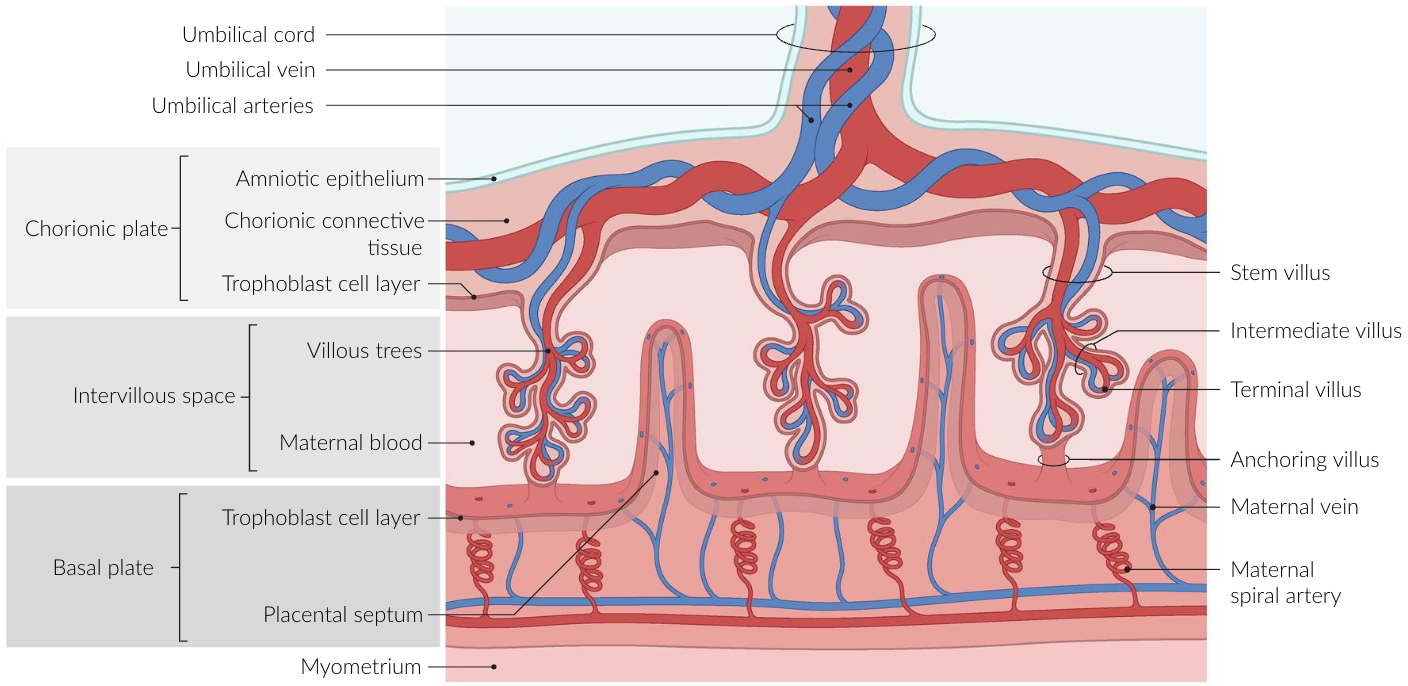
Placenta: Chorionic Plate
Fetal component
Contain:
Embryonal Cells: Syncytiotrophoblast, cytotrophoblast, extraembryonic mesoderm
Connected to umbilical cord
3 blood vessels with fetal blood
2 Umbilical Arteries: Carry de-O2 blood from fetus → Placenta
1 Umbilical Vein: Carry O2 blood from placenta → Fetus

Placenta: Physiology
Hormone production
Gas, waste, nutrient exchange
Placenta Physiology: Hormone Production
hCG
Human placental lactogen
CRH
Relaxin
Estrogen
Progesterone
Placenta: hCG
Maintain pregnancy
Stimualte progesterone + estrogen production
Placenta: Human Placental Lactogen
Fetal growth + development
Increase insulin production
Decrease maternal insulin sensitivity → Induce gestational DM
Placenta: CRH
Produce surfactant
Placenta: Relaxin
Prevent uterine contraction
Dilate afferent arteriole in kidneys = Increase filtration rate
Placenta: Estrogen
Fetal growth
Endometrial proliferation
Mammary gland development
Placenta: Progesterone
Increase maternal basal body temp
Prevent menstruation + maintain pregnancy
Close cervix
Prevent uterine contractions
Placenta Physiology: Gas, Waste, Nutrient Exchange
Across chorionic villi
Passive: O2, CO2, urea, bilirubin, water, drugs, glucose, lactate
Active: Macronutrients, micronutrients, hormones, antibodies (IgG)
Preconception Care
Optimize maternal health+ prevent teratogenic exposures
Genetic counseling
Conception timing
Vaccines
Lifestyle
Diet
Preconception Care: Genetic Counseling
Test for…
Spinal muscular atrophy
CF
Major congenital anomalies (fragile X syndrome, familial adenomatous polyposis)
Hereditary cancers
Preconception Care: Conception Timing
Delay if…
Live vaccine
Recent travel
Recent teratogenic medication use
Bariatric surgery
Recent live birth
Preconception Care: Vaccines
MMR
Varicella
Preceonception Care: Lifestyle
Stop teratogenic medications
Maintain normal body weight + exercise
Preconception Care: Diet
Vit + mineral supplementation
Folic acid
Decrease seafood
Antenatal Care
Diet
Lifestyle
Antenatal Care: Diet
Increase calories
Vit + mineral supplementation
Folic acid
Vit B12
Vit D
Decrease caffeine
No alcohol + seafood
Antenatal Care: Lifestyle
Regular exercise
Travel precautions (vaccines, VTE)
Antenatal Care: 1st Trimester
GTPALS history
FMHx
Screening
US
Antenatal Care 1st Trimester: Screening
Comorbidities
CBC: Anemia, thrombocytopenia, ABO, Rh factor
Urine: Proteinuria, bacteriuria
STIs: HIV, HBV, HCV, syphilis
Psychosocial
Genetic testing
Antenatal Care 1st Trimester: US
Confirm pregnancy + location
Evaluate embryo
Anatomy
Gestational age
Determine estimated delivery date
Antenatal Care: 2nd Trimester
Physical exam
Screening
US
Antenatal Care 2nd Trimester: Physical Exam
Weight
BP: < 140/90
Fundal height
Normal: Correspond to gestational age > 20 weeks
Fetal heart
Antenatal Care 2nd Trimester: Screening
Comorbidities
CBC: Anemia
OGTT: Gestational DM
Antenatal Care 2nd Trimester: US
Biophysical profile (BPP)
Movement
Tone
Breathing
Amniotic fluid volume
Normal: Deepest fluid pocket = 2-7cm
Fetal HR
Normal: 110-160 BPM
Placenta location
Low-Lying
Previa: Covering internal os

High-Risk Pregnancy: Description
1+ risk factors present
High-Risk Pregnancy: Epidemiology
Risk factors…
Maternal
≥ 35 years
Medical conditions
Metabolic: HTN, DM, obesity
Resp: Asthma, pulmonary HTN
Structural heart condition
Anemia
CKD
Infection: HIV, Zika, chorioamnionitis, toxoplasmosis, CMV
Myasthenia gravis
Antiphospholipid syndrome
Gynecological conditions
Uterine leiomyoma: Benign fibroids
Uterine surgery
Substance use
Fetal
Multiple gestation
Placental abnormalities
Vasa previa: Blood vessels over birth canal
Abnormal amniotic fluid levels
Chromosomal abnormalities
High-Risk Pregnancy: Investigations
Screening
Fetal aneuploidy + neural tube defect
OGTT
Routine blood tests
Urinalysis + culture
Imaging: US
High-Risk Pregnancy Screening: Fetal Abnormalities
Enhanced 1st trimester screening (eFTS)
Multiple marker screening
Non-invasive prenatal testing (NIPT)
Fetal Abnormalities Screening: eFTS
Serum Analysis:
Beta-hCG: Tumor marker
Increased
PAPP-A (pregnancy-associated protein A): Placental protein
Increased
AFP (alpha-fetoprotein): Tumor marker
Decreased
US: Nuchal translucency
Fetal Abnormalities Screening: Multiple Marker Screening
Serum Analysis:
Beta-hCG
AFP
Unconjugated estriol: Weak estrogen
Decreased
Inhibin A: Placental protein
Increased
Fetal Abnormalities Screening: NIPT
Serum Analysis: Cell-free fetal DNA (genetic testing)
High-Risk Pregnancy Screening: OGTT
Gestational DM
Earlier at < 15 weeks
High-Risk Pregnancy Screening: Routine Blood Tests
Blood type + Rh
CBC
Rubella/varicella immunity
STI screening
High-Risk Pregnancy Investigation: US
1st Trimester: ≤ 13 weeks
Confirm pregnancy
Estimate gestational age
2nd Trimester: 18-22 weeks
Anatomy survey
Limitation: Low sensitivity for cardiac, GI, MSK, and facial features
3rd Trimester: ≤ 36 weeks
Routine fetal surveillance
Limitation: User error
High-Risk Pregnancy: OTC Medications
AVOID:
Ginger: After 1st trimester
Nausea/vomiting
Sodium bicarbonate
GERD
NSAIDs
Pain
Oral stimulate decongestants (pseudoephedrine)
Rhinitis
Retinoids
Acne
Teratogenic Prescriptions
ACE inhibitors/ARBs
Warfarin
Anticonvulsants
Valproate
Phenytoin
Carbamazepine
Lithium
Tetracyclines
Aminoglycosides
Streptomycin
Teratogens: ACE Inhibitors/ARBs
Alternative: Labetalol
Adverse Effects:
Affect renal + skull development
Growth restriction
Increase amniotic fluid
Teratogens: Warfarin
Alternative: Heparin
Adverse Effect: Fetal warfarin syndrome
Affect nasal development
CNS defects
Growth restriction
Fetal bleeding
Teratogens: Anticonvulsants
Alternative: Lamotrigine
Adverse Effects:
Neural tube defects
Congenital heart defects
Cleft lip/palate
Developmental delay
Teratogens: Lithium
Alternatives:
Atypical antipsychotics
Quetiapine
Olanzapine
Aripiprazole
Risperidone
Lamotrigine
Adverse Effects: Cardiac anomalies (Ebstein)
Teratogens: Tetracyclines + Aminoglycosides
Alternative: Beta-lactams
Adverse Effect: Ototoxicity
High-Risk Pregnancy: Complications
Diabetes
UTI
Pregnancy Diabetes: Investigations
Gestational DM: 24-28 weeks
OGTT
Pregestational DM:
HbA1c < 15 weeks
Fasting blood glucose
Pregnancy Diabetes: Treatment/Management
Nonpharmacological
Pharmacological
Pregnancy Diabetes Management: Nonpharmacological
Patient education
Nutrition
Physical activity
Glycemic control
Diet changes
HbA1c monthly
Self glucose monitoring
Fetal monitoring: US
Delivery planning
Cesarean: Fetal weight > 4500 g
Early delivery: Poor glycemic control
Pregnancy Diabetes Management: Pharmacological
Insulin: First-line
During pregnancy
Infusion during delivery
Low dose ASA
Oral antihyperglycemics
Metformin: Preferred
Glyburide (sulfonylurea)
Pregnancy Diabetes: Complications
Maternal
HTN
UTI
Polyhydramnios: Increased amniotic fluid
Preterm labour
Diabetic embryopathy
Congenital heart disease
Neural tube defects
Small left colon
Renal disorders
Caudal regression: Loss of scrum + lower lumbar spine
Diabetic fetopathy
Macrosomia
Postnatal hypoglycemia
Polycythemia: High RBC
Pregnancy UTI: Pathophysiology
Progesterone (uterine relaxation) + in-utero fetal pressure on bladder = Urinary stasis
Pregnancy UTI: Investigations
Screening: 1st trimester
Urinalysis
Urine culture
Pregnancy UTI Investigations: Urinalysis
Pyuria:
WBC
Leukocyte esterase
Bacteriuria: Urinary nitrites
Leukocyte casts: Pyelonephritis
Pregnancy UTI Investigations: Urine Culture
Bacteriuria: ≥ 105 CFU/mL
Pregnancy UTI: Treatment
Empiric antibiotics
Repeat culture: 1 week
Pregnancy UTI Treatment: Empiric Antibiotics
Indications:
Asymptomatic bacteriuria
Lower UTI
Agents:
Fosfomycin
Beta-lactams
Cephalosporin
Aminopenicillins + beta-lactamase inhibitor (amox/clav)
Nitrofurantoin: Avoid close to delivery
TMP/SMX: Avoid during 1st trimester + > 32 weeks
AVOID: Fluoroquinolones, aminoglycosides
Pregnancy UTI: Complications
Pyelonephiritis
Preterm labour
HTN + preeclampsia
Chorioamnionitis
Pyelonephritis: Description
Infection in renal pelvis + parenchyma
Pyelonephritis: Clinical Presentation
Fever
Flank pain
CVA tenderness
UTI symptoms
Pyelonephritis: Investigations
Urinalysis
Urine culture
Blood culture
Blood tests
CBC: Leukocytosis
Inflammatory markers: Elevated
Pyelonephritis: Treatment/Management
Empiric antibiotics
Analgesics
Pyelonephritis Treatment: Empiric Anitbiotics
Ampicillin + gentamicin: First-line
TMP/SMX
Amox/clav
Cefpodoxime
Preterm Labour: Description
Labour between 20 and < 37 weeks’ gestation
Preterm Labour: Epidemiology
Risk factors…
Nonmodifiable
Preterm birth hx
Cervical insufficiency: Cervical dilation in 2nd trimester
Multiple gestations
Modifiable
Smoking
Substance + cannabis use
Maternal age
≤ 18 years
> 35 years
Infection
Chorioamnionitis
UTI
Bacterial vaginosis
STIs
Abdominal trauma
Preterm Labour: Treatment/Management
37 Weeks: Deliver
< 34 Weeks: Tocolytics, steroids
< 32 Weeks: Magnesium sulfate, steroids
Antibiotics
Preterm Labour Treatment: Tocolytics
Inhibit uterine contractions
Types:
Nifedipine
Indomethacin
Terbutaline
Magnesium sulfate
Tocolytics: Nifedipine
Class: CCB
Adverse Effects:
Maternal
Hypotension
Dizziness
Tocolytics: Indomethacin
Class: NSAID
Adverse Effects:
Maternal
Esophageal reflux
Gastritis
Nausea/vomiting
Fetal
Renal dysfunction
Premature ductus arteriosus closure
Tocolytics: Terbutaline
MOA: Beta-2 adrenergic agonist
Adverse Effects:
Maternal
Tachycardia
Hypotension
Hypokalemia
Hyperglycemia
Fetal
Tachycardia
Hypoglycemia
Tocolytics: Magnesium Sulfate
Fetal neuroprotection
Class: CCB
Adverse Effects:
Maternal: Mg2+ Toxicity
Hypocalcemia
Respiratory depression
Pulmonary edema
Preterm Labour Treatment: Steroids
Promote surfactant production + fetal lung maturity
Ex: Betamethasone, dexamethasone
Preterm Labour Treatment: Antibiotics
GBS prophylaxis
Penicillin G
Ampicillin
Penicillin allergy
Cefazolin
Clindamycin
PPROM prophylaxis
7 days ampicillin + erythromycin → 5 days amoxicillin + erythromycin