Module 4: Axial and Appendicular System
 Call Kai
 Learn
 Practice Test
 Spaced Repetition
 Match
 Flashcards
 Knowt Play
1/48

There's no tags or description
Looks like no tags are added yet.
49 Terms
what consists of the axial skeleton
bones within the long axis of the body
what consists of the appendicular skeleton
bones in the body’s limbs
bones of the axial skeleton
skull, hyoid bone, vertebral column, ribs, sternum
bones of the appendicular skeleton
shoulder girdle, arm, hand, pelvic girdle, leg, foot
functions of cranial bones
surround and protect the brain
attachment of head and neck muscles through surface features
house and protect special sense organs
bones of cranial
singular frontal, occipital, ethmoid, and sphenoid
paired temporal and parietal
functions of facial bones
form underlying scaffold for face
provides passages for air and food
provides anchor site for teeth
provides anchors for face muscles
form cavities for special sense organs
bones of facial
singular mandible and vomer
paired maxillary, sygomatic, nasal, lacrimal, palantine, and inferior nasal conchae
how many cranial bones?
8
feautres of frontal bone
supraorbital margin
supraorbital foramen
glabella

features of parietal bones
sagittal suture
coronal suture
squamous suture
lambdoid suture

features of occipital bone
foramen magnum
occipital condyles
superior and inferior nuchal lines
external occipital protuburance

features of temporal bones
squamous region
tympanic region
mastoid region
petrous region

features of spenoid bone
sella turcica
optic canals
foramen rotundum, ovale, spinosum
superior orbital fissure
pterygoid process

features in ethmoid bone
cribriform plate
cribriform foramina
Crista galli
nasal septum
lateral masses

cranial cavity
largest cavity; surrounds the brain
formed by cranial bones
nasal cavity
contains passages for air and sensory neurons for smell
formed by several bones lined with mucous membranes
orbital cavities
contains eyeballs, blood vessels, muscles, nerves, and lacrimal glands
formed by parts of 7 bones: sphenoid, frontal, sygomatic, ethmoid, lacrimal, maxilla, palatine
oral cavity
contains teeth tongue, passage for food and air, and most salivary glands
first part of GI tract
roof formed by har palate
lacks bony floor and back wall
hyoid bone
onyl bone in the body that doesn’t articulate with any others
position in neck maintained by ligaments
serve as important attachment site for muscles involved in swallowing and phonation
body of vertebra
block-like structure
faces thoracic cavity
primary weight-bearing part of the vertebra
vertebral foramen of vertebra
spinal cord and associated components pass
transverse processes of vertebra
lateral projections off the vertebral arches; attachment site for skeletal muscles
spinous processes of vertebra
project backwards from each vertebra; also serve as attachment sites for skeletal muscles
articular processes of vertebra
contain facets through which adjacent vertebrae articulate
vertebral arch of vertebra
formed by pedicles and laminae; enclose posterior region of vertebral foramen
features of intertebral discs
sit between adjacent bodies
cushion/absorb physical shock
resist grinding between bones
facilitate motion
features of herniated discs
outer ring weakens, allowing inner core to bulge out
occurs due to age, physical trauma/strain, or awkward motions
treatments include bed rest, physical therapy, medications
features of rib cage
formed by 12 pairs of rib bones and their associated anterior costal cartilage
bones of sternum
these stabilize the rib cage and protect vital organs
manubrium
body
xiphoid process
features of pectoral girdle
acts as a brace to resist longitudinal compression
keeps scapula in correct position
anatomy of the scapula
spine
acromion process
glenoid cavity
coracoid process
supraspinous, infraspinous, and subscapular fossae
the pelvis contains 3 main parts, which are the
ilium, ischium, and pubis
features of the pelvis
acetabulum, obturator foramen, ilium, ischium, pubis
features of the upper leg bones
fovea capitis
trochanters
linea apsera
condyles
linea aspera
condyles
patella
features of the lower leg bones: tibia
condyles
intercondylar eminence
tibial tuberosity
anterior crest
Soleil line
features of the lower leg bones: fibula
tibiofibular joints
fibular styloid process
lateral malleoulus
features of ankle and foot
metatarsals, cuneiform bones, talus, calcaneus, cuboid, phalanges
arches of foot
transverse arch, medial longitudinal arch, lateral longitudinal arch
carpal tunnel syndrome
numbness, tingling, and weakness in hand/arm
regional specialization: sacrum
fused sacral ribs:
sacroiliac joint surface
anterior and posterior sacral foramina
thoracic and sacral kyphosis is what kind of curvature
primary
cervical and lumbar lordosis are what kind of curvature
secondary
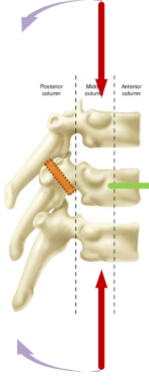
modes of failure: flexion/distraction injury
acute combined axial tension and flexion
soft tissue and bony failure of the lamina and associated processes in tension (tearing)
tearing is directed along the vertebral canal, has lass chance of affecting the dural sac and the spinal cord

modes of failure: fracture dislocation
acute lateral or rotational loading
failure of the intercentral and interarticular joints in shear
shears the vertebral canal, often leading to extensive neurological deficit

modes of failure: spondylolysis
repeated flexion and extension or chronic
lumbar hyperextension together with axial compression
stress fracture of the laminae in between the articular processes
spinous process remains attached to eh next inferior vertebra; superior articular process, pedicles and centrum remain attached to the adjacent superior vertebra
presenting complaints for this injury may be as simple as diffuse lower back pain on extension

modes of failure: spondylolisthesis
allows affected vertebra to slowly slide anteriorly on the intercentral joint
normal lordotic curvature of the lumbar spine & increased axial compression from body weight in the lumbar region = lumbar vertebrae especially vulnerable to spondylolisthesis
why do most clavicular fractures occur in the middle of the bone?
the thinnest part of the shaft, lacks strong muscular or ligamentous support, and is where the bone changes its structural curvature
why do clavicular fractures present similarly?
muscle actions on upper limb without connection to axial skeleton through clavicle