Lecture 13: Equity Valuation
 Call Kai
 Learn
 Practice Test
 Spaced Repetition
 Match
 Flashcards
 Knowt Play
1/38

There's no tags or description
Looks like no tags are added yet.
39 Terms
What is book value?
The net worth of the firm’s common equity as reported on the balance sheet
It is simply Total Assets minus Total Liabilities
Example of book value
firm has $500 in assets, $300 in liabilities so book value of equity is $200 and if there are 10 million shares outstanding, the book value per share is $20
What is the limitation of book value?
book value uses historical costs, does not reflect what assets are worth today
What is liquidation value?
Net cash that would be realized if the firm sold all of its assets and paid off all its debts or liabilities
It is a “what if we shut down today” measure
Often lower than book value because assets may sell at a discount in a forced sale
Example of liquidation value
The firm’s assets could be sold for $420 million
Debts total $300 million
Liquidation value = $420m - $300m = $120 million
What is replacement cost?
Cost to replace the firm's assets with the new ones of the same productive capacity
It answers “What would it cost to build this firm from scratch today?”
Is closer to current economic value than historical book value
Example of replacement cost
A firm’s plant and equipment were bought years ago for $200 million
Today, equivalent new equipment would cost $350 million
Replacement cost of those assets = $350 million
What is tobin’s q?
Ratio of the firm’s market value to the replacement cost of its assets
Tobin’s q = Market value of firm/ replacement cost of assets
"Is this company worth more as a business than it would cost me to build the same company from scratch?"
compares what investors think a company is worth with what it would cost to recreate that company
What does tobin’s q: q > 1 mean?
the market values the firm more than it would cost to replace its assets
The company is worth MORE than it would cost to replace its assets
The firm is creating value
What does tobin’s q: q < 1 mean?
market values the firm less than its replacement cost, may be cheaper to buy the firm than to build one
The company is worth LESS than it would cost to replace its assets.
Example of tobin’s q
Market value of the firm = $400 million
Replacement cost of assets = $350 million
Tobin’s q = 400 / 350 ≈ 1.14. The firm is creating value
What is the formula for expected HPR?
E(r ) = (E(D1) + [E(P1) - P0] ) / Po
Example of expected HPR: Example: Suppose you purchased a share for $40 in January. You expect to sell it for $42 in December and expect to receive a dividend of $2.42 during that year. What is your expected HPR?
E(r ) = (E(D1) + [E(P1) - P0] ) / Po
E(r ) = 2.42 + 42 - 40 / 40 = 11.05%
What is intrinsic value?
The present value of a firm’s expected future net cash flows, discounted at the required rate of return
Estimate of what the stock is truly worth, based on the cash is expected to generate
Example of intrinsic value
A firm is expected to pay $2 in dividends next year, growing at 3% per year forever.
The required return is 8%.
Intrinsic value = $2 / (0.08 - 0.03) = $40 per share
used gordon growth model: Po = D1/ r- g
What is the market capitalization rate (k)?
market’s consensus estimate of the appropriate discount rate for equity cash flows, often denoted by k
the minimum return investors want to earn for investing in a company's stock
k = The percentage return investors want to earn for taking the risk of investing in a stock
What is true if the intrinsic value > market price?
the stock looks undervalued
What is true if the intrinsic value < market price?
the stock looks overvalued
What is true if the intrinsic value = market price?
stock returned to being on the SML line
What is the formula to find the intrinsic value for one period?
Vo = (D1 + P1) / 1+k
k = market capitalization rate and discount
Note: All future dividends and prices are expected values; notation removed to avoid clutter.
How do you find the intrinsic value for holding period H?
Vo = D1/(1+ k) + D2/(1+k)² + D3/(1+k)³
Note: All future dividends and prices are expected values; notation removed to avoid clutter.
What is the formula for constant-growth DDM?
Vo = D1/k-g (present value of perpetuity formula) SOOO
Vo = Do(1+g) / k-g
form of DDM that assumes dividends will grow at constant rate
dividends grow at constant rate of growth (g)
k > g
The constant growth model states that a stocks value will be greater…
the larger its expected dividend per share
the lower the market capitalization rate, k
the higher the expected growth rate of dividends
What is are key takeaways about this formula/relationship?
Vo = Do(1+g) / k-g
future dividend payments are the ones that count, not ones that have already been made
If D1 increases, then Vo increases
If k increases, Vo decreases
If g increases, Vo increases
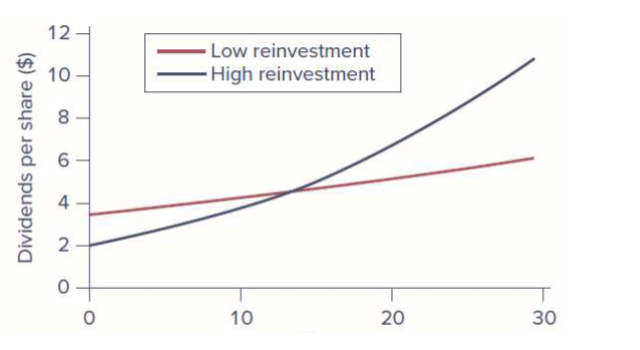
What does the graph regarding DDM: Stock value show?
Red firm: low investment, high dividend payout rate
0 reinvestment, then line would be horizontal line
Blue firm: reinvests a lot
Difference: how much money they retain versus how much they payout
Firm that pays less in dividends will make larger payments

What is the dividend payout ratio?
percentage of earnings paid as dividends
What is the plowback ratio/earning retention ratio?
proportion of firm’s earnings reinvested in business
Retained earning last period/ net income last period
What formula allows you to find the Present Value of growth opportunities (PVGO)?
Po = No-Growth Value per Share + PVGO = (E1/k) + PVGO
PVGO = Po - E1/k
Po = market value of stock, price per share OR intrinsic value per share
PVGO = present value of growth opportunities
E1 = earnings per share, will stay constant, can be E1 or Eo
k = market capitalization (PV = CF/r)
What is true about value of the firm? (free cashflow valuation)
the value of a firm can be obtained by discounting expected cashflows to the firm — whatever remains after meeting all operating expenses and taxes but excluding debt payments
project future free cash flows of the firm for as many periods as you can AND discount back to the present (the discount rate is the firm’s WACC)
WACC: weighted average of cost of debt, equity, and hybrids such as preferred stocks
Cannot use the market capitalization rate alone
What is true about value of equity? (free cashflow valuation)
Similarly, we can determine the value of equity by discounting expected cashflows to equity — whatever remains after meeting all operating expenses, taxes, and debt payments
The discount rate in this case is the market capitalization rate (or cost of equity, ke) as opposed to the WACC
What is the formula for free cash flow to firm?
EBIT( 1-t) - (Cap. Exp. - Dep) - Change in WC
What is the formula for free cash flow to equity?
Net Inc - Net Cap Exp (1-Debt ratio) - Ch WC (1-D.r.)
How can you find FCFE using FCFF?
free cash flow to equity = FCFF - Interest (1-t) + Change in Net Debt
What is true about expected growth in EPS?
g = (retained earnings last period/ net income last period) * ROE
SO = retention ratio * ROE
Plowback ratio = 1- Dividend Payment Ratio
Long run growth rate cannot exceed ROE
There will be no growth without reinvestment
The quality of new projects matters as it affects the ROE
Why does growth matter?
Can we assume constant, stable growth? We will have to make that assumption to find the terminal value
If so, the value of the firm (or its equity, depending on which cash flows and discount rate we use) will be given by: Value = Expected Cash Flow Next Period / (r - g)
Remember, this rate of growth cannot exceed the rate of growth of the economy as a whole (or your discount rate!)
This may be a reasonable assumption for a mature firm
One may argue all firms will eventually get there, so this is not entirely unreasonable
What is true about projecting CFs/dividends, finding the rates of growth, and discount rates?
it’s a lot of work and valuation is affected by judgement we make, slight changes in assumptions produce different results
Solution: we can try to price firms relative to the industries in which they operate
What main assumptions do we make if we do relative valuation?
Easier way: valuations by multiples →
Other firms in the industry are, on average, correctly priced
They are all of similar risk
They are at the same stage of their growth cycle
If these assumptions have been met, we can obtain the value of a firm based on the values of other, similar firms using common ratios, such as
price/earnings (P/E) ratios
price/book value (P/BV) ratios
price/sales ratios and their variants
Much simpler than discounted cash flow valuation, but we must trust current market price
To find the intrinsic value of the firm’s equity what do we look at?
look at FCFE and cost of equity
To find the intrinsic value of the firm what do we look at?
look at FCFF and WACC