Sensation and Perception Exam 2
 Call Kai
 Learn
 Practice Test
 Spaced Repetition
 Match
 Flashcards
 Knowt Play
1/111

There's no tags or description
Looks like no tags are added yet.
112 Terms
Cornea
transparent structure in front (has no blood vessels); it bends light rays for focusing
Ciliary body
connects choroid to iris; it contains the ciliary muscle for changing the lens’s shape during focusing
Choroid
has a rich supply of blood vessels & is dark brown for absorbing stray light rays
Iris
colored part of the eye; its free edge forms the pupil; it contains smooth muscle for regulating pupil diameter
Lens
transparent, biconvex structure behind the iris and in front of the vitreous humor
Zonular fibers
collectively form the suspensory ligament
Accommodation
the process of adjustment brought about by lens shape changes
Emmetropia
normal vision
Myopia
nearsightedness; distant objects cant be brought into sharp focus, although near objects are seen sharply; caused by an eyeball that is too long or less often a lens system that is too strong; corrected with a concave lens
Hyperopia
farsightedness; near objects cant be brought into sharp focus, although far objects are seen sharply; caused by an eyeball that is too short or less often a lens system that is too weak; corrected with a convex lens
Astigmatism
caused by a lens or corners that does not have a smoothly spherical surface, causing blurry or distorted vision
Presbyopia
with aging, lens loses elasticity and thus loses the ability to assume a spherical shape; results in a decline in the ability to accommodate for near vision
Cataract
a clouding of the normally clear lens of the eye that causes blurry, hazy, or dim vision
Rods
translate light into neural signals, thus setting the stage for visual perception; more numerous than cones, located in peripheral retinal regions, specialized for low light conditions, multiple rods converge onto a single ganglion cell; black and white vision
Cones
translate light into neural signals, thus setting the stage for visual perception; have a lower sensitivity than rods, specialized for brighter environments, provide more detail then rods, provide color vision, located in the fovea, the great acuity they provide is partly explained by their one to one connections with ganglion cells
Fovea
a tiny 1.5 mm depression located in the exact center of the retina's macula. It provides the sharpest, highest-acuity central vision in the human eye
Peripheral vision
the ability to see objects, shapes, and motion outside your direct line of sight without turning your head or moving your eyes
Visual angle
the angle that a viewed object subtends at the nodal point of the eye. It determines how large an image appears on the retina
Optic disc
the circular or oval exit point at the back of the eye where about 1.2 million retinal ganglion cell axons gather to form the optic nerve
Blind spot
a small, normal gap in your vision where the optic nerve passes through the retina at the back of the eye
Dark adaptation
the process where the eye gradually increases its sensitivity to light after moving from a bright environment to a dark one
Purkinje Shift
is the shift in the eye's peak luminance sensitivity toward the blue-green end of the color spectrum as light levels transition from bright daylight to dim night conditions
Sensitivity-Acuity tradeoff
the convergence made the cell wonderfully sensitive, it fires even for a dim wash that no single rod could have reported on its own
Rhodopsin
photopigment in rods, combination of a large protein and the carotenoid pigment retinal
Retinal
derivative of vitamin A and is the light sensitive part of the photopigments
Receptive field
the specific region of the visual field or patch of photoreceptors on the retina that, when stimulated by light, changes the electrical firing rate of a given neuron
Horizontal cells
plays a crucial role in lateral inhibition, modulating the signals transmitted to bipolar and ganglion cells; they build the inhibitory surround of the ganglion receptive fields
Amacrine cells
detect movement and direction of movement and distinguishes between steady and flickering light
Ganglion cells
specialized projection neurons located in the inner surface of the vertebrate retina
on-center/off surround cell
light hitting the center zone increases the cells firing rate, while light hitting the surround zone decreases the firing rate
off-center/ on-surround cell
light hitting the center zone inhibits the cell, while light hitting the surround zone excites it
Parvocellular cells
coonect to parvocelluar layers in the lateral geniculate nucleus of the thalamus; have smaller receptive fields, produces a sustained or tonic repsponse to a stimulus, highly sensitive to color, texture and fine details
Magnocellular cells
connect to magnocellular layers in the LGN of the thalamus; larger receptive fields, produces a transient, or phasic response to a stimulus, specialized for motion detection & perception of depth
Lateral inhibition
a method of refining or sharpening information in sensory neurons and sensory pathways to the brain in which an excited fiber excites the neuron “ahead” of it while simultaneously giving rise to lateral inhibitory signals that spread to the “sides” of the excitatory pathway and inhibit adjacent neurons
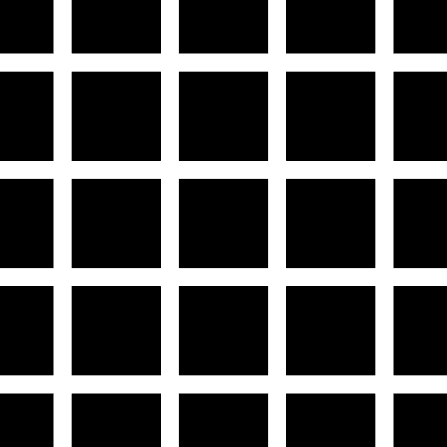
Hermann Grid
is a grid of black squares that are evenly spaced on a white background; many people see gray dots at the intersections when scanning the grid

Mach bands
these bands consist of alternating dark and light stripes along a gradient; the bands appear to exaggerate the differences in light intensity at the boundary where the luminance level changes, making the edges seem sharper than what they are

White’s illusion
the gray bars are all the same gray but with the way the black bars are the grays will seem like different colors
Wallach’s Ratio Theory
our perception of an objects lightness depends on the ratio of the objects absolute brightness and the brightness of the objects surroundings/background
Principle of belongingness
Gestalt idea; elements are grouped together to form a holistic pattern
Optic nerve
the axons of the ganglion cells are bundled together
Optic Chiasm
structure formed by the merging of the right and left optic nerves
Optic tract
fibers project to several brain structures with the largest number traveling to the thalamus
Nasal Retina
portion of the right retina, located closer to the nose sends signals to the left half of the brain; while the portion of the left retina sends signals to the right half of the brain
Temporal Retina
portion of the right retina is closer to the sides of the head and sends signals to the right half of the brain, while the portion of the left retina sends signals to the left half of the brain
Primary visual cortex (V1)
the first cortical destination for visual information arriving from the LGN
Simple Cortical Cells
these cells response to edges with specific orientations; highly selective and will fire in response to an edge at a particular location and orientation
Complex Cortical Cells
respond to a correctly orientated edge anywhere in their receptive field; the edges exact position no longer matters
End-Stop Cells
specialized in responding to lines of a specific length and the length of the line matters in their activation
Blindsight
condition in which the person reports being blind but has the ability to respond to objects and respond to motion; damage to the V1 can result in this
Ventral Stream
the shape and color pathways, feeding into the temporal lobe (“what” pathway)
Dorsal Stream
both motion branches to V5/MT and the parietal lobe (“where” pathway)
Binocular rivalry
a phenomenon where one eye receives different visual information than the other; this leads to perceptual alternations between the two images
Continuous flash suppression
unique version of binocular rivalry; the dominant eye is shown randomly changing visual noise “static” and the non dominant eye is presenting with a clear image of an object such as a house or a word (it does not receive static)
Modularity
certain behaviors or mental processes are served by specific brain regions
Fusiform Face Area (FFA)
located in the temporal lobe, shows remarkable specialization in processing visual information regarding faces
Prosopagnosia
a disorder in which the person cannot recognize people from thier faces, even people they know; it can result from damage to the FFA
Parahippocampal Place Area (PPA)
located in both the left and right temporal lobes
Inner Theatre
a metaphor describing the mind as a private stage where conscious experiences—such as thoughts, feelings, sensations, and images—are projected and observed
Libet Study
they had the subject indicate the point at which they were conscious of willing their arm to move, indicate the time at which they were conscious of their arm moving; researchers used the timing of the appearance of a readiness potential in the brain and the point at which the arm muscles actually contracted
Visual Search
the process by which we locate a specific target item within a visual field containing numerous distractors
Feature Search
characterized by the presence of a single distinctive feature that sets the target apart from the distractors, our visual system can efficiently detect this unique feature, guiding our attention to the target
Conjunction Search
a combination of features are looked for to identify the target accurately
Feature Integration Theory
claims that our attention plays a crucial role in binding visual features together and efficiently detects that feature when none of the distractions share this visual feature
Inattentional blindness
occurs when we are so absorbed in one task or aspect of our visual environment that we completely miss something unexpected and unrelated that is plainly visible
Change blindness
occurs when one fails to detect significant changes between a before and after scenario; between two displays that are separated by a brief disruption
Attentional blink
a brief cognitive delay where the brain fails to detect a second visual target if it appears within 200 to 500 milliseconds after a first target
Lag 1 sparing
a brief time during which attention becomes unavailable
Proximity
suggests that we tend to group objects that are physically close to each other
Similarity
we tend to group objects that share common attributes such as shape color and size
Good continuation
dictates that we prefer to perceive continuous and uninterrupted forms or patterns; when line or contours intersect we tend to follow the smoothest and most continuous path
Closure
refers to our inclination to mentally complete or “close” incomplete shapes or forms
Common region
suggests that we group elements that appear within the same spatial region or boundary as belonging together
Connectedness
when objects are physically connected by line or other visual cues we tend to group them together
Pragnanz
every patterns is seen in the simplest way possible
light from above assumption
an object lit from above typically appears as if its upper surface is illuminated and its lower parts are in shadow
Inverse projection problem
a given image on the retina could have been produced by an infinite number of different objects in the world
Edge extraction
our brain first identifies and processes the edges and contours that form the boundaries of objects
Formation of geons
Geons are 36 basic geometric shapes that represent the building blocks of object recognition
Object recognition
by assembling and combining geons we can recognize and identify different objects in our environment
Non Accidental properties
features of an edge patterns that stay the same from almost every viewpoint
Trichromatic Theory of Color Vision
combing the signals from the three types of cones, our Brian creates the perception of a wide range of colors
Principle of Univariance
a single photoreceptor can only signal how much light it absorbed, it cannot signal which wave length did the work
Metamers
physically different lights that look identical because they produce the same pattern of cone responses
Opponent process theory
we have specific vision cells especially ganglion cells that respond in a spectrally “opponent” manner to pairs of colors
Double opponent cells
the central region responds in an excitatory manner to one color while inhibiting responses to its opposing color
V4
region of the cerebral cortex plays a pivotal role in color perception
Cerebral achromatopsia
loss of color experience
X linked inheritance of red-green deficiency
red-green blindness is more prevalent in males because the genes that cause the condition are located on the X chromosome only
Color Constancy
our brain adjusts for changes in lighting conditions to maintain a consistent perception of an objects color
Amomalous trichromats
have all three cone types, but one is shifted in sensitivity
Dichromats
only have two working cone types, protanopes, deuteranopes, and the rare tritanopes
Monochromats
have one or no working cone types and see in shades of gray
Oculormotor
the network and control of the eye muscles and central nervous system that govern eye movements and visual stability
Monocular
the use of only a single eye for sight
Motion-produced
visual signals that allow the brain to perceive three-dimensional depth, distance, and spatial layout through relative movement between an observer and the objects in their environment
Binocular depth cues
visual information gathered by both eyes working together to create a three-dimensional (3D) sense of space and depth
Binocular disparity
a given point may be seen by both eyes that point falls on a different portion of the left retina relative to where the point falls on the right retina. the degree of this discrepancy is different for far away objects versus near objects
Stereopsis
the perception of depth and 3D structure that occurs when the brain combines the two slightly different images received from the two eyes
Horopter
an imaginary arc that may pass through various objects
Correspondence problem
highlights the complexity of our visual system, we don’t fully understand how our brains effortlessly match up corresponding retinal points to create a coherent perception of depth