Micro Lab 6 - Microbial Growth Requirements (last for exam 1)
 Call Kai
 Learn
Learn Practice Test
 Spaced Repetition
 Match
Match Flashcards
 Knowt Play
1/23

There's no tags or description
Looks like no tags are added yet.
Name | Mastery | Learn | Test | Matching | Spaced | Call with Kai | Chat |
|---|
No analytics yet
Send a link to your students to track their progress
24 Terms
Ocean Floor Prokaryotes
very low temperatures (about 4°C)

Geothermal vents Prokaryotes
very high temperatures up to 400°C) (very high atmospheric pressure- up to 1000x sea level.

Salt lakes Prokaryotes
up to 13% salt

Geysers
about 95°C

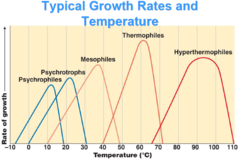
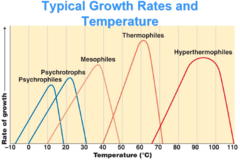
Psychrophiles
0.5- 20 °C
-very cold
-LOW fluidity, proteins rigid, slow diffusion
-unsaturated
-HIGH hydrophobicity
-HIGH flexabiliity
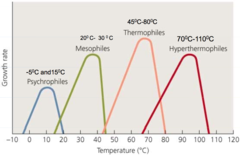
Mesophiles
20-45 °C
-moderate temp
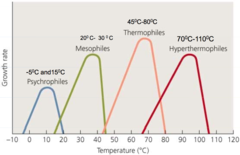
Thermophiles
50-80 °C
-high temp
-membrane too fluid and therefore impairing metabolism; proteins + nucleic acids denature
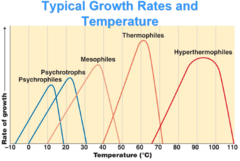
Hyperthermophiles
80-110°C
-evolbes/adapts
-very high temp
-saturated
-HIGH bonds and prevents denaturation
Halotolerant
negative numbers - 10% NACI
-doesnt require salt for growth, but can grow in high salts

Nonhalophiles
less than 1% NACI
-grows best in low salt concentrations

Halophile
0-12% NACI
-thrives in high salt concentrations

Slight Halophiles
1.7-4.8% NACI
Moderate Halophiles
4.7-20% NACI
Extreme halophile
20-30% NACI
-very high salt concentrations needed to grow

Radiation
Some microbes are capable of withstanding radiation through the formation of endospores. These organisms often can live for longer periods of UV exposure than non-spore forming organisms.
Anaerobic organisms
must be handled in a way so as not to expose them to oxygen from the time a culture is taken from a patient until they are grown in the lab.
Special anaerobic sample devices
Chemical packet = when opened, consumes the oxygen to near zero level and they often also release CO2 which stimulates the growth of some anaerobes.
Oxygen indicator = turns color when oxygen is present. Many obligate anaerobes will grow on the same media as aerobic bacteria.
Tryptic soy agar for both the aerobic and anaerobic incubations
Bacteria being used
Serratia marcescens
Staphylococcus epidermidis
Escherichia coli
Bacillus subtilis
Activity 1: Determining the Optimal Temperature for Growth of Bacteria
Inoculate 5 broths with assigned microorganism.
Incubate one each at 5°C, 25°C, 37°C, 45°C, and 60°C and leave one uninoculated
turbidity
can be described as: none, slight, medium, or heavy.

Activity 2: Determining the Optimal Osmotic Pressure for Growth of Bacteria
Inoculate each salt broth with assigned microorganism.
Incubate at 37°C for 24-48h

Activity 3: UV radiation
Swab 4 plates with assigned organism. Swab the plate for confluent growth.
One plate will act as your control, do not expose to UV.
For the other 3 plates, expose them to UV for the following times -1m, 2.5m, or 5m.
-During exposure the lids should be off, UV light is impeded by the plastic covers.
-It is easiest to put all 3 plates under the UV lamp and start your 5 min timer. At 1 min remove the first plate, at 2.5 min remove the second, and remove the third when the timer goes off.
After exposure, cover the plates, and incubate at 37°C for 24-48h
Growth can be
· None
· Slight - few colonies
· Moderate - confluents but some areas with no growth
· Heavy - confluent
Activity 4: Growing microbes in anaerobic bags.
Pseudomonas aeruginosa
Escherichia coli
Enterococcus faecalis
Clostridium sporogenes
2 TSA plates per group of 4 students
Each student works with one species from the list above.
Students working in groups of 4 will streak their organism in 1 quadrant of the agar plate.
One plate will be incubated aerobically at 37ºC in a canister and 1 plate will be incubated at 37C in an anaerobic bag until next lab.

Activity 5: Growing microbes in anaerobic media
Each student will need one tube of thioglycolate media.
Inoculate the thioglycolate media with the bacteria chosen in Activity 4.
Incubate at 37°C for 24-48h
