Week 5: Nerves Continued
 Call Kai
 Learn
Learn Practice Test
 Spaced Repetition
 Match
Match Flashcards
 Knowt Play
1/71

There's no tags or description
Looks like no tags are added yet.
Name | Mastery | Learn | Test | Matching | Spaced | Call with Kai | Chat |
|---|
No analytics yet
Send a link to your students to track their progress
72 Terms
what is the basis of animal integration
nerves
what are the 2 types of nervous systems?
central nervous system and peripheral nervous system
what are the 2 main parts of the central nervous system?
what does the CNS serve as?
brain and spinal cord
serves as the major center for processing and integrating info
what are the 2 main nervous systems (ns) of the peripheral nervous system?
autonomic ns = regulates involuntary processes like heart rate, digestion
somatic ns = deals w/ seonsory system and voluntary control of skeletal muscles
what are the 2 main ns in the autonomic ns?
sympathetic ns and parasympathetic ns
what are the 2 categories never cells fall into?
neurons and neuroglia cells
define neurons
excitable cells that are capable of transmitting/generating electric signals
define neuroglia cells
non-excitable nerve cells that carry out functions specialized nerve cells cannot
in jellyfish, are neuroglia cells present, which type organism are they ALWAYS in?
the neuroglia cells are rare or absent in jellyfish but ALL 5 types are found in verts
list and define the 5 types of neuroglia cells
astrocytes - provide support and nourishment for neurons
schwann cells - from myelin sheaths around single PNS axons
oligodendrocytes - CNS myelin forms sheaths around several axons
microglia cells - carry out immunity duties w/in the cerebral spinal fluid
ependymal cells - line third ventricle of the brain and spinal canal; produce cerebral-spinal fluid
which neuroglia cells are part of the central ns and peripheral ns?
Central ns: oligodendrocytes, astrocytes, microglia, ependymal
Peripheral ns: astrocytes, Schwann cells

which neuroglia cell is this?
Schwann cells

which neuroglia cell is this?
oligodendricytes

which neuroglia cell is this?
ependymal cells
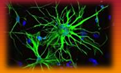
which neuroglia cell is this?
astrocytes

which neuroglia cell is this?
microglia
what are the 8 factors which make up the basic structure of excitable neurons
cell body or soma
cell processes
dendrites
axon
collateral axons
Schwann cells
Nodes of Ranvier
Axon terminals, synaptic batons, or presynaptic terminal
what does the cell body or soma contain?
contains cellular organelles
what are the cell processes part of?
extensions arising from the soma
what do dendrites receive?
impulses from other neurons or sensory cells
what is the purpose of axons?
to convey signals away from the soma toward other cells
where are collateral axons located?
branches off the main axon
what do Schwann cells make up?
make up the myelin sheath (if present)
what do the Nodes of Ranvier make up?
gaps in the myelin sheath (if present)
what do axon terminals, synaptic batons, or presynaptic terminals produce/secrete?
produces and/or secretes neurotransmitter substances
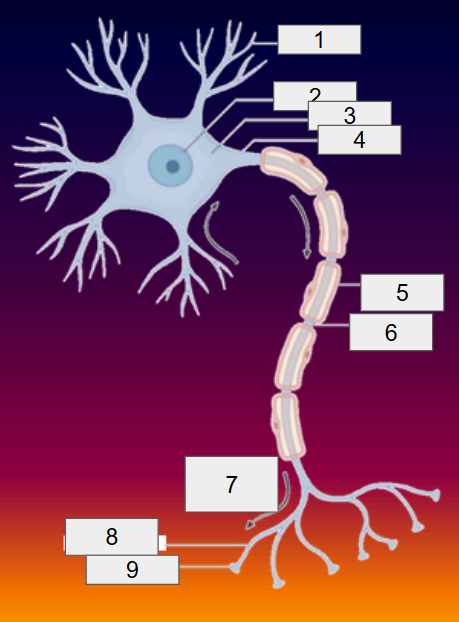
label the excitable neuron
dendrite
nucleus
cell body
axon
myelin sheath
node of ranvier
direction of impulse
axon terminal
synapse
what is the pathway of electrical signals running through the neuron?
dendrites receive the info => the soma integrates it => the axon carries action potential => the axon terminals pass the info on
list and define the 2 basic types of excitable neuron conduction types to move from one end of the neuron to the other
be sure to describe AP signals
electronic conduction - AP signals are propagated along entire axon in myelinated neurons
salutatory conduction - AP signal “jumps” b/w nodes of Ranvier, skipping myelinated sections of the axon in unmyelinated neurons
describe the 5 step process of the synapse, in which transmission w/out signal loss occurs
when an AP reaches the axonal baton, transmitter vesicles mobilize along the pre-synaptic membrane in response to Ca++ release
pre-synaptic vesicles empty transmitter substances into the synaptic cleft (aka: synaptic junction or nexus)
postsynaptic membrane ligand gated receptor channels receive transmitter substances and initiate an AP along the post synaptic neuron
transmitter substances are removed by diffusion, absorption, or enzymatic breakdown
the signal is rectified (i.e., the signal can only move in one direction)
define neurotransmitter substances
chemical messengers that cross the synaptic cleft to depolarize a postsynaptic neuron or effector target
what are the 4 major neurotransmitter classes and their functions
monoamines: dopamine, histamine, adrenaline, serotonin
wide range of functions like behavior, arousal, and other physiological responses
peptides: oxytocin, vasopressin, opiods, endorphins
larger molecules made from chains of amino acids and often produce longer-lasting effects, some can also function as hormones
amino acids: glutamine, gamma, aminobutyric acid
important in CNS to increase/decrease neuronal activity
other:
acetylcholine = communication b/w neurons and muscles
adenosine
nitric oxide = gas so doesnt follow same typical vessicle release pathway
what are the 7 “small molecule” neurotransmitters that do most of the work in mammals and what do they transmit?
acetylcholine - neuromuscular transmitter
gamma-aminobutyric acid - primary CNS inhibitory neurotransmitter
norepinephrine - catecholamine CNS and PNS neurotransmitter
dopamine - central nervous system pain/pleasure processing
glutamate - CNS neurotransmitter key to learning and memory
histamine - stimulates post-synaptic CNS receptors
serotonin - CNS neurotransmitter regulating mood
how many subtypes can neurotransmitters have?
provide example
neurotransmitters can have several subtypes
ex = serotonin has 15 subtypes
how does acetylcholine work differently in arthropods compared to other verts and advanced inverts?
acetylcholine is a neuromuscular transmitted in all vert and advanced inverts except for arthropods in which its ineffective at motor nerve endings
how does epinephrine work differently b/w non-human animals and fish/amphibians?
epinephrine is a transmitter substance in the para-sympathetic nervous system of most non-human animals, but is the sympathetic nervous system transmitter substance in fish and amphibians
what is the norepinephrine?
aka nonadrenaline, is the major transmitter substance in human sympathetic nervous system
what is gamma-aminobutyric acid (GABA)?
inhibitory neuromuscular transmitter substance for most crustaceans, insects, and other inverts as well as higher verts
what are the 4 morphological classifications of neurons?
pyramidal, bipolar interneuron, unipolar sensory neuron, multipolar motor neuron
define the pyramidal neuron
specialized multipolar CNS neurons and the primary excitation unit of the mammalian prefrontal cortex (the thinky-thinky part of your brain)
define the bipolar interneuron
a PNS neuron transmitting impulses b/w other neurons, usually associated w/ sensory/motor neurons and reflex arcs
define unipolar sensory neuron
sensory neurons w/ cell bodies housed in the spinal or cranial vault as nerve ganglia
define multipolar motor neuron
majority of neurons found in the CNS that function as motor neurons and interneurons
describe how action potential voltage and speed of conduction vary across animal groups.
action potential voltage (-120 mV) is relatively constant across animal groups, while the speed of conduction varies tremendously
what is the trend of the speed of conduction comparing inverts to verts?
inverts have slower conduction rates than verts
what are the 3 factors determining speed of nerve conduction?
synaptic connection type, neuronal diameter, axonal modifications
what is the result of highly specialized gap junctions across inverts and verts?
highly specialized gap junctions increase speed in many inverts and in limited areas of vertebrate CNS
how does current flow w/ a membrane separation from 2nm to non-existent gap junctions?
w/ membrane separation from 2nm to non-existent gap junctions allows current to flow directly b/w nerve cells through openings b/w adjacent cells
what transmission is faster than neurotransmitter systems?
ephaptic (electrical) or septal synapse transmission
what is the flow that ephaptic junctions provide?
two-way flow but the signal is unrectified
what is the invert solution to transmission speed?
provide 4 invert examples
giant neurons bc they ALWAYS coordinate large muscle groups for quick escape or withdrawal
cockroach jump-forward response, crayfish tail-flip response, earthworm withdrawal response, squid jet propulsive mantle contraction
how has the giant neuron originally found in inverts evolved to other animal groups?
present in most fish and amphibians, the neuron innervated tail muscles used to avoid aerial predators
what 2 animal groups are giant neurons absent in?
absent in tailless amphibians and bottom dwelling species
what are the regions of giant neurons determined by?
transmitter dominance NOT morphological boundaries
how much larger are giant neurons than an animal’s regular motor neurons?
fast responding giant neurons may be 50-100x the diameter of the animal’s regulator motor neurons
what is the major problem of giant neurons?
the major problem w/ giant neurons is that 100-fold increase in velocity requires a 1000-fold increase in diameter and 10,000 fold increase in volume => sooooo great for roaches but not whales
what is the vert solution to conduction speed?
myelinated neurons
describe the rate of nerve conduction in verts?
verts have one of the highest rates of nerve conduction in the animal kingdom: 120m/sec (270 mph) in mammals vs. 30m/sec (70mph) in fast earthworm fibers
what are myelinated neurons covered in?
myelinated neurons have axons covered by a thin sheath of fat-like myelin
what encircles the axon?
Schwann cells and oligodendrocytes have annular Nodes of Ranvier (i.e., they encircle the axon)
what occurs when depolarization of the exposed cell membrane occurs? how does this affect the travel of AP?
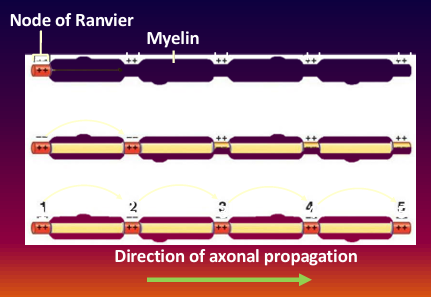
this is salutatory (to leap or dance) and generates a current strong enough to “trip” the next mode, as a result AP does NOT travel down the axon but rather “jumps” b/w nodes
describe the 4 steps of saltatory conduction action in a myelinated axon?
1) initial segment stimulation yields a local disturbance => 2) the disturbance produces an AP at the Ranvier node Nodal depolarization trips the next node in line => 3) after depolarizing nodes are hyperpolarized, preventing the signal from moving backward => 4) the process is faster than continuous conduction, where the impulse must travel the entire unmyelinated neuron
what is the invert solution to “myelinated” neurons
inverts have functionally equivalent “myelin-like” sheathes that have multiple loosely wrapped membranes w/ extracellular spaces forming ion reservoirs that change the cable properties
how do neuron nodes differ in inverts compared to verts
unlike verts, invert neuron nodes occur in larger numbers, are irregularly spaces, and may be either annular or fenestrated (i.e., are restricted to “spots”)
what is the best studied invert regarding myelin?
earthworm myelin consists of 20-200 layers that are not always compact
describe the layers of non-compact regions of myelin
non-compact regions typically have thin layers of cytoplasm b/w glial cell membranes
what is notable about invert phylogeny and the patter of distribution of myelin-like sheaths?
even tho many invert groups have nerve sheaths, strikingly similar to myelin but the pattern of distribution is not consistent w/ invert phylogeny
describe the ability of ions to compromise the invert sheath
the ability of ions to compromise the invert sheath insulation is limited
what is the advantage of myelinated fibers vs non-myelinated fibers in earthworms?
while conduction speed of earthworm myelinated fibers is high compared to that for non-myelinated fibers of the same diameter, the advantage is only a few fold
describe the presence of myelin sheaths in lampreys and hagfish and other chordates
Lampreys and hagfish lack myelin sheaths, whereas all other chordates have well-developed sheaths
describe the presence of myelin sheaths in decapods
Among decapods, shrimp have myelin sheaths, but crabs do not
describe the presence of myelin sheaths in earthworms and leeches, what does this suggest for all inverts
earthworms have myelinated nerves, but leeches do not: suggesting that myelin like sheaths evolved independently among invertebrate groups
what organism has the fastest recorded conduction speed in myelin-like axons?
Kuruma shrimp exhibits conduction rates ranging between 90 and 200 m/s, (450 mph) compared to 100–120m/s for the fastest myelinated vertebrate axon while unsheathed earthworm neurons have speeds of only 0.5 to 2.0 m/sec (1.1 to 4.5 mph)