Biology: Cell Structure, Function, and Membrane Dynamics
 Call Kai
 Learn
Learn Practice Test
 Spaced Repetition
 Match
Match Flashcards
 Knowt Play
1/82

There's no tags or description
Looks like no tags are added yet.
Name | Mastery | Learn | Test | Matching | Spaced | Call with Kai | Chat |
|---|
No analytics yet
Send a link to your students to track their progress
83 Terms
What is the definition of energy?
Energy is the capacity to cause change.
What type of energy is associated with motion?
Kinetic energy.

What is potential energy?
Stored energy that an object has because of its location or structure.
What principle explains that energy cannot be created or destroyed?
Conservation of energy.
What is heat in terms of energy?
A type of kinetic energy contained in the random motion of atoms and molecules.
What is entropy?
A measure of disorder or randomness in a system.
What is chemical energy?
Potential energy stored in the arrangement of atoms that can be released by a chemical reaction.
What is cellular respiration?
The energy-releasing chemical breakdown of fuel molecules and the storage of that energy in a usable form.
What percentage of food energy do humans convert to useful work?
About 34%.
What is ATP?
Adenosine triphosphate, a molecule that acts like an energy shuttle, storing and releasing energy as needed.

How does ATP energize other molecules?
By transferring phosphate groups to those molecules.
What is the ATP cycle?
The process where ATP is continuously spent and recycled from ADP and phosphate using energy from cellular respiration.

What is metabolism?
The total of all chemical reactions in an organism.
What role do enzymes play in metabolism?
Enzymes speed up chemical reactions without being consumed.
What is activation energy?
The energy that must be invested to start a reaction.
How do enzymes affect activation energy?
They reduce the amount of activation energy required to initiate a reaction.
What is the induced fit model in enzyme activity?
The interaction where the substrate induces the enzyme to change shape slightly for a snug fit.
What is a substrate in enzymatic reactions?
The specific reactant molecule that an enzyme recognizes and acts upon.
What is the significance of directed evolution in enzyme engineering?
It allows researchers to isolate genes that code for more efficient enzymes through mutation and selection.
What happens to ATP in a working muscle cell?
Up to 10 million ATPs are consumed and recycled each second.
What is the relationship between energy transformations and heat?
All energy conversions generate some heat, which increases entropy.
What is the primary function of the plasma membrane in cells?
To control the chemical environment of the cell.
What is a key characteristic of enzymes?
Enzymes can function repeatedly after releasing products from the active site.
How does an enzyme recognize its substrate?
The substrate and the enzyme's active site are complementary in shape and chemistry.
What happens to enzymes when the environment gets too hot?
Enzymes unravel and stop functioning.
What does the function of an enzyme depend on?
The function depends on its specific shape (structure).
What are enzyme inhibitors?
Molecules that inhibit a metabolic reaction by binding to an enzyme and disrupting its function.
What is facilitated diffusion?
A type of passive transport that uses proteins to assist the movement of molecules down their concentration gradient without energy input.
What is osmosis?
The diffusion of water across a selectively permeable membrane.
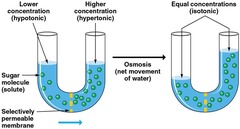
What is the difference between hypertonic, hypotonic, and isotonic solutions?
Hypertonic has a higher solute concentration, hypotonic has a lower solute concentration, and isotonic has equal solute concentration.
What is osmoregulation?
The control of water balance in cells to survive hypotonic or hypertonic environments.
What happens to plant cells in a hypotonic environment?
They experience a net inflow of water, which expands their cell walls without bursting.
What is active transport?
The movement of molecules across a membrane that requires cellular energy, usually ATP.
What is exocytosis?
The movement of materials out of the cytoplasm of a cell via vesicles that fuse with the plasma membrane.
What is endocytosis?
The process by which a cell takes material in via vesicles that bud inward.
What is phagocytosis?
A type of endocytosis where a cell engulfs a particle and packages it within a food vacuole.
What role do phospholipids play in cell membranes?
They are key ingredients of membranes and self-assemble into simple membranes.
Why is the formation of membrane-enclosed collections of molecules significant?
It was a critical step in the evolution of the first cells, allowing regulation of chemical exchanges with the environment.
What is the evolutionary significance of plasma membranes?
All cells are enclosed by a plasma membrane that is similar in structure and function, illustrating the evolutionary unity of life.
What is cytology?
The study of cell structures.
What two fields developed modern cell biology?
Cytology and biochemistry.
What is the function of a light microscope?
It allows visible light to pass through a specimen and is focused by glass lenses.
What is magnification?
The ratio of an object's image to its real size.
What does resolving power measure?
Image clarity, specifically the minimum distance two points can be separated and still viewed as separate.
What is the practical resolution limit of light microscopes?
About 2 microns, the size of a small bacterium.
What is the maximum effective magnification of light microscopes?
About 1,000 times the size of the actual specimen.
What technique enhances contrast in microscopy?
Staining, which can involve dyes or fluorescence.
What is the primary use of an electron microscope (EM)?
To resolve smaller structures using a beam of electrons.
What is the theoretical resolution of a modern electron microscope?
0.1 nanometer (nm), with a practical limit closer to 2 nm.
What is the function of transmission electron microscopes (TEM)?
To study the internal ultrastructure of cells.
How do scanning electron microscopes (SEM) function?
They study surface structures by covering the sample with a thin film of gold.
What is the fluid mosaic model?
The current model describing membrane structure, where phospholipids and proteins move laterally.
How do unsaturated fatty acids affect membrane fluidity?
They increase the fluidity of the membrane.
What role does cholesterol play in cell membranes?
It stabilizes the membrane by enhancing fluidity in cold and decreasing it in heat.
What are integral proteins?
Proteins embedded in the lipid bilayer of membranes.
What is the function of membrane carbohydrates?
They are important for cell-cell recognition.
What distinguishes prokaryotic cells from eukaryotic cells?
Prokaryotic cells lack nuclei and membrane-enclosed organelles, while eukaryotic cells have them.
What are the two types of eukaryotic cells?
Plant cells and animal cells.
What organelles do plant cells have that animal cells usually do not?
Chloroplasts, a large central vacuole, and cell walls.
What is the nucleus's role in a eukaryotic cell?
It contains the cell's genetic library.
What is chromatin?
DNA organized with proteins into thin fibers that coil to form chromosomes.
What are nucleoli?
Sites of ribosome synthesis associated with chromatin in non-dividing cells.
What is the function of ribosomes?
They build a cell's proteins.
What are the two types of ribosomes and where are they found?
Free ribosomes in the cytosol and bound ribosomes on the outside of the endoplasmic reticulum (ER) and nuclear envelope.
What is the primary function of the endoplasmic reticulum (ER)?
The ER manufactures membranes and performs many biosynthetic functions.
What distinguishes rough ER from smooth ER?
Rough ER has bound ribosomes and produces cell membrane and secretory proteins, while smooth ER lacks ribosomes and synthesizes steroids, metabolizes carbohydrates, stores calcium, and detoxifies poisons.
What is the role of the Golgi apparatus?
The Golgi apparatus finishes, sorts, and ships cell products, modifying proteins received from the ER.
What are lysosomes and what is their function?
Lysosomes are membranous sacs of hydrolytic enzymes that break down macromolecules for recycling and substances ingested by phagocytosis.
What is the function of vacuoles in plant cells?
Vacuoles function in storage, waste disposal, cell growth, and protection.
What is the primary function of mitochondria?
Mitochondria are the sites of cellular respiration and ATP production in eukaryotes.
What is the structure of chloroplasts?
Chloroplasts contain chlorophyll and other pigments, surrounded by two membranes and containing thylakoids stacked into grana.
What is the cytoskeleton and its main components?
The cytoskeleton provides structural support and is made of microtubules, microfilaments, and intermediate filaments.
What is the role of microtubules in the cell?
Microtubules shape the cell, guide organelle movement, and help separate chromosome copies during cell division.
What are cilia and flagella composed of?
Cilia and flagella are motile appendages containing microtubule doublets moved by the motor protein dynein.
What are microfilaments and their functions?
Microfilaments are thin rods built from actin, functioning in muscle contraction, amoeboid movement, cytoplasmic streaming, and support for microvilli.
What are intermediate filaments and their role?
Intermediate filaments are made of fibrous proteins like keratin, supporting cell shape and fixing organelles in place.
What is the composition of plant cell walls?
Plant cell walls are composed of cellulose fibers embedded in other polysaccharides and proteins.
What is the extracellular matrix (ECM) in animal cells?
The ECM functions in support, adhesion, movement, and regulation, composed of glycoproteins like collagen and proteoglycans.
What are plasmodesmata?
Plasmodesmata are channels that pass through adjoining plant cell walls, facilitating intercellular communication.
What are tight junctions and where are they found?
Tight junctions bind cells together, forming a barrier that prevents fluid movement, predominantly found in epithelial tissues.
What are anchoring junctions and their function?
Anchoring junctions are thickened patches in cell membranes that bind cells together and anchor fibers in the cytoskeleton.
What are gap junctions and their role in cell communication?
Gap junctions are communicating junctions that allow the passage of water and small molecules between adjacent cells.
What is the significance of the centrosome in animal cells?
The centrosome organizes microtubules and contains two centrioles, playing a key role in cell division.