PSYCH 3WA3 Midterm
 Call Kai
 Learn
 Practice Test
 Spaced Repetition
 Match
 Flashcards
 Knowt Play
1/98

Earn XP
Description and Tags
Weeks 1-5
99 Terms
Ways to Achieve MAWA
Artful Cognition
Novel Arts Functions in Humans
Joint Evolutionary Precursors
Applied-Arts Effects on Cognition/Behaviour
Artful Cognition
Ex. Social behaviour as theatre
You are the hero of your story
Novel Arts Functions in Humans
Ex. Musical scales
Joint Evolutionary Precursors
Ex. Co-evolution of music and language
Applied-Arts Effects on Cognition/Behaviour
Ex. Melodic Intonation Therapy
People with aphasia use musical therapy to help people speak
Art Thinking
Make ordinary thinking art-like by thinking outside of the box
Standard Model
Arts reflect cognitive capacities
Ordinary thinking → art thinking
MAWA Concept
Ordinary thinking has an art-like nature to it
The arts shaped cognitive capacities
Ordinary thinking ↔ art-thinking
6 Forms of Artful Cognition
Display Thinking
Graphical Cognition
Narrative Thinking
Theatrical Thinking
Proto-Dancing
Proto-Music
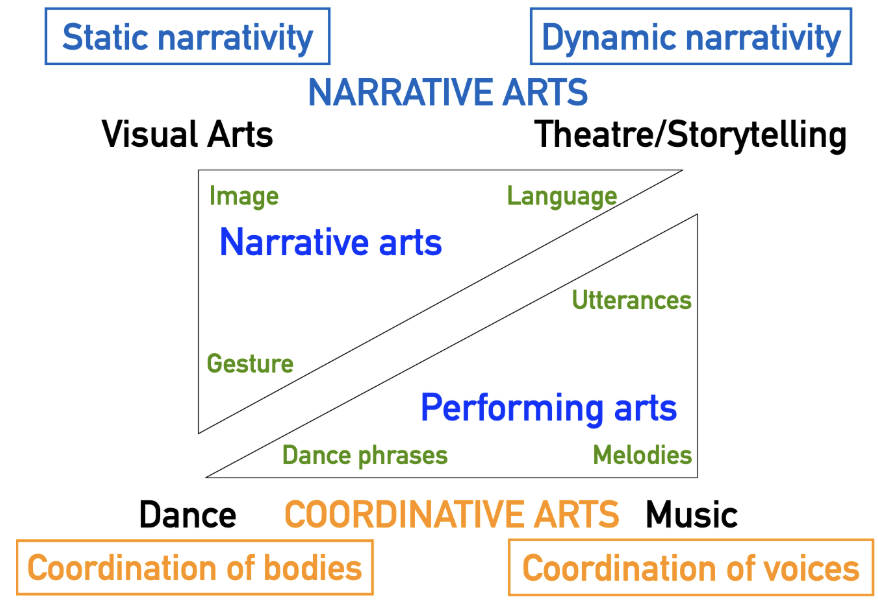
Classifying the Arts
Narrative Arts (story-telling)
Static
Performance (narrated/acted out)
Coordinative arts (interpersonal coordination)
Systems of Core Knowledge
Objects
Objects and Their Categorization
Language
Numerical Cognition
Logic and Deductive Reasoning
Spatial Cognition and Orientation
Events
Causal Inference Through Inductive Reasoning
Mental Time Travel
Agents - Social Beings
Mentalizing (theory-of-mind)
Social Intelligence: Categorizing People
Self-Awareness: Self-Regulation
Domain-General
Wide variety of tasks and functions, rather than one specific function
Ex. attention, forming associations, short-term memory
Domain-Specific
Systems that apply to one targeted thing
Domain-Specific Systems
Mime/Pantomime
Figurative Drawing (iconic images in 2D)
Acting (impersonation)
Rhythmic Synchronization of Movement to other People Through Group Dancing
Most Diverse Musical Scale Systems of Any Species
Most Diverse Chorusing Types of Any Species
Most Elaborate Group Rituals of Any Species
Systems of Social Knowledge
Social Psychology → Evolutionary Psychology
Cooperative Social Groups
Altruism
Food-sharing
Collaborative actions
Biological paradox of Group Living
Individual organisms self-serving (ex. selfish)
In groups, “cheaters” reap the benefits of cooperation without paying costs
Because social groups are unstable, they require mechanisms to maintain commitment, defection is common
Performance rituals where individuals synchronizing with one another are important to supporting group functionality
Within-Group
Competition: me vs you
Cooperation: us
Between-Group
Competition: us vs them
Cooperation: us + them
Social Brain Hypothesis
↑Group size → ↑Social relationships → ↑Brain size
The larger the group you live in, the more you have to deal with social relations, therefore, volume is larger
Social Intelligence
Keeping track of relationships in social networks (friend vs foe)
Categorizing the self and others into groups (us vs them)
Theory-of-Mind: making inferences about people’s mental states
Folk Psychology: explaining people’s behaviours with regard to their mental states
Empathy: sharing in people’s emotional states
Schadenfreude: feeling opposite of how a person is feeling
Altruism: helping people
Reciprocity
Helping someone after they help you
Works well for duos but not large groups
Behavioural Coordination
Group rituals that simulate coordination → Behavioural coordination → cooperation of the group
Functions of Group Rituals
Demonstrate commitment to group
Increase group cohesion (me → we)
Ceremonies-as-Arts
Religious ceremonies are (nothing more than) collections of arts behaviours and objects
Creativity
Ideas of products that are:
Novel (original)
Surprising
Useful
Generic, not art-specific
Is Creativity Domain-Specific or Domain-General?
Non-creative tasks just as domain-specific as creative tasks

Domain-General Approach: Divergent Thinking
AUT: give common object (brick) and list all its alternate uses
Higher rated the more you list different uses
Two Types of Creativity
Functional Creativity
Display Creativiry
Functional Creativity
Novelty for solving problems
Developing novel solutions to existing problems
Operant Conditioning (trial-and-error learning)
First step in creative work is problem finding
Problem Solving Cycle
Vast majority of creativity is incremental
Much creativity is a modification of some existing product
“Making better”: making small improvements to existing products or ideas
Improvements accumulate across generations

Display Creativity
Novelty for its own sake
Artification
Geneplore Model
Generation: between problem formulation and solution formulation
Exploration: between solution formulation and solution implementation
Creative work driven by a core idea
Neither random nor fully formed, requires exploration
Divergent Thinking
Thinking outside the box, brainstorming
Creative ideas appear out of the blue
Insight = illumination = eureka moment
People believe that divergent ideas come from divergent people (mental illness)
Analytical Thinking
New product follows from existing products
Being inspired by someone else’s work (“strategic theft”)
Phases of Creative Work
Conception
Idea Development
Production
Completion
Creativity/Aesthetics Cycle
Creates a feedback loop
Creators produce work to appeal to some target audience

Cultural Evolution
Biological Evolution: change in frequencies

Modification
Builds upon existing products
Based on analytical thinking
Blending
Having two types of sources for idea
Essentially forming associations
Natural selection is a blend: selection + nature
Cultural evolution is a blend: culture + biological evolution
Conceptual Blending
Analogical reasoning
Ex. “he was like a fish out of water”
Blending two types of environments to show similarity between them
Aesthetic Perception
Emotions are appraisals
Ex. is this good or bad for me?
Personal consequentiality
Self: For most of human history, most people did not know what they looked like
Other: people. natural objects and spaces, products of human creativity
Three Dimensions of Emotion
Valence: positive or negative (binary)
Intensity: weak to intense (graded)
Focus: what the emotion is about
Basic Emotion Theory (Focus)
1D Model: Having six emotions in the range of 800 does not explain them properly

Circumplex Model (Valence and Intensity)
2D Model: 800 emotions can be placed in their corresponding quadrant
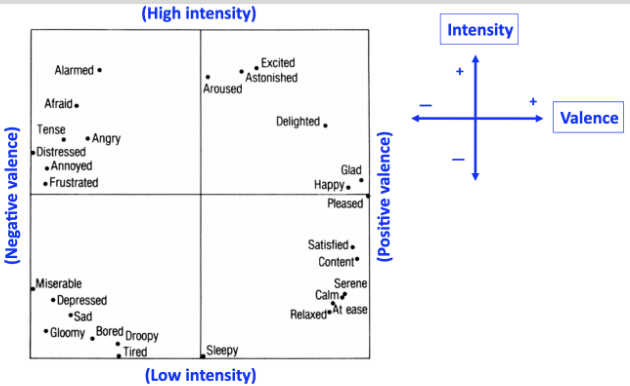
OCC Model (Valence, Intensity, and Focus)
3D Model: Built from foundation of 2D model
Outcomes: Motivation Emotions
Pleased (+) ↔ Displeased (-)
Retrospective Emotions: emotion in the moment
Happy (+) or sad (-)
Prospective Emotions: future emotions
Hopeful (+) or apprehensive (-)
Objects: Aesthetic Emotions
Liking (+) ↔ Disliking (-)
Agents: Moral/Social Emotions
Approving (+) ↔ Disapproving (-)
Beauty-as-Good Relationship
Strong correlation between aesthetic and moral assessments
Ex. People who are good (agent) are attractive (object), people who are evil (agent) are ugly (object)
Ex. Things that are beautiful (object) are good (agent), things that are ugly (object) are bad (agent)
Situations where emotional foci have opposing valences create cognitive dissonance
“Halo Effect”
When shown a random person, attractive people rated as morally nicer, more successful, and more sociable
Aesthetics
Typical Definition: The perception of beauty in artworks
But beauty in everything, not just beauty but ugliness, and not just perception but also production
Cognition/Emotion Relationship
Emotion → motivation (desire to act) → decision making (alternative actions, costs/benefits)

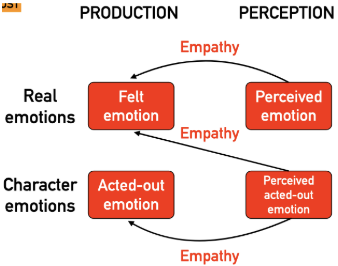
Real Emotions
Production
Felt emotion
Perceiving someone’s emotion makes you feel the emotion
Perception
Perceived emotion
Perceiving the sadness of someone makes you feel the emotion
Character Emotions
Production
Acted-out emotion
Perception
Perceived acted-out emotion
Can also feel real emotion for a perceived acted-out emotion
Theatre as art form would not exist if people could not empathize with virtual emotions of fictional characters
Real Emotions vs Character Emotions
Group Emotional Expression
Attunement (contagion): individual emotional expression → group emotional expression
Coordination and Group Emotions
Emotional attunement (contagion)
Adopt what others around you are feeling
Shared emotional experience
Feeling emotionally connected to others
Group catharsis
Aesthetic Production
Artification: production counterpart to aesthetic perception
Modification of existing products just as in many forms of creativity
Not to change the function
Things we do to make things more desirable

Three Mechanisms of Artification
Ornamentation/Stylization
Exaggeration
Repetition
In space (patterns)
In time (rhythm)
Display Thinking
Creative and aesthetic strategies we use to attract attention to ourselves
Used to convey information about desirability, uniqueness, social status, physique, profession, gender, ethnic identity, religious affiliation, etc
Display thinking unites creativity and aesthetics via display creativity
Imaginary Audience
Even when you are not in public, you might imagine displaying yourself to an audience
Individual Displays: Mating Displays
Me vs you
Mixture of dancing and vocalizing to attract mates
Group Displays: Territorial Displays
Us vs them
Coordinated duets to show cohesiveness and mark territory
The Recursiveness of Visual Art
Visual art objects are objects that represent other objects
Performing Arts
Dynamic
Synchronous Experience
Visual Arts
Static (fixed objects)
Asynchronous Experience
Production: creativity → perception: aesthetics
Performing vs Visual Art Trade-Off
Visual art not good for interpersonal coordination
Visual art enduring (sticks around for long time) while performance is not
Expectation is “Performance Art”
The body as a paintbrush, canvas for applying media, art object
Core Features of Visual Arts
Functional Creativity
Conceive
Produce
Display Creativity
Ornament
Display
Functions of Static Displays
Artify a person (ex. makeup)
Self-promotion (ex. posting a gym selfie)
Artify an object or space
Function as deity or religious symbol (ex. wearing a cross)
Capture a dynamic expression or action (ex. some cultures wear masks)
Signify social functions within a culture (in terms of social roles ex. police officer, flight attendant → display signifies your role)
Signify group identity (ex. sports teams wear different jerseys)
Signify national identity (ex. country’s flag)
Signify institutional identity (ex. logos)
Convey a story or myth
Commemorate an event or a person (ex. statue of a historical figure)
Classifying Visual Art

The Globular Brain Theory
Human brain has become more spherical
Parietal bone globularity associated with parietal lobe expansion in brain
Tool use proposed as a selection pressure that expanded the parietal lobe
Graphical Objects
Shape
Length → size
Angle → shape
Patterns on objects
Ornamentation
Graphical Spaces
Layout
Distance
Sense (R/L)
Patterns of objects
Display
Numerical Cognition
Approximate Number System
Relative: more vs less
Ratios
Large or small numbers
Specific Number System
Absolute: specific counts
Absolute numbers
Small number only
Approximate number system interacts with layout geometry
Reciprocal Challenges of Vision and Drawing
The Challenge of Vision: construct a 3D precept from a 2D retinal image
The Challenge of Drawing: create a 2D representation from a 3D percept
Drawing is art-specific function conversion of 3D to 2D
Drawing can create dedicated art work, not just artification of some object
3 Categories of Images
Pictures
Emblems: sign that indicates something, but happens to be in form of a picture
Notations

Representational Content + Gestural Focus

Transitive Actions
Instrumental: object-directed gestures
Actions where you are using a tool
Some instrumental gestures are joint actions
Intransitive Actions
Do not use an object
Pantomimes
Iconic gesturing
Done in a specific context that warrants this gesture (in general)
Empty-handed version of an instrumental (transitive) gesture
Done for narrative (communicative) purposes
Two Major Ways to Do a Pantomime
Egocentric
Body parts maintain their identity
“Imaginary object" pantomime
Peripersonal space (body space stays the same → action is something that would actually happen in this space)
Allocentric
Body part is replaced by some other object
“Body-part-as-object” pantomime
Drawing vs Pantomime
Drawing leaves a trail behind as the image unfolds on canvas
Emanation: emergence of image as drawing occurs on a surface
Defining feature of drawing as a motor behaviour
Pantomime is “drawing in the air” without emanation
Static Pictures
Implied Motion: dual static/dynamic nature of visual art
Has frozen expression (freeze frame)
2D Pictures
Implied Depth: Depth in 2D objects uses monocular depth cues
Can perceive depth using one eye only
What Pathway (Ventral Stream)
What the object is (shape)
Static aspect of pictures
Fusiform Face Area
Deciphering who the person is when looking at their face
Extrastriate Body Area
Deciphering who the person is when looking at their body

Where Pathway (Dorsal Stream)
Where the object is in space (layout)
Dynamic aspect of pictures

Drawing System of the Human Brain
Drawing is a visual-manual activity
Where pathway leads to motor cortex to then become the how pathway
Includes all visual systems (what, where, and how)
Watching emanation activates full drawing system, except for motor cortex

Origins of Visual Art
Found as old as 77,000 years ago
Theories About Origins of Geometrics in Rock Art
Neurons in V1
Hallucinations
Early rock art made in altered states
Phosphene Theory
Pushing eyeball generates light that is not there
Real origins come from the way our motor system draws art
Axes of Limb Movement
Stage 1: Linears
Stage 2: Circulars
Stage 3: Linears and Circulars Combined
Tadpole: when children draw people, they don’t draw bodies
Geometrics are the Building Blocks of…
Object Recognition
Recognition-By-Components Theory
Fundamental geons form objects when combined
Object Ornamentation
Decorating things around us highlights geometrics
Architecture
Geometric patterns not derived from nature
Feature of human design and production
Notation Systems
English writing and musical notation
Human Interaction
The way people position themselves when they interact is geometric
Ex. formations of people (face-to-face, side by side)
Imitative Arts
2D
Can tell stories either with one or multiple 2D images
Etching and Paintings
Petroglyph: rock etching
Pictograph: rock painting
3D
Figurines
3 Manners of Generating Figurativity
Memory
Tracing
Copying
Gestural Model of Drawing Origin
Object perception (what pathway) → tool use (how pathway) → mark-making (emanation)

Gestural Model of Drawing Origin Hypothesis
The representational capacity of drawing evolved from that pantomime

Functions of Visual Symbols
Offline Cognition: capacity to represent things that are not currently present
Off-Loading: cognition onto the environment
Writing Systems
Phoneme (speech sound)
Consonants and vowels
Grapheme (written sign)
Some phonemic, some pictorial
Pictographic/Logographic
Each grapheme represents complete word (generally iconic)
Syllabic
Each grapheme represents syllable (ex. ba)
Phonetic
Consonantal: each grapheme represents consonant
Alphabetic: each grapheme represents consonant or vowel