Phonics
 Call Kai
 Learn
 Practice Test
 Spaced Repetition
 Match
 Flashcards
 Knowt Play
1/30

There's no tags or description
Looks like no tags are added yet.
31 Terms
Vowel Digraph
two vowels that make a single vowel sound when together in a word, also known as "vowel teams"
Example.
the "ai" in paint; the "ee" in need; the "oa" in boat
Onset and Rime Production
the ability to hear and understand that the sound(s) before the vowel in a syllable is the onset, and the vowel and everything that comes after it in a syllable is the rime
Example.
In the word cat, the onset is /c/ and the rime is /at/
Word Awareness
knowing that individual words make up a sentence
Example.
“A brown cat jumped over the car.” has 7 words
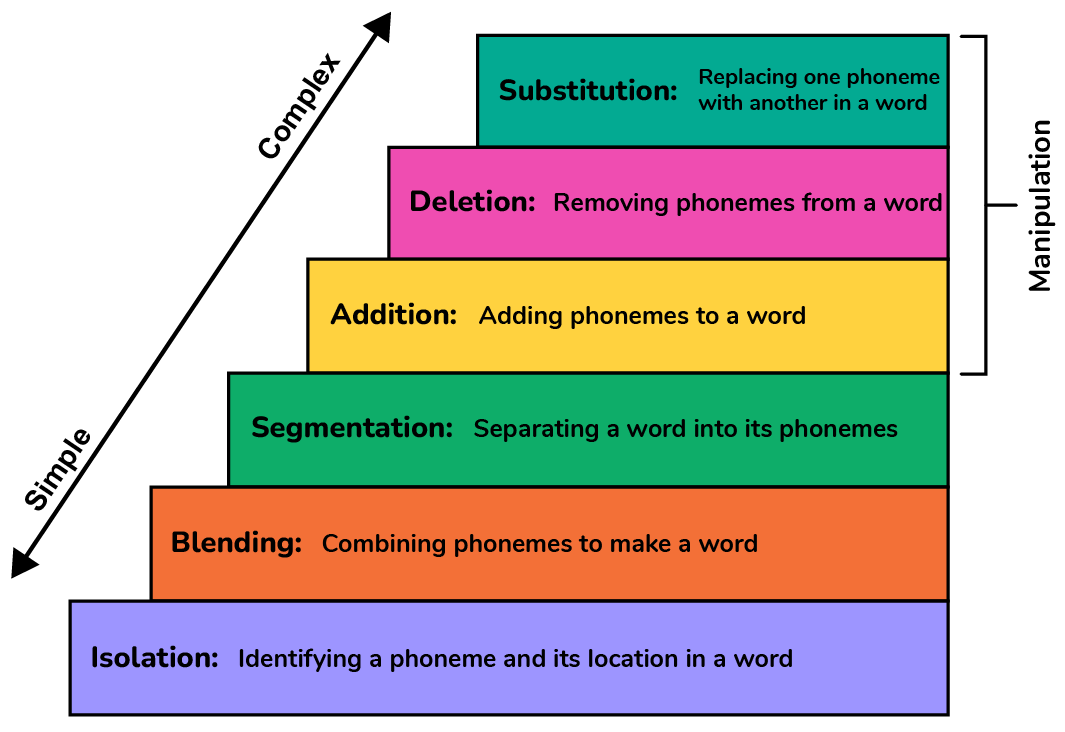
Phoneme Segmentation
the ability to break down a word into separate sounds, as they say and count each sound
Example.
How many sounds are there in the word bug? /b/ /u/ /g/? There are three.
Word Families
a group of words with a shared ending letter group/sound
Example.
back, black, stack, shack, quack, lack, tack
Phoneme Manipulation
the ability to perform phoneme deletion, addition, and substitution.
Phoneme Blending
the ability to blend two sounds to make a word
Example.
Blend together these sounds to make a word: /b/ /a/ /t/ to form bat.
Decoding
in reading out loud, being able to sound out words by breaking them into simple forms; in reading for comprehension, the understanding of how to read each letter or letter pattern in a word to determine the word's meaning
Phoneme Isolation
the ability to hear and recognize the individual sounds in words
Example.
What is the first sound you hear in dog? /d/
Final Stable Syllable
consonant + -le syllable occurs at the end of a word.
If the consonant + -le syllable is found next to an open syllable, then the vowel in the open syllable stays long.
If the consonant + -le is next to a closed syllable, the vowel in the closed syllable stays short.
Example.
bugle, candle, bubble, circle, and trample
Consonant Digraph
two consonants that make a single consonant sound when together in a word
Example.
In the word "wish," the letters s and h form the consonant digraph, sh.
Affix
a letter or letters that change a root word's meaning
Example.
prefixes or suffixes
Vowel-Consonant-E Syllable
has a silent "e" and makes the vowel before it long; this syllable is usually found at the end of a word
Example.
name, mice, cake, compete
Closed Syllable
syllable that ends in a consonant; vowel has its short sound
Example.
hot, help, dog, mistake
Morphology
the study of forms of words, including affixes, roots, stems, and parts of speech
Example.
The word "bicycles" is made up of three individual morphemes. The prefix bi-, the stem cycle, and the suffix -s.
Phoneme Deletion
the ability to recognize and understand a word or sound(s) that remain when a phoneme is removed
Example.
"What is bat without the /b/?" "at"
Phoneme Substitution
the ability to substitute one phoneme for a different one
Example.
replace the first sound in 'bug' with 'r' . Rug
Morpheme
a combination of sounds that has meaning in speech or writing and cannot be divided into smaller grammatical parts; this includes prefixes and suffixes
Example.
write, cat, laugh, box
Phonemic Awareness / Sound Awareness
the ability to hear, identify, and re-create individual sounds in spoken words
Example.
A student can hear that /b/ makes first sound in the word blue.
Encoding
using individual sounds to spell a word
Example.
To encode, a student must represent the sounds of a word with letters. For example, the word cat would be encoded as /c/, /a/ and /t/.
Diphthong
one vowel sound made by the combination of two vowel sounds
Example.
the "ou" in south; the "au" in taught; the "oy" in oyster
Phonics / Graphophonemic Principle
using the relationship between symbols (letters and words) and sounds of a language to read and write
R-Controlled Syllable
syllable that contains a vowel followed by the letter r; the r controls the vowel and changes the way the vowel is pronounced
Example.
car, guitar, mother, and manor
Grapheme
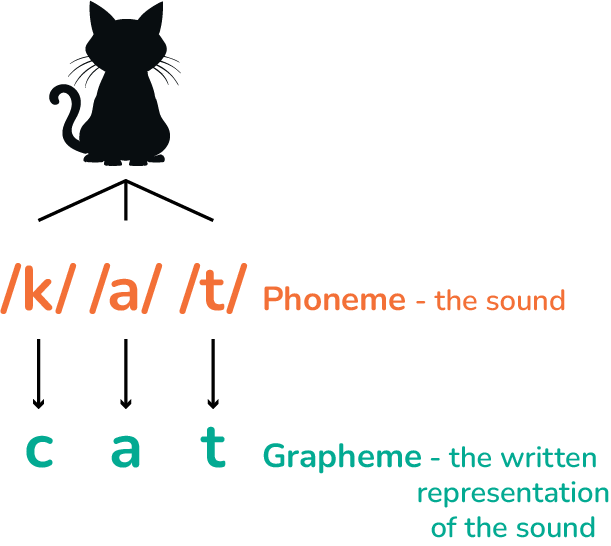
a written letter or a combination of letters that represents a single sound
Example.
"ph" makes a "f" sound
Syllable Awareness / Syllabication / Syllable Segmentation
the ability to hear individual parts/syllables of words
Example.
“Education” has four syllables “ed-u-ca-tion”
Phoneme Addition
the ability to make a new word(s) by adding a phoneme to an existing word
Example.
What new word can you make by adding a sound to the beginning of at? Bat, cat, rat, and sat.
R-Controlled Vowel
a vowel followed by the letter r where the "r" that doesn't make its normal short or long sound
Example.
In the word, "tiger," the letter e is an r-controlled vowel, as its pronunciation changes because it is followed by an r.
Rhyme Awareness / Rhyming
the ability first to hear words that rhyme and then to be able to produce a rhyme(s)
Example.
“Blue” and “Flew” rhyme
Phoneme
the smallest individual sounds in a word
Example.
The word “bit” has three phonemes – b – i – t.
Open Syllable
ends in a vowel; the vowel has its long sound
Example.
vacant, brutal, agent
Consonant Blend
two or more consonants that blend together when decoded, but each retains its own sound
Example.
In the word "blue," the letters b and l form the consonant blend, bl.