Lecture 11: Gas Exchange
 Call Kai
 Learn
 Practice Test
 Spaced Repetition
 Match
 Flashcards
 Knowt Play
1/100

Earn XP
Description and Tags
BISC 101 with Dr. Williams
101 Terms
animals have to take in _____ for cell respiration, and expel _____ to stay alive
O2, CO2
____ and _____ provide very different constraints on the design of gas exchange systems
air, water
gas exchange by diffusion is maximized by what three factors?
large area, small diffusion distance, partial pressure (concentration) gradient
larger organisms have ___________ to replenish oxygen around gas exchange surfaces
ventilatory mechanisms
circulatory systems use the pressure generated by one or more specialized organs (hearts) for __________ of gases (and nutrients, etc.)
bulk transport
in large organisms, gases are transported in specialized tissue (______) using specialized oxygen-carrying proteins (____________)
blood, respiratory pigments
what order are the four steps of gas exchange?
ventilation → gas exchange → circulation → cellular respiration
ventilation
movement of air/water through or around gas exchange surfaces (skin, trachae, gill, lung)
gas exchange
occurs by diffusion as O2 and CO2 move between air/water and blood at respiratory surface
circulatory systems
transports gases throughout the body delivering them to cells/tissues
gas exchange occurs by diffusion at tissues between _______ and ________
blood, cells
O2 is ______ at sea level, plentiful!
21%

air is less _____ and _____ compared to water
dense, viscous
ventilation is relatively ______
easy
air can utilize…
bi-directional flow
gas exchange in air is ______ efficiency since we only extract _____ of O2 in the air
low; 25%
gas exchange in water contains ____ less O2 than air
less
how much oxygen does water contain vs air on average?
7ml/L (water) vs. 210ml/L (air)
high density/viscosity = _______
hard to move
breathing in water is relatively ___________
energy demanding
respiratory systems for animals who do gas exchange in water are unidirectional, making it _____________
high efficiency
what do small animals rely on due to lacking specialized gas exchange organs?
diffusion across their body surface
how thin are the walls of organisms lacking specialized gas exchange organs?
1-2 cells thick
how are small organisms without specialized gas exchange organs shaped?
long, thin, or flattened body shape
why does having a thin body help organisms without specialized gas exchange organs?
short diffusion distances as they rely on diffusion
what minimizes the distance substances must diffuse to enter/leave the cell in small organisms?
circulatory systems
Fick’s Law for rate of diffusion
(diffusion constant) x (area for gas exchange) x (difference in partial pressure of gar on either side of barrier to diffusion) / (distance)

O2 from air diffuses across how many cell layers at gas exchange surfaces?
2 cell layers
at tissues, O2 diffuses a short distance from ______ to _______
blood, cells
aquatic animals use what for gas exchange?
gills
gills increase ________ for gas exchange
surface area
organisms use _________ to maintain O2/CO2 gradients
ventilation
operculum
gill cover
fish gills are a ____________ system
countercurrent exchange
in fish, water moves ____ through the mouth and _______ through the operculum
in, out

ventilation occurs in fish through what two methods?
buccal pumping (pumping of the mouth) or ram ventilation (simply swimming forward)
what type of ventilation do fish use?
positive pressure ventilation
gills consist of 4 _________
gill arches (bone)
what does each gill arch have?
2 rows of gill filaments

what does each row of gill filaments have?
hundreds/thousands of gill lamellae
water flows through lamellae in the _________ direction to blood flow, which is known as countercurrent exchange
opposite
___________ exchange is much more efficient than ___________ exchange
countercurrent, concurrent
countercurrent flow means that a ________________ exists along the whole length of the lamella
positive partial-pressure gradient
the countercurrent exchange ________ the amount of O2 extracted from water
maximizes
how does the insect tracheal system work?
air-filled tubes (trachea) branch throughout body + air sacs

how does the tracheal system in insects interact with rest of the body?
smallest (tracheoles) reach individual cells and have fluid-filled tips
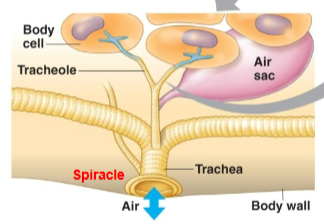
what does the insect tracheal system rely on?
diffusion (small insects) or pumping movements of body
openings of the trachea (spiracles) regulate _________ and __________
air flow, water loss
what is the order structures from beginning to end in the mammalian respiratory system?
trachea → bronchi → bronchioles → alveoli
no gas exchange occurs in which three structures of the mammalian respiratory system?
trachea, bronchi, and bronchioles
how many alveoli are there in humans?
150 million
alveoli are responsible for what function and why?
site of gas exchange; large surface area to accomodate
how does diffusion occur in the mammalian respiratory system?
diffusion across the alveolus wall
what is the distance and surface area of the alveolus wall?
distance is 0.2 μm (1/200 of a page); SA is 140 m2 (1/3 basketball court)
what drives negative-pressure ventilation in the mammalian respiratory system?
changes in the volume and pressure of the chest cavity
inhalation in mammalian respiratory system
intercostal (rib) muscles contract, pulling ribs up and out as diaphragm moves down
during inhalation, how does the volume, pressure, and air change?
volume increases, pressure decreases (more negative), air comes in
exhalation in mammalian respiratory system
mostly passive; diaphragm and muscles relax
during exhalation, how does the volume, pressure, and air change?
volume decreases, pressure increases (less negative), air out
what happens during active exhalation?
muscles pull ribs down and in
what do active muscle tissues use?
oxygen (pO2 decreases)
what do active muscle tissues produce?
carbon dioxide (pCO2 increases)
regulation of ventilation in mammals mainly relies on changes in ______ and _______
pCO2 and pH
what are the inputs of the respiratory system?
pH [CO2] of cerebrospinal fluid, pH sensors in major blood vessels (carotid bodies)
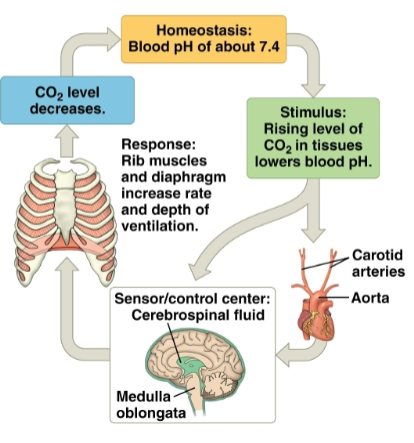
what happens after pH [CO2] of the cerebrospinal fluid and carotid bodies are input?
medulla oblongata receives signal and sets basic rhythm for breathing

how many breaths per minute does the medulla oblongata set?
12/14 breaths/min
what are the outputs of mammalian respiration in active muscle tissue?
neural signals to diaphragm and muscles of rib cage

breathing is normally regulated by…
involuntary mechanisms
how are oxygen and carbon dioxide transported in the blood?
partial pressure gradients of O2 and CO2 drive diffusion of gases in different parts of the circulatory system
carbon dioxide has _____ solubility in blood than O2
higher
what is the solubility of carbon dioxide in the blood?
200mL CO2/L of blood
_____ solubility of oxygen in the blood and high metabolic demands require specific adaptations for _____ and ______ of O2
low, binding, transport
what is the solubility of oxygen in blood?
(4.5 ml O2/L of blood)
what do respiratory pigments for oxygen do?
help with binding and transport of oxygen
CO2 produced by cell respiration enters the blood to react with ______
water

what does the combination of tissue-produce carbon dioxide and water form?
carbonic acid
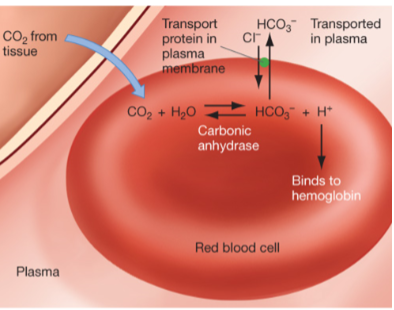
what enzyme does carbonic acid require?
carbonic anhydrase
what does carbonic acid rapidly dissociate to form?
bicarbonate ions and protons

what is the formula of carbon dioxide + hydrogen → carbonic acid → bicarbonate ions and protons
CO2 + H2O → H2CO3 → H+ + HCO3-
what are the 3 forms CO2 is transported?
bicarbonate ions in blood plasma, bound to AA side-chains of hemoglobin, dissolved in blood plasma
what percent of CO2 are transported as bicarbonate ions (HCO3-) in blood plasma?
70%
what percent of CO2 are transported to bind to AA side-chains of hemoglobin?
23%
what percent of CO2 are transported to dissolve in solution in blood plasma?
7%
respiratory pigments for O2 transport have distinct ________ due to O2-binding metal ions
colours
what is hemoglobin?
4 polypeptide chains (tetramer) each with a non-protein heme group with one iron ion (Fe2+)

what does the Fe2+ in hemoglobin bind to?
oxygen

which organism has green blood?
marine worm
what does the oxygen-Hb equilibrium curve describe?
how much oxygen % binds to hemoglobin with variation in pO2
the oxygen dissociation curve is…
sigmoidal (S-shaped)
in cooperative binding, there is a _____ increases in O2 unloading
17%

in noncooperative binding, there is a _______ increase in O2 unloading
7%

on the steep part of the oxygen-hemoglobin equilibrium curve, a _________ in pO2 leads to a _________ in how much O2 is unloaded
small change, large change
Hb is __________ to changes in pO2
very sensitive
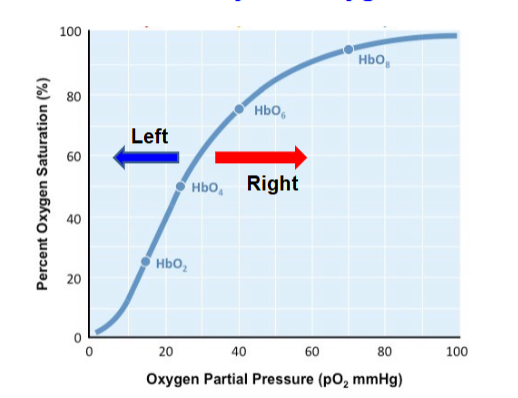
what does shifting the oxygen dissociation curve change?
“affinity” for oxygen
left shift in oxygen dissociation curve = Hb saturates at lower pO2 = __________
high affinity (good at lungs)
right shift in oxygen dissociation curve = Hb unloads O2 at even higher pO2 =__________
lower affinity (good at cells)
local ____________ can influence how strongly O2 binds to hemoglobin
biochemical environment
CO2 production by active tissues affects pH in what way?
decreases pH due to proton (H+) production
lower pH ___________ of hemoglobin for O2 (how strongly O2 is bound)
decreases affinity
what is the term for the following process:
Hb releases more O2 in more active tissues during exercise due to decreased affinity since pH is lowered
Bohr shift
