Glycolysis Case Study
 Call Kai
 Learn
Learn Practice Test
 Spaced Repetition
 Match
Match Flashcards
 Knowt Play
1/82

There's no tags or description
Looks like no tags are added yet.
Name | Mastery | Learn | Test | Matching | Spaced | Call with Kai | Chat |
|---|
No analytics yet
Send a link to your students to track their progress
83 Terms
what two things things does the directionality of a reaction depend on??
free energy
relative concentrations of reactants and products available
enzymes control the ______ of forward and reverse reactions in a pathway
rates
what is a benefit of having enzyme-mediated regulatory mechanisms
makes pathways sensitive and responsive to the needs of the organism
where do phototrophs get their energy? chemotrophs?
phototrophs→sunlight
chemotrophs→oxidation of carbon fuels
what are the five basic principles that govern energy manipulations in all cells
molecules are synthesized/degraded in a stepwise fashion via a series of reactions (=metabolic pathways)
ATP is the energy currency of life
ATP can be formed by the oxidation of carbon fuels
there are a limited number of reaction types involving specific intermediates that are common to all metabolic pathways
metabolic pathways are highly regulated
what are the two categories of metabolic pathways
catabolic and anabolic pathways
what is an anabolic pathway
anabolic pathways USE ATP and reducing power to synthesize larger biomolecules (aka building)

what is a catabolic pathway
reactions that involve the combustion of carbon fuels to make ATP (aka breaking things down and usually at least yielding CO2)

compare catabolic and anabolic pathways in terms of ATP use
catabolic reactions have a net yield of ATP (even if they have to consume a little) and anabolic reactions have a net consumption of ATP
what are amphibolic pathways
pathways that can either be anabolic or catabolic
can anabolic and catabolic reactions share reactions? even if they are irreversible?
yes!
irreversible reactions are always distinct though (makes sense because anabolic is building up and catabolic breaking down)
does glycolysis happen in all cells?
common to virtually all cells (prokaryotes and eukaryotes)
what are the two major phases of glycolysis? (and what steps do they include)
the energy investment stage (steps 1-5) and energy payoff stage (steps 6-10)
what is broadly happening energy investment and payoff stage?
investment: glucose transformed and 2 ATP used
payoff: 4 ATP formed and NAD+, reduced to 2NADH and 2H+, and 2 pyruvate + 2H2O formed

what are the three net reactions of glycolysis
glucose→2 pyruvate + 2 H2O (glucose transformation)
4 ATP formed - 2 ATP used → 2 ATP gained (ATP)
2 NAD+ + 4e- + 4H+ → 2NADH + 2 H+ (redox)
does each numbered step in glycolysis involve a unique enzyme?
yes, each different reaction is catalyzed by a unique enzyme
what is glucose
6-carbon monosaccharide
steps 6-10 have ___ x for every glucose molecule
2 times
how many pyruvate are made for 1 glucose molecule
2 pyruvate for every glucose
in which step does glucose get split in half?
step 4
which steps are we focusing on (hint: there are 5)
step 1, 3, 6, 7, and 10
are we talking about a specific step in glycolysis or the whole reaction when we say it is catabolic?
the whole reaction because it generates a net amount of ATP
what is the reaction called when a phosphate is added?
phosphoryl transfer
what is happening in step 1 of glycolysis? (transformation, reaction type, ATP consumed or produced, enzyme, reversibility)
glucose→glucose 6-phosphate (aka phosphorylation)
reaction type: phosphoryl transfer
the consumption of ATP
catalyzed by hexokinase
irreversible (has a delta G of -33.5)
what is the goal of step 1 of glycolysis?
transforms glucose to a version that cannot leave the cell (aka trapping it in the cell)
is hexokinase seen in other parts of glycolysis?
nope! this single enzymes catalyzes this step 1
how can you tell a reaction is reversible/irreversible in glycolysis?
look at delta G (not delta G prime), and if it is really close to 0→reversible and larger negative value→irreversible (energetically favorable)
what is going on in step 3? (transformation, reaction type, ATP consumed or produced, enzyme, reversibility)
fructose 6-phosphate→ fructose 1, 6 bisphosphate (phosphorylated/phosphoryl transfer)
reaction type: phosphoryl transfer
ATP consumed
enzyme: phosphofructokinase aka PFK1
irreversible (has a delta G of -22.2)
(not one of the official ones to know but for my sake) what is happening in step 4? is it reversible?
fructose 1, 6-bisphosphate is broken down to 1 dihydroxyacetonephosphate (DHAP) and 1 glyceraldehyde 3-phosphate (G3P)
it is reversible (has a delta G of -1.3)
can DHAP proceed in glycolysis to step 5?
nope, it needs to be G3P
why do steps 6-10 happen twice
because glucose is now in the form of 2 G3P (3 carbon each) so both need to be consumed
what is going on in step 6? (transformation (2), reaction type, ATP consumed or produced, enzyme, reversibility)
transformation: G3P is oxidized and phosphorylated to form 1,3-bisphosphoglycerate AND 2NAD+ is reduced to 2NADH + 2H+
reaction type: phosphorylation coupled to oxidation
no ATP is consumed/produced in this step
enzyme: triose phosphate dehydrogenase
reversible (has a delta G of -1.7 so reversed reaction is still energetically favorable)
what is going on in step 7? (transformation, reaction type, ATP consumed or produced, enzyme, reversibility)
transformation: 1,3 bisphosphoglycerate into 3-phosphoglycerate (dephosphorylated)
reaction type: phosphoryl transfer
2 ATP are produced (ultimately after going through it twice or another way of thinking about it is 1 ATP produced in this step)
enzyme: phosphoglycerkinase
reversible because its delta G is +1.3 (close to 0)
what is going on in step 10? (transformation, reaction type, ATP consumed or produced, enzyme, reversibility)
phosphoenolpyruvate (PEP) into pyruvate (will happen twice to yield 2 pyruvate) (aka dephosphorylated)
reaction type: phosphoryl transfer
ATP is produced (one per step 10 but net yield is 2 ATP since it happens twice)
enzyme: pyruvate kinase
more irreversible since its delta G is -16.7
what are the three irreversible steps we need to know of glycolysis
steps 1 (trapping glucose), 3 (phosphorylating and using ATP), and 10 (dephosphorylating and yielding ATP)
glycolysis can only proceed if the delta G values of all reactions are _____
negative
we know that delta G for all reactions of glycolysis need to be negative but what about some of the reactions, like step 7, that have small positive delta G values?
we assume that the concentration of metabolites in vivo in cells undergoing glycolysis are not precisely known
describe the energy profile of glycolysis (ex: what steps have the largest energy group and how can we tell what parts of reversible with this graph)
steps 1, 3, and 10 have the largest energy drop (hence why they are reversible)
the section highlighted at yellow are basically at or near equilibrium and are freely reversible in vivo

the enzymes involved in very exergonic (irreversible) reactions are subject to _____ control
allosteric (when molecules binds to active site or another spot to result in a shape change, altering the activity)
is pyruvate more or less stable than glucose
more stable (lower in energy)
what is an oxidation-reduction reaction (redox)
the transfer of electrons during chemical reactions, resulting in a release of energy stored in organic molecules
the released energy from redox reactions is used to synthesize what?
ATP
what happens during oxidation vs reduction?
oxidation: substance loses electrons (OIL)
reduction: substance gains electrons (amount of positive charge is reduced RIG)

rank these molecules from highest to lowest energy
highest: methane, methanol, formaldehyde, formic acid, and carbon dioxide

rank these molecules from highest to lowest stability
carbon dioxide, formic acid, formaldehyde, methanol, and methane

rank these molecules in reactivity highest to lowest
highest
methane, methanol, formaldehyde, formic acid, and carbon dioxide
methane has a delta G oxidation value of -820 vs carbon dioxide has a delta G oxidation value of 0. what can we conclude/which one releases more energy?
methane releases more energy (the better fuel because it is less stable)
is carbon dioxide considered fully oxidized or reduced? what about methane?
CO2 is considered fully oxidized (more oxygens)
methane is considered fully reduced (has more hydrogens)
what is the relationship between energy/stability with electronegativity (esp in terms of C-H and C-O bonds)
with higher electronegativity difference (C-O bond), there is lower energy. this is because electrons are held more tightly, making them at a low energy level and unlikely to react→more stable molecule
with a lower electronegativity difference (C-H bond), there is higher energy. the electrons are held loosely and are at a higher energy level. this makes them more likely to react→less stable molecule
the lower the energy the more or less stable a molecule is?
more stable
(gain or loss) oxidation is the _____ of oxygen and reduction is the _____ of oxygen
oxidation is the GAIN of oxygen and reduction is the LOSS of oxygen
(gain or loss) oxidation is the _____ of hydrogen and reduction is the _____ of hydrogen
oxidation is the LOSS of hydrogen and reduction is the GAIN of hydrogen
(gain or loss) oxidation is the _____ of electrons and reduction is the _____ of electrons
oxidation is the LOSS of electrons and reduction is the GAIN of electrons
redox reactions must involve what key molecules
electron carriers
what does NAD+ stand for/slightly describe its structure
nicotinamide adenine dinucleotide
it has an active site in red and ADP in black)

what is a hallmark aspect of step 6 besides the actual phosphorylatoin
the coupled redox reaction, where NAD+ gets reduced (aka gain hydrogens)
what should we look at first when determining what is getting oxidized and reduced in the context of this case
look at the electron carrier to see whether or not it is getting reduced or oxidized. then, the other molecule is the opposite
how many steps are in step 6 and what are they?
two steps
1: oxidation of carbon (G3P into oxidized G3P intermediate)
2: acyl-phosphate formation (phosphorylation of oxidized G3P intermediate into phosphorylated 1,3 bisphosphoglycerate)

because step 6 has more than one step, are more than one enzyme needed
nope! these two steps are catalyzed by the same enzyme (glyceraldehyde 1-phosphate dehydrogenase or triose phosphate dehydrogenase—same molecule different name)
little hint if the glycolysis diagram lists the enzyme, what does this mean
the reaction is irreversible
where is the inorganic phosphate form in step 6
the cytosol
what will the phosphate attack during acyl phosphate formation of step 6
the thioester intermediate (not the oxidized G3P intermediate)
what comes first: oxidation or reduction in a redox rxn
oxidation covers the cost of reduction
what covers the cost of phosphorylation in step 6
oxidation of G3P (more specifically thioester formation)
what is reaction coupling
when a thermodynamically unfavorable reaction in a pathway can occur by coupling it to a more favorable reaction

in order construct a metabolic pathway, what two criteria must be met
the individual reactions must be specific
the pathway in total must by thermodynamically favorable
what is the role of an enzyme in reaction coupling
it facilitates the transfer of energy from one reaction to the next
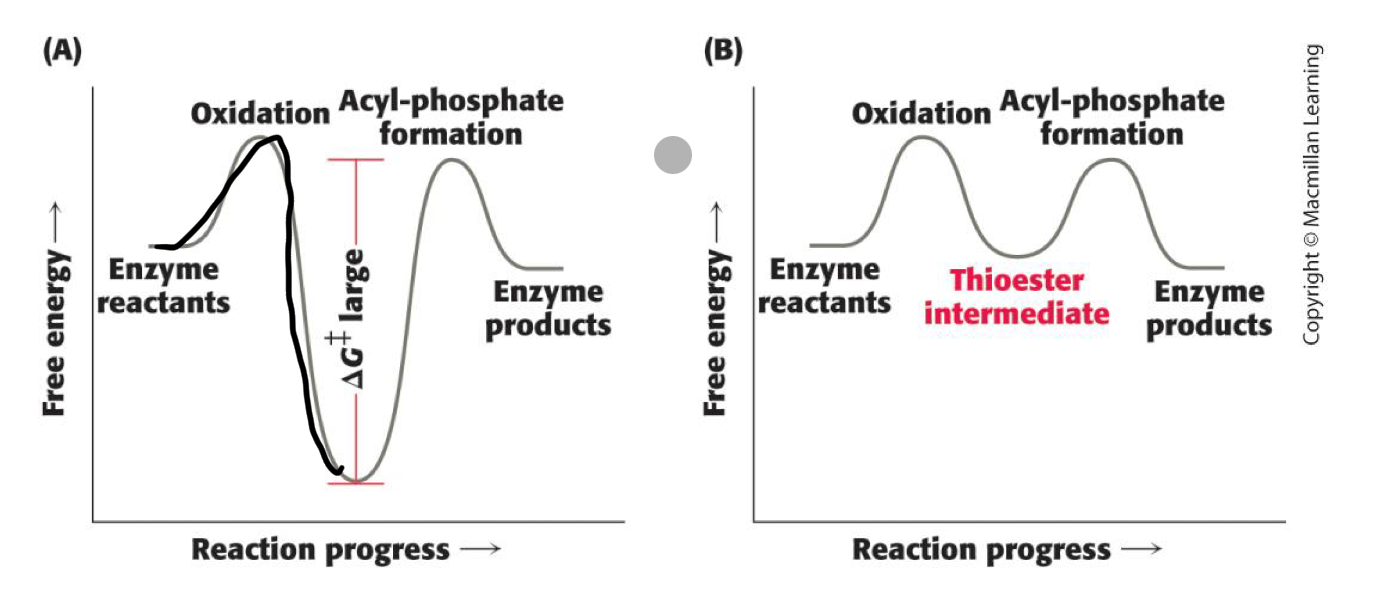
how is reaction coupling seen in step 6 (mention why thioester intermediate formation is necessary)
favorable reaction: oxidation of G3P; this step releases a lot of energy
unfavorable reaction: phosphorylation of G3P to form 1, 3 bisphosphoglycerate
the oxidation of G3P releases a lot of energy, but a thioester intermediate forms to “trap” that energy through the formation of a C-S bond (higher energy bond/more unstable). thiolate is a better leaving group than a C-O bond, making its leaving favorable. this makes it “easier”/ more favorable to phosphorylate, allowing phosphorylation to happen

compare and contrast a reaction energy profile for step 6 with and without a thioester intermediate
the first one shows no coupling while the second one is the actual case with coupling. without coupling, there is a large activation barrier, making the reaction very slow
describe the structure of ATP, ADP, and AMP (which one has more repulsion/more stable)
ATP has the most repulsion because it has the most phosphate groups (3) (negatively charged), ADP is the second (2 groups), and AMP is the most stable/least amount of repulsion (only one phosphate group)

describe the kinetics and thermodynamics of ATP hydrolysis
kinetically stable: the reaction is slow without an enzyme bc the Ea required is very high
thermodynamically unstable: the system has a high Gibbs free energy and wants to move to a lower, more stable energy state (aka talking about how ATP is high in energy bc of repulsion/not stable and ADP is lower in energy/less repulsion)
is the hydrolysis of ATP an energetically favorable
yes, has a negative delta G (spontaneous)

how common ATP hydrolysis/synthesis
very common
ATP hydrolysis powers motion, active transport (ex: ATPase in osteoclast, biosynthesis, signal amplification)
ATP synthesis from ADP is seen in oxidation of fuel molecules or fuel synthesis (catabolic)
is biosynthesis anabolic or catabolic
anabolic
what is the standard free energy of hydrolysis
the energy released in a phosphoryl transfer reaction
how do we determine whether a phosphoryl transfer reaction is favorable/which one will be the donor
see which one has the highest phosphoryl transfer potential (can tell with delta G)
define phosphoryl transfer potential
the tendency of a phosphate bearing molecules to donate a phosphoryl group to an acceptor molecules
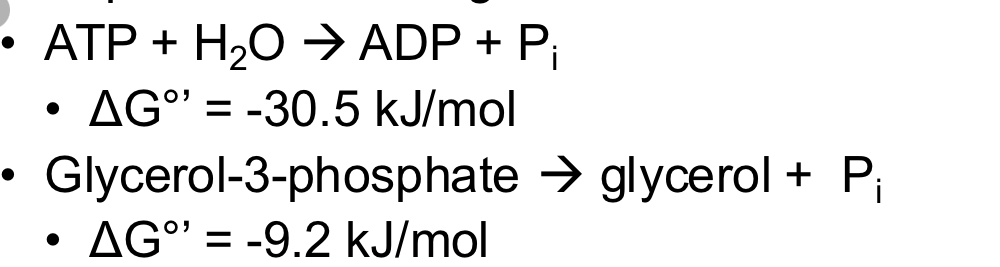
which one has the higher phosphoryl transfer potential: G3P or ATP
ATP (releases more energy)
what are four reasons why ATP has a high phosphoryl transfer potential
electrostatic repulsion
stabilization due to hydration: ADP and Pi forming bonds with water
increase in entropy (one molecule to two molecules in hydrolysis)
resonance stablization (Pi has greater resonance stabilization than ATP) (see slide 32 for structure)

rank these in highest to lowest phosphoryl transfer potentials (ignore creatine)
PEP
1,3 - BPG
ATP
glucose 6-phosphate
what needs to happen to form ATP from ADP
the phosphate donor must be a substrate with a higher phosphoryl transfer potential than ATP
describe how keto-enol tautomerization contributes to the favorability of step 10
in step 10, pyruvate kinase transfers a phosphate group from PEP (enol phosphate after enolase makes PEP from phosphoglycerate to remove H2O and make a C=C bond) to ADP to form ATP and enol pyruvate. the enol pyruvate will spontaneously tautomerize to form the stable keto form of pyruvate

what is tautomerization
the spontaneous rearrangement of atoms within a molecule to produce a more stable isomer=tautomer (ex: enol (C=C and OH) to keto (carbonyl group)