Exam 3
 Call Kai
 Learn
 Practice Test
 Spaced Repetition
 Match
 Flashcards
 Knowt Play
1/121

There's no tags or description
Looks like no tags are added yet.
122 Terms
amt of membranes in prok v.s. euk cells
prok → 1 plasma membrane to separate cell from outside
euk → add’l internal membranes enclose indiv organelles
what inhibits ions (ex. Cl-) from passing thru plasma membrane?
the hydrophobic interior of plasma membrane
3 important functions of plasma membrane
receptor proteins in it act as sensors that enable cell to receive info abt changes in its environment & respond to them
passes nutrients inwards & waste products outwards
expands for cell growth & mvmt
the most common phospholipid in cell membranes is ____. describe its parts.
Phosphatidylcholine
its parts:
Choline: the hydrophilic head
Phosphate: links choline to glycerol
Glycerol: links phosphate to 2 hydrocarbon chains
2 hydrocarbon chains: which originate as fatty acids
why are amphipathic phospholipids useful?
form a lipid bilayer
separate aqueous environment inside cell from aqueous environment outside cell
hydrophilic heads = attracted to water
hydrophobic tails = don’t like water
describe the self-sealing qualities of cell membrane
created by same forces which make it amphipathic
this closed structure = stable bc it avoids exposure of hydrophobic hydrocarbon tails to water, which would otherwise be energetically unfavorable
what are liposomes?
a pure phospholipid in a close, spherical formation

what influences the fluidity of the phospholipid bilayer?
Temperature
Types of hydrocarbon tails (phospholipid composition)
Hydrocarbon tails that do not pack closely together inc the fluidity of the membrane (saturated vs unsaturated tails)
Unsaturated fatty acid tails increase the fluidity
Short tails inc fluidity of membrane
how are lipid bilayers synthesized?
Newly synthesized phospholipid molecules are added to cytosolic side of the ER membrane
Scramblases then transfer some of these molecules to the opposite monolayer so that the entire bilayer expands
phospholipids randomly distributed
Flippases (enzyme found in Golgi) help maintain asymmetry of plasma membrane in animal cells
fixes random distribution and makes sure phospholipid distribution is asymmetric
purpose of cholesterol in cell membrane
cholesterol fits into gaps btwn phospholipid molecules in lipid bilayer → stiffens it → makes it more rigid & less permeable
can also prevent hydrocarbon chains from coming tg & crystalizing
how are phospholipids & glycolipids distributed in cell membrane in relation to each other?
they’re distributed asymmetrically
the 2 sides of the lipid bilayer are…
cytosolic: faces cytosol
noncytosolic: faces exterior of cell OR interior of internal organelle
Membranes ____ (do/don’t) retain their orientation even after transfer between cell compartments
DO
original cytosolic surface remains facing the cytosol; Noncytosolic surface continues to face away from the cytosol
describe glycolipids
they’re located mainly in plasma membrane
found only in the Noncytosolic half of the bilayer
sugar groups facing exterior of cell
they acquire their sugar groups in Golgi (since enzymes that add sugars are confined inside Golgi)
what are transmembrane proteins?
protein that goes all the way through membrane, and is sticking out from both sides

describe a transmembrane hydrophilic pore
Five transmembrane α helices forma water-filled channel across the lipid bilayer
The hydrophobic amino acid side chains on one side of each helix contact the hydrophobic hydrocarbon tails, while the hydrophilic side chains on the opposite side of the helices form a water filled pore
what are monolayer-associated membrane proteins?
protein only on one side of the membrane

what are lipid-linked membrane proteins?
lipid connects protein to membrane
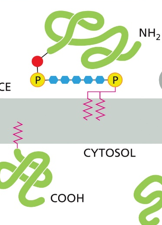
what are protein-attached (peripheral membrane) proteins?
sticking out from membrane

if you want to break up a lipid bilayer, you have to…
use a detergent
Small amphipathic lipid-like molecules which only have one hydrophobic tail
Spontaneously aggregate into clusters, or micelles, in water
Able to squeeze in btwn lipids & proteins in plasma membrane, separate them, & keep them in water soluble complexes

what is a cell cortex?
meshwork of fibrous proteins that are attached to the cytosolic surface of the membrane
cell membrane lays on top of it
determines shape of cell AND its mechanical properties
what’s spectrin?
main component of cell cortex
a long, thin, flexible rode and is attached to cytosolic surface of membrane
Spectrin dimers, tg w/ a smaller # of actin molecules, are linked tg in a netlike meshwork that is attached into plasma membrane by binding of at least 2 types of attachment proteins to 2 kinds of transmembrane proteins

how is the lateral mobility of the plasma membrane proteins restricted?
Proteins can be:
Tethered to the cell cortex inside the cell
Tethered to the extracellular matrix molecules outside the cell
Tethered to proteins on the surface of another cell
Diffusion barriers which can restrict proteins to a particular membrane domain
The eukaryotic cell surface is coated with ____. describe them/their functions
sugars
Attached to both lipids and proteins in the extracellular face only
Functions:
Absorb water
give the cell a slimy surface
prevent blood cells from sticking to one another or to the walls of blood vessels
Play an important role in cell-cell recognition and adhesion
describe neutrophils, oligosaccharides, & their roles in battling infection
cell-surface carbohydrate on neutrophils (aka WBC) is recognized by the cells lining the blood vessels at sites of infection
Oligosaccharides (short sugar chains) carried by glycolipids and glycoproteins on the extracellular faces of neutrophils
Oligo. recognized by lectins on the endothelial cells lining the blood vessels @ site of infection
Provide “ID” tags for cells, which are recognized by immune system, and unfortunately, also pathogens
neutrophil now able to migrate to infected tissue

describe bacteriorhodopsin
transporter protein that crosses the lipid bilayer as 7 α helices
acts as a proton pump during the light-activated pumping cycle
When retinal (chromophore) absorbs a photon of light, it changes shape, & causes the protein to undergo a series of small conformational changes
The changes result in the transfer of 1 H+ moving across the bilayer along the pump channel
In presence of sunlight, thousands of bacteriorhodopsin pump H+ out of cell, generating a concentration gradient of H+ across the plasma membrane, which can be converted into ATP
how can photobleaching techniques measure the rate of lateral diffusion of a membrane protein?
FRAP: Fluorescence Recovery After Photobleaching
GFP: Green Fluorescent Protein derived from a jellyfish
glows when exposed to correct wavelength of light
The membrane protein of interest is tagged with GFP
The cell expressing the GFP fusion protein is irradiated with a laser beam that irreversibly bleaches the fluorescent group in a spot
rate of “fluorescence recovery” = diffusion rate of tagged membrane bound proteins

what is Single-particle tracking (SPT) microscopy, and why is it useful?
Labeling proteins w/ antibodies coated w/ gold particles
The gold spheres appear as tiny black dots under the microscope
The movement of individually tagged proteins can be tracked using video microscopy
The patterns of movement range from random diffusion to complete immobility
Some proteins switch between these different kinds of motion

what kind of molecules can pass rapidly across the bilayer?
small hydrophobic molecules
small uncharged polar molecules
Na+ is the most plentiful positively charged ion (cation) ____ the cell, while K+ is the most plentiful ____
outside; inside
transporter v.s. channel proteins
transporter: undergoes conformational changes to transfer specific molecules across the membrane
channel: Has a hydrophilic pore, through which specific molecules can diffuse
describe passive transport
No energy required
If a molecule moves from an area of high concentration to an area of low concentration, then the molecule is moving down its concentration gradient
Simple diffusion: no transport protein required
Facilitated diffusion: transport proteins required
describe active transport
Requires energy
If a molecule moves from an area of low concentration to an area of high concentration, then the molecule is moving up its concentration gradient
describe the 2 conformational states of a transport protein
The binding sites for the solute are exposed on the outside of the membrane
The same sites are exposed on the other side of the membrane

Both _______ and _______ drive passive transport
concentration gradients; electrical forces

Electrochemical gradient is determined by what 2 factors?
Concentration gradient of an ion
it overrides every other factor that can influence
Distribution of positive and negative charges on either side of the membrane called membrane potential
describe the 3 diff types of active transport
Coupled Transport: mvmt of one molecule down its concentration gradient is coupled to the movement of another molecule up its concentration gradient
ATP-driven pump: mvmt of one molecule up its concentration gradient is coupled to the hydrolysis of ATP to ADP
Light-driven pump (most are in bacteria): mvmt of one molecule up its concentration gradient is coupled to the light energy

Why does a cell need to control the concentration of Na+ and K+ across its membrane?
cell must maintain high concentration of Na+ on the extracellular side of the membrane, as the movement of Na+ into the cell is coupled to the movement of other molecules across the membrane (coupled transport)
cell must maintain high concentration of K+ on the cytoplasmic side of the membrane for proper functioning of the nervous system
purpose of ATPase
enzyme that converts ATP to ADP
component of Na+-K+ pump
6 steps of sodium-potassium pump
Na+ binds to protein transporter
pump phosphorylates itself, hydrolyzing ATP'
phosphate is in high-energy linkage w/ transport protein
phosphorylation triggers conformational change & Na+ is ejected
K+ binds
pump dephosphorylates itself
phosphate removes itself from transport protein
pump returns to OG confirmation & K+ is ejected inside cell
describe the Ca2+ pump & why it’s important
Intracellular signaling often involves an increase of intracellular (cytosolic) Ca2+, therefore, the intracellular concentration of Ca2+ must be kept low
Similar to Na+-K+ pump: requires ATP
Contains ATPase within pump
describe the 2 types of couple transport
Symport: 2 molecules are transported in the same direction across the membrane
Antiport: 2 molecules are transported in the opposite directions across the membrane

describe uniport
only one molecule is transferred across the membrane
The glucose-Na+ symport protein uses the ______ to drive the import of glucose via _____
electrochemical Na+ gradient
symport
H+ is pumped into ______ in animal cells and _____ in plant cells to control the _______ & _______ of _________
lysosomes
vacuoles
pH & function of organelles
If the concentration of solutes inside a cell is higher than outside, then…
water will move in by osmosis, causing the cell to swell (cell lysis)
If a cell is placed in a high-salt solution, then…
water will rush out (crenate)
describe aquaporins
allow the selective passage of water molecules across a membrane (osmosis)
The majority of channels in animals and plants are _____ (describe them)
ion channels
Depends on the diameter/shape of an ion and the amino acids in the interior of the pump (the ion will squeeze through these)
Opposite charges work best
Because ions are surrounded by water, the channels can get “jammed”, forcing the flow of ions to slow down
Most ion channels are also gated (switch between open and closed confirmation)
describe voltage-gated channels
Controlled by membrane potential
major player in transmission of signals between nerve cells
Controlled by extremely sensitive voltage sensors
(Specialized charged protein domains on ion channel proteins)
Changes in the membrane potential above certain threshold → exerts sufficient electrical force on voltage sensors → channel to opens/closes
describe ligand-gated channels
Controlled by binding of a ligand (such as neurotransmitters) to the channel protein (receptor)
describe stress-activated channels
Controlled by mechanical force
Ex: sounds trigger the opening of ion channels in ear hair cells
how do stress-gated ion channels allow us to hear?
basilar membrane below and the tectorial membrane above are not lipid bilayer membranes, but sheets of extracellular matrix
Sound vibration causes the basilar membrane to vibrate up and down, causing the stereocilia to tilt
Each stereocilium on each hair cell is attached to the next shorter stereocilium by a fine filament
The tilting stretches the filaments, which pull open stress-gated ion channels in the stereocilium membrane, allowing positively charged ions to enter from the surrounding fluid
The influx of ions activates the hair cells, which stimulate underlying endings of the auditory nerve fibers that convey the auditory signal to the brain.
Ions on each side of the membrane decide the _____. define it
membrane potential = Voltage diff across membrane due to a slight excess of positive ions on one side and of negative ions on the other
A typical potential for an animal cell plasma membrane is about ______, measured relative to the surrounding fluid
-60 mV (inside negative
why are K+ leak channels important for the membrane potential?
The high intracellular concentration of K+ is in part generated by the Na+-K+ pump, which actively pumps K+ into the cells
In a resting cell, K+ leak channels are the main ion channels open in the plasma membrane
what kinds of channels are used for action potentials, and how do they work?
ligand-gated channels
they open temporarily & cause depolarization of the plasma membrane (change in membrane potential) at that particular site
Membrane potential becomes less negative
Depolarization stimulates opening of voltage-gated Na+ channels
Leads to further depolarization
how do rapid changes in membrane potential trigger an action potential?
resting membrane potential: -60 mV
stimulus depolarizes the plasma membrane by about 20 mV to make the membrane potential -40 mV
-40 mV is the threshold value for initiating an action potential
After an action potential is triggered, the membrane rapidly depolarizes and reaches +40 mV before it returns to its resting state
describe the 3 conformations a voltage-gated Na+ channel can adopt
open (Na+ can flood into cell)
inactive (unpolarized membrane; closed & CANNOT reopen)
this state allows us to ensure that action potential only travels in one direction
closed (polarized membrane & membrane @ rest; ready to go)

In order for the plasma membrane to return to its resting membrane potential after experiencing an action potential, 2 events occur:
Na+ channels automatically switch to an inactive state
Voltage-gated K+ channels open
K+ moves out of the cell (down its electrochemical gradient in the depolarized cell)
synaptic vesicles contain…
neuorotransmitters
at the nerve terminal, an ____ signal is converted into a ____ signal. how?
electrical; chemical
When an action potential reaches a nerve terminal, it opens voltage-gated Ca2+ channels in the plasma membrane, allowing Ca2+ to flow into the terminal
The increased Ca2+ in the nerve terminal stimulates the synaptic vesicles to fuse with the plasma membrane, releasing their neurotransmitter into the synaptic cleft
A ____ signal is converted into an ____ signal by transmitter-gated ion channels at a synapse. how?
chemical; electrical
The released neurotransmitter binds to and opens the transmitter-gated ion channels in the plasma membrane of the postsynaptic cell
The resting ion flows alter the membrane potential of the postsynaptic cell, thereby converting the chemical signal back into an electrical one
excitatory vs inhibitory neurotrans
Excitatory neurotransmitters activate ion channels that allow the passage of Na+
Inhibitory neurotransmitters activate ion channels that allow the passage of Cl-
Three stages of cellular metabolism lead from food to waste
breakdown of large food molecules to simple subunits
mostly occurs outside cells, although lysosomes can digest large molecules in the cell interior
breakdown of simple subunits to acetyl CoA; limited amts of ATP & NADH produced
occurs mainly in cytosol: except for the final step of conversion of pyruvate to acetyl groups on acetyl CoA, which occurs in the mitochondria
complete oxidation of acetyl grp in acetyl CoA to H2O & CO2; large amts of ATP produced on inner mitochondrial membrane
occurs entirely in the mitochondria
3 general steps of glycolysis
energy investment to be recouped later
Glucose is converted to fructose 1,6-bisphosphate
cleavage of 6-carbon sugar to two 3-carbon sugars
energy generation
explain step 1 of glycolysis
one molecule of glucose experiences catalysis of hexokinase, which phosphorylates the glucose
irreversible reaction
rearrange molecule into fructose
fructose 1,6-bisphosphate produced by another phosphorylation w/ phosphofructokinase
irreversible reaction
net results of glycolysis
2 pyruvate, 2 ATP, 2 NADH
synthesis of ATP in glycolysis is known as substrate-level phosphorylation
Involves the transfer of a phosphate group directly from a substrate molecule
when animal muscle cells & certain bacteria are lacking oxygen, pyruvate is converted to _____. what’s this process called? how does it occur?
lactate
this process is anaerobic; it’s called fermentation
glycolysis → pyruvate + NADH → lactate + NAD+
when yeast is lacking oxygen, pyruvate is converted to _____. what’s this process called? how does it occur?
ethanol & CO2
this process is anaerobic; it’s called fermentation
glycolysis → Pyruvate --> acetaldehyde + CO2 --> ethanol (NADH is oxidized to NAD⁺)
how does the oxidation of pyruvate result in acetyl CoA?
Pyruvate is oxidized to acetyl CoA & CO2 by pyruvate dehydrogenase
pyruvate (3C) + NAD+ + CoA → acetyl CoA + CO2 NADH
occurs in mitochondrial matrix
one acetyl CoA per pyruvate
how does the oxidation of fatty acids result in acetyl CoA?
long fatty acid chain → acetyl CoA + NADH + FADH2
chops off 2C at a time from carbon chain → multiple acetyl CoA per pyruvate
occurs in mitochondria
where does the citric acid cycle/Kreb’s cycle occur? why?
in the mitochondria
bc pyruvate & fatty acids are directed there for acetyl CoA production
the citric acid cycle catalyzes the complete ____ of ___ atoms in _____ _____
oxidation
carbon
acetyl CoA
what are the net products of the Kreb’s cycle?
3 NADH
1 FADH2
1 GTP
2 CO2
per 1 acetyl CoA
products of each step of the Kreb’s cycle
Citrate Is Kreb’s Starting Substrate For Making Oxaloacetate
C: citrate
I: isocitrate
K: ketoglurate
S: succinyl CoA
S: succinate
F: fumarate
M: malate
O: oxaloacetate
Glycolysis and the TCA cycle provide the precursors needed to …. & give example
synthesize many important biological molecules
many of the intermediates formed are used for biosynthetic (anabolic) pathways, where they’re converted into amino acids, nucleotides, lipids, & other small organic molecules
To maintain order with cells, all organisms need to ____ through _____
constantly replenish their ATP pools
sugar or fat oxidation
Why do cells synthesize food reserves?
To store energy when food is plentiful for times of scarcity.
What is a key role of metabolic regulation?
Directing metabolites into anabolic or catabolic pathways.
pyruvate is a very common substrate; name some reactions it’s involved in
Pyruvate dehydrogenase converts pyruvate to acetyl CoA
Lactate dehydrogenase converts it to lactate
Another enzyme can convert it to oxaloacetate
Another can change it to alanine
_____ = “reverse” reactions from glycolysis; describe it
Gluconeogenesis
makes blood glucose from small non-carbohydrate organic molecules like lactate, pyruvate, or amino acids
mainly in the liver
requires energy
bypasses glycolysis’s irreversible steps 1, 3, and 10 using 4 bypass reactions
Both glycolysis & glycogenesis pathways are tightly regulated
Animal cells store ____ to provide energy in times of fasting; describe it
glycogen
its structure is very similar to that of starch in plants
branched polymer of glucose
starch has many few branch pts than glycogen
What regulates glycogen synthesis and breakdown?
Low energy: Cells break down glycogen for energy.
Glycogen phosphorylase: Breaks glycogen → glucose-1-phosphate → glucose-6-phosphate (enters glycolysis).
Glucose-6-phosphate (G6P):
Activates glycogen synthase (glycogen synthesis).
Inhibits glycogen phosphorylase (glycogen breakdown).
ATP also inhibits glycogen phosphorylase.
Why is fat a better energy store than glycogen?
~2× more energy per gram than glycogen.
Glycogen binds water, making its stored mass ~6× greater for equal energy.
Energy reserves: Glycogen lasts ~1 day; fat lasts nearly 1 month.
auditory hair cells are ____ gated
stress-mechnically
_____ leak channels are important for maintaing the resting membrane potential of -60 to -80 mV in animal cells
potassium
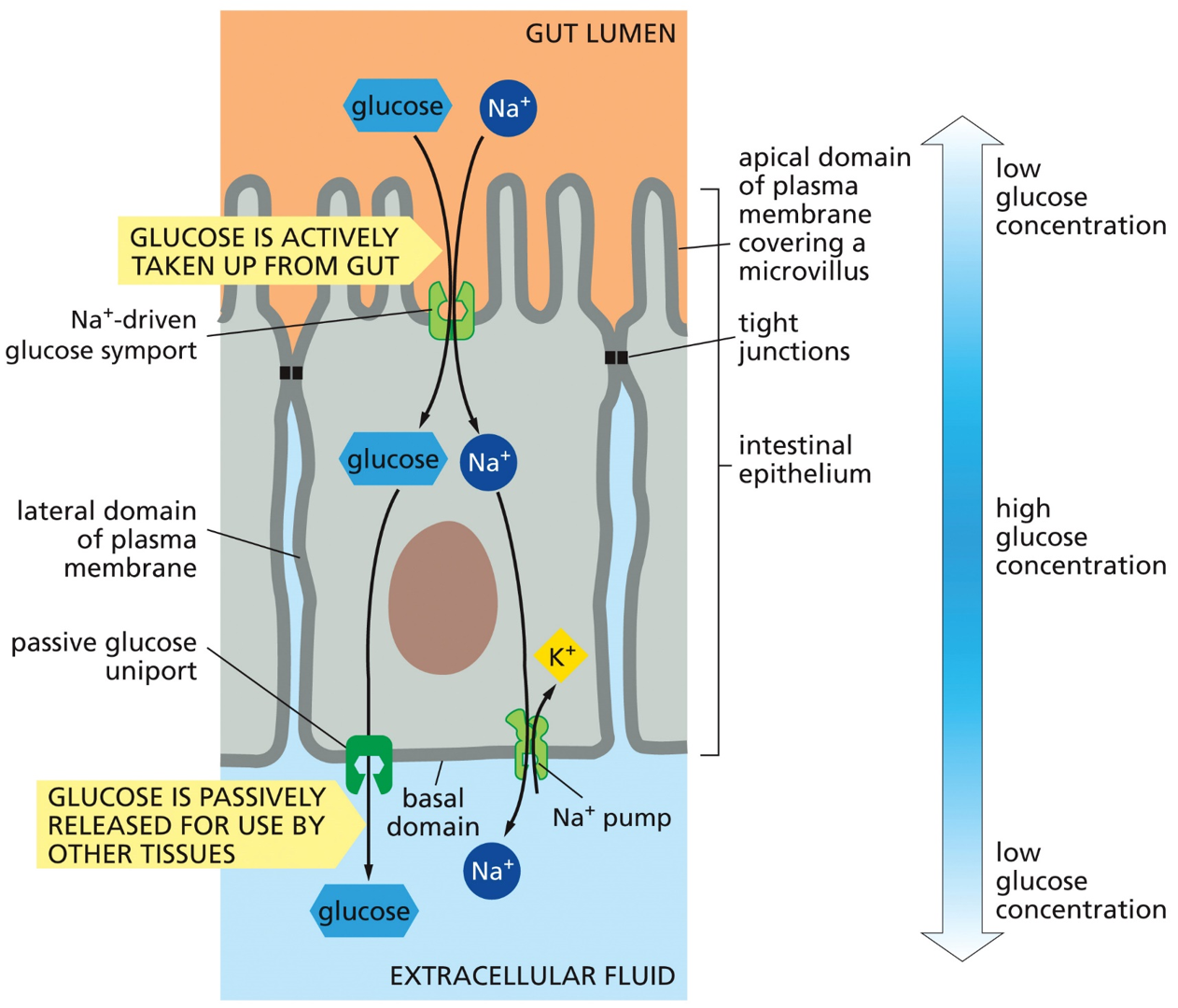
how is glucose absorbed from gut lumen into intestinal epithelial cells?
Na+-glucose symporter on apical membrane uses Na+ moving down its electrochemical gradient to drive glucose uptake against its gradient (active transport)
Na+/K+ pump uses ATP to move Na+ out & K+ in, maintaining this gradient
how does glucose leave intestinal epithelial cells, & where does it go?
GLUT uniporters on basolateral membrane allow glucose to exit via facilitated diffusion
moves down its concentration gradient into extracellular fluid for use by other tissues

what are key membrane regions & structures in intestinal glucose absorption?
apical membrane faces gut lumen
basolateral membrane faces extra cellular fluid
tight junctions seal neighboring cells & maintain distinct membrane domains
Na+ enters apically w/ glucose & is pumped out basolaterally using ATP
the high concentration of H+ ions can be found in…
intermembrane space (space btwn outer & inner membranes)
which part of ATP synthase is responsible for linking the diff moving parts?
stator, specifically its peripheral stalk
How does the electron transport chain (ETC) generate ATP?
NADH and FADH₂ donate electrons to ETC in inner mitochondrial membrane
e- pass through carriers to progressively lower energy states → released energy pumps H⁺ across the membrane → proton gradient created → ATP synthesis from ADP
Finally, O₂ accepts the electrons and combines with H⁺ to form H₂O

The essential requirements for harnessing energy in the form of ATP are…
A membrane containing a series of electron carriers (ETC), a pump protein, and an ATP synthase
Sources of high-energy electrons derived from the oxidation of food and of protons
describe the stages of chemiosmosis during oxidative phosphorylation
Stage 1: Electron transport and proton pumping
High-energy electrons release energy as they move through the electron transport chain.
This energy powers proton pumps that move (H+) across the membrane, creating a high concentration of protons on one side.
Stage 2: ATP synthesis
Protons flow back across the membrane through ATP synthase, moving down their electrochemical gradient.
ATP synthase uses this energy to combine ADP and inorganic phosphate to produce ATP.

describe chemiosmotic coupling
Uses energy from e- transport to pump H⁺ across inner mitochondrial membrane, creating a proton gradient
H⁺ then flows through ATP synthase, driving ATP production from ADP + phosphate
describe some basic characteristics of mitochondria
Contain own DNA and RNA
Constantly change shape and position in the cell
Position varies between cell types depending on where the majority of ATP is needed
a mitochondrion is organized into 4 separate compartments; describe them
matrix: Innermost compartment; contains enzymes for pyruvate oxidation, fatty acid oxidation, and the citric acid cycle.
inner membrane: Folded into cristae; contains the electron transport chain and ATP synthase for oxidative phosphorylation.
outer membrane: Surrounds the mitochondrion; contains porins that allow small molecules (≤ 5,000 Da) to pass through.
intermembrane space: Space between the inner and outer membranes; accumulates H⁺ during electron transport to create the gradient used for ATP synthesis.

how do NAD⁺ and NADH carry electrons and hydrogen during cellular respiration?
(A) Reduction: NAD⁺ → NADH
NAD⁺ accepts a high-energy electron and becomes a negatively charged intermediate.
It then accepts an H+ from the surrounding water.
The carrier becomes reduced NADH, carrying high-energy electrons.
(B) Oxidation: NADH → NAD⁺
NADH donates its high-energy electron to another molecule.
This creates a positively charged intermediate.
The intermediate releases H+ into the surrounding water, regenerating oxidized NAD⁺.

How does the ETC create a proton gradient in cellular respiration?
NADH and FADH₂ donate electrons to the ETC.
Their energy powers H⁺ pumps across the inner mitochondrial membrane, creating a gradient that drives ATP synthase.
O₂ accepts electrons and H⁺ to form H₂O.
