Health Sci 1001A Midterm
 Call Kai
 Learn
 Practice Test
 Spaced Repetition
 Match
 Flashcards
 Knowt Play
1/142

Earn XP
Description and Tags
week 1-7
143 Terms
what is the pathogenic view of health?
presence or absence of disease
what is the salutogenic view of health?
how we can become healthy despite having disease (holistic view)
what is the difference btwn health and wellness?
health - how we feel in the moment
wellness - a process
what are non-modifiable risk factors?
things we can’t control (genetics, ethnicity)
what are modifiable risk factors?
thing we can change (smoking, exercise)
what are the nine dimensions of wellness?
physical
emotional
intellectual (brain)
interpersonal (relationships)
cultural
spiritual
environmental
financial
occupational (liking your job)
what are infectious (communicable) diseases?
spread by bacteria
what are chronic (noncommunicable) diseases?
continue for a long period of time
what are the trends of infectious vs. chronic disease?
infectious is unsteady, chronic is steady
what were some of the major health threats in the 1920’s?
hygiene, infectious disease, no medicine
what are some of the major health threats in the 2020’s?
chronic disease, climate change, antibiotic resistance
what is health promotion?
promoting health through literacy and behaviours
what is health behaviour change?
changing unhealthy habits to health habits

what model is this?
health belief model
what is bounded rationality?
people make decisions that are good enough instead of perfect ones

what model is this?
transtheoretical model
what are the steps of the transtheoretical model?
pre-contemplation - no change
contemplation - knows theres a problem
preparation - wants to do something about it
action - does something
maintenance - keeps it up
relapse
termination - fixed
what is the difference btwn state and trait?
state - temporary
trait - prolonged
what is choice architecture?
environment influences decision-making (e.g. groccery stores putting things in the back)
what is mental hygiene?
focus on mental disorders
what is mental health?
focus on living an enjoyable life despite challenges

what model is this?
dual-continua model of mental health
what is positive (humanistic) psychology?
having a fulfilled life
what are the levels of maslow’s hierarchy of needs?
psychological needs (food, shelter)
safety/security (safe neighbourhood)
love/belonging (relationships)
self-esteem (achievement)
self-actualization (creativity)
what is subjective wellbeing?
how a person thinks about their life
what are the two types of subjective wellbeing?
hedonic - focuses on good experiences
eudaimonic - focuses on self-actualization
what is self-concept?
who we believe ourselves to be (strengths, weaknesses)
what is integration?
bringing parts of yourself together into an identity
what is agoraphobia?
fear of public spaces where you can’t escape
what is panic disorder?
panic attacks
what is thalassophobia?
fear of deep water
what is social anxiety disorder?
fear of being observed by others
what is generalized anxiety disorder (GAD)?
fear of everything
what is the difference btwn obsession and compulsion?
obsession - causes anxiety (contamination, perfection)
compulsion - things you have to do to relieve anxiety (checking the door knob)
what is post-traumatic stress disorder (PTSD)?
traumatic event that continues to cause anxiety
what is the difference btwn anxiety and mood disorders?
anxiety - fear of something
mood - sadness
what is the difference btwn loneliness and solitude?
loneliness - involuntarily being alone
solitude - voluntarily being alone

what acronym do we use for signs of suicide?
IS PATH WARM
what is the biologcal model and its treatment?
biological model - illness comes from the brain itself
medication - serotonin/norepinephrine reuptake inhibitors
what is the behavioural model and its treatment?
behavioural model - illness comes from bad habits
operant conditioning - reinforcements/punishments
what is the cognitive model and its treatment?
cognitive model - illness comes from our thoughts
cognitive behavioural therapy (CBT) - talking about your processes of thinking
what is the psychodynamic model and its treatment?
psychodynamic model - illness comes from our unconsciousness
psychodynamic therapy - talking about the past
what is the difference btwn psychotherapists/counsellors, psychologists, and psychiatrists?
psychotherapists/counsellors - can give therapy (masters)
psychologists - can diagnose (PhD)
psychiatrists - can prescribe (MD)
what is the physical response to stress?
nervous system + endocrine system
what is the difference btwn the nervous and endocrine system?
nervous - fast and short-lasting
endocrine - slow and long-lasting
what is the difference btwn the autonomic and somatic nervous system?
autonomic - involuntary
somatic - voluntary
what are the two types of the autonomic system?
parasympathetic - rest and digest
sympathetic - fight/flight
what is the difference btwn adrenaline/epinephine and cortisol?
epinephrine - quick response
cortisol - long-term response
what is fight, flight, freeze, fawn?
fight - interact with threat
flight - run away
freeze - body doesn’t respond
fawn - being nice to threat
what is the cognitive response to stress?
thinking about the stressor
what is cognitive appraisal?
how bad we think the stressor is (harmful, threatening, challenging)
what is the emotional response to stress?
how we feel about a stressor
what is the window of tolerance?
window of tolerance - best
hyper-arousal - scared (fight/flight)
hypo-arousal - defeated (freeze)
what is the behavioural response to stress?
the things we do (our choices)
what are some examples of behavioural responses to stress?
binge eating, exercising
what is the difference btwn eustress and distress?
eustress - good stress
distress - bad stress
what is the general adaptation syndrome (GAS) theory?
#1 alarm stage - fight/flight/freeze/fawn
#2 resistance stage - new baseline
#3 exhaustion stage - can’t be handled
what is rejection therapy?
putting yourself in a situation where you will be told NO
what is allostasis?
how our body is able to anticipate and react to stressors (homeostasis)
what is allostatic load?
the effect of all stressors
acute, chronic, cumulative, repetitive
what is allostatic overload?
when stress is too much to handle (stressor + symptoms)
what is psychoneuroimmunology?
nervous, immune, endocrine systems
what is the process of psychoneuroimmunology?
epinephrine makes immune cells release cytokines (promotes inflammation)
what are behavioural strategies to manage stress?
exercise, sleep, nutrition
what are cognitive strategies to manage stress?
positive self-talk
what are emotional strategies to manage stress?
focused attention mindfulness (FAM) and open monitoring meditation (OMM)
what are social strategies to manage stress?
reach out to friends or family
what is body composition?
what our body weight is made of
what is fat-free mass?
essential for our body (organs, water, etc)
what are the functions of fat?
energy, insulation, fights infections
what is the difference btwn leptin and ghrelin?
leptin - tells the brain its full
ghrelin - tells the brain its hungry
what is leptin resistance?
body produces too much leptin, body becomes resistant, and you keep eating
what is subcutaneous fat?
skin fat
what is visceral fat?
abdominal fat
what is ectopic fat?
over organs
what is body mass index (BMI)?
compares weight to height
what are skinfold calipers?
calipers pinch skin
what is the body roundness index (BRI)?
using weight, height, and waist
what is bio-electrical impedance analysis (BIA)?
current travels through the body
fat is resistant (no water), fat-free is not resistant (has water)
what is the bod pod?
sees how much air you displace
what is the dual emission x-ray absorptiometry (DEXA)?
takes an x-ray
what is the socio-ecological model?
individual - interpersonal - community - society
what are some individual factors that contribute to obesity?
genetics (nutrigenomics)
metabolism (resting metabolic rate)
leptin, ghrelin
fat cells
lifestyle choices
what are some interpersonal factors that contribute to obesity?
parents, culture
what are some community/organizational factors that contribute to obesity?
type of food available
what are some policy/societal factors that contribute to obesity?
health policies (e.g. mandatory nutrition facts)
what is an obesogenic environment?
how our environment promotes obesity
how many calories is 1kg of body fat?
7000 calories
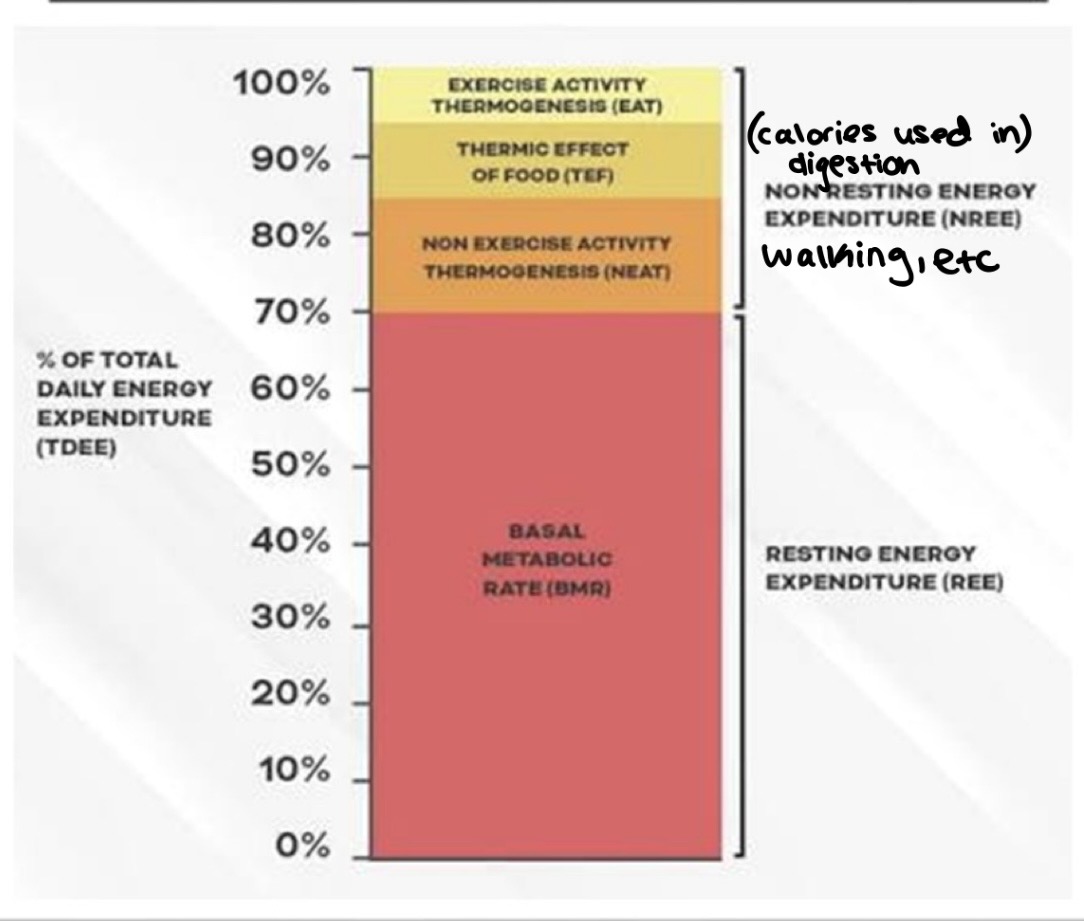
what model is this?
total daily energy expenditure breakdown
what are dietary supplements?
supplements that promise weight loss
what is the difference btwn weight bias, weight stigma, and weight discrimination?
weight bias - assumptions people make (internal)
weight stigma - stereotypes people make (societal)
weight discrimination - excluding based on weight
what is body dysmorphic disorder?
not liking how your body looks
what is anorexia nervosa?
not eating enough food
what is bulimia nervosa?
binging then purging
what is binge eating disorder?
eating a lot
what is orthorexia?
obsession with healthy food
what is ARFID?
avoidant restrictive food intake disorder
what is nutrition?
the science behind eating
what are essential nutrients?
nutrients our body can’t make, have to get from food
what are the macronutrients and their calories?
carbs - 4 calories
protein - 4 calories
fats - 9 calories