Exam 3 Study Guide - Geology 101
 Call Kai
 Learn
 Practice Test
 Spaced Repetition
 Match
 Flashcards
 Knowt Play
1/76

There's no tags or description
Looks like no tags are added yet.
77 Terms

Where is the oldest layer in this tilted sequence of sedimentary rocks?
a. the darkest layers
b. layers on the right of the photograph
c. at the top of the hill in the center of the photograph
d. layers on the lower left part of the photograph
d. layers on the lower left part of the photograph
Which statement is most accurate?
a. Glaciers are shrinking because of more rapid melting associated with higher temperatures of global warming.
b. Glaciers are growing because of increased precipitation due to greater evaporation rates due to global warming.
a. Glaciers are shrinking because of more rapid melting associated with higher temperatures of global warming.
True or False?
An plutonic igneous rock such as granite would be older than the surrounding rock.
False
True or False?
The albedo of the Earth's surface is highest at the poles.
True
True or False?
Carbon dioxide concentrations in the atmosphere are ~3% of the dry air.
False
You analyze the radioactive isotopes of a rock, and you find that for every 1 radioactive parent isotope, there are 7 stable daughter isotopes. How many half-lifes have past?
a. 5
b. 1
c. 3
d. 4
e. 2
c. 3
True or False?
On average, surface temperatures are warmer in lower latitudes and colder in higher latitudes.
True
An increase in the size of icesheets on the planet would result in a _______ forcing
Select one:
a. positive internal
b. negative external
c. positive external
d. negative internal
d. negative internal
True or False?
The largest glaciers in the world are classified as alpine glaciers.
False
What would happen if the tilt of our planet decreased to 21 degrees? (select all that apply)
Select one or more:
a. Summers would get colder
b. Summers would get warmer
c. Winters would get warmer
d. Winters would get colder
a. Summer would get colder and c. Winters would get warmer
When did dinosaurs first evolve?
Select one:
a. Cenozoic
b. Mesozoic
c. Precambrian
d. Paleozoic
b. Mesozoic

Of the following numbered units listed below, which is the oldest?
Select one:
a. 9
b. 5
c. 2
d. 8
e. 11
d. 8
Which of these statements about the current climate system is TRUE?
Select one:
a. Carbon dioxide concentrations today are higher than they have ever been
b. Temperatures in the past have been significantly warmer than today
c. Carbon dioxide concentrations today are lower than they have ever been
d. Temperatures today are warmer than they have ever been
b. Temperatures in the past have been significantly warmer than today

What type of unconformity is occurring between the rocks F and B?
Select one:
a. Angular unconformity
b. Nonconformity
c. Disconformity
b. Nonconformity
What is the terminus of a glacier?
Select one:
The source of the glacier.
The place where the amount of ice and snow lost is equal to the ice and snow gained.
The lower surface of the glacier where it is in contact with the underlying bedrock.
The end of the glacier, where it is melting.
The end of the glacier, where it is melting.
Which of the following statements about carbon dioxide levels in our geologic past are correct?
Select one:
a. Carbon dioxide does not correlate with global temperatures
b. When carbon dioxide levels are higher, global temperatures are higher
c. When carbon dioxide levels are higher, global temperatures are lower
d. When carbon dioxide levels are lower, global temperatures are higher
b. When carbon dioxide levels are higher, global temperatures are higher
Ages were calculated for four rocks. Which of the following rocks would be classified as Precambrian?
Select one or more:
Rock B, 2000 million years old
Rock C, 3800 million years old
Rock A, 400 million years old
Rock D, 720 million years old
1, 2, and 4 - Precambrian Era ended around 541 million years ago
A radioactive isotope X has a half-life of 500 million years. You sample a rock and find that, for every 1 radioactive parent isotope X, there is 1 stable daughter isotope. How old is this rock?
Select one:
a. 2500
b. 500
c. 1000
d. 1,500
e. 2000
b. 500
Which statement best describes how energy moves into and out of the Earth system?
Select one:
a. Earth's surface receives most of its energy from the sun in the form of light, and the Earth emits radioactivity back into space
b. Earth's surface receives most of its energy from the sun in the form of heat, and the Earth emits light back into space
c. Earth's surface receives most of its energy heat escaping from the core, and the Earth emits heat back into space
d. Earth's surface receives most of its energy from the sun in the form of light, and the Earth emits heat back into space
d. Earth's surface receives most of its energy from the sun in the form of light, and the Earth emits heat back into space
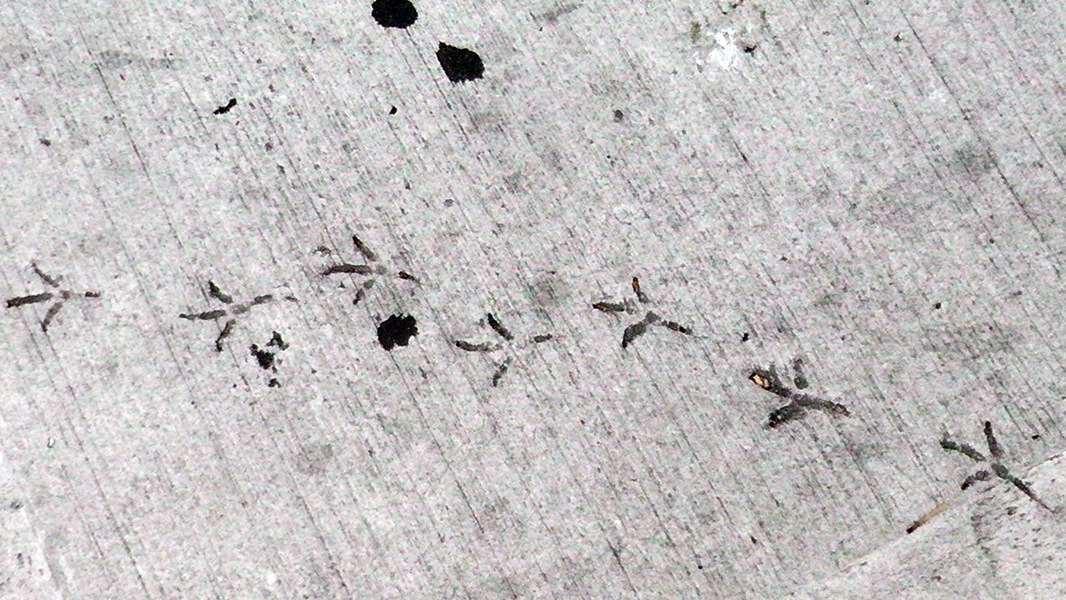
Classify this fossil:
Select one:
a. Not a Fossil
b. Body Fossil
c. Trace Fossil
c. Trace Fossil

What happened between the deposition of units 1 and 2?
Select one:
a. erosion and weathering
b. magma (5) intruded
c. magma in 5 solidified to form a rock
d. all of the above
d. all of the above
Identify the appropriate words to fill in the blanks in the following sentence. Heavy monsoon rains occur during ____________ in India as moist air from the Indian Ocean is drawn over land due to the presence of a _______ pressure system over the Himalayas.
Select one:
a. winter; low
b. summer; high
c. winter; high
d. summer; low
d. summer; low
The principle of original horizontality states that
Select one:
a. sedimentary rocks are deposited as horizontal layers.
b. higher sedimentary layers are younger than lower layers.
c. younger sediment can contain pieces of an older rock.
d. older rock units can be cross cut by younger rocks.
a. sedimentary rocks are deposited as horizontal layers.
Which of these surfaces would have the lowest abledo?
Select one:
a. sandy deserts
b. deep ocean
c. clouds
d. glacial ice
b. deep ocean
You analyze the radioactive isotopes of a rock, and you find that for every 1 radioactive parent isotope, there are 31 stable daughter isotopes. How many half-lifes have past?
Select one:
a. 4
b. 5
c. 1
d. 2
e. 3
b. 5
True or False?
Most of our rainforests occur in places where atmospheric circulation causes air at the surface to rise up to higher altitudes.
True
A major volcanic eruption which adds high concentrations of tephra into the atmosphere would result in a ______ forcing
Select one:
a. positive
b. external
c. neutral
d. anthropogenic
e. negative
e. negative
What is the name for the sediments that are deposited from glaciers?
Select one:
a. Ice sediments
b. Till
c. Drumlins
d. Moraines
b. Till
What would happen if the tilt of our planet increased to 25 degrees? (select all that apply)
a. Winters would get colder
b. Summers would get warmer
c. Winters would get warmer
d. Summers would get colder
a. Winters would get colder
b. Summers would get warmer
When did plants first move onto land and form our first forests?
Select one:
a. Precambrian
b. Cenozoic
c. Paleozoic
d. Mesozoic
c. Paleozoic
How have global average temperatures changed over the last 1000 years?
Select one:
a. Temperatures have been moving from extreme cold glacial periods to warmer interglacials over this time period
b. Temperatures have been steadily decreasing over this time period
c. Temperatures have remained mostly constant over this time period until the very end
d. Temperatures have been steadily increasing over this time period
c. Temperatures have remained mostly constant over this time period until the very end

What type of unconformity is occurring between the layers A and E?
Select one:
a. Angular unconformity
b. Disconformity
c. Nonconformity
b. Disconformity
Approximately when did the most recent Ice Age begin?
Select one:
a. 12 million years ago
b. 2 million years ago
c. 120,000 years ago
d. 20,000 years ago
b. 2 million years ago
Which of the following is not a greenhouse gas?
Select one:
a. Water
b. Carbon Dioxide
c. Nitrogen
d. Methane
c. Nitrogen
Approximately what age was determined for the oldest rocks that have been found on Earth?
Select one:
a. 4 billion years
b. 1.7 billion years
c. 400 million years
d. 2500 million years
a. 4 billion years
A radioactive isotope X has a half-life of 500 million years. You sample a rock and find that, for every 1 radioactive parent isotope X, there are 3 stable daughter isotopes. How old is this rock?
Select one:
a. 2000
b. 1,500
c. 2500
d. 1000
e. 500
d. 1000
How does carbon dioxide warm the planet?
Select one:
a. carbon dioxide absorbs energy from the sun before it hits the surface
b. carbon dioxide captures heat escaping from the surface of the planet
c. carbon dioxide creates friction in clouds generating heat
d. carbon dioxide destroys ozone, allowing more energy in from the sun
b. carbon dioxide captures heat escaping from the surface of the planet

Classify this fossil:
Select one:
a. Not a Fossil
b. Body Fossil
c. Trace Fossil
b. Body Fossil
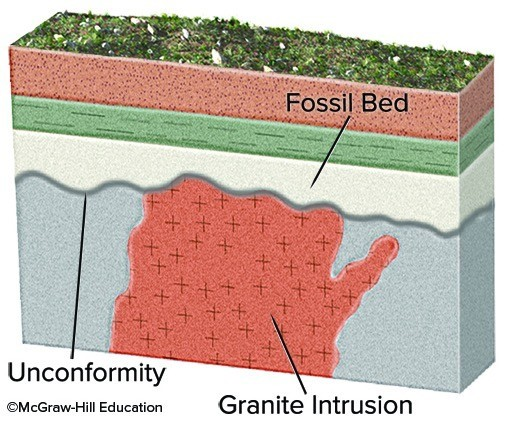
Which of the following statements about the figure below are TRUE?
Select one:
a. The unconformity is older than the fossil bed.
b. The unconformity is older than the isotopic age of the granite.
c. The fossils are older than the granite intrusion
d. The granite is younger than the unconformity.
a. The unconformity is older than the fossil bed.
Prior to this current episode of global warming, when was the last period of near equivalent temperatures?
Select one:
a. 120 years ago
b. 450 years ago
c. 1000 years ago
c. 1000 years ago
The principle of superposition states that
Select one:
a. older rock units can be cross cut by younger rocks.
b. higher sedimentary layers are younger than lower layers.
c. sedimentary rocks are deposited as horizontal layers.
d. younger sediment can contain pieces of an older rock.
b. higher sedimentary layers are younger than lower layers.
Which surface has the highest albedo?
Select one:
a. snow
b. sandy deserts
c. deep ocean
d. forest
a. space
You analyze the radioactive isotopes of a rock, and you find that for every 1 radioactive parent isotope, there are 15 stable daughter isotopes. How many half-lifes have past?
Select one:
a. 2
b. 1
c. 5
d. 4
e. 3
d. 4
True or False?
Surface temperatures over the land are more variable than temperatures over the ocean.
True
Which of the following would classify as an external positive forcing?
Select one:
a. The Earth's orbit becoming more elliptical (oval shaped)
b. Increased ice volume
c. Forest being cut down and replaced with cropland
d. Increase in energy emitted from the sun
e. Burning fossil fuels
d. Increase in energy emitted from the sun

What is the origin of curved ridges (R on this figure) in the Great Lakes area?
Select one:
a. paths of ancient rivers
b. remnants of a meteoroid impact
c. folds produced during a continental collision
d. piles of sediment deposited by retreating glaciers
d. piles of sediment deposited by retreating glaciers
The evolution of hard parts which lead to an abundant fossil record is what we use to define the beginning of which Eon?
Select one:
a. Proterozoic
b. Phanerozoic
c. Archean
b. Phanerozoic
What is the cause of the long cold glacial periods and short warm interglacial periods that the planet has experienced over the last 800,000 years?
Select one:
a. Changes in the intensity of energy from the sung
b. Orbital cycles that affect the distribution of energy from the sun
c. Large scale volcanic eruptions which blanket the atmosphere in tephra
d. Changes in rates of photosynthesis that pull carbon dioxide out of the atmosphere
b. Orbital cycles that affect the distribution of energy from the sun
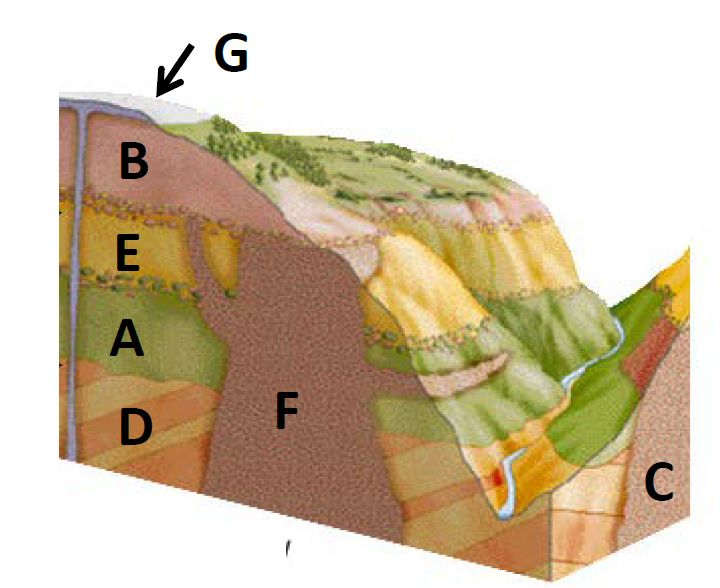
What type of unconformity is occurring between the layers D and A?
Select one:
a. Nonconformity
b. Angular unconformity
c. Disconformity
b. Angular unconformity
In another 11,500 years, Earth's precession will cause its axis to be tilted in the ____ direction. This will result in the coolest temperatures in North America occurring during _____. In contrast the eccentricity of Earth's orbit relates to how _____ Earth is from the sun during different seasons.
opposite; July; far
A radioactive isotope X has a half-life of 500 million years. You sample a rock and find that, for every 1 radioactive parent isotope X, there are 15 stable daughter isotopes. How old is this rock?
Select one:
a. 2500
b. 500
c. 2000
d. 1,500
e. 1000
c. 2000
Classify this fossil:
Select one:
a. Trace Fossil
b. Body Fossil
c. Not a Fossil
b. Body Fossil

Which stratigraphic principle would you use to determine which layer in this picture is the oldest?
Select one:
a. Cross-Cutting Relationships
b. Lateral Continuity
c. Superposition
d. Inclusion
e. Original Horizontality
c. Superposition
How much has global temperature increased since 1860? (in degrees Celsius)
Select one:
a. 0.8 C
b. 3.0 C
c. 8 C
a. 0.8 C
True or False?
An plutonic igneous rock such as granite would be younger than the surrounding rock.
True
True or False?
Due to atmospheric circulation, air masses are rising at the equator.
True
Which of the following examples would be classified as a positive anthropogenic forcing?
Select one:
a. Burning of fossil fuels
b. Increase in cloud cover
c. Increase in the energy from the sun
d. A decrease in the tilt of the planet
e. Ice volume increasing
a. Burning of fossil fuels

True or False?
These sharp mountain ridges formed predominantly from the erosion of glaciers.
True
When did mammals evolve large bodies and become the dominant form of life on land?
Select one:
a. Paleozoic
b. Cenozoic
c. Precambrian
d. Mesozoic
b. Cenozoic
Roughly 80 million years ago, a series of intense volcanic eruptions which significantly changed the climate. What happened?
Select one:
a. Tephra was pushed up into the atmosphere, causing the planet to cool
b. Sulfur dioxide was released which destroyed the ozone layer, causing the planet to warm
c. Greenhouse gases were released, causing the planet to warm
d. Large lakes of lava formed, causing the planet to warm
c. Greenhouse gases were released, causing the planet to warm
What is sea ice made of?
Select one:
a. freshwater
b. salt water
a. freshwater
Earth is approximately the same age as
Select one or more:
a. the Moon.
b. meteorites.
c. the Milky Way.
a & b

Classify this fossil:
Select one:
a. Trace Fossil
b. Not a Fossil
c. Body Fossil
c. Body Fossil
True or False?
Most of our deserts occur in places where atmospheric circulation causes air from higher up in the atmosphere to sink.
True
What is the name for the specific type of glacier that forms on the poles of the Earth?
Select one:
a. Mountain Glaciers
b. Ice Sheets
c. High-Latitude Glaciers
d. Polar Glaciers
b. Ice Sheets
Which of the following time intervals are eras?
Select one or more:
a. Cambrian
b. Phanerozoic
c. Mesozoic
d. Cenozoic
c & d
Classify this fossil:
Select one:
a. Body Fossil
b. Not a Fossil
c. Trace Fossil
a. Body Fossil
Which geologic feature will form due to a period of non-deposition or erosion?
Select one:
a. a fold
b. an intrusion
c. an unconformity
d. a gap
e. an inclusion
c. an unconformity
True or False?
Rising air results in cloudy conditions and precipitation.
True
A change in the Earth system that results in an increase in the amount of energy on the surface of our planet is referred to as a _______ forcing.
Select one:
a. internal
b. anthropogenic
c. positive
d. external
e. negative
c. positive
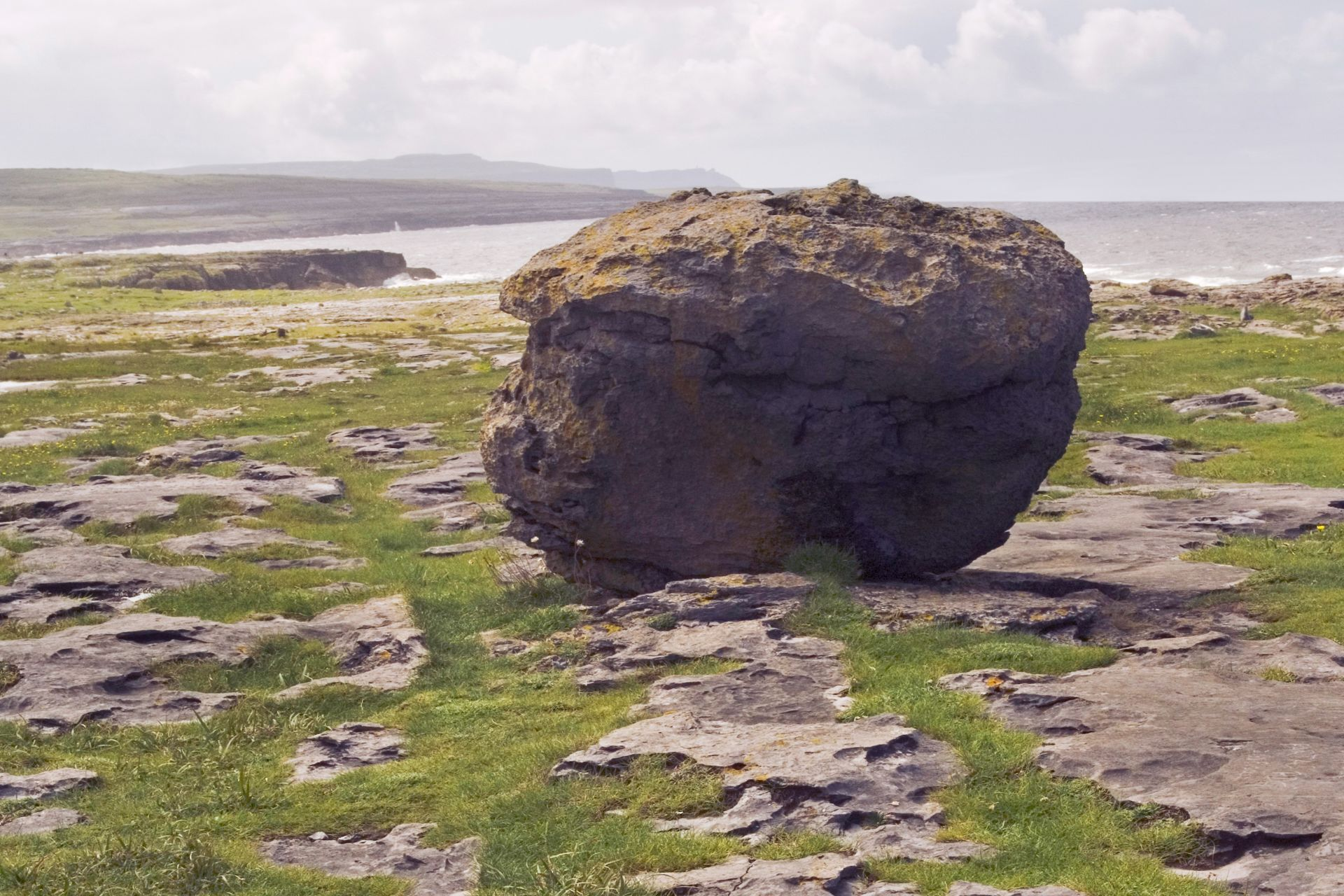
True or False?
This large rock was deposited by a melting glacier.
True
True or False?
When air sinks from higher in the atmosphere, it becomes drier.
True
Till is
a. well sorted
b. poorly sorted
c. moderately sorted
b. poorly sorted
Which of the statements about the figure below is TRUE?
Select one:
a. The unconformity is younger than the fossil ages on the tilted bed.
b. The unconformity is older than the fossil ages in layers above the unconformity.
c. The amount of time represented by the unconformity can be approximately bracketed by the ages of the fossils above and below.
d. All of the above are true
d. All of the above are true
f you were trying to correlate these two sequences of rocks, what would be the most straightforward strategy to use?
Select one:
a. compare the fossils of the middle layers
b. compare the thicknesses of the lower layer
c. determine numeric ages on pieces of rock in the landslide on top
d. compare the thicknesses of the middle layer
a. compare the fossils of the middle layers