Chapter 1: Thinking Like An Economist
 Call Kai
 Learn
 Practice Test
 Spaced Repetition
 Match
 Flashcards
 Knowt Play
1/50

There's no tags or description
Looks like no tags are added yet.
51 Terms
Microeconomics
Study of:
Choice under scarcity
Individual choices + group behaviour in individual markets (incl firms)
. Scarcity is ever present, even when material resources are abundant. There are always important limitations on time, energy and the other things we need to pursue our goals.
What does every choice involve?
Elements of scarcity
Time, money, resources
How to make more accurate macroeconomic predictions?
Need more careful analysis of the individual markets that make up broader aggregates
Cost-benefit approach to decisions
Compare costs + benefits of doing the activity
B(x) > C(x) = do x
C(x) > B(x) = don’t do x
Define benefits B(x)
The max monetary amount you would be willing to pay to do x
Usually hypothetical magnitude (even if no money involved)
Define costs C(x)
The value of all the resources you must give up in order to do x
Not necessarily monetary
Reservation price
The price at which a person would be indifferent betw doing x + not doing x
Activity x
B(x) = C(x)
Opportunity cost
The value of everything that must be sacrificed in order to do the activity
Imp in cost-benefit trade off
If doing x means you can’t do y → value of y = OC of doing x
Why are economists assumptions of peoples behaviour criticised?
Thought to be unrealistic
Responses to this criticism that economic assumptions are unrealistic
People may act as if they calculate costs/benefits, even without doing so explicitly.
Even when models don’t accurately describe behaviour, they can still guide more efficient decisions.
Do people always behave as economic models predict?
No
Can behave irrationally → differ from model predictions
Why are economic models still useful if they don't always predict behaviour?
Provide guidance for achieving goals more efficiently
Even when descriptively inaccurate
An unrealistic assumption is acceptable / useful if it produces accurate predictions!!
Why can people act rationally without consciously calculating?
Thru trial + error → internalise rules of rational decision making
Common pitfalls in decision making
Ignoring implicit costs
Failing to ignore sunk costs
Measuring costs + benefits as proportions rather than absolute monetary amounts
Failing to understand the average-marginal distinction
Explicit cost
Cost involving direct monetary payment
Implicit cost
Cost w no direct monetary payment
Eg opportunity cost
Example of ignoring implicit cost
Only consider explicit costs (money), ignore value of opp cost (loss of activity y by chosing x)
Imp: need to consider opp cost
Sol- rephrase equation: should i do x → should i do x or y → y = most highly valued alternative to x
Question (use CB analysis):
Should you visit friends or work as a research assistant?
Context:
Visit friends = $60 benefit
Trip cost = $40
Job pays $45/day
Job = next best alternative to trip
Trip cost not just $40
Need to consider explicit + IMPLICIT costs
Trip cost= $40 + $45 (explicit + opp cost of lost earnings) = $85
85>60 = C(x)>B(x)
Do the job!
(if ignore opp cost → incorrectly arrive at conclusion of visit friends)
1.3 the dishes
Sunk costs
Cost that is beyond recovery at the time a decision is made + so should be ignored
Already incurred + can’t be recovered → ignore + shouldn’t affect future decisions
Which costs should and shouldn’t be ignore in decision making?
IGNORE: Sunk
DON’T IGNORE: Opportunity cost
example 1.4
exmaple 1.5
Should you measure costs + benefits as proportions or absolute monetary amounts?
Absolute monetary amounts
Focus on how much money (in absolute terms eg $10) is being saved, NOT the percentage change
Issue with comparing costs + benefits as proportions over absolute amounts?
Leads to poor / inconsistent decisions depending on og price
Makes the same absolute benefit seem more / less valuable depending on the og price

Explain pitfall 4: Failure to Understand the Average–Marginal Distinction
When deciding whether to increase an activity, you SHOULD:
Compare MB with MC
NOT AB with AC
Increase as long as MB>MC
Why are average figures insufficient?
They describe existing units
Not necessarily the cost or benefit of the next unit

Example
Example: Should Tom launch another boat?
Tom currently launches 3 boats per day.
Measure | 3 boats |
|---|---|
Total cost | €300 |
Average cost per boat | €100 |
Total revenue | €600 |
Average revenue per boat | €200 |
Tom thinks he should launch a fourth boat because his average revenue (€200) exceeds his average cost (€100). This is incorrect reasoning.
Suppose launching another boat costs €100, and total revenue changes as follows:
Boats launched | Total revenue | Average revenue per boat |
|---|---|---|
3 | €600 | €200 |
4 | €640 | €160 |
The fourth boat adds only €40 to total revenue.
Marginal benefit = €640 − €600 = €40
Marginal cost = €100
Since \(MB < MC\), Tom should not launch the fourth boat.
The additional €40 revenue does not cover the €100 additional cost, so he would lose €60 by launching it.
Exam takeaway: Average revenue can exceed average cost while launching one more unit is still unprofitable. Average figures alone cannot tell you whether an additional unit is worthwhile.

Marginal cost
The increase in total cost resulting from carrying out one additional unit of activity
Additional cost
Marginal benefit
The increase in total benefit resulting from carrying out one additional unit of an activity
Additional benefit
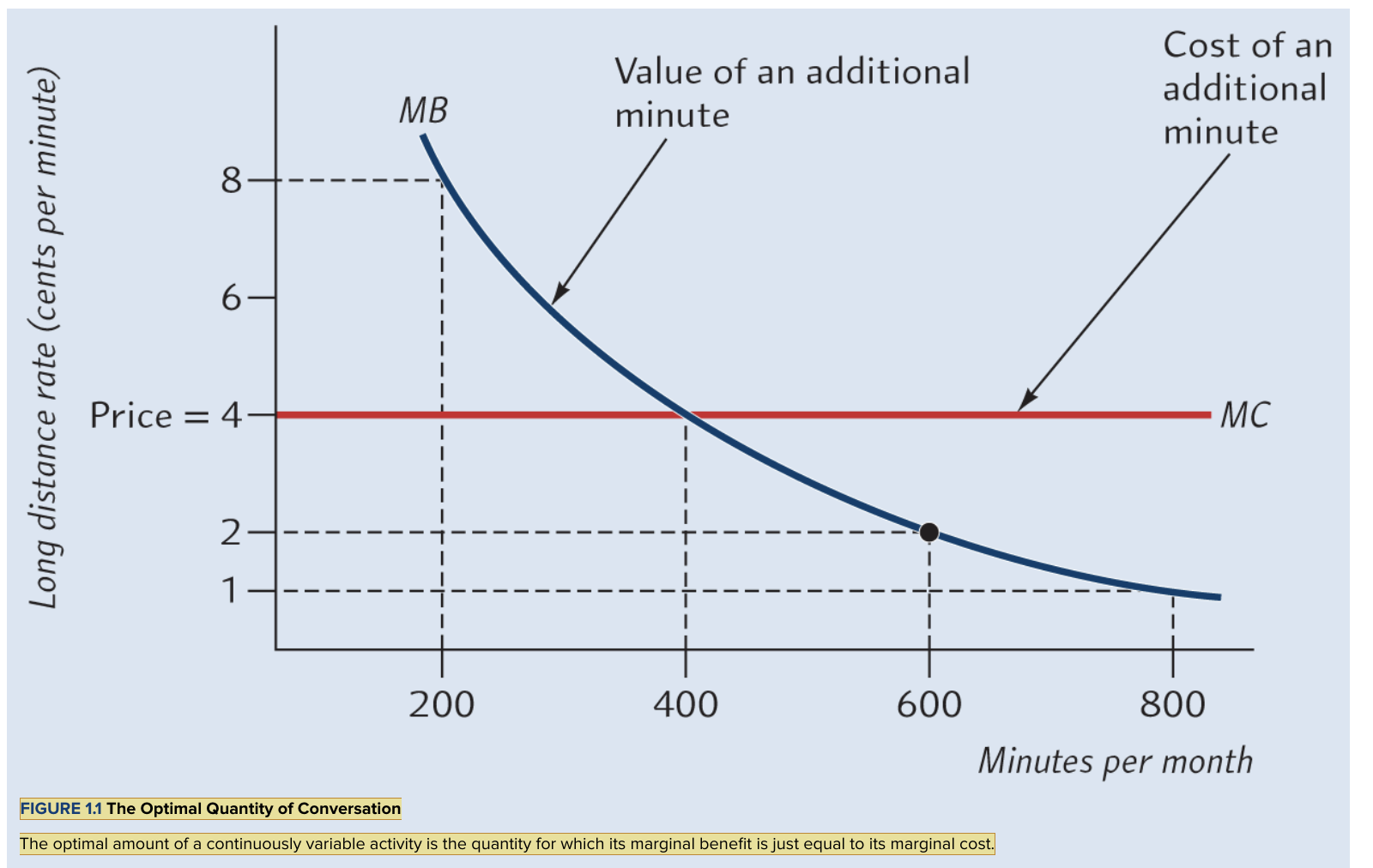
According to the cost-benefit, until what point should you keep increasing the level of an activity?
As long as its marginal benefit exceeds its marginal cost
MB>MC
Average cost
Cost per unit of activity of output
Total cost / quantity
Average benefit
Benefit per unit of activity of output
Total benefit / quantity
How are MB and MC displayed for discrete vs. continuous activities?
Levels- table (change in TC/change in Q)
Continuous- graph (MC curve)
Optimum / efficient level of an activity
MB = MC
Why do economists express benefits + costs in monetary terms?
Money = simple, easily interpreted unit of measurement
Homo economicus
Simplified model of a person / decision-maker who is assumed to act purely in their own self-interest
Only motivated by their own material costs + benefits
Is the standard self-interest model of decision-making
Limitation of Homo economicus / self-interest assumption
Its a simplification = unrealistic
Humans aren’t always selfish
Care abt others, altruism, loyalty, fairness
What does the self-interest model used for?
Explain / predict behaviour
NOT a claim that everyone behaves this way
Why can self-interested people still cooperate?
Build relationships bc trust + alliances can benefit them materially
Self-interest ≠ selfishness in every situation
What is overfishing caused by?
Excess demand for fish
Over-employment in the fishing industry
Positive question
Question that has a definitive right or wrong answer
ie: What is? → Can be tested with evidence.

Normative question
Question that elicits value judgements on what should or ought to be
Value judgement = an opinion about what is good/bad
Positive vs normative questions
POSITIVE
What IS
Can be tested w evidence
“Would increasing the minimum wage increase unemployment?”
NORMATIVE
What SHOULD be
Needs a value judgement (opinion)
“Should the government increase the minimum wage?”

Chapter 1 summary
Why does marginal benefit often decrease as activity increases?
Each additional unit tends to provide less extra value than the previous one
The more u consume somthn → each additional unit provides less value
Why does MB slope downwards
Diminishing MB as quantity increases
If scarcity didn’t exist?
All prices would be 0