Reproduction: How Life Continues
 Call Kai
 Learn
 Practice Test
 Spaced Repetition
 Match
 Flashcards
 Knowt Play
1/24

Earn XP
Description and Tags
Vocabulary practice flashcards covering asexual and sexual reproduction across plants, animals, and humans based on Chapter 11.
25 Terms

Vegetative Propagation
A form of asexual reproduction in plants where new individuals arise from growing vegetative parts, such as fleshy underground stems, stem cuttings, or leaves, producing genetically identical offspring.
Grafting
An agricultural vegetative propagation method where a healthy stem cutting from one plant variety is inserted and secured into a slit on a rooted plant until the tissues heal together.

Layering
A vegetative propagation method in which a flexible, thin twig of a shrub or tree is bent and buried in the soil until adventitious roots develop, after which it is detached to grow independently.

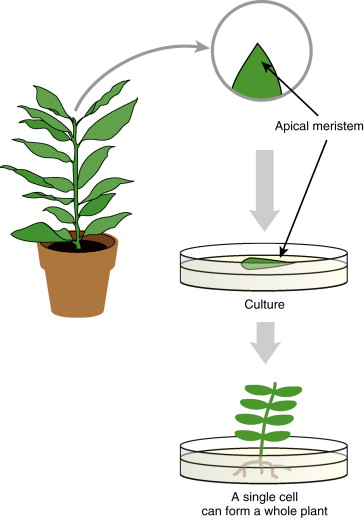
Tissue Culture
A technique of plant propagation where healthy, disease-free plantlets are mass-produced from the shoot tip (apical meristem), ensuring high crop yields and eliminating virus-infected plants.

Budding
An asexual reproduction method seen in yeast and hydra where repeated cell division produces a small outgrowth (bud) that enlarges, detaches, and lives as an independent individual.


Spores
Lightweight, microscopic reproductive units formed in sac-like structures or on fungal hyphae that disperse through air currents and germinate when moisture and nutrients are available.

Mitosis
A type of cell division central to asexual reproduction that produces two daughter cells, each having the same number of chromosomes identical to the parent cell.

Meiosis
A specialized reduction division that halves the chromosome number from diploid in the parent cell to haploid in daughter cells, forming gametes and facilitating genetic variation.

Stamen
The male reproductive whorl of a flower, consisting of a slender stalk called the filament and a terminal anther that produces pollen grains containing male gametes.


Pistil
The female reproductive whorl of a flower, composed of a sticky pollen-receptive stigma at the top, a slender connecting style, and a basal ovary containing ovules.

Self Pollination
The transfer of pollen grains from the anther to the stigma of the same flower by abiotic agents like wind and water, or biotic agents like insects and birds.


Cross-Pollination
The transfer of pollen grains from the anther of a flower on one plant to the stigma of a flower on a different plant of the same species.

Fertilisation (in Flowering Plants)
The fusion of the male gamete, transported through an elongating pollen tube, with the egg cell inside an ovule to form a diploid zygote.


P. Maheshwari
A pioneering Indian scientist celebrated as the 'Father of Indian Embryology' who developed in-vitro fertilisation in flowering plants and authored 'An Introduction to the Embryology of Angiosperms' (1950).
Artificial Hybridisation
A plant breeding technique involving the manual removal of stamens (emasculation) from flowers, bagging them to prevent unwanted self-pollination, and dusting selected pollen to crossbreed desirable traits.

External Fertilisation
A reproductive mode common in aquatic animals like fish and frogs where gametes are shed into water and the fusion of sperm and egg occurs entirely outside the body.
Internal Fertilisation
A reproductive mode found in reptiles, birds, and mammals where sperm is deposited inside the female reproductive tract, allowing fertilisation and embryo development within a protected environment.

Larva
An intermediate, active feeding stage that hatches from an egg containing minimal yolk in animals such as butterflies and frogs, accumulating nutrients before transforming into an adult.
Scrotum
An external sac of skin holding the testes that maintains a temperature slightly cooler than the core body temperature, which is essential for proper sperm formation.
Vas Deferens
A long muscular duct in the male reproductive system that transports mature sperm from the testes to the urethra.
Gametogenesis
The biological process of gamete formation that takes place via meiosis in the testes (spermatogenesis) and ovaries (oogenesis).
Ovulation
The physiological event in human females, typically occurring around day 14 of a 28-day menstrual cycle, in which a mature egg is released from an ovary into the fallopian tube.
Menstruation
The periodic breakdown and shedding of the thickened inner uterine lining accompanied by blood through the vagina, usually lasting 3 to 7days when pregnancy does not occur.

Subhash Mukhopadhyay
The Indian physician and scientist from Kolkata who pioneered India's first test-tube baby, Kanupriya Agarwal (nicknamed Durga), through experimental in-vitro fertilisation (IVF) in 1978.

Intra-Uterine Device (IUD)
A contraceptive device, such as the Copper-T, that is inserted into the uterus to prevent pregnancy.