biomg3310 quiz 8
 Call Kai
 Learn
 Practice Test
 Spaced Repetition
 Match
 Flashcards
 Knowt Play
1/24

There's no tags or description
Looks like no tags are added yet.
25 Terms
Phosphofructokinase 1 allosteric control
2 issues:
Substrates of PFK1 are ATP and F-6-P, but overall glycolysis has net yield of 2 ATP per glucose → you want to slow PFK-1 if you don’t need more ATP and slow it if its substrate gets high… but if the ATP is getting higher then you know… yeah
[ATP] in the cell changes by <10%, which is not much → so we must amplify the small change in [ATP] with [AMP], increased [AMP] speeds up glycolysis
Overall: all eukaryotic cells use adenylate kinase

How is [AMP] used to amplify changes in [ATP]?
Adenylate kinase catalyzes the following reaction:
ADP + ADP ← → ATP + AMP
So KEq = 0.44 = ([ATP][AMP])/[ADP]2 if you start with [ATP] = 8mM, [ADP] = 1mM, [AMP] = 0.055mM
If you hydrolyze 10% of ATP → ADP like for reaction coupling:
ATP + H2O ← → ADP + Pi + H+
[ATP] changes to 7.2mM, [ADP] changes to 1.8mM
calculating [AMP] from Keq equation → [AMP] = 0.2mM → 360% higher than starting [AMP]!!! wow!! much bigger change, increase in amp → signals to increase glycolysis → induces more R state PFK 1

PFK-2/FBPase-2
a bifunctional enzyme with 2 separate catalytic domains on 1 protein chain
PFK2 acts as a kinase and adds phosphate to F6P to get F-2,6-BP → F-2,6-BP signals for more R-state PFK1 → activating this increases [F-2,6-BP]
FBPase2 acts as a phosphatase and breaks down F-2,6-BP by removing its phosphate and turning it back into F6P → activating this decreases [F-2,6-BP]

Hormonal control of PFK-1 in the liver
Glucagon signals low blood sugar, tells liver to stop using glucose, many liver cells have many glucagon receptors
Adenylate cyclase
Protein kinase A (target arg-arg-ANY-ser*)
Also can go activate phosphorylase kinase to activate glycogen phosphorylase b → a to break down glycogen → eventual release of glucose into blood
PFK2/FBPase-2 (isoform 1)→ FBPase-2 function is activated
Decreases [F-2,6-BP], decreases R state PFK1, less glucose is used by liver
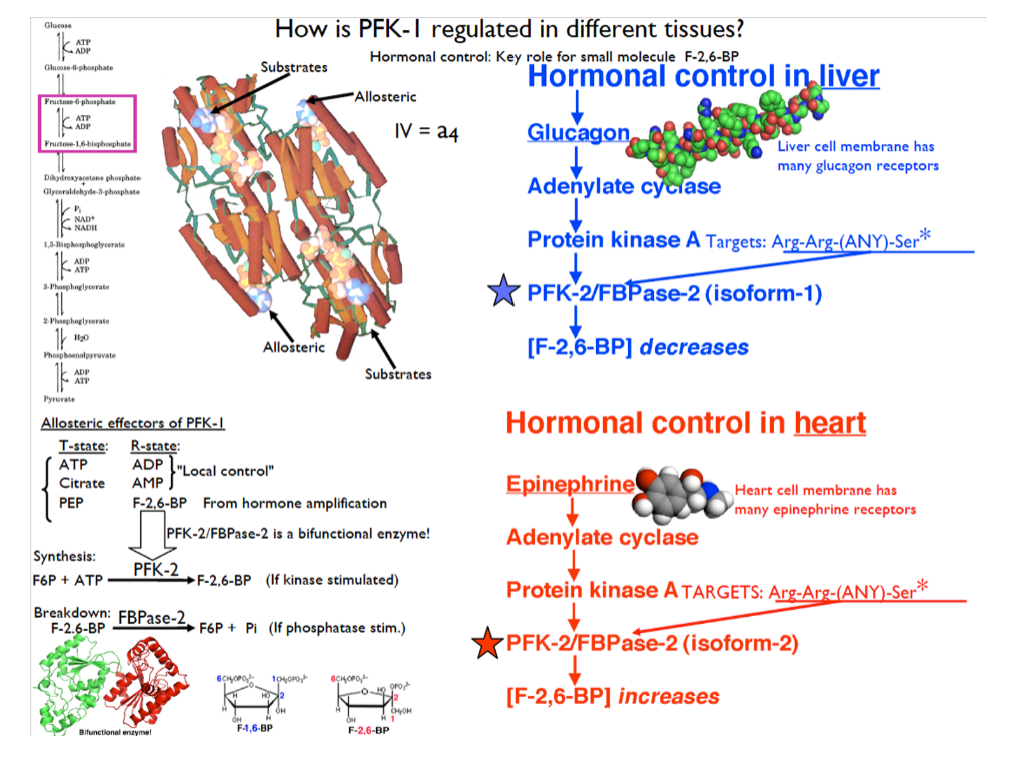
Hormonal control of PFK-1 in the heart
Epinephrine - heart cell membrane has many epinephrine receptors
Adenylate cyclase
Protein kinase A (target arg-arg-ANY-ser*)
PFK-2/FBPase-2 (isoform 2) → PFK-2 function is activated
Increases [F-2,6-BP], increases R state PFK 1, heart makes more ATP!!

Pyruvate kinase regulation
The last reaction of glycolysis: ADP + PEP ← → ATP + pyruvate
Also regulated via hormonal control and by protein kinase A because contains a sequence: arg-arg-ala-ser*
Hormonal control in liver:
Glucagon appears to signal low [Glc]blood → PK activity decreases (Ser-OPO32-, PK phosphorylation increases T state in liver), liver uses less glucose, shifts v vs [PEP] curves down
Insulin appears to signal high [Glc]blood → PK activity increases (Ser-OH), liver uses/stores glucose, shifts v vs [PEP] curves up
Local control
Positive allosteric activators: PEP (substrate), F-1,6-BP (substrate precursor) → shift reaction v curves up
Negative allosteric inhibitors: ATP, acetyl-CoA, fatty acids, free alanine → shift reaction v curves down

Why do organisms have many different ATP producing reactions?
so many options!!
After glycolysis, pyruvate can go → pyruvate dehydrogenase → citric acid cycle → oxidative phosphorylation
Fastest option: phosphocreatine + ADP + H+ ← → creatine + ATP
Phosphocreatine is kept at a higher concentration than ATP in muscle
The rate at which ATP is needed varies by length of activity and intensity → slower rate for ATP is needed as you increase length of activity

Pyruvate fates
NAD+ is used up by glycolysis, reaction of pyruvate → lactate catalyzed by lactase dehydrogenase replenishes NAD+
This also speeds up glycolysis by using up pyruvate and NADH (decreasing reaction products - mass action!!)
NAD+ may also be replenished by converting pyruvate → acetaldehyde via pyruvate decarboxylase → ethanol via alcohol dehydrogenase

Glucose 6 phosphate alternative fate from glycolysis
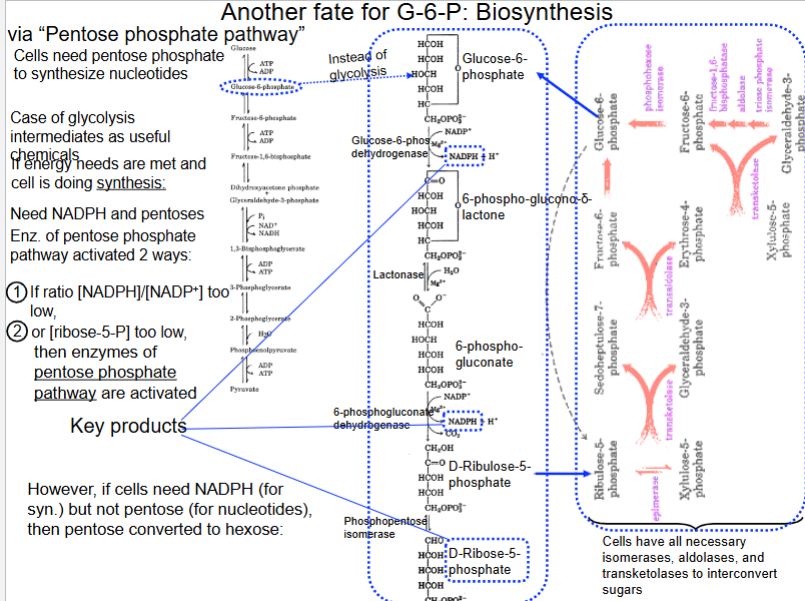
biosynthesis - pentose phosphate pathway (PPP) → G6P is used to produce D-ribose-5-phosphate for nucleotides synthesis
Key products: 2 NADPH and D-ribose-5-phosphate
Only if energy needs are met and cell is doing synthesis
PPP requires NADPH and pentoses. The enzymes of PPP are activated if:
the ratio of [NADPH]/[NADP+] is too low
If [ribose-5-P] is too low
However, if cells need NADPH for synthesis, but not pentose for nucleotides, then pentose is converted to hexose - cells have all necessary isomerases, aldolases, and transketolases to interconvert sugars
Nonoxidative phase: transketolase, transaldolase to go from ribose-5-P to G6P, also connected to G3P
Oxidative phase is going from G6P to ribose 5-phosphate
Cells that use pentose phosphate pathway
• rapidly dividing cells use ribose 5-phosphate to make RNA, DNA, and coenzymes
• tissues that carry out extensive fatty acid synthesis (liver, adipose, lactating mammary gland) require the NADPH provided by this pathway.
• tissues that actively synthesize cholesterol and steroid hormones (liver, adrenal glands, gonads) require the NADPH provided by this pathway.
NADP+/NADPH is generally used for/produced by anabolism, while NAD+ is used for/produced by catabolism
Further metabolism of pyruvate + 3 stages of cellular respiration
Pyruvate converted to acetyl-CoA, which is connected to many other metabolic reaction pathways
Stage 1: acetyl-CoA production - glucose becomes pyruvate via glycolysis, acetyl-CoA is produced from pyruvate via the pyruvate dehydrogenase complex
Stage 2: Acetyl-CoA oxidation in the citric acid cycle → produce reduced e- carriers (in mitochondrial matrix)
Stage 3: Electron transfer and oxidative phosphorylation → respiratory electron transfer chain (in mitochondrial inner membrane)
Where is pyruvate further metabolized?
in the mitochondria via a pyruvate transport protein in the mitochondrial inner membrane → Next step is pyruvate dehydrogenase complex
Outer membrane: permeable to <10kD
Inner membrane: not permeable - need transporter proteins, contains one enzyme of the citric acid cycle, has more surface area due to protrusions
Aqueous matrix: Where pyruvate dehydrogenase complex is + 7 other soluble enzymes of the citric acid cycle and all enzymes for beta oxidation of fatty acids + where urea cycle starts
Pyruvate dehydrogenase complex IV structure
huge guy: alpha120beta60gamma12
30 tetramers, Alpha (E1) = pyruvate dehydrogenase - coenzyme thiamine pyrophosphate (TPP)
60 monomers, Beta (E2) = transacetylase - coenzyme lipoamide
6 dimers, Gamma (E3) = dihydrolipoyl dehydrogenase - coenzyme flavine adenine dinucleotide (FAD) + CoA + NAD+
Completes 5 chemical reactions, but products move from one active side to the next without leaving the PDH complex → AKA substrate channeling → increases the overall reaction rate (by eliminating the need for intermediates to diffuse to the next active site) and prevents unwanted side reactions
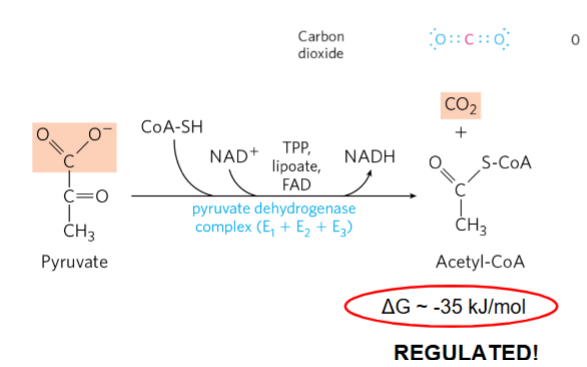
Overall reaction: pyruvate + CoA + NAD+ ← → acetyl-CoA + CO2 + NADH

How is acetyl-CoA formed from pyruvate
Overall reaction: pyruvate + CoA + NAD+ ← → acetyl-CoA + CO2 + NADH
Pyruvate carboxylate group is cleaved and this becomes the CO2
The remaining acetyl group is attached to the CoA-S-
This reaction has a large negative delta G → 35 kJ/mol, and is thuse regulated

The coenzymes of the PDH complex
Coenzyme A is a carrier of acyl groups, includes pantothenic acid (vitamin B5)
FAD: Vitamin B2 - riboflavin
Lipoic acid - in the PDH complex, lipoate acts as a molecular string:
In oxidized form, has a disulfide bond in a ring. In reduced form, this disulfide bond is broken → have 2 SH groups. In acetylated from, an acetyl (O=C-CH3) group is attached to one of the S-.
Thiamine Pyrophosphate: the thiazolium ring plays an important role in the cleave of bonds adjacent to a carbonyl group → this is important for step one (vitamin B1 = thiamine)
NAD+ → Vitamin: niacin
These guys are all free in solution


PDH Complex mechanism
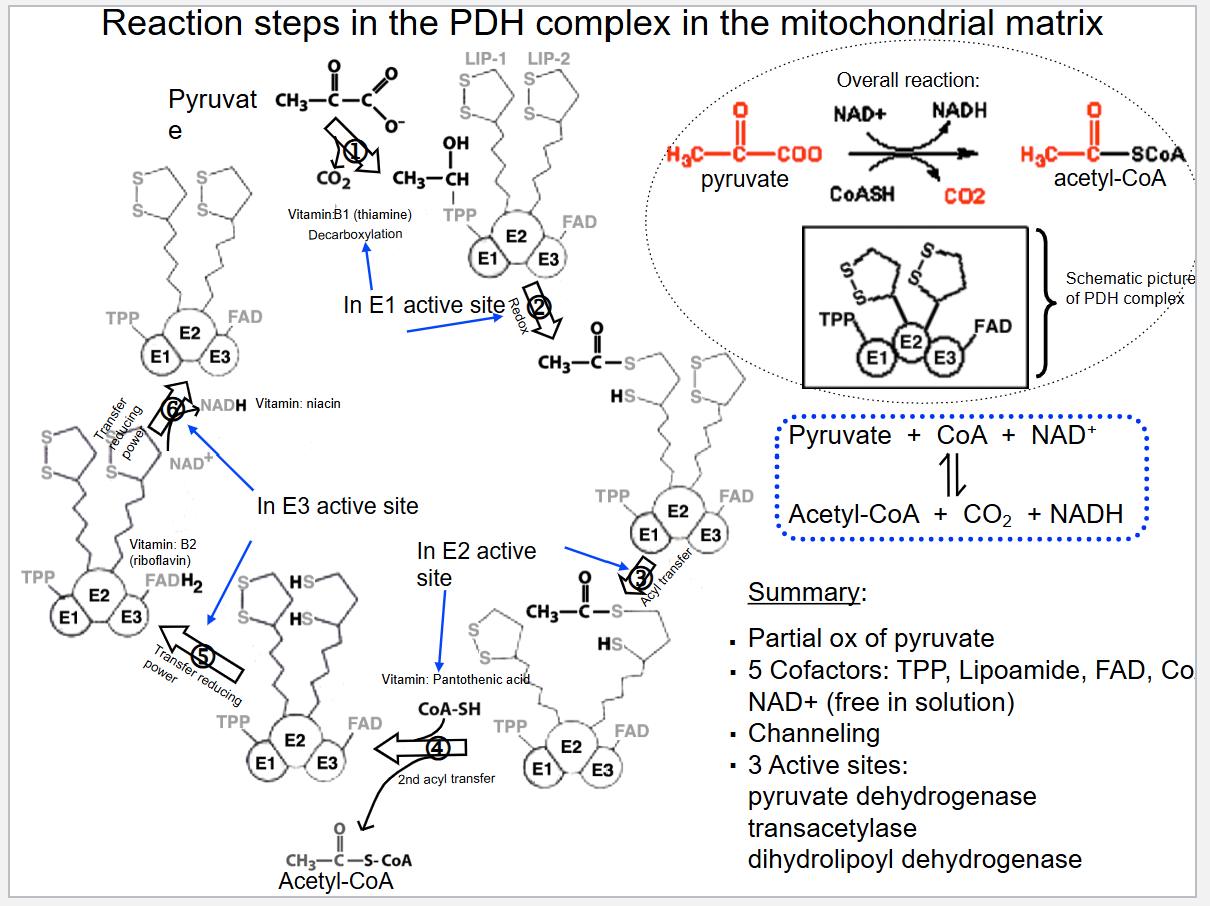
Overall reaction is an oxidative decarboxylation and IRREVERSIBLE!! Products are more oxidized than the substrate, CO2 is released from the substrate
In E1 active site, Pyruvate → TPP-acetyl + CO2, this is the irreversible decarboxylation step
In E1 active site, redox reaction to transfer the acetyl to oxidized lipoyllysine → form acetyl lipollysine
In E2 active site, 1st acyl transfer from the left Lipoyllysine 1 to right lipoyllysine 2
In E2 active site, 2nd acyl transfer from acetyl lipoyllysine to CoA-SH → Acetyl-CoA + Reduced lipoyllsine
Transfer reducing power from reduced lipoyllysine to FAD → FADH2 + oxidized lipoyllysine
Transfer reducing power from FADH2 to NAD+ → NADH + H+
Why is the citric acid cycle a cycle?
The final product (oxaloacetate) is used as a substrate for the next cycle

Citric acid cycle big picture: Other names, overall reaction
AKA Kreb’s cycle or tricarboxylic acid (TCA) cycle
Overall reaction:
Acetyl-CoA + 3NAD+ + FAD + GDP + Pi + 2H2O ← → CoA + 2CO2 + 3NADH + FADH2 + GTP + 3H+
Note: GTP or ATP can be made. we just focus on GTP
Also note: Product is CO2 → oxidation of glucose is completed
3 regulated steps: 1, 3, and 4 (citrate synthase, isocitrate dehydrogenase, alpha-ketoglutarate dehydrogenase)

Citric acid cycle Step 1
Claisen Condensation: Oxaloacetate + Acetyl-CoA → 3o OH Citrate
Enzyme: citrate synthase
Delta G ~-50kJ/mol → regulated!
Thioester linkage in acetyl-CoA activates methyl Hs → Asp 375 takes a H+ from methyl group → enolate intermediate, stabilized by H bonding to and/or protonation by His274
Enolate rearranges to attack C=O of oxaloacetate, Hi274 is positioned to steal the proton it gave before. His320 acts as general acid → produces citroyl-CoA
Thioester is hydrolyzed → regenerates CoA-SH and forms tertiary alcohol citrate, no further oxidation can occur without breaking a C-C bond → this does not happen

Citric acid cycle step 2
Essentially a preparation step to reach the next major goal, oxidation
Dehydration: citrate → cis-aconitate + H2O
Hydration: cis-aconitate + H2O → 2o OH isocitrate - we convert to a secondary alcohol so that we can further oxidize the molecule without breaking a C-C bond
Enzyme: aconitase
We are basically taking a H2O off and readding it back in a different position

Citric acid cycle step 3
Oxidative decarboxylation: Isocitrate + NAD+ → CO2 + NADH + H+ + alpha ketogluterate
Enzyme: isocitrate dehydrogenase
DeltaG ~ -20 kJ/mol → regulated step
Isocitrate + NAD(P)+ → NAD(P)H + H+ + oxalosuccinate: isocitrate is oxidized by H- transfer to NAD+ or NADP+
Oxalosuccinate → CO2 + enol intermediate: decarboxylation is facilitated by e- withdrawal by adjacent C=o and coordinated Mn2+
Rearrangement of enol intermediate to generate alpha ketogluterate

Citric acid cycle step 4
alpha-ketoglutarate + CoA-SH + NAD+ → NADH + succinyl-CoA + CO2
Enzyme: alpha-ketoglutarate dehydrogenase complex (similar structure and steps to PDH complex!)
deltaG ~ -45 kJ/mol → regulated
Basically we take the carboxylate (COO-) group is cleaved off, producing CO2 and the rest of the molecule is slapped onto CoA-S-
Succinyl CoA is a thioester, very high E!!!

Citric acid cycle step 5
Succinyl-CoA + GDP + Pi → GTP + CoA-SH + Succinate
Enzyme: succinyl-CoA synthetase
deltaGo’ = -2.9 kJ/mol
Substrate level phosphorylation reaction → depends on [P] and [R], utilizes free Pi to generate GTP or ATP, similar to steps 7 and 10 in glycolysis, where we make ATP

Citric acid cycle step 6 - 8
succinate (14 e-) + FAD → FADH2 + fumarate (12 e-)
→ Overall oxidation-reduction yields FADH2, Enzyme: succinate dehydrogenase - a membrane bound enzyme that connects to the e- transfer chain!
Fumuarate (12 e-) + OH- → carbanion transition state, carbanion transition state + H+ → L-Malate (12e-), a 2o OH that is easily reduced!
→ Overall, H2O adds across C=C, Enzyme: fumarase
L-malate (12 e-) + NAD+ → NADH + H+ + oxaloacetate (10 e-)
→ Overall, oxidation-reduction yields NADH, Enzyme: L-malate dehydrogenase
How is the CA cycle connected to other metabolism?
Used to make AA and nucleotides:
Alpha-ketoglutarate → glutamate → Gln, pro, arg, purines
Oxaloacetate → PEP (enzyme PEP carboxykinase) → Glucose, ser, gly, cys, phe, tyr, trp
Succinyl-CoA → poryphyrins, heme, chlorophyll
NOTE: acetyl entering CAC has 2C, but 2C are lost as 2CO2 → must replenish CAC intermediates
Anaplerotic reactions are replenishing reactions that steal products and intermediates from glycolysis → PEP and pyruvate replenish the Cs:
PEP can also be turned back into oxaloacetate with enzyme PEP carboxylase
Pyruvate may be turned into malate by malic enzyme
