Biological Principles Exam 3 (Mods. 7-10)
 Call Kai
 Learn
 Practice Test
 Spaced Repetition
 Match
 Flashcards
 Knowt Play
1/138

There's no tags or description
Looks like no tags are added yet.
139 Terms
Natural Selection
The process by which organisms with certain traits are more likely to survive and reproduce than other organisms

How do factors in the environment drive evolution by natural selection?
they determine which traits help organisms survive and reproduce best in that setting
better traits = better chances

Evolution
A change in the frequency of heritable traits within a population over time

Mutation
a random change in the DNA sequence

How do mutations lead to different traits?
DNA mutations create new versions of genes, and different gene versions can produce different traits
What feature of evolution is being measured?
Frequency
True/False: new traits occur in response to environmental pressures
False: environmental pressures are not genetic and therefore cannot be passed down (ex., dyed hair)
True/False: Individuals don't evolve
True: evolution as a whole works on change in generations, not individuals
True/False: natural selection is the only mechanism of evolution
False: evolution can occur through genetic drift, gene flow, and sexual selection too
True/False: evolution has a goal
False: There is no built‑in direction toward "higher" or "better" organisms—just continual adjustment to whatever environment exists at that time
True/False: Natural selection works with heritable traits
True: only encoded genetic traits can be passed down from generation to generation (ex., a child inherits their blue-eyes from their mother)
True/False: all life shares a common cellular and molecular basis
True: all known species on Earth are understood to share a common ancestor in the distant past.

True/False: a species is the smallest unit that can evolve
False: A population is the smallest unit that can evolve
How do environmental pressures affect natural selection? (similar to Q2)
They EXPOSE which traits are more helpful-- but they DO NOT trigger their occurrence
Would you expect evolution to proceed more or less quickly in a rapidly changing environment?
Because natural selection favors organisms best suited to the local environment, rapid change will promote faster evolution

One big rock and one small rock are in the middle of a field. Which would you expect to last longer?
The larger-- it's better equipped to withstand force and pressure that tries to move it
A herd of zebras are being chased by a pride of lions. The average speed of the herd is 30 mph. The pride catches only the slowest 10%-- what's the new average speed of the herd?
(Below, at, or above 30 mph)
Above 30 mph-- the average speed can be increased by removing the slowest individuals/outliers

The nature of a population will change if which three conditions change?
variation, inheritance, reproductive success
The first antibiotic used clinically?
Penicillin

Why isn't penicillin as useful as it once was?
because of the evolution of penicillin-resistant bacteria
Normal Flora
microorganisms that commonly live on or in your body
MRSA (methicillin-resistant Staphylococcus aureus)
strain of SA that has evolved resistance to multiple antibiotics, making it a dangerous "superbug."
Antibiotics
drugs that inhibit or kill bacteria
How do antibiotics kill bacteria without harming human cells?
by disabling a necessary component of bacterial cells that is not found in human cells
"Susceptible" bacteria
able to be killed or have growth inhibited by a drug
"Resistant" bacteria
mutations and natural selection have changed them so the antibiotic no longer works
Adaptation
the accumulation of favorable traits in a population over time
Artificial Selection
the selective breeding of domesticated crops and animals

Population
A group of individuals that belong to the SAME species and live in the SAME area at the SAME time


Two birds fly across geographic barriers, meet, and mate. Are they considered the same population?
Yes, because they are capable of meeting and mating


Two squirrels live on two different islands beside each other. Are they considered the same population?
No, because they cannot reach each other to mate and reproduce. Their populations will evolve independently on their respective islands.
Sexual Recombination
Gametes produce new arrangements of existing genes (mix n' match)

Gene pool
All of the forms of all the genes in a population at any one time

Microevolution
a generation-to-generation change in the gene pool; evolution on its smallest scale
Darwinian Fitness
The contribution that an individual makes to the gene pool of the next generation versus the contributions from other individuals
How is Darwinian fitness measured?
only in terms of the number of healthy offspring produced
Genetic drift
a change in a gene pool due to chance
The bottleneck affect
A change in the gene pool due to a reduction in population size-- causing a loss of diversity

The founder affect
A new, small group establishes a new population with allele frequencies that differ from the original population

Gene flow
Movement of alleles between populations through migration and breeding
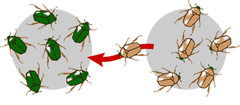
Sexual selection
certain individuals are more likely to attract mates and, therefore, have more offspring

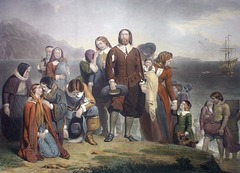
The Mayflower pilgrims land at Cape Cod in North America, far from their hometown in England. They begin to colonize. What is this an example of?
The founder affect

Female peacocks prefer male peacocks with larger and more vibrant plumage. What is this an example of?
Sexual selection

An Italian man marries an Irish woman and brings her to his hometown, Venice. They have children together. Over generations, the town begins to see more and more redheads. What is this an example of?
Gene flow

Pink and yellow tulips are planted in the same meadow. By accident, tourists step on most of the yellow tulips before they can produce seeds. Over time, the meadow contains mostly pink tulips. What is this an example of?
Genetic drift

Cheetahs have nearly been hunted to extinction. The population is recovering, but it now has a limited gene pool to share. What is this an example of?
The bottleneck affect
Ecology
the study of how organisms interact with each other and with their environment
Environmentalism
a broad philosophy and social movement that seeks to maintain environmental quality

Biosphere
the sum of all ecosystems on Earth

Biotic factors are
living parts of an ecosystem

Abiotic factors are
nonliving parts of an ecosystem (physical and chemical)

Community
All the different populations that live together in an area

Interspecific interactions
interactions between different species
Competitive exclusion principle
if the resources required by two species are too similar, they cannot coexist

Mutualism
A relationship between two species in which both species benefit

Symbiotic relationship
species living in close physical association with one another (does not necessarily describe whether it's + or -)
Predation
An interaction in which one organism kills another for food.

Herbivory
the eating of plant parts by an animal

Parasitism
One organism benefits and the other is harmed
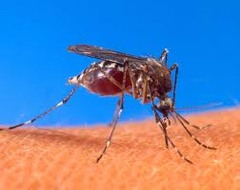
Commensalism
one species benefits and the other is not affected
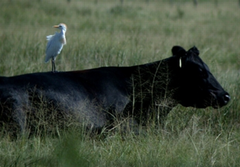

A caterpillar eats foliage so it can survive metamorphosis. What is this an example of?
Herbivory
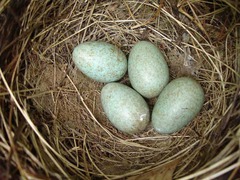
A bird nests in a tree for shelter. What is this an example of?
Commensalism

Cleaner fish eat nutrient-rich bacteria off sharks' teeth. What is this an example of?
Mutualism
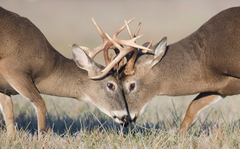
Elk often fight for mating rights. What is this an example of?
Competition
Children often get itchy from head lice. What is this an example of?
Parasitism

A bear catches a king salmon from a stream for her cubs. What is this an example of?
Predation
Food chain
a simplified description of one part of the trophic structure, following the passage of food energy from one individual to another

Food web
A system of interlocking food chains

What are trophic levels?
The successive levels of organisms consuming one another

What are THE trophic levels?
producer, primary consumer, secondary consumer, tertiary consumer, quaternary consumer
Producers
Support all ascending levels of the food chain; majority use photosynthesis

Primary consumers
Consume producers; Herbivores

Secondary consumers
Eat primary consumers

Tertiary consumers
Eat secondary consumers

Quaternary consumers
Eat tertiary consumers; often the apex predator

Decomposers
Organisms that break down the dead remains of other organisms
Biological magnification
the tendency of toxins to become concentrated as they pass through a food chain
Would you expect a rat or a snake to have more toxins in their bloodstream?
A snake, because it occupies a higher trophic level
Invasive species
a non-native species that occupies a foreign habitat and spreads quickly, causing environmental damage

Biological control
the intentional release of a natural enemy to attack a pest population
Integrated pest management
a variety of pest control methods that include repairs, traps, bait, poison, predators, etc. to eliminate pests
How are invasive species introduced to ecosystems?
almost always by humans, accidentally and intentionally (ex., illegal wildlife smuggling)
Are all non-native species considered invasive?
No. Some non-native species are harmless. Invasive species are always harmful.
What happens to one trophic level when another trophic level is altered by the introduction or loss of a species?
It will almost always cause a ripple effect→ negative for some and positive for others.

An invasive fish species enters a lake and consumes large amounts of aquatic insects. What population(s) are most likely to decline, and which may benefit?
Native fish that also eat aquatic insects may decline.
Birds that prey on invasive fish may increase.
(Answers may vary-- just get the idea!!)

A non-native rabbit species is introduced to a grassland ecosystem. The rabbit population doubles every year. How would this affect the amount of grass, and then the amount of native herbivores?
More rabbits → less grass → fewer native herbivores

An invasive species of rat arrives on an island. The rats eat large numbers of bird eggs. Over the next several years, the bird population declines dramatically.
How might insect populations, and then plant populations, react to the loss of birds?
More rats→ less birds→ less predation of insects (rise pop.) → more predation on plants (decline pop.)
Ecosystem
all the living things in a particular area together with all the nonliving parts of that environment

Global warming
A gradual increase in average global temperature
Cellular Respiration
the process cells use to break down sugar using oxygen to make ATP, releasing carbon dioxide and water as by-products
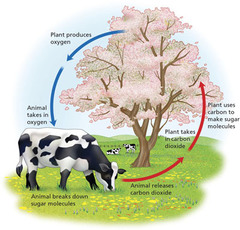
T/F: Plants perform photosynthesis, but only animals perform cellular respiration
False: Plants perform both photosynthesis and cellular respiration.
T/F: Matter is recycled through an ecosystem, while Energy comes in and out of the ecosystem
True
Carbon cycle
the movement of carbon from the nonliving environment into living things and back
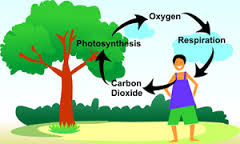
What or where is the primary reservoir of carbon?
Oceans (followed by atmosphere)
How does the carbon cycle move through biotic factors?
Producers use CO₂ from the atmosphere in photosynthesis, storing carbon in their tissues. When consumers eat producers, that carbon becomes part of the consumers' bodies
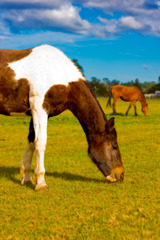
How does the carbon cycle move through abiotic factors?
Decomposers break down dead organisms and wastes, releasing carbon back as CO₂ to abiotic reservoirs (Ex., air, water, soil), completing the cycle
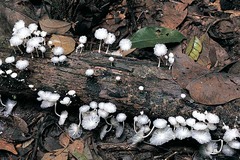
How do things like burning fossil fuels and deforestation affect the carbon cycle?
Burning fossil fuels releases much CO2 into the atmosphere, and deforestation reduces the ability of plants to remove the excess CO2
Greenhouse effect
the warming of Earth's surface because greenhouse gases in the atmosphere trap heat

What do greenhouse gases do?
they absorb and trap heat that would've otherwise radiated away from earth
4 examples of greenhouse gases
carbon dioxide (CO2), methane (CH4), nitrous oxide (N2O), water vapor (H2O)