2.5: Nucleic Acids
 Call Kai
 Learn
Learn Practice Test
 Spaced Repetition
 Match
Match Flashcards
 Knowt Play
1/31

There's no tags or description
Looks like no tags are added yet.
Name | Mastery | Learn | Test | Matching | Spaced | Call with Kai | Chat |
|---|
No analytics yet
Send a link to your students to track their progress
32 Terms
Define nucleotides
monomers that are linked by condensation reactions to form nuclei acids
Two main types of nucleic acids
DNA - deoxyribonucleic acid
RNA - ribonucleic acid
Basic structure of a nucleotide
pentose sugar (sugar with 5 carbon atoms)
nitrogenous base (attached to 1’ carbon)
phosphate group (attached to 5’ carbon)

DNA deoxyribose pentose sugar vs RNA ribose pentose sugar
Ribose sugar:
hydroxyl (OH) group at the 2’ carbon position
deoxyribose sugar:
hydrogen (H) at the 2’ carbon position

Nitrogenous bases of DNA
adenine (A)
thymine (T)
cystosine (C)
guanine (G)
A is complementary to T
C is complementary to G
Nitrogenous bases of RNA
Uracil (U) replaces thymine (T)
adenine (A)
uracil (U)
cytosine (C)
guanine (G)
Type of molecule: DNA vs RNA & why?
The presence of the 2' hydroxyl group makes RNA more susceptible to hydrolysis
As a result:
DNA is the storage molecule
RNA is the transport molecule with a shorter molecular lifespan
The nitrogenous base molecules found in the nucleotides of DNA (A, T, C, G) and RNA (A, U, C, G) occur in two structural forms:
purines
pyrimidines
Difference between purines and pyrimidines
purines have a double ring structure
pyrimidines have a single ring structure
purines will always bond/ be complementary to a pyrimidine
Which bases are purines?
adenine
guanine
Which bases are pyrimidines?
cytosine
thymine
uracil
Separate nucleotides are joined via ____ reactions to form polymers/ polynucleotides - DNA or RNA
condensation
(releasing a water molecule)
The condensation reaction occur between..
the phosphate group of one nucleotide
and the pentose sugar of the next nucleotide
A condensation reaction between two nucleotides forms a ___ bond
phosphodiester bond
(a type of covalent bond)
The chain of alternating phosphate groups and pentose sugars produced as a result of many phosphodiester bonds is known as the…
sugar-phosphate backbone
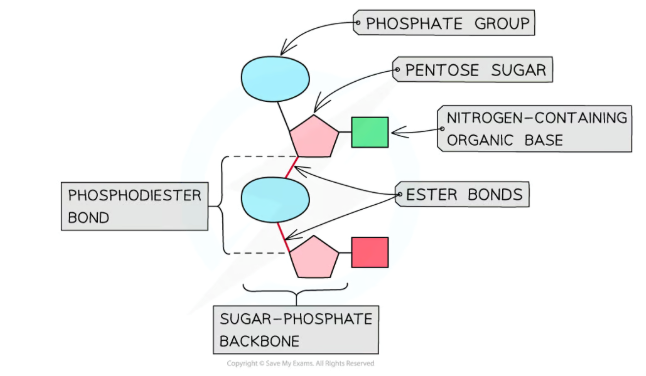
Strands of a DNA molecule
DNA molecules are made up of two polynucleotide strands (double helix) lying side by side that are antiparallel (running in opposite directions)
- each DNA polynucleotide strand is said to have a 3’ end and a 5’ end
- as the strands are antiparallel, one strand is known as the 5’ to 3’ strand and the other is known as the 3’ to 5’ strand
Each individual polynucleotide strand is made up of…
alternating deoxyribose sugars and phosphate groups bonded together by phosphodiester bonds to form the sugar-phosphate backbone
the nitrogenous bases of each nucleotide project out from the backbone towards the interior of the double-stranded DNA molecule

The two antiparallel DNA polynucleotide strands are held together by…
hydrogen bonds between the nitrogenous bases
Hydrogen bonds always occur between the same pairs of bases. In DNA, what are these base pairs, and how many hydrogen bonds are formed between these bases?
the purine adenine (A) always pairs with the pyrimidine thymine (T)
→ two hydrogen bonds are formed between these basesthe purine guanine (G) always pairs with the pyrimidine cytosine (C)
→ three hydrogen bonds are formed between these bases
this is known as complementary base pairing

What structure is DNA described as
double helix

Diagram showing a DNA molecule

Summary of bonding: phosphodiester bonds vs hydrogen bonds
phosphodiester bonds: join the nucleotides in the sugar phosphate backbone
hydrogen bonds: join the bases of the two complementary strands together
Is RNA double stranded?
no, it is single stranded
Nitrogenous bases in RNA
A, G, C, U
RNA molecule diagram
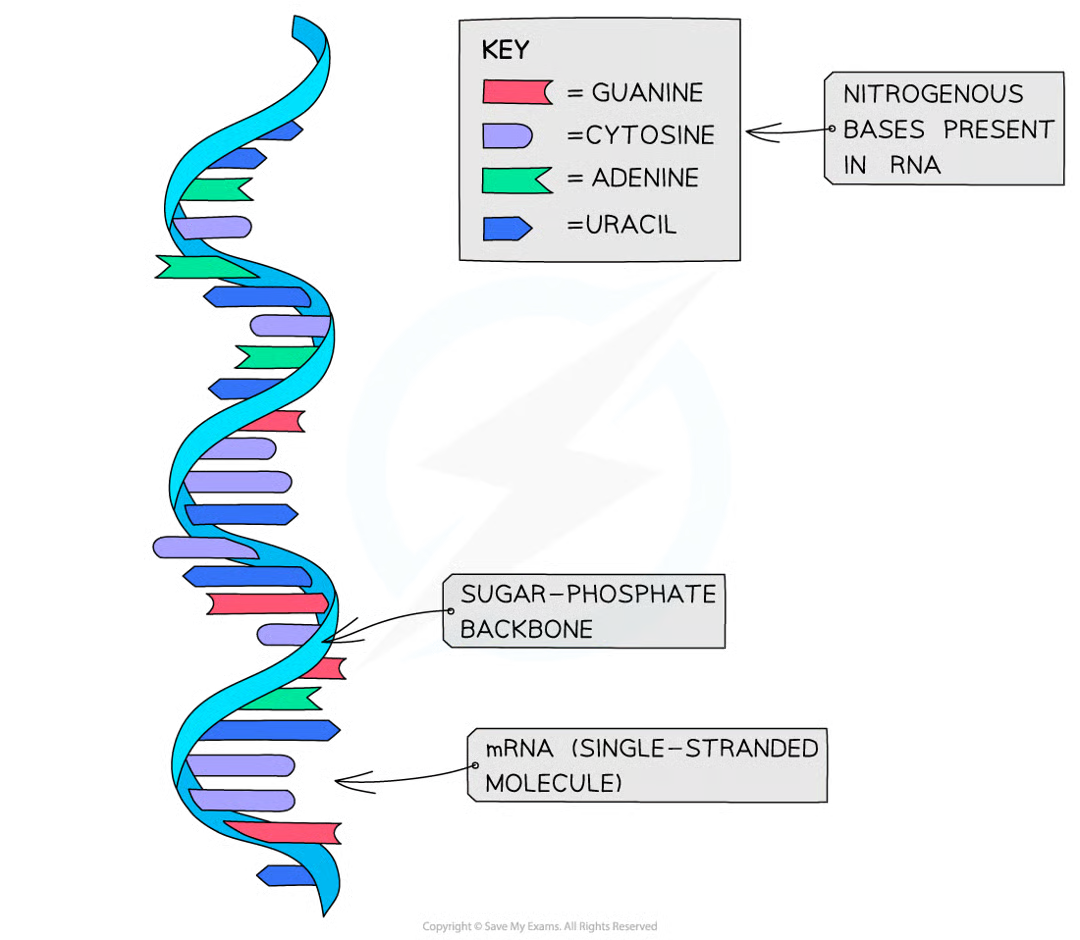
RNA vs DNA: Similarities
both are polynucleotides
both are nucleic acids
both contain the nitrogenous bases adenine (A), guanine (G) and cytosine
both contain a phosphate group
both contain a pentose sugar
both have a sugar-phosphate backbone held together by phosphodiester bonds
DNA vs RNA: Differences
DNA is double stranded, RNA is single stranded
RNA polynucleotide chains are shorter than DNA chains
DNA has a deoxyribose pentose sugar whereas RNA has a ribose pentose sugar
DNA has the nitrogenous bases A, G, C, T whereas RNA has the nitrogenous bases A, G, C, U
DNA is found inside the nucleus whereas RNA is found both inside and outside of the nucleus
DNA is a storage molecule whilst RNA is a transport molecule
Examples of RNA
messenger RNA (mRNA), which is the transcript copy of a gene that encodes for a specific polypeptide
transfer RNA (tRNA)
ribosomal RNA (rRNA)
Messenger RNA (mRNA)
mRNA is a single strand
mRNA is made in the nucleus in a process called transcription
It then leaves the nucleus and goes out into the cytoplasm and to the ribosome where it is used to make a protein during translation

tRNA
single nucleotide chain folded into a clover shaped molecule
it is held in shape by hydrogen bonds between base pairs (A-U or C-G)
at one end of the tRNA molecule there is a specific of 3 bases called an anticodon
at the other end is an amino acid binding site
tRNA carries amino acids to the ribosome where they are used to make proteins

Main role of DNA
stores genetic information
Main role of RNA
RNA has several roles including:
mRNA: transferring genetic information from DNA to ribosomes
rRNA: combining with proteins to form ribosomes
tRNA: being involved in protein synthesis