LECTURE 5
 Call Kai
 Learn
Learn Practice Test
 Spaced Repetition
 Match
Match Flashcards
 Knowt Play
1/53

There's no tags or description
Looks like no tags are added yet.
Name | Mastery | Learn | Test | Matching | Spaced | Call with Kai | Chat |
|---|
No analytics yet
Send a link to your students to track their progress
54 Terms
exterior sensory
receptor potential : change in MP due to receipt of signal from _________ (tough info, light info) cue
receptor potential
_________ : change in MP due to receipt of signal from exterior sensory (tough info, light info) cue
depolarization, energy, hyperpolarize
Receptor Potential
The energy from the environment will react with membrane proteins and in general this will cause __________
Depolarization of sensory receptors upon receipt of specific ________ (ex . pressure)
exception : photoreceptors ______
sensory cell membrane
Receptor Potential
Similar to PSP, the receptor proteins are embedded in _________
change shape
Receptor Potential
The receptor proteins of the sensory cells will __________ when specific energy (ex. touch) is received
& generally depolarize membrane
opens , amplifying
Receptor Potential
When the receptor protein changes shape, it can either
directly ______ ion channels (ex. cation channels → leads to depolarization of the membrane) (like ionotropic)
enzyme is activated via g protein coupling → leading to production of 2nd messenger (cAMP, cGMP, InP3)→ lots of 2nd messenger → _________ the signal (like metabotropic pathway)
G-protein coupled, ion channels
Receptor Potential
Chemical stimulus binds to specific metabotropic receptor (___________) → activation of G protein → activates adjacent enzyme (adenyl cyclase)→ produces 2nd messengers (cAMP) → cAMP activates kinases → directly interact with ______ or phosphorylate other

2
Stages of Amplification
There are __ stages of amplification
activate, enzyme
Stages of Amplification
G protein can ________ a number of different _____ molecules
2nd messenger , lots
Stages of Amplification
each of these enzyme molecules will produce lots of ________(cAMP)
thus one stimulus molecule can produce ____ of 2nd messenger (cAMP)
amplifcation
added advantage of metabotropic effect : enzyme activation leads to process of _______
classic metabotropic receptor : sensory proteins are embedded in the membrane in the sensory terminal
olfactory receptors line the mucus layer (so they are embedded in mucus)
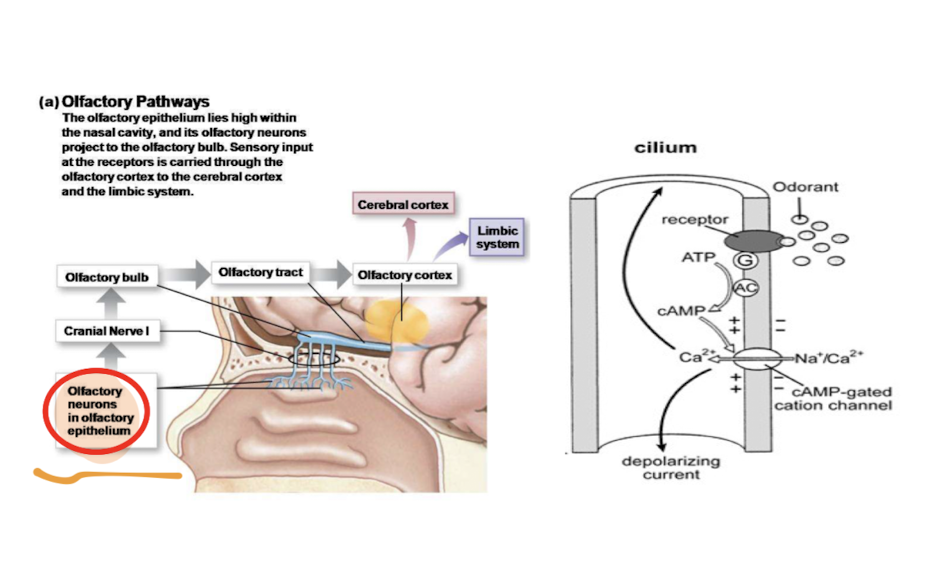
olfactory
this is where the chemical stimuli/odorant dissolved in the mucus layer binds to specific receptors in _________ cell membrane

odorant
Olfactory Receptor
the specific receptor proteins bind specific ________

G protein, production , ion channels, cations
specific receptor proteins bind specific odorant (ex. roses) → activates ______ → activates adenylyl cyclase → _______ of cAMP → cAMP directly binds _______ → allows ______ (Na+ and Ca++) to go thru → depolarization of the membrane
this may lead to firing of AP that goes to ur brain “hmm I smell roses”

trigger , passively , strong
The depolarizing current has to travel down the membrane and down to ______ zone of the axon (_______)
receptor potential is not AP → graded potential
if the depolarizing current is _____ enough and brings trigger one to threshold , u fire AP

amplification
bc we are generating current indirectly thru metabotropic mechanism → result = _______ of signal
this is why olfactory cells are v sensitive, to even just 1 or 2 molecules in the air
compare with ionotropic pathway : just 1 or 2 channels open , this means you’ll never be able to detect that odorant

AP, spike generating zone , vesicles
Sensory Cell Transmission
categories of sensory cell transmission:
1. sensory cell generates an ______ at a ______________
2. sensory cell releases _____ when depolarized; impulses generated in post - synaptic neuron
branch point, summation
Transmission of Signal (AP)
located at the axon terminal (eg. in the sensory axon innervating the skin)
first patch of excitable membrane will generally be at the _______, thus the receptor potential will have to travel and generate ________ at a branch point to reach threshold to get an AP

ion channels , summation
depolarizing current → reach trigger zone & bring to threshold to fire AP
mechanoreceptors found in skin that respond to pressure
pinch yourself & the pressure will open some ________ in membrane & generate the depolarizing current (RP)
the RP (which is a graded potential) travels and generates ______ at branchpoints to reach threshold and fire AP

volt-gated sodium
branch point = where we have ________ channels (lots)
AP can be generated here

release
2nd category of sensory cell transmission
sensory cell releases vesicles when depolarized, impulses generated in post synaptic neuron
idea is that sensory cell does NOT have to generate its own AP as long as it can _______ neurotransmitters
exocytosis, vesicles
Transmission of Signal (Vesicles)
The depolarizing current don’t produce any AP → travel throughout the membrane and at the other end → they depolarize the membrane sufficiently →influx of Ca++ ions and trigger _______ vesicles -→ sensory cell is releasing ______ and not producing an AP
next
Transmission of Signal (Vesicles)
if sensory cell release transmitters: ____ cell picks this up & acts a post synaptic neuron & fires AP
depolarization in 1st order neuron (sensory cell that does not generate AP) → release neurotransmitter by opening calcium channels
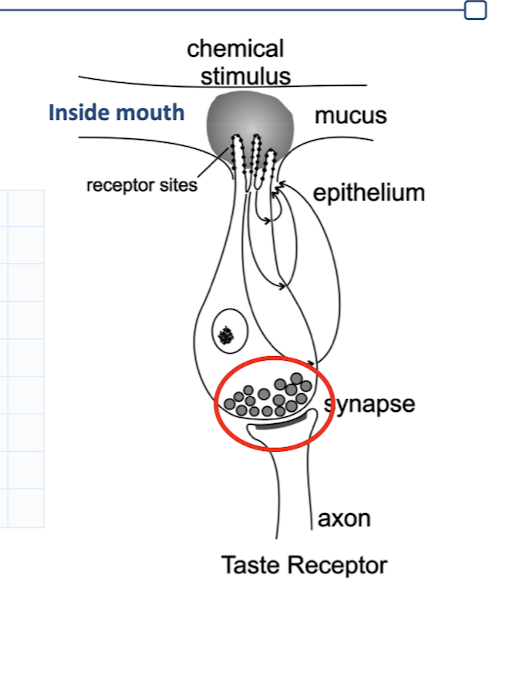
Taste Receptor
RP travel throughout the membrane and at the other end → influx of Ca++ ions → vesicles released vesicles (not producing an AP)

Taste Receptor
depolarizing current (generated due to chemical stimulus binding) passively travels thru the membrane & reaches other end of cell
opens volt-gated calcium channels → triggers calcium influx
calcium triggers exocytosis of vesicles

neighbouring, produce
Taste Receptor
releasing to ________ neuron and job of 2nd order neuron to _______ AP
decay , sustained, constant
Adaptation
The MP can _____ over time leading to adaptation
the original voltage is not __________ and it’s dropped over time, even though the stimulus may be _______
ex. hot bath (v hot at beginning, doesn’t feel as hot after tho)
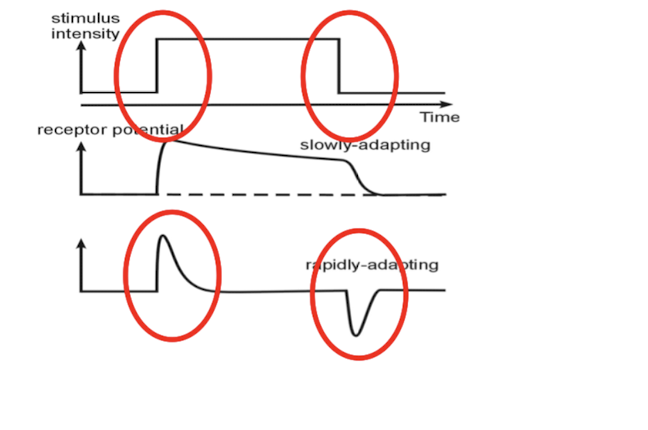
slowly, rapidly
Types of adaptation
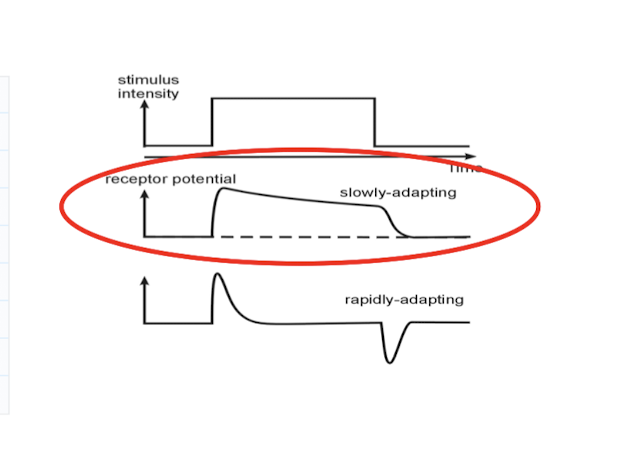
______ adapting
________ adapting
duration, magnitude
Adaptation (Slow)
slowly adapting : receptor potential sustained for _______ of stimulus
interested in overall ______ of stimulus
always some RP that is sustained as long as you maintain stimulus
decay is slow
zero, constant ,quickly
Adaptation (Rapid )
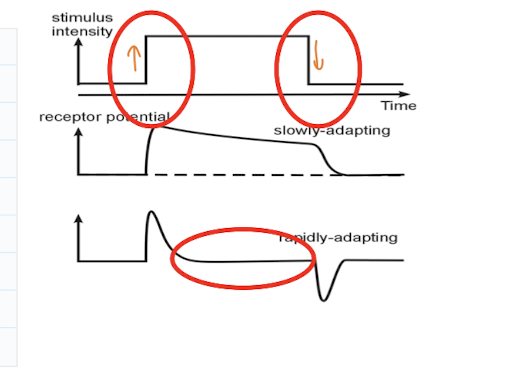
Rapidly adapting : RP elicited by change in stimulus energy, decays to _____ when stimulus is _______
interested in how ______ the stimulus is being delivered, the velocity of stimulus being delivered
hyperpolarization
removing stimulus : response in opposite direction = _______
successive, repeated, weaker
Habituation
is the response to _______ stimuli in time
Habituation : ________ stimuli (identical) in succession elicit progressively _______ responses
large
Habituation response depends on the cell, some will show _____ degree and some won’t
successive
adaptation = not subject to conscious control
sensory cells will do this on their own
is us becoming accustomed to _____ stimuli that we pay less and less attention
if you wait an hour or longer tho before the next identical stimuli , you won’t get habituation

intensity
Coding of Stimulus Intensity
The RP will vary directly in proportion with the ______ of the stimulus
depolarization , released , frequency
Coding of Stimulus Intensity
Greater the stimulus intensity→ the greater the receptor _____ (graded potential) → more transmitter _______ OR higher AP ________
receptor potential
Coding of Stimulus Intensity
huge stimulus vs little stimulus
big pinch = greater change in _______
more AP being fired in given time (frequency coding) or more transmitters being released (taste cells)
depolarization, hyperpolarization , spike
Coding of Stimulus Intensity
The greater the ________ → the faster the membrane will be brought up from ________ to generate a new _______
great stimulus → great receptor depolarization → membrane reach threshold faster to generate new AP , spike
spike train
Coding of Stimulus Intensity
great long lasting stimulus → generation of _______
refractory
Coding of Stimulus Intensity
The impulse frequency will always be limited by _______ period
there is a limit to how many AP in one second and the limit is bound by existence of refractory period
need some time to restore volt-gated sodium channels, can only fire 1000 AP in one second
ceiling, refractory
Coding of Stimulus Intensity
After a while, you will reach a _____ due to ________ period
recruit , neurons, threshold
Coding of Stimulus Intensity
to code above the ceiling, the strategy is to _____ additional _____
as stimulus intensity increases (beyond limit of AP frequency = 1000 AP/second), we recruit higher __________ sensory neurons (require greater stimulus before tehy generated RP)
receptor B
Post Synaptic Receptors
Strategies to code for the strength of stimulus
Increase frequency of AP at excitable membrane ( incr in intensity of stimulus → incr in frequency of AP [receptor A])
With increasing stimulus strength, we recruit an additional ________, which has a higher threshold
reach maximal discharge rate (1000 AP) , can’t fire AP’s faster
![<p><u>Post Synaptic Receptors</u></p><p>Strategies to code for the strength of stimulus</p><ul><li><p>Increase frequency of AP at excitable membrane ( incr in intensity of stimulus → incr in frequency of AP [receptor A])</p></li><li><p>With increasing stimulus strength, we recruit an additional ________, which has a higher threshold</p></li></ul><p><em>reach maximal discharge rate (1000 AP) , can’t fire AP’s faster</em></p><p></p>](https://assets.knowt.com/user-attachments/36c228f9-f1cc-4892-8673-62f87d1904eb.png)
labeled line
Coding for Modality
how to code for diff types of stimulus?
we use ________ strategy
nothing
Coding for Modality
labelled lined strategy means that activity in one pathway means a particular stimulus quality and _____ else
sub modalities
Coding for Modality
within a modality, we could have a variety of stimulus qualities (diff colours)
all sensations have ______ that you could distinguish (ex. touch : smooth, rough, oily, etc)
not enough space for a diff receptor for all these qualities + not efficient
ratio
Population Code
is coding using the ____ of activity from a restricted number of different receptor types
specific stimulus is coded by ratio of activity across population of receptors and not by seeing the specific effect on one receptor type
peak, strongly
Population Code
a given receptor (ex. A), type will respond to wide range, but it has a ____ which is different from others
thus, any given stimulus (dotted line) will activate one receptor (C) very ______ but others (A,B) more weakly

spatial
Receptive Field
Each sensory neuron is going to respond to a particular ______ area (e.g. skin, it’s the territory on the skin) → Receptive Field
what territory does each neuron cover
activate, sensory, different
Receptive Field
of a given sensory neuron is the territory in which you could _____ that neuron
Receptive Field is always defined in relation to a given _______ neuron, each sensory neuron will have a _______ Receptive Field
skin, smaller
Receptive Field in cutaneous sensory neuron is the ____ territory in which adequate stimulation elicits a response and is generally about 10-20 mm across (in the fingertips, it can be as little as 1 mm across)
finger tips = ______ receptive fields than back
can squeeze more sensory neurons → make denser → greater sensitivity
