Organic Chemistry Synthesis Reactions and Reagents
 Call Kai
 Learn
Learn Practice Test
 Spaced Repetition
 Match
Match Flashcards
 Knowt Play
1/17

There's no tags or description
Looks like no tags are added yet.
Name | Mastery | Learn | Test | Matching | Spaced | Call with Kai | Chat |
|---|
No analytics yet
Send a link to your students to track their progress
18 Terms
Williamson Ether Synthesis
1) NaH
2) RX
Synthesizes an ether from an alcohol.

Alkoxymercuration-demercuration
1) Mg(OAc)2, ROH
2) NaBH4
Synthesizes an ether from an alkene.

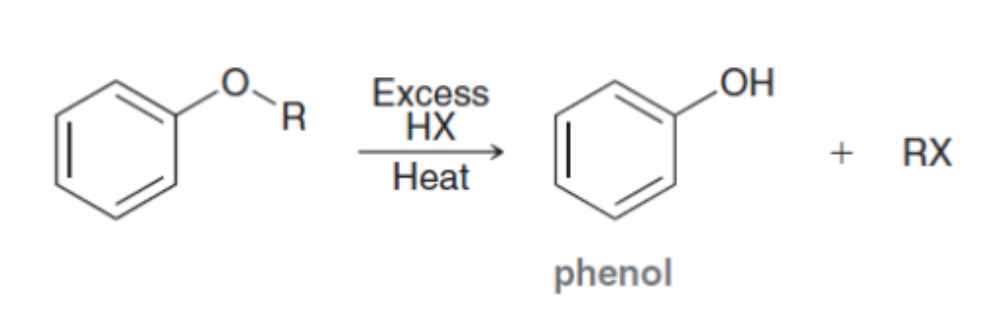
Acid-promoted Cleavage of Ethers
1) Excess HX, heat
Produces an alcohol and alkyl halide from an ether.
Carbons must be sp3 hybridized.
Epoxidation of Alkenes
1) RCO3 or MCPBA
Synthesizes an epoxide from an alkene.
Stereospecific. Will form a cis epoxide from a cis alkene and a trans epoxide from a trans alkene.

Epoxidation of Halohydrins
1) NaOH
Produces an epoxide from a halohydrin.

Ring-Opening Reactions of Epoxides
1) A strong nucleophile (NaOR, NaCN, NaSR, RMgBr, LiAlH4)
2) H3O+
Opens the ring of an epoxide, forming an alcohol and attaching the nucleophilic molecule to the less-substituted carbon.
Under acidic conditions (H2SO4), if a tertiary carbon is present, the nucleophilic molecule will attach to that carbon instead.

Oxidation of Thiols
1) Br2, NaOH, H2O
Forms a disulfide from two thiols.

Reduction of Disulfides
1) HCl, Zn
Forms two thiols from a disulfide. (The inverse of oxidation of thiols)

Sulfoxidation
1) NaIO4
Forms a sulfoxide from a sulfide.

Sulfonation
1) 2H2O2
Forms a sulfone from a sulfide.

Halogenation (EAS)
1) FeBr3 or AlBr3 or AlCl3
An aromatic proton is replaced by a halogen
Sulfonation (EAS)
1) Concentrated fuming H2SO4
An aromatic proton is replaced by SO3
Nitration (EAS)
1) HNO3 with H2SO4
An aromatic proton replaced by NO2
Friedel-Crafts Alkylation
1) Alkyl Halide with AlCl3
An aromatic proton is replaced with an alkyl group.
Friedel-Crafts Acylation
1) Acyl Halide with AlCl3
An aromatic proton is replaced with an acyl group.
Clemmensen Reduction
Zn(Hg) with HCl, heat
A carbonyl oxygen is replaced with two hydrogen atoms, reducing a ketone or aldehyde and forming the corresponding alkane.
Nucleophilic Aromatic Substitution
1) Strong NP
2) H3O+
Replaces a leaving group with a strong nucleophile. Requires an EWG and a good leaving group positioned ortho or para to the EWG.
Elimination-Addition via Benzyne
1) Strong NP, 350℃
2) H3O+