Exam 1-- Cytology slides
 Call Kai
 Learn
Learn Practice Test
 Spaced Repetition
 Match
Match Flashcards
 Knowt Play
1/35

There's no tags or description
Looks like no tags are added yet.
Name | Mastery | Learn | Test | Matching | Spaced | Call with Kai | Chat |
|---|
No analytics yet
Send a link to your students to track their progress
36 Terms
cytology
study of cell
squamous
flat & thin cells

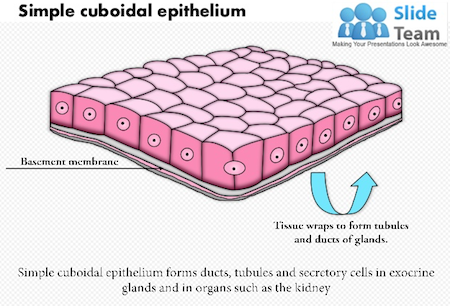
cuboidal
cube shaped cells
columnar
tall & thin cells

cells
first living level of organization
cell membrane
outer boundary that controls what enters and exits the cell
cytoskeleton
network of supportive proteins that provide internal support
cytoplasm
contains cytosol (fluid inside the cell) and organelles (structures that facilitate cellular function)
functions of cell membrane
-shape & protection
-Communication
-Semi-permeable
Cell membrane structure
-Bilayer membrane
-Phospholipids hydrophobic & hydrophilic (amphiphilic)
-Cholestrol (between phospholipids, provide rigidity)
-Glycolipids (carbs & lipids extend from cellular surface)
-Membrane proteins ( large molecules can’t pass easily thru)
Membrane Protein Functions
-Receptors (communication as receptors for neurotransmitters)
-Second-messengers (relay signals from outside the cell to inside)
-Enzymes (breakdown chemical messengers & nutrients)
-Channel proteins (allow water & other hydrophilic solutes to pass)
-Carriers (shuttle larger molecules)
-Cell-identity markers (glycoproteins that identify cell as ‘self’)
-Cell adhesion molecules (physically connect adjacent cells)
microvilli
small projections that increase the surface of a cell
cilia
small hair like projections.. some don’t move , some have sensory functions, others in respiratory areas
flagella
found in sperm cells, responsible for movement
passive vs active transport
Active transport moves molecules against a concentration gradient using energy, while passive transport moves molecules along a gradient without using energy
filtration
hydrostatic pressure to move particles
simple diffusion
movement of particles down a concentration gradient high —> low
osmosis
diffusion of water high concentration to low concentration
carrier-mediated-transport
movement with protein assistance (facilitated diffusion and active transport)
facilitated diffusion
movement of substances high to low concentration with protein
ATP not required
Active Transport
movement of substances low to high concentration with protein and ATP is required
Vesicular Transport
used to move large molecules across the membrane requiring ATP
(endocytosis and exocytosis)
endocytosis
into the cell
exocytosis
out of the cell
cytoplasm
contents inside the cell, contains cytosol and organelles
nucleus
“control center”
Found in most cells
contains DNA
surround by a bilayer membrane
contains the nucleolus
endoplasmic reticulum (ER)
system of interconnected channels called cisternae
2 types: rough & smooth
rough ER
continuous with nuclear envelope, contains ribosomes
smooth ER
continuous with rough ER, does not contain ribosomes
Ribosomes
produced in the nucleolus of the nucleus, attached to rough ER and free in the cytosol
reads the genetic material and produces peptides and proteins
Golgi Complex
small stacks of cisternae
finishes off proteins and synthesizes carbs
Golgi vesicles transport products (exocytosis)
lysosomes
specialized type of Golgi vesicle, contain digestive enzymes, travel through cell and breakdown unwanted materials
peroxisomes
resemble lysosomes, produced by ER, help to detoxify cytosol
mitochondria
oval in shape
internal folds known as cristae
synthesize ATP
centrioles
short cylindrical assembly of microtubules (proteins during cell division)
found in pairs
perpendicular to one another
used in cell division