PSYCH UNIT 3/4
 Call Kai
 Learn
Learn Practice Test
 Spaced Repetition
 Match
Match Flashcards
 Knowt Play
1/613

There's no tags or description
Looks like no tags are added yet.
Name | Mastery | Learn | Test | Matching | Spaced | Call with Kai | Chat |
|---|
No analytics yet
Send a link to your students to track their progress
614 Terms
Behaviourist appraoches to learning
Classical conditioning
Operant conditioning
social-cognitive approach to learning
observational learning
Attention (atkinson shiffrin model)
The process required to transfer info from sensory memory to STM

what does the 8 ways of Aboriginal learning framework demonstrate?
How ATSI approaches to learning use several different methods,
breaking down a concept into different components
Neutral stimulus
A stimulus that does not initially elicit a response
Unconditioned stimulus
A stimulus that elicits a reflexive response
unconditioned response
A natural (unlearned/reflex) behaviour to a given stimulus
Conditioned stimulus
A stimulus that elicits a response due to being paired with an unconditioned stimulus
Conditioned response
A response caused by the conditioned stimulus
Classical conditioning definition
A type of learning in which a neutral stimulus is repeatedly paired with an unconditioned stimulus until it produces a conditioned response.
The Ideal Interval between a neutral and unconditional stimulus in classical conditioning
NS is presented, wait 0.5 seconds, then UCS is presented
Classical conditioning- role of the learner
Passive
the learner does not need to actively engage
learning occurs through association
Classical conditioning- timing of stimulus
The stimulus occurs ½ second before the response
stimulus —> response
Classical conditioning- nature of response
Involuntary and automatic
Antecedent
Anything in the learner’s environment that triggers a response.
Behaviour
The learner’s voluntary response to the antecedent
Consequence
The event in the learner’s environment
that follows the response,
making the behaviour more or less likely to be repeated.
Reinforcement (observational learning)
The learner→ positively reinforced with the addition of a positive consequence,
Increases the likelihood of completing the behaviour again in the future.
Positive reinforcement
The addition of a desirable consequence in response to a behaviour
For example, a child getting a lolly for completing homework
Increases the likelihood of the behaviour.
Negative reinforcement
The removal of an unpleasant stimulus in response to a behaviour
For example, a child does not have to do chores for completing homework
Increases the likelihood of the behaviour.
Punishment
Punishment is thought of as an undesirable consequence for behaviour.
Therefore it decreases the likelihood of the behaviour.
Positive punishment
The addition of an unwanted stimulus, in response to a behaviour
decreases the likelihood of the behaviour.
Negative punishment (response cost)
The removal of a desirable stimulus, in response to a behaviour
For example, a teacher confiscates your phone when you are using it in class
decreases the likelihood of the behaviour.
Operant conditioning
A type of learning in which behaviour is strengthened or weakened depending on the consequences that follow it.
Effectiveness of punishment & reinforcement
Consequence follows response IMMEDIATELY after it occurs
Reinforcement- desirable
Punishment- undesirable
Example response operant conditoning process
The antecedent is Penny’s phone ringing, prompting her behaviour of taking the call in the hall. The consequence she receives is a chocolate.
This is positive reinforcement as the addition of the desirable stimulus (chocolate) increases the likelihood of her repeating the behaviour of taking the call outside when her phone rings again.
Similarities between classical and operant conditioning
Both are Behaviourist models
explain learning in 3 phases.
In both there is an acquisition process where a response is conditioned
Both are achieved through the
repeated association of two events
that follow each other closely in time.
Differences between classical and operant conditioning
operant conditioning= consequences are vital for learning
Classical Conditioning= no environmental consequences
Classical conditioning- association of NS & UCS- provides the basis of learning
Why is reinforcement considered a better strategy for modifying behaviour than punishment?
Punishment does not promote more desirable behaviour in its place.
Reinforcement strengthens desirable behaviours to replace undesireable behaviours
Operant conditioning- role of the learner
Active- the learner actively performs behaviours and learns from consequences.
Operant conditioning- timing of stimulus
The consequence occurs after the behaviour
Operant conditioning- nature of response
Voluntary
What is Observational learning?
A type of learning that occurs through observing the behaviour of a model and the consequences of that behaviour.
Socio cognitive
5 key processes necessary in observational learning
Attention
Retention
Reproduction
Motivation
Reinforcement
ARRMR
Attention (observational model)
The learner must actively focus on the actions of the model, as well as the consequences of their actions.
Not paying attention= unable to retain information required to reproduce the behaviour.
What influences our likelihood to imitate someone?
If the model is familiar to learner
Similar features to learner eg: age, gender
The model is perceived positively eg: celebrity
Makes the learner more likely to actively focus on the model
Retention (observational learning)
The learner stores the information they have observed as a mental representation (memory).
Reproduction
The learner needs to have both the mental and physical capabilities required to reproduce the observed behaviour, such as having adequate motor skills
Motivation
The learner must have a desire to imitate the behaviour so that they can receive a positive consequence
Reinforcement
increases likelihood of learner repeating the behaviour.
can occur vicariously= learner seeing/hearing the consequence of another person’s behaviour.
Observational learning- role of the learner
Active- the learner must pay attention, remember, and reproduce the behaviour
Observational learning- timing of stimulus
Observation—> imitation
Observational learning-nature of response
Voluntary
Learning as a System of Knowledge (ATSI)
Knowledge and skills being based on an interconnected and spiritual understanding, and in turn inform survival and contribute to a strong sense of identity.
different types of knowledge are learned together, not separately
understanding comes from seeing the relationships between ideas
Holistic in nature
What are concepts connected through in a system of knowledge?
story
symbols
place
experience
The role of the learner in a system of knowledge
The learner is:
an active participant within the holistic system
positioned within relationships, culture and Country
learning through observation, participation and experience
Gradually become a holder + transmitter of knowledge - learner AND teacher.
What does multimodal learning mean?
(use this for ways of knowing questions)
Learning occurs through a complex and sophisticated system using multiple modes at once, including:
storytelling
art
movement
Example of multimodal learning & how it shows
During storytelling:
the story is spoken/ sung
actions are performed
symbols or body paint may be used
Multimodal learning= knowledge is communicated through multiple forms simultaneously.
Example of 3 of the 8 ways of learning? (ATSI)
Story-sharing:
Learning by listening + sharing stories & songs of past, present and future.
Learning maps:
creating visuals to map pathways or processes
Non-verbal
physical techniques, e.g. dance, gestures, facial expressions
Kinship in Learning
A holistic system of relationships and responsibilities that connects individuals through:
family
community
cultural roles
It determines:
roles and responsibilities
how knowledge is shared
who holds and transmits knowledge
The role of the learner in kinship
to gain knowledge through observation, participation and experience
to become a teacher, who will eventually pass knowledge on
to become a custodian of future knowledge, responsible for maintaining and transmitting knowledge across generations
What does learning being patterned on Country mean?
Knowledge is organised and learned through connection to specific places
where the land holds meaning and information
What is Country?
A holistic connection to land, environment and spirituality, including:
land, waterways and sky
plants and animals
ancestors and cultural history
Learning being patterned on Country example & how it shows this
Learning is patterned on country due to knowledge being
embedded in place
connected to cultural and spiritual meaning
learned through experience and responsibility
Example- a learner walks through bushland and is taught:
which plants are safe to eat
when animals appear
How is learning embedded in relationships?
knowledge exists through connections between people, Country, culture
spirituality relies on bi-directional kinship bond b/w teacher and learner
Encoding
Conversion of information into a usable form so that it can be neurologically represented and stored in memory
Storage
retention of the encoded information over time
Retrieval
Recovery of stored information and bringing it into conscious awareness for use when needed.
This occurs when info from long-term memory is brought into short-term memory
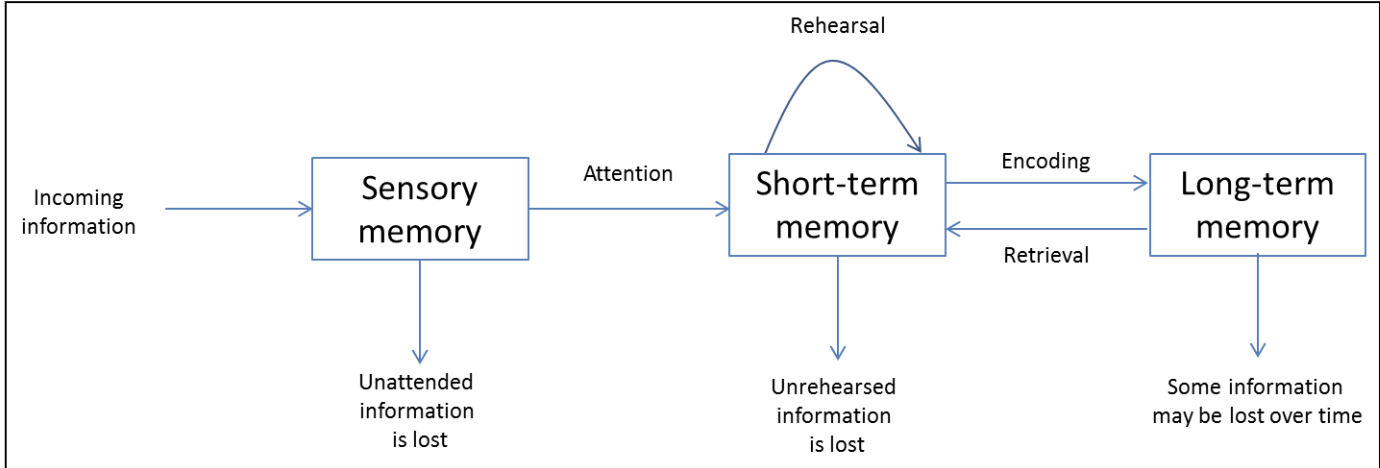
3 stores of the Atkinson-Shiffrin multi-store model
sensory memory
short term memory
long term memory
Atkinson-Shiffrin multi-store model of memory diagram
Sensory memory: role
To retain information which has been detected by the senses in its raw sensory form
Sensory memory: Capacity
Vast, potentially unlimited
Sensory memory: duration
0.2 - 4 seconds
How does info enter sensory memory and then short term memory?
Raw info from environment is detected by the senses and enters the sensory memory store.
If info is attended to, it is converted into a usable form & transferred to STM for conscious processing
Short-term memory function in atkinson shiffrin model
Receives info from sensory memory
Transfers info to and from LTM
Maintains info in conscious awareness for manipulation and use.
Short-term memory (STM)- capacity
7 plus or minus 2 items
7±2
(5-9 items)
Short-term memory (STM)- duration
18 - 30 seconds
How is info from short-term memory transferred to long-term memory?
By being actively rehearsed for encoding into LTM
How is info from long-term memory transferred to short-term memory?
Through the process of retrieval
Long-term memory (LTM)- function
to store information which can be retrieved for future use
Long-term memory (LTM)- capacity
vast, potentially unlimited
Long-term memory (LTM)- duration
relatively permanent
Explanatory power of Atkinson-Shiffrin: strengths
Distinguishes b/w different stores of memory
Outlines that each memory store has a different capacity and duration.
Provides a good understanding of the structure and process of memory.
Explanatory power of Atkinson-Shiffrin: weaknesses
Considered to be oversimplified.
STM is more complex and involves different components than the model suggests.
The model ignores factors, e.g motivation and strategy, which can assist in encoding information from STM to LTM.
Reciprocal (ATSI)
A two-way relationship of giving and receiving information
Learners both gain knowledge and have a responsibility to:
pass it on
care for others
care for Country
Explains why ATSI knowledge systems help contribute to a strong identity
Implicit memory
Refers to memory that does not require conscious or intentional retrieval
Procedural memory
long-term implicit memory of motor skills and actions that have been learned previously
E.g. cutting up food
Classically conditioned memory
Conditioned responses to conditioned stimuli acquired through classical conditioning
E.g. anxiety before completing a SAC
Explicit memory
when information can be consciously or intentionally retrieved and declared
Semantic memory
Refers to the long-term explicit memory of facts and knowledge about the world.
E.g. 7 days in a week, cells are the building blocks of life, Melbourne is capital of Victoria
Episodic memory
Long-term explicit memory of personally experienced events
E.g. First day of highschool
Hippocampus + what brain regions it works with
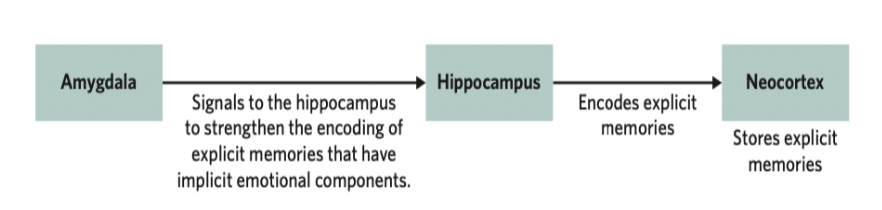
Primarily involved in the encoding and formation of new explicit memories
Transfers info to the neocortex to store and retrieve explicit LTM.
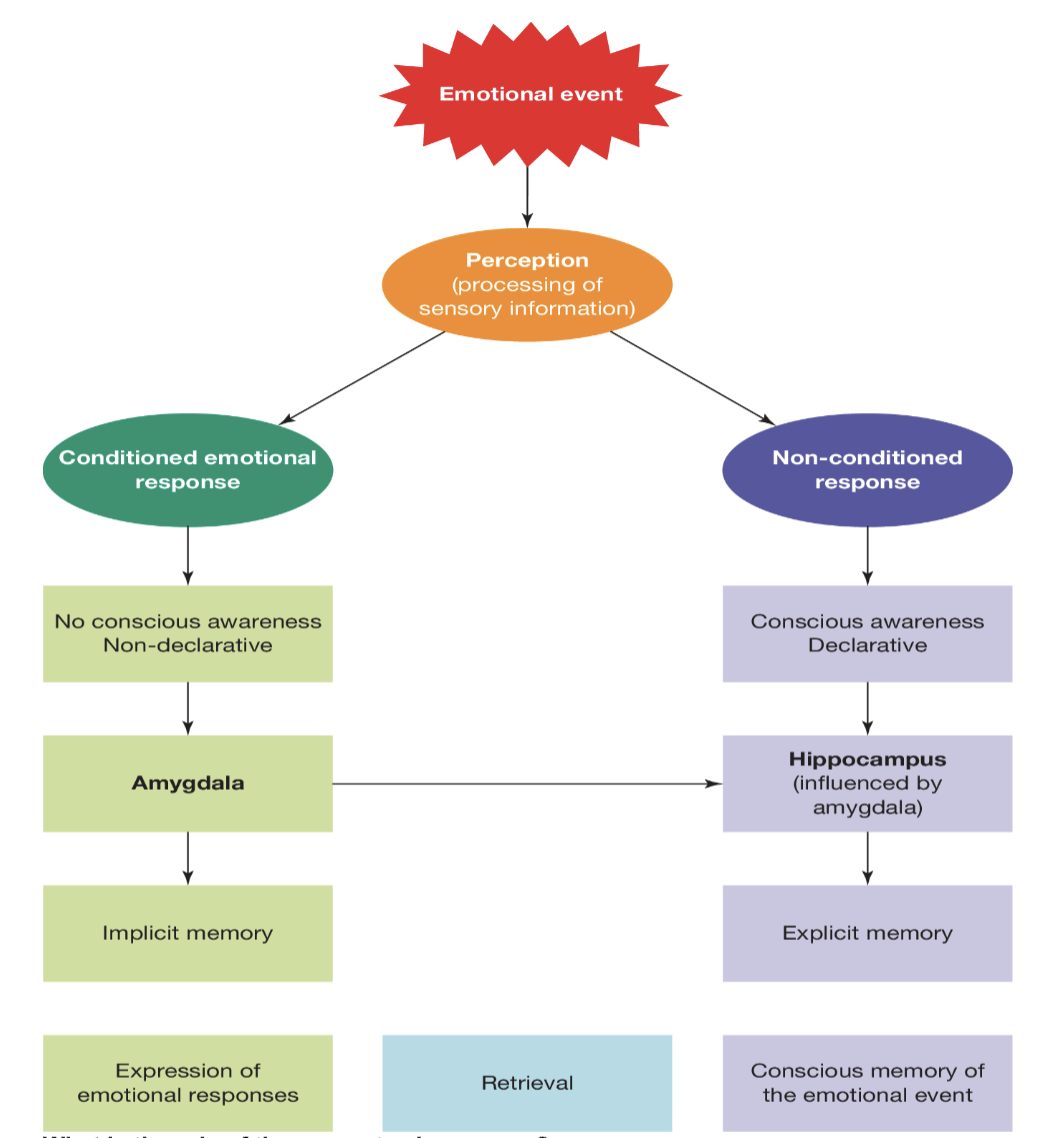
Works w/ amygdala in encoding emotionally arousing memories
Does not store info
Amygdala
Involved in the encoding of the emotionally arousing component of explicit and classically conditioned memories (particularly fear responses)
Can improve the memorability of an event by enhancing the encoding of information by the hippocampus.
The level of emotional arousal at the time of encoding influences the strength of the LTM formed of that event.
How do the amygdala and hippocampus work together in memory?
Amygdala detects an emotionally arousing memory
Amygdala signals to the hippocampus that it is meaningful, upregulating it
Hippocampus enhances the strength of the memory during encoding, for a stronger, more durable memory trace that can be more efficiently retrieved.
Neocortex
Stores explicit episodic and semantic memories that have been encoded by the hippocampus
Memories are stored in the locations of the neocortex that it was first processed (e.g., visual info stored in occipital lobe)
Also stores very well-learned motor memories.
What happens if the neocortex is damaged?
likely to result in the loss of the memories stored there.
How does the neocortex interact with the hippocampus?
The neocortex processes sensory information
The hippocampus receives information from the locations of the neocortex and encodes it, forming a whole memory
The components of the memory are then stored in the location of the neocortex that first processed it
When retrieved, info is transferred from neocortex to hippocampus again
The basal ganglia
Encodes + stores procedural memories related to motor skills & sequential movements→ through connection w/ cerebellum
Encodes + stores memories related to reward-based learning→ leads to habit formation
Supports these behaviours becoming automatic→ through repetition and reinforcement
What happens if the basal ganglia is damaged?
Difficulty learning new motor skills and habits
Previously learned skills may become harder to perform automatically
The cerebellum (part 1-basic understanding)
Stores long-term implicit procedural memories.
critical in classical conditioning
encodes,
stores &
precisely times
learned associations b/w a conditioned stimulus & motor response.
The cerebellum (part 2- extra info)
Helps to coordinate muscular movements necessary for procedural memories via connection w/ basal ganglia
Involved in activities requiring a skilled sequence of movements
What happens if the cerebellum is damaged?
Difficulty learning a response via classical conditioning
Learned skills are performed poorly and less smoothly
doesn’t affect explicit memories of experiences during CC
How do the basal ganglia and cerebellum work together in procedural memory and
habit formation?
● note- they are not distinct
1. The basal ganglia encodes and automates the skill
2. The cerebellum refines that memory, adjusting errors and improving
performance
3. Over time, the procedural memory becomes automatic (basal ganglia) and
accurate and well-timed (cerebellum)
Role of the neocortex in procedural memory and habit formation? ( relates to Basal ganglia and cerebellum)
involved in initial conscious processing of explicit details of skill when learning.
Basal ganglia and cerebellum take over after repetition to allow automation and coordination.
Habit formation
responding emotionally to a stimulus
e.g. difficulty→ nail biting
encoded and stored by basal ganglia
What are the five brain regions involved in LTM memory?
Hippocampus
Amygdala
Neocortex
Basal ganglia
Cerebellum
What happens if the hippocampus is damaged?
Difficulty forming new explicit long-term memories and their transfer to the neocortex for storage
Does not seem to affect the formation, storage or retrieval of procedural memories
(as they do not require the hippocampus)
Does not affect STM, but consolidation of memories into LTM is compromised
What happens if the amygdala is damaged?
Problems with the formation of emotional memories and details
Acquisition of conditioned fear responses may be hindered.
Autobiographical memory
Memories of personally lived experiences
Overlap of episodic and semantic memory.
e.g. memory of the event of a 16th birthday party
Possible imagined futures
Hypothetical experiences and situations that an individual can create and conceptualise in their mind.
E.g. imagining what you’re going to do tomorrow