PSY 1101 Midterm #2
 Call Kai
 Learn
 Practice Test
 Spaced Repetition
 Match
 Flashcards
 Knowt Play
1/97

Earn XP
Description and Tags
Chapter 5 - Sensation & Perception ; Chapter 6 - Consciousness
98 Terms
The Sensory Systems ____ While the Brain _____
Receive; Perceives
Sensation
The process by which our sensory organs receive stimulus energies from the environment and transduce them into the electrical energy of the nervous system
Transduction
The transformation of sensory stimulus energy from the environment into neural impulses
Perception
The neural processing of electrical signals to form an internal mental representation inside your brain of what’s on the outside
______ exist in our ability to perceive different stimuli
Thresholds

Psychophysics
The study of the relationship between the physical characteristics of environmental stimuli and our mental experience of them
Absolute thresholds
The absolute threshold is the smallest level of a stimulus that can be detected by the human senses, such as sound, sight, and smell. This concept is crucial in psychology research to understand sensory capabilities and limitations. Typically, it is defined as the minimum stimulus level detectable at least 50% of the time
Signal detection theory
takes into account both the intensity of the stimulus and psychological biases for a more accurate assessment
Liberal bias
reporting perception more readily
Conservative bias
reporting perception more hesitantly
People can distinguish between similar sensory stimuli that are both above __ ____ but that differ __ ____
above a threshold but that differ in magnitude
Just-noticeable difference (JND) or difference threshold
The minimum difference required between two stimuli for an observer to detect a difference half the time
Adaptation
stop noticing a stimulus that remains constant over time, resulting in enhanced detection of stimulus changes
The benefit of adaptation
Our senses ignore unhelpful information and optimize sensitivity to important information.
Sensory adaption
occurs at the level of the sensory receptors
Perceptual adaptation
occurs in the perceptual centers of the brain
Aftereffects & Examples
opposing sensory or perceptual distortions that occur after adaptation
Examples of aftereffects include phenomena like:
seeing a black spot after looking at a lightbulb,
seeing opposing movement on still surfaces after looking at a waterfall,
and even seeing opposing facial expressions after looking staring at a facial expression.
Can also happen with movement: feeling unsteady after being on a ship or treadmill
Light is _____ that is visible to our eyes.
electromagnetic radiation
Humans can visually sense only a small range of the spectrum of ______ ____
electromagnetic energy
Electromagnetic radiation has a _____, _______ and ________
wavelength, frequency, and amplitude
Photons are
the basic unit of all forms of electromagnetic energy and have wave-like properties
1) High frequency (short wavelengths) →
2) Low frequency (long wavelengths) →
1) highest energy content (e.g. gamma radiation, X-rays)
2) less energy (e.g. radar, radio waves)
Range of Visible Light
400-700 nm
Wavelength =
Variations in wavelenghts
Variations determine the quality/hue/color we perceive (violet ≈ 400nm – red ≈ 700nm)
Frequency
is the number of cycles per second of a wave
It is the inverse of wavelength
Higher frequencies = shorter wavelength
1) Amplitude
2) Its variations determine:
is the height of the wave
Variations determine the intensity/brightness of color

Anatomy of the eye

Role of the pupil
Pupil allows light in
Role of the Iris
Iris gives eye color – controls the size of the pupil and the amount of light that enters
Sclera
Sclera is the white of the eye
Role of the cornea
Cornea provides refraction and protects the eye (sclera)
Role of the lens
Lens focuses light onto the retina
Retina
Retina is the light-sensitive layer of cells at the back of the eye
= A surface on the back of the eye that contains photoreceptors, which contain photopigments that are sensitive to light
Rod
Photoreceptor cell that primarily supports night time vision
= More disks → x1000 more sensitive to light Only one type of photopigment
Cone
Photoreceptor cell that is responsible for high-resolution daylight color vision
= Do most of the work under daytime lighting
3 types of cones each with different photopigment – allows for color vision
Optic Nerve
Optic Nerve carries axons from the retina
Process of Refraction / Focus
Eye collects light, focuses it on retina/fovea, for maximum acuity
Cornea provides strongest refractive power – air to liquid
Lens provides additional refraction, particularly for near objects → accommodation
Lens is critical for objects closer than 9m
How close to the eye is too close?
6.5 cm from the eye
Which condition leads to difficulty focusing on close objects?
Presbyopia → Hardened lens, insufficient accommodation
Myopia
Short-sighted
Eye-ball too long → concave lens
Hyperopia
Far-sighted
Eye-ball too short → convex lens
Astigmatism is a ____ and _____ ____ _____ in the ______of the eye that causes ______ and ___ vision. Astigmatism occurs when either the ____ _____ ___ ___ ___ ____ or the ___ _____ the has __ curves.
Astigmatism is a common and generally treatable imperfection in the curvature of the eye that causes blurred distance and near vision. Astigmatism occurs when either the front surface of the eye (cornea) or the lens inside the eye has mismatched curves.
Optic disk
where blood vessels originate, and optic nerve exits
No photoreceptors
Blind spot
Blood vessel shadows
Macula
no blood vessels
Central vision
5.5 mm diameter
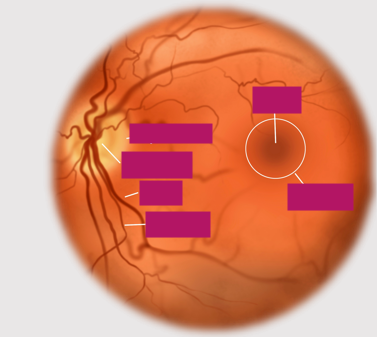
Retina opthalmoscope image

Fovea (structure, position, diameter, presence of optic fibers, concentration of cones?)
highest acuity, thinner retina
Center of the retina (nasal vs. temporal)
2 mm in diameter (pit)
No optic fibers
High concentration of cones

Nasal and Retinal Fibers
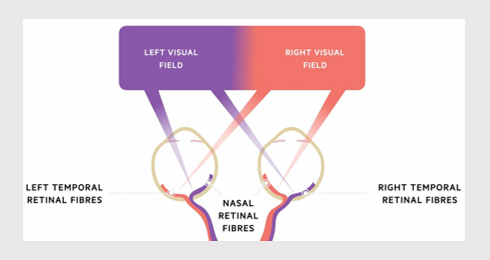
Photoreceptors are the only __________ _____ in the _____
light-sensitive cells; retina
Ganglion cells are the only ______ from the
output; retina
Ganglion cells are the only ______ _____ to fire _____ _____
retinal cells; action potentials
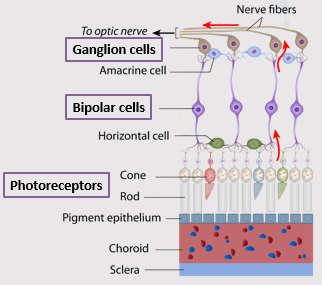
Laminar Organization of the Retina

Outer segments
Contain a stack of membranous disks
Light-sensitive photopigments in those disk membranes absorb light
This triggers changes in the photoreceptor membrane potential

Photoreceptors

Rods and cones are _____ _______ _________ _______ the retina
Rods and cones are not uniformly distributed across the retina

Photoreceptor Distribution
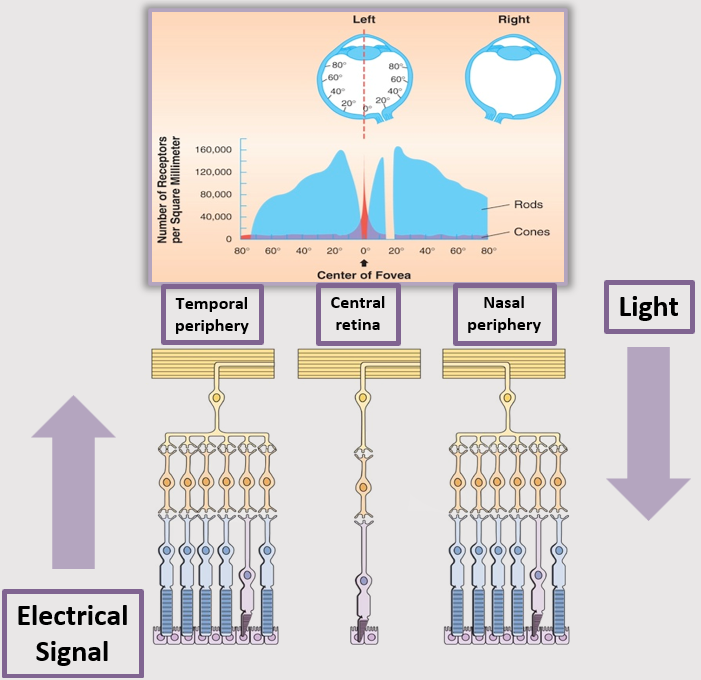
nb of photoreceptors per retina
100 million photoreceptors per retina
5 million cones
95 million rods (rods 20:1)
nb of retinal ganglion cells
1 million retinal ganglion cells
Central retina (convergence level, photoreceptors per ganglion cells, components, ability)
Central retina: less convergence
Few cones per ganglion cell
Fovea is all cones
More acuity – more cortical representation
Peripheral retina (convergence level, photoreceptors per ganglion cells, components, ability)
Peripheral retina: more convergence
More rods per ganglion cell
Mostly rods
More sensitive to light
The retina is not _______ ________
The retina is not organized uniformly
Rods are ___ _____ to light
•Provide ___ ____ _______ in dark conditions
•___________ under daylight conditions
•Cones need a lot of _____ to _____ → Fovea is _____ during scotopic (night) conditions
Rods are highly sensitive to light
•Provide good light sensitivity in dark conditions
•Saturated (non-functional) under daylight conditions
•Cones need a lot of light to react → Fovea is blind during scotopic (night) conditions
Under daylight conditions ______ do the work
Three different photopigments (instead of _____): ___, ___ and ____ (____)
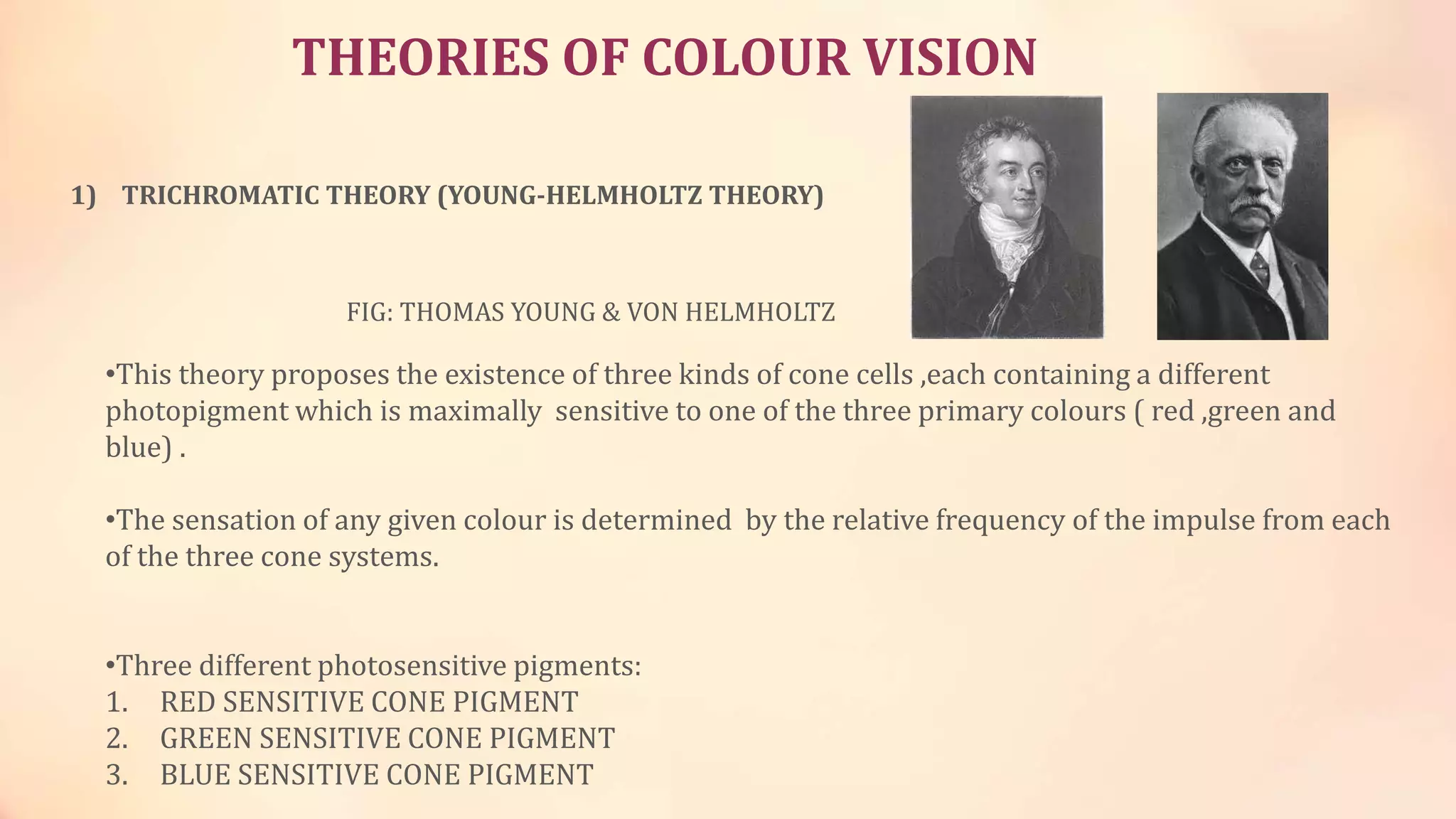
___________ _______ theory of color vision
Under daylight conditions cones do the work
Three different photopigments (instead of rhodopsin): red, green and blue (RGB)
Young—Helmholtz trichromacy theory of color vision
(The three types of cones have peak wavelengths near 564–580 nm, 534–545 nm, and 420–440 nm, respectively, depending on the individual.)
We cannot see color when ______ are inactive
Inability to distinguish ________
Poor color discrimination in our _______
We cannot see color when cones are inactive
Inability to distinguish wavelength
Poor color discrimination in our periphery
STATES OF CONSCIOUSNESS
not yet finished ch.5
Consciousness
the result of several brain processes.
Conscious Content
Your subjective experience of the internal and external world
Sense of self, plans, dreams
Day-to-day perception of space and time
= subjective internal/external experience (e.g., Inside Out - Riley's emotions/sense of self is a nice pop-culture hook).
States of Consciousness
Different levels of arousal and attention
Alert and focused, drowsy, daydreaming, asleep, anesthetized
Stream of consciousness
The metaphor "stream of consciousness" is commonly used to describe the continuous flow of thoughts within first-person subjective experience.
William James (1890) called this the 'stream of consciousness' - it never sits still
Attention
Prioritizing Information for Processing = selecting information from the internal/external environment to prioritize for processing.
Active attention (top-down or bottom-up?)
Top-down: controlled by your own goals
Example: scanning a crowd for a friend's face
Passive attention (top-down or bottom-up?)
Bottom-up: controlled by the physical features of the stimulus
Example: a loud bang or a bright flash grabs you automatically
Focused Attention
One Stimulus, Filtering Out the Rest
Focused Auditory Attention
The 'cocktail party effect': tracking one conversation in a noisy room
Measured with dichotic listening / shadowing tasks
Dichotic Listening Task

Focused Visual Attention
Attending to one visual target while ignoring competing input
Ex: Simons & Chabris (1999) gorilla video
Inattentional blindness
Refers to the tendency to miss changes to some kinds of information when your attention is engaged elsewhere.
= Failing to notice something unexpected because you're focused on another task
Example: not seeing a cyclist at an intersection while scanning for cars
Divided Attention
Simultaneously attending to two (or more) tasks - multitasking
Automaticity
Refers to fast, effortless processing of information without conscious thought. = a well-practiced skill that requires little conscious attention
Experience can improve multitasking through automaticity
Change Blindness
Failing to notice a change to something right in front of you
Ex: Simons & Levin (1998) Door Study
Sub/unconscious procesing
information we perceive but aren't aware is influencing our behavior
The stimulus is consciously perceived, but unconsciously impacts behavior
Example: Supermarket wine study (1997)
Background music shifted purchasing choices
French music boosted French wine sales, German music boosted German wine sales
Subliminal processing
a stimulus presented below the threshold of conscious awareness
Example: a subaudible or subvisual message embedded in media
Subvisual message: hidden n****y/hints in Fight Club
Subaudible message: weight loss tapes
Does Subliminal Advertising Actually Work?
In 1957, a marketer claimed flashing 'Drink Coca-Cola' for 1/3000th of a second in a movie boosted sales
The study was later revealed to be fabricated
Controlled studies find subliminal stimuli can produce small, brief effects on simple judgments
BUT not the dramatic behaviour control shown in movies
We assume our decisions come from ____, ______ reasoning
Often, choices are shaped before we're even ____ __ ________
We assume our decisions come from careful, conscious reasoning
Often, choices are shaped before we're even aware of choosing
Two hidden forces form Unonscious Desicion-making
Environmental cues
Internal signals
Environmental cues
music, product placement, default options
Internal signals
emotions, “gut feelings,” hunger, fatigue
Wine study: French music in-store (environmental cue or internal/emotional signal?)
Environmental cue
Holding a warm vs cold cup changes perception of stranger’s personality (environmental cue or internal/emotional signal?)
Internal / emotional signal
Judges' favourable parole rulings dip before meals, rebound after (environmental cue or internal/emotional signal?)
Internal / emotional signal
People exposed to a faint citrus cleaning smell kept their table cleaner while eating a crumbly biscuit, without noticing the smell’s role (environmental cue or internal/emotional signal?)
Environmental cue
Iowa Gambling Task: “gut feelings” steer choices to safer decks before people can explain why (environmental cue or internal/emotional signal?)
Internal / emotional signal
Organ donor: opt-out countries ~90%+ consent vs ~10–20% opt-in same “free choice” (environmental cue or internal/emotional signal?)
Environmental cue
Libet (1983): brain activity tied to a “______” ________ begins ~_____ before you feel like you've ______
Libet (1983): brain activity tied to a “voluntary” movement begins ~350ms before you feel like you've decided
Readiness Potential

Stimuli can be ________ and _______ without being _______ perceived
Stimuli can be discriminated and preferred without being consciously perceived
Subject: B., 72-year-old man who had a severe case of Herpes simplex encephalitis in 1975
Complete bilateral destruction of the amygdala, hippocampus, basal forebrain, plus extensive damage to insula, OFC, and ant. cingulate.
Severe case of amnesia, agnosia, ageusia and anosmia
Drank and finished 2% Glucose, saline, and 100% lime juice, all said to taste “delicious”, “like pop” – no individual recognition
However, when given the choice between saline and sucrose he almost always choose sucrose (18/19), but could not say why
Visual neglect
typically follows damage (lesions) to the right parietal lobe
Patients are not aware of stimuli in their left visual field