Ch. 25 History of Life
 Call Kai
 Learn
Learn Practice Test
 Spaced Repetition
 Match
Match Flashcards
 Knowt Play
1/19

There's no tags or description
Looks like no tags are added yet.
Name | Mastery | Learn | Test | Matching | Spaced | Call with Kai | Chat |
|---|
No analytics yet
Send a link to your students to track their progress
20 Terms
Four conditions for Origin of Life
Abiotic synthesis, macromolecule formation, protocell packaging, and self-replication.
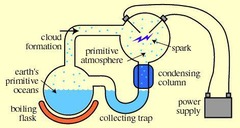
Miller-Urey Experiments
Demonstrated that amino acids can be produced from non-living processes with an energy source.
Murchison meteorite
A meteorite containing both water and amino acids discovered in 1980 questioned earlier theories about how life may have originated on Earth.

Abiotic macromolecule formation
Simple RNA and polypeptide polymers form when monomers are placed on hot rocks or sand.

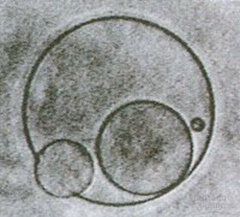
Protocells
Prebiotic lipid vesicles that isolate an internal environment to maintain homeostasis.
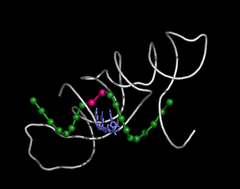
Ribozymes
RNA molecules capable of replicating short nucleotide sequences.
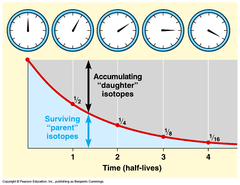
Absolute geologic dating
Determined using ratios of unstable isotopes and their predictable half-lives.
Earliest evidence of life
Stromatolites in Tanzania dating to 3.7 billion years ago (bya).

Oxygen Revolution
Oxygenic photosynthesis by prokaryotes increased atmospheric O2 and rusted ocean iron (~2.3-2.7 bya).

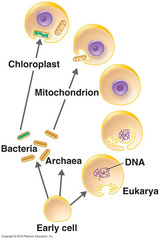
Origin of Eukaryotes
Arose from serial endosymbiotic relationships between early prokaryotic cells 1.8 bya.
First multicellular eukaryotes
Algae that arose approximately 1.2 to 1.8 bya, aided by increased oxygen.

Animal origins date
Molecular clock studies of sponges suggest animals first arose approximately 700 mya.

Cambrian Explosion
Massive radiation of animal phyla over 10 million years starting ~542 mya.

Earliest land plants
Evidence of plants with land adaptations dates from ~420 million years ago.

Plate tectonics rate
Continents continually float on the liquid mantle at a rate of ~2 cm/year.

Mass extinctions
Five events over the last 500 million years where at least 75% of species went extinct.
Mammalian adaptive radiation
Followed the 66 mya mass extinction, potentially aided by the advantage of endothermy.

Adaptive radiation triggers
Mass extinctions, colonization events, and novel adaptations.
Hox genes function
Homeotic genes whose mutations result in large modifications to body plans.

Evolutionary trends
Can build extreme complexity or trend toward fewer, more specialized characteristics.