Rad 130 Quiz 3 structure of matter 3 and EMR part 1
 Call Kai
 Learn
 Practice Test
 Spaced Repetition
 Match
 Flashcards
 Knowt Play
1/122

There's no tags or description
Looks like no tags are added yet.
123 Terms
Isotope
An atom with the same number of protons and a different number of neutrons from other atoms of the same element.

Radioisotopes
Isotopes that have unstable nuclei and undergo radioactive decay in order to become stable

Radioactivity
The ability of radioisotopes to give off ionizing radiation or particles as their nuclei break apart on their own.

Too few or too many neutrons in an atom
What urges an atom to become radioactive?
Radioactive decay
The spontaneous active emission of gamma radiation and alpha/beta particles by an unstable atomic nucleus in order to become stable again. Occurs when a radioisotope becomes radioactive.

Radioactive Half Life
The amount of time it takes for half of a radioactive substance (radionuclide) to decay into a different element. This time varies widely, from less than a second to many years, depending on the substance.

Radioactive Decay Law
What is the law that states radioactive atoms decay faster when more are present, and as their number decreases, the decay rate slows, but always follows a predictable exponential pattern?

Marie Curie
Notable female Polish/French chemist and physicist around the turn of the 20th century. Won two nobel prizes. Did pioneering work in radioactivity.

Becquerel or Curie
What is radioactive material measured in?
Alpha and beta particles
What are the 2 types of particulate radiation?
A violent process where an unstable nucleus ejects two protons and two neutrons to become more stable. They travel at high speed but lose energy quickly, penetrating only a few centimeters in air (5cm) and less than 100 microns in soft tissue. Because of this low penetration, external exposure is usually harmless, but if inhaled or ingested, it can be very dangerous.
What is alpha radiation/emission?

4
What's the atomic mass of an alpha particle?
2
What's the atomic number of an alpha particle?
+2
What's the charge of an alpha particle?
Occurs when a high-speed electron is emitted from the nucleus, leaving the atom with a +1 charge and changing it into a different element. These particles are small, with almost no mass and a negative charge. They can ionize hundreds of atoms per centimeter and are more penetrating than alpha particles, though still limited in range.
What is beta radiation/emission?
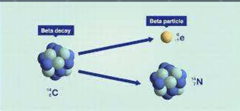
0
What's the atomic mass of a beta particle?
0
What's the atomic number of a beta particle?
-1
What's the charge of a beta particle?
X-ray and Gamma rays
What are the 2 types of electromagnetic radiation caused by radioactivity?
Bundles of energy called photons with no mass and no charge. They travel at the speed of light and are just energy disturbances moving through space. Unlike particles like alpha and beta, photons have an unlimited range in matter. X-rays and gamma rays can go much farther and are used to see inside the body.
What's electromagnetic radiation?
A type of invisible, high-energy light that comes from the electron cloud of an atom. It's able to pass through the body to create images of bones and other structures.
What's an X-ray?
The electron cloud
Where do X-rays originate from?
High-energy light (photon) with no mass and no charge. It comes from the nucleus of an atom and can travel deep into materials. These rays are the strongest.
What's a gamma ray?
The nucleus (often accompanied by alpha and beta particles)
Where do gamma rays originate from?
Mass
Energy
Velocity
Charge
Origin
All ionizing radiation acts similarly in tissue, but there are FIVE fundamental differences. What are the differences?
piece of paper
What material can block alpha particles?
layer of aluminum foil
What material can block beta particles?
Concrete or lead
What material can block gamma rays?
Radioactive decay
When an atom is unstable and it starts to emit particles it is said to be undergoing what?
Bq (barquell)
What unit (SI) is used to measure radioactivity in the SI system?
Curie
What traditional unit is used to measure radioactivity?
the time required for a quantity of radioactivity to be reduced to one-half its original value
What is radioactive half-life?
Particulate and Electromagnetic
What are the 2 classifications of ionizing radiation?
Alpha and beta particles
What are the 2 types of particulate radiation?
Electromagnetic
What type of radiation are x-rays and gamma rays?
2 protons and 2 neutrons
What subatomic particles are emitted in alpha particles?
4
What is the atomic mass number of alpha particles?
+2
What charge does the alpha particle possess?
external exposure is relatively harmless but internal exposure is very harmful
Discuss the penetrability of the alpha particle:
Radon
Give an example of how alpha can be very harmful:
Electron
What subatomic particle(s) are emitted in beta particles?
0
What is the atomic mass number of a beta particle?
-1
What charge does the beta particle possess?
More penetrable than alpha but less than X-rays or gamma.
Discuss the penetrability of the beta particle:
X-ray and Gamma rays
What are the 2 types of electromagnetic radiation caused by radioactivity?
X-rays originate in the shells of an atom whereas Gamma rays originate in the nucleus of an atom.
What is the difference between X-rays and Gamma rays?
(HINT: They originate in 2 different places)
Bundle of energy called quantum which travels at the speed of light (c) and can also exist at various energy levels. (smallest quantity of any type of Electromagnetic radiation). energy disturbances in space which have no mass/charge and have a field around them called the electromagnetic field. Consists of both electric and magnetic and must be moving to exist.
What is a Photon?

sinusoidal fashion/wave
In what way do photons move?
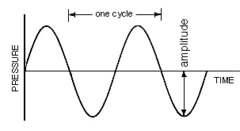
1 cycle consisting of 2 pulses. Contains both a crest and a valley where the positive half represents the top (crest) and negative the bottom (valley) or negative half.
What's a sine wave?

Amplitude
Height of a wave (Maximum displacement from its equilibrium point) (½ range from crest to valley of sine wave)

Frequency
Number of crests or valleys which pass a point in a given amount of time (represented by "f").

Hertz (Hz) (1Hz= 1 cycle/sec)
Basic unit of measure for frequency?

Wavelength
Distance from one crest to another, or from one valley to another. (measured in meters (m) ) symbol is lambda (λ).

Lambda
What's the symbol for wavelength?

Meter (lambda λ) (Angstrom)
Basic unit of measure for wavelength?
Inverse (if traveling at same speed/velocity). As wavelength increases, frequency decreases if the speed/velocity is constant.
How are wavelength and frequency related?

v = fλ
velocity = frequency x wavelength
What is the wave equation?

The speed of an electromagnetic wave equals its frequency times its wavelength. So, if you know how often the wave vibrates (frequency) and how long each wave is (wavelength), you can find how fast it's moving.
Why is the wave equation important? What does it tell us about electromagnetic waves?
c=fλ
Electromagnetic radiation = frequency x wavelength
What is the Electromagnetic wave equation?
All Friendly Waves Vibrate
Mnemonic for remembering the measurable characteristics of waves?
Amplitude
Frequency
Wavelength
Velocity (speed of light)
All Electromagnetic radiation is "c"
All waves have their own measurable characteristics. What are they?
10 crests per 1 second (10Hz)
You count 40 crests passing you in a 4 second period, what is the frequency?
Every second, 60 crests occur. So, in 1/60 of a second each crest occurs 1 crest out of the 60 occur.
A current has a frequency of 60 Hz, how long will it take for one cycle to complete?
Meters per second (m/s)
Basic unit of measure for velocity?
Electron volt or ev (joules)
Basic unit of measure for energy?
3x10^8 m/s / 5000m = 60,000 or 6x10^4
A photon has a wavelength of 5000 m. What is the frequency of the photon?
3x10^8 m/s / 900m = 3.33x10^5
A photon has a wavelength of .9km. What is the frequency of the photon?
Electromagnetic spectrum (EMS)
The range of wavelengths or frequencies over which electromagnetic radiation extends. Wavelength and energy are inversely related, so as wavelength decreases, energy increases. Energy is directly proportional to frequency, so as energy increases, frequency increases.

Radiofrequency (RF)
low energy, long wavelength, low frequency. MRI uses this to take images. (identified by frequency)
Visible light
electromagnetic waves that you can see, measured in nanometers (nm) (identified by wavelength)
Ionizing radiation
energy of photon high enough to cause damage, an 80Kvp contains photons from 0-80kev. An xray photon has much more energy than visible light photons or RF. (identified by energy)
Frequency increases and wavelength decreases (inverse)
If an X-ray photons have more energy than visible light or RF photons, what happens to wavelength and frequency?
electromagnetic
What type of energy is a photon?
speed of light (3x10^8)
What is the velocity of a photon?
Meters per second (m/s)
Base unit for velocity (SI)?
electromagnetic fields
What fields surround a photon?
Sinusoidal fashion/wave
In what fashion do photons move?

Crest
What is each bump called on a sine wave?

Valley
Each dip is referred to as what on a sine wave?

cycle
2 "bumps" are referred to as what?
Amplitude
Frequency
Wavelength
Velocity (speed of light)
All Electromagnetic radiation is "c"
All waves have what major characteristics?
Height of a wave (Maximum displacement from its equilibrium point) (½ range from crest to valley of sine wave)
What is amplitude?
Number of crests or valleys which pass a point in a given amount of time (represented by "f").
What is frequency?
f
What symbol is used for frequency?
Hertz (Hz)
What is the base unit of measure for frequency (SI)?
Distance from one crest to another, or from one valley to another. (measured in meters (m) ) symbol is lambda (λ).
What is wavelength?
meters
What is the base unit for wavelength (SI)?
lambda (λ)
What symbol is used for wavelength?

Inverse
What's the relationship between wavelength and frequency?
Inverse
What's the relationship between wavelength and energy?
Directly related
What's the relationship between energy and frequency?
Increases
When referring to the Electromagnetic spectrum, what happens to energy as you move up the spectrum?
Decreases
When referring to the Electromagnetic spectrum, what happens to wavelength as you move up the spectrum?
Increases
When referring to the Electromagnetic spectrum, what happens to frequency as you move up the spectrum?
Electron volt or EV (joules)
What is the base unit for energy in X-ray?
v = fλ
velocity = frequency x wavelength
What is the wave equation?
c=fλ
Electromagnetic radiation = frequency x wavelength
What is the electromagnetic wave equation?
Measured in nanometers (nm) and identified by it's wavelength
Although all photons have wavelength, frequency, and energy, how do we more specifically classify visible light?
Identified by frequency and its low energy, long wavelength, low frequency.
Although all photons have wavelength, frequency, and energy, how do we more specifically classify Radiofrequency?
Identified by energy
Although all photons have wavelength, frequency, and energy, how do we more specifically classify X-ray's?