CH 220: Nucleophilic Substitution

0.0(0)
Studied by 0 people
call kaiCall Kai
learnLearn
examPractice Test
spaced repetitionSpaced Repetition
heart puzzleMatch
flashcardsFlashcards
GameKnowt Play
Card Sorting

1/39

encourage image

There's no tags or description

Looks like no tags are added yet.

40 Terms

1
New cards
Starting material in this lab?
2-methyl-2-butanol (tertiary alcohol).
2
New cards
Expected product?
2-chloro-2-methylbutane.
3
New cards
Two requirements for substitution?
A nucleophile and a good leaving group.
4
New cards
Nucleophile in this experiment?
Cl⁻ from HCl.
5
New cards
Why is OH⁻ a problem?
It is a poor leaving group.
6
New cards
What are the TWO roles of HCl?
  1. Provides Cl⁻

  2. Protonates OH to make H₂O a leaving group.

    • Converts poor leaving group OH⁻ into neutral H₂O.


7
New cards
Why is the reaction SN1?

Tertiary alcohol forms a relatively stable carbocation.

8
New cards

SN1 steps?

  1. Protonate the alcohol oxygen.

  2. Water leaves; carbocation forms.

    • (rate determining)

  3. Cl⁻ attacks the carbocation.


Protonate → Water leaves → Carbocation forms → Chloride attacks.


<ol><li><p>Protonate the alcohol oxygen.</p></li><li><p>Water leaves; carbocation forms.</p><ul><li><p>(rate determining)</p></li></ul></li><li><p>Cl⁻ attacks the carbocation.</p></li></ol><p></p><p>Protonate → Water leaves → Carbocation forms → Chloride attacks.</p><p></p>
9
New cards
SN1 rate-determining step?

Leaving group departs to form the carbocation.

10
New cards

SN1 vs SN2: intermediate / steps?

SN1 has a carbocation & is stepwise; SN2 has none & is concerted.

<p>SN1 has a carbocation &amp; is stepwise; SN2 has none &amp; is concerted.</p>
11
New cards
Why is SN2 slow at tertiary carbon?
Steric hindrance blocks backside attack.
12
New cards

fastest arrangement for SN1 vs SN2

SN1: tertiary alkyl halide (or resonance stabalized), weak nucleophile (h2o, OH)

SN2: primary alkyl halide (or methyl)

<p>SN1: tertiary alkyl halide (or resonance stabalized), weak nucleophile (h2o, OH)</p><p>SN2: primary alkyl halide (or methyl)</p>
13
New cards

HCl volume and concentration?

12.5 mL of approximately 10.1 M HCl.
14
New cards

Why use IR in this lab, what does it measure?

Check expected bonds and compare product spectrum with a reference.

Measures infrared absorption by molecular vibrations.

15
New cards
Functional-group IR region?
About 4000–1250 cm⁻¹.
16
New cards
Fingerprint IR region?
About 1250–400 cm⁻¹.
17
New cards
Alkane C–H stretch location?
About 2850–3000 cm⁻¹.
18
New cards
Alcohol O–H stretch location?
About 3200–3600 cm⁻¹.
19
New cards
Carbonyl C=O stretch location?
About 1650–1750 cm⁻¹; typically strong.
20
New cards
Which IR peak should disappear after reaction?
Alcohol O–H stretch (about 3200–3600 cm⁻¹).
21
New cards

Which IR signal should remain?

Alkane C–H stretching around 3000 cm⁻¹.
22
New cards

IR: Peak frequency vs intensity?

Frequency tells WHERE a peak occurs; intensity tells HOW STRONG it is.

<p>Frequency tells WHERE a peak occurs; intensity tells HOW STRONG it is.</p>
23
New cards
Why does O–H peak width vary?
Different degrees of hydrogen bonding.
24
New cards
What does a fingerprint match support?

Product identity compared with a known reference IR spectrum.

  • even molecules with similar functional groups can have different fingerprint-region patterns.


25
New cards
Why can’t the lab IR reliably verify C–Cl?
Limited resolution near ~700 cm⁻¹.
26
New cards
Why perform halide tests?
Support presence of alkyl halide and behavior of tertiary chloride.
27
New cards

Which halide test follows SN2 vs SN1?

Sodium iodide (NaI) test vs Silver nitrate (AgNO₃) test.

<p>Sodium iodide (NaI) test vs Silver nitrate (AgNO₃) test.</p>
28
New cards
Expected AgNO₃ result for tertiary chloride?

Precipitate forms very quickly.

<p>Precipitate forms very quickly.</p>
29
New cards
Expected NaI result for tertiary chloride?
Very slow or no precipitate within five minutes.
30
New cards
Why do halide test rates differ?
Tertiary substrates favor SN1 and strongly hinder SN2.
31
New cards
NaI test: what precipitates?

Sodium halide (NaX)

32
New cards
AgNO₃ test: what precipitates?

Silver halide (AgX)

33
New cards
What is the key HCl hazard?
Concentrated acid is corrosive; avoid exposure and spills.
34
New cards

Four IR instrument rules?

Clean area; clean instrument; follow instructions; inspect spectrum.

35
New cards

Nucleophile

Electron-rich species that attacks a carbon

  • ex. Cl-


36
New cards

Why do we use HCl instead of NaCl?

  1. Supplies Cl⁻, the nucleophile.

  2. Supplies H⁺, which protonates –OH and converts it into H₂O, a good leaving group.


37
New cards

Why does our experiment follow SN1?

2-methyl-2-butanol is a tertiary alcohol. Once protonated water leaves, a relatively stable tertiary carbocation can form, favoring the SN1 pathway.

38
New cards

Overall reaction

2-methyl-2-butanol → 2-chloro-2-methylbutane
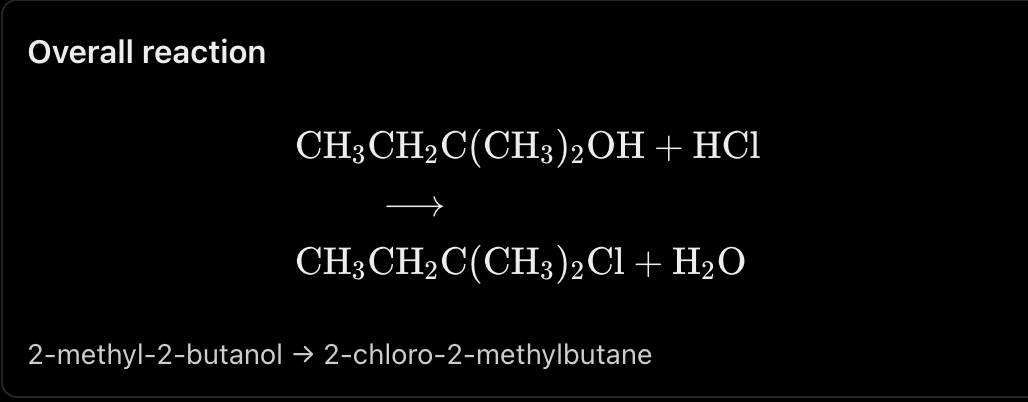
<p>2-methyl-2-butanol → 2-chloro-2-methylbutane</p>
39
New cards

Wash versus extraction

Extraction

Wash

Transfers the desired compound into an extracting solvent

Transfers unwanted impurities into a washing solvent

Goal: collect the substance of interest

Goal: purify the product

Product moves into the extraction solvent

Product remains in its original phase


Our experiment uses a wash to remove excess HCl and other unwanted substances while keeping the organic product.

40
New cards

IR observation from this lab

Most important observation: The alcohol O–H peak should disappear.

  • C-H present

  • OH & C=O absent

  • Fingerprint region simialr to known 2-chloro-2-methylbutane reference



