BCH4024 Douma Exam 4 - Lecture 7
 Call Kai
 Learn
Learn Practice Test
 Spaced Repetition
 Match
Match Flashcards
 Knowt Play
1/33

There's no tags or description
Looks like no tags are added yet.
Name | Mastery | Learn | Test | Matching | Spaced | Call with Kai | Chat |
|---|
No analytics yet
Send a link to your students to track their progress
34 Terms
What is negative gene regulation?
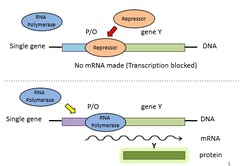
The repression of transcription by proteins called repressors that bind DNA and block RNA polymerase from reaching the transcription start site.
How do repressors block transcription in prokaryotes?
They bind to operator sites (cis-acting elements) usually located downstream or within the promoter, physically blocking RNA polymerase from reaching the transcription start site.
What is an operator site?
A DNA sequence where a repressor binds to block transcription.
What is an effector molecule?
A small molecule that binds to a transcription factor (activator or repressor) and changes its shape, thereby regulating its DNA-binding ability.
How do some repressors respond to effector molecules?
Some repressors bind DNA only when the effector molecule is absent; binding of the effector hides the recognition helix and prevents DNA binding.
How do other repressors respond to effector molecules?
Some repressors bind DNA only when the effector molecule is present; binding of the effector exposes the recognition helix for DNA binding.
What is positive gene regulation?
The activation or stimulation of transcription by proteins called activators.
Where do activators bind?
To activator binding sites located upstream of the promoter.
How do activators stimulate transcription?
By binding upstream of the promoter and interacting directly with the alpha subunits of RNA polymerase to increase its recruitment and affinity for the promoter.

How do effector molecules regulate activators?
Some activators bind DNA only in the presence of their effector molecule, while others bind only in its absence.
What is the lac operon?
A cluster of genes in E. coli that encode enzymes for lactose metabolism, regulated by both negative and positive control mechanisms.
What carbon source does E. coli prefer?
Glucose.
What happens when glucose is low in E. coli?
Adenylate cyclase produces cyclic AMP (cAMP), which acts as an effector molecule for the CRP activator to promote transcription of alternative carbon source operons like the lac operon.
What is the lac repressor?
A homo-tetramer protein that binds to operator sites in the lac operon to block transcription in the absence of lactose.
How is the lac repressor regulated?
Allolactose (an isomer of lactose) binds the lac repressor, changing its shape and preventing it from binding DNA when lactose is present.
Where are the operator sites in the lac operon?
Three sites: O1 (main site just downstream of promoter), O2 (within coding region), and O3 (upstream of promoter).
What must the lac repressor bind to repress transcription?
It must bind to O1 and either O2 or O3, forming a DNA loop that blocks RNA polymerase from accessing the transcription start site.
Is the lacI gene part of the lac operon?
No, lacI (encoding the lac repressor) is located elsewhere on the genome and is not part of the operon itself.
What is CRP (cAMP receptor protein)?
An activator that binds upstream of the lac promoter in the presence of cAMP to enhance RNA polymerase recruitment.
When does CRP bind the DNA?
When cAMP levels are high, indicating low glucose availability.
How does CRP stimulate transcription?
By interacting with the alpha subunits of RNA polymerase, increasing its affinity for the promoter.
What is the strength of the lac operon promoter?
It is a weak promoter that deviates from the consensus sequence, resulting in inherently low RNA polymerase affinity without activators.
What happens when lactose is absent and glucose is high?
Lac repressor binds DNA, transcription is repressed.
What happens when lactose is absent and glucose is low?
Lac repressor binds DNA, even though CRP is active; transcription remains repressed.
What happens when lactose is present and glucose is high?
Lac repressor is inactive, CRP is inactive; weak promoter results in low-level transcription.
What happens when lactose is present and glucose is low?
Lac repressor is inactive, CRP is active; high levels of transcription occur.
Why is there always some low level of transcription even when repressed?
Because repressor-DNA interactions are reversible, allowing occasional RNA polymerase access.
Why does increasing the number of protein subunits (dimer, tetramer) enhance DNA binding specificity?
More subunits require multiple DNA sequence elements positioned correctly, reducing random binding and increasing stability.
What is the recognition helix?
The second alpha helix of a helix-turn-helix motif that inserts into the major groove of DNA and makes sequence-specific contacts.
What does the binding of a recognition helix depend on?
Weak hydrogen bonds and Van der Waals interactions with specific nitrogenous bases exposed in the major groove of DNA.
Why do transcription factors usually bind the major groove?
The major groove provides more sequence-specific information than the minor groove.
Which groove does sigma primarily bind?
The minor groove, allowing it to tolerate slight sequence variations in the promoter.
What is an activator binding site?
A DNA sequence upstream of the promoter where activators bind to stimulate transcription.
What are the three factors regulating transcription levels from an inducible promoter?
Specificity factors (like sigma), repressors, and activators.