02deliberate practice and deliberate play
 Call Kai
 Learn
 Practice Test
 Spaced Repetition
 Match
 Flashcards
 Knowt Play
1/6

There's no tags or description
Looks like no tags are added yet.
7 Terms
What is the formal definition of Deliberate Practice (Ericsson, 2008)?
Repetitive execution of a well-defined task at an appropriate difficulty level, with opportunities for informative feedback and the repetition and correction of errors
What are the 8 core characteristics of Deliberate Practice?
Tasks with well-defined goals
Requires high motivation for improvement
Requires full concentration
Includes detailed feedback
Offers repetition & refinement
Requires hard work & high intensity
Not primarily designed for enjoyment
Offers no instant gratification/rewards
What are the main criticisms of Ericsson's Deliberate Practice model?
Training Science: Physical adaptations occur even with low concentration/intensity → training effect
Enjoyment: Elite athletes frequently report experiencing inherent fun during practice.
Individual Needs: Ignores individual developmental stages and varying recovery needs.
The quality of practice matters not just the quantity!
What is Deliberate Play (Côté, Baker, & Abernethy, 2007) and its key features?
Definition: Early physical activities designed to maximize enjoyment, intrinsically motivating, and providing immediate gratification.
Features:
Unstructured & loosely monitored
Done without adult supervision/corrective feedback
Flexible, open-ended, and play-oriented
Activities that are not specific to the sport (but can be)
Predominantly inherent sources of enjoyment
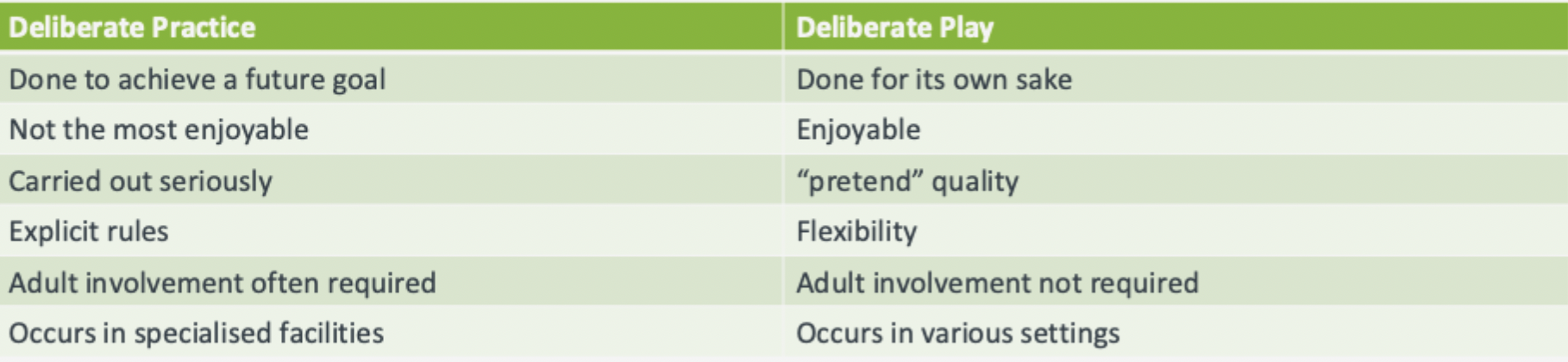
How do Deliberate Practice and Deliberate Play contrast across key dimensions?
Goal: Future performance (Practice) vs. Enjoyment / intrinsic (Play)
Experience: Serious, less enjoyable (Practice) vs. Enjoyable, "pretend" quality (Play)
Rules: Explicit & rigid (Practice) vs. Flexible & adaptable (Play)
Environment: Specialized facilities + adult supervision (Practice) vs. Diverse settings + no adult needed (Play)
What are the two core dimensions of Deliberate Practice (Practice design vs. Learning conditions) and how are they illustrated in the football passing example?
Practice Design:
Appropriately challenging tasks
Clear, specific improvement goals
Repetition and error correction
Learning Conditions:
Informative feedback
Focused attention
Adjustment based on performance
Illustrative Sport Example (Football Passing):
Goal: Improve passes under pressure
Task: Repeated passing sequences with defenders
Feedback: Accuracy and decision timing
Correction: Adapt movement and repeat
(Note: Practice is important, but expertise is not explained by practice alone.)
What are the potential contributions of Deliberate Play and how do Play and Practice compare as typical tendencies across key dimensions?
Potential Contributions of Deliberate Play:
Enjoyment and sustained engagement
Opportunities for experimentation
Creative solutions to game situations
Informal tactical decision-making (Note: Proposed benefits/opportunities, not guaranteed outcomes.)
Ideal-Typical Comparison / Typical Tendencies:
Primary purpose: Enjoyment / activity itself (Play) vs. Improving a defined skill (Practice)
Organisation: Flexible, often informal (Play) vs. Structured and goal-directed (Practice)
Rules: Adaptable (Play) vs. More explicit task requirements (Practice)
Feedback: Not necessarily external (Play) vs. Informative feedback central (Practice)
Repetition: Emerges through play (Play) vs. Purposeful repetition and correction (Practice)
(Note: Typical tendencies rather than strict, mutually exclusive categories.)