SA Alimentary 6: Surgery 2 – Part B
 Call Kai
 Learn
 Practice Test
 Spaced Repetition
 Match
 Flashcards
 Knowt Play
1/18

There's no tags or description
Looks like no tags are added yet.
19 Terms
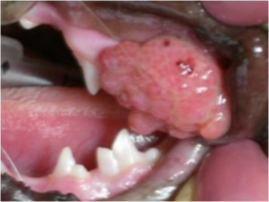
A 3-month-old puppy has a large, irregular, ulcerated mass attached to the caudal maxilla and an enlarged ipsilateral submandibular lymph node. What should you prioritise during the conscious clinical examination?
Assess the oral cavity as far as the puppy will tolerate, including the mass’s location and extent, ulceration or friability, pain and effects on eating. Examine the regional lymph nodes and perform a general examination, including thoracic auscultation.
A 3-month-old puppy has a large, friable mass attached to the caudal maxilla and an enlarged ipsilateral submandibular lymph node. You suspect an oral tumour. Rank the following investigations by priority and explain what each would tell you.
Cytology/Histology of the mass
Cytology/Histology of the lymph node
Thoracic imaging (Radiography/CT)
Skull imaging (Radiography/CT)
Bloods
Sample the mass to establish the diagnosis; tumour type will guide treatment and surgical margins.
Sample the enlarged lymph node to check for local metastasis, which could affect whether surgery is appropriate.
Image the skull to assess local bone and soft-tissue involvement and help plan surgery. CT gives more detail than radiographs.
Image the thorax to check for distant metastasis once neoplasia is suspected and staging would inform the treatment decision.
Perform blood tests mainly for pre-anaesthetic assessment; they are lower priority for diagnosing or staging the mass.
Priorities can change if a result would not alter the owner’s decision about treatment. In a cost-constrained case, focus first on the tests most likely to change the plan.
Which two diagnostic procedures for an oral mass and enlarged regional lymph node may be possible without sedation in a wriggly puppy?
Fine-needle aspiration (FNA) of the lymph node and an impression smear of the oral mass. More invasive sampling, such as an incisional or excisional biopsy, is more likely to require sedation or general anaesthesia.
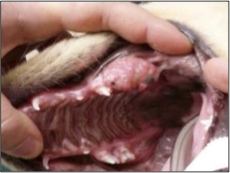
A dog has a confirmed oral squamous cell carcinoma, with no local or distant metastasis identified. Considering cost, recurrence risk, prognosis and cosmetic outcome, which surgery is most likely to provide the best long-term outcome?
Partial left caudal maxillectomy with 2 cm margins
What complications can occur after partial maxillectomy?
Wound dehiscence, altered appearance, difficulty eating and chronic pain
What complications are associated with mandibulectomy?
Loss of tongue support and mandibular drift.
A puppy is eating normally before a planned maxillectomy. Which feeding-tube options are reasonable? Select all that apply.
A. None
B. Naso-oesophageal
C. Oesophagostomy
D. Gastrostomy
A, B and C. No tube may be reasonable because Maisie is eating normally; a naso-oesophageal tube is a cheap, non-surgical option; and an oesophagostomy tube is a reasonable surgical option. The lecturer said she would most likely choose an oesophagostomy tube, but considered all three reasonable. Gastrostomy was considered too much for this case, given its more serious potential complications.
After maxillectomy, how should you decide whether to place a feeding tube, and how do the options compare?
Consider whether the puppy is likely to eat after surgery and whether nutritional support is likely to be needed.
No tube: Avoids unnecessary intervention if the patient eats, but poor appetite may mean a second anaesthetic to place one.
Naso-oesophageal tube: Avoids surgical morbidity and is cheap, but is easily dislodged or blocked, allows only very runny food and is often poorly tolerated long-term.
Oesophagostomy tube: Simple surgical option, allows more food choices and is easy to remove, but has a stoma-infection risk and requires a neck bandage.
Gastrostomy: Accommodates a larger tube and more food choices, but complications can be more serious; it requires a body bandage and may mean longer hospitalisation.

A dog has a slowly enlarging, soft, fluid-filled, non-painful swelling on the ventral neck, slightly left of midline and proximal to the larynx. What differentials should you consider?
Thyroid mass, neoplastic or reactive lymph node, skin/subcutaneous tumour, abscess, migrating foreign body, salivary mucocele, seroma and haematoma.
A 4-year-old dog has a slowly enlarging, soft, fluid-filled, non-painful swelling on the ventral neck, slightly left of midline and proximal to the larynx. How do these examination findings narrow the differentials?
Firm thyroid, lymph-node and skin/subcutaneous masses become less likely.
A reactive lymph node is less likely because it is rarely fluid-filled and is usually not midline.
Abscess, migrating foreign body, salivary mucocele, seroma and haematoma can be fluid-filled; the location is compatible with a cervical salivary mucocele.
The owners of a dog with a cervical swelling are worried about the cost of investigations and unsure whether they would pursue surgery if it were cancer. Aspiration/FNA and cytology have been agreed at a total cost of £165. The result confirms a cervical mucocele. What should you recommend?
Explain that sialoadenectomy is the definitive treatment and recommend it as the best chance of cure. If the owners decline or need time to decide, drainage can temporarily relieve the swelling, but arrange a planned recheck rather than simply asking them to return if it recurs, and explain that drainage is not definitive.

A cervical mucocele has recurred and enlarged substantially six weeks after drainage. The dog remains bright, and the owners ask for it to be drained again. What do you recommend?
Recommend sialoadenectomy as definitive treatment.
Repeated drainage may be a short-term bridge while owners arrange treatment, but it is likely to recur, risks infection and further inflammation, may complicate later surgery and may cost more in the long run.
Steroids are NOT an effective solution; adding them may increase infection risk.
Further diagnostics for sialoliths are unlikely to change treatment.
Euthanasia is NOT indicated solely on the information given.
Which glands should be removed to treat a cervical salivary mucocele and reduce recurrence risk?
Remove both the mandibular and sublingual glands on the affected side. Identifying the correct side is essential.
Contralateral gland involvement occurs in only ~5% of cases.
Apparent “recurrence” is almost always due to surgical removal of the incorrect (unaffected) side or incomplete excision of the sublingual gland chain.
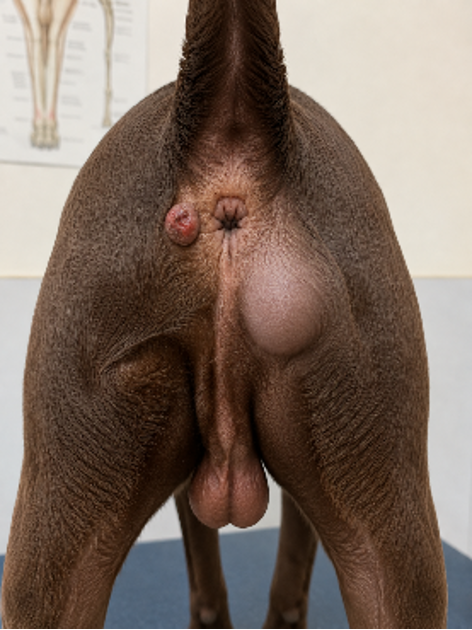
An older male dog has a growing, ulcerated lump beside the anus. What are the main differentials?
Circumanal adenoma/adenocarcinoma, anal sac adenocarcinoma, skin/subcutaneous tumour, marked anal-sac inflammation, anal gland abscess with or without a draining tract, other inflammatory skin disease such as contact allergy, skin infection and self-trauma.
What history is useful when investigating a perianal mass in an older male dog?
Ask about previous illness; general demeanour; appetite and weight change; thirst and urination; and defaecation, including straining, taking longer, passing less stool or producing drier stool. Ask about anal-sac problems, scooting and fishy odour.
What three components of a clinical examination should you prioritise for a male dog with a perianal mass?
Express the anal sacs to check for infection or masses; perform a rectal examination to assess the rectum, perineal herniation and prostate; and examine the testes for masses.
Barney is a 9-year-old male Labrador with an ulcerated perianal mass. FNA is most consistent with a circumanal adenoma; examination also finds a right-sided perineal hernia and a mildly enlarged, smooth, non-painful prostate. What further tests could be considered, and what findings would justify them?
No further tests are essential based on these findings. Consider them only if there’s a specific concern, e.g.:
Abdominal imaging to assess the prostate or suspected abdominal abnormalities.
Thoracic radiographs if metastasis is a concern; they are not justified by the current FNA result alone.
Blood tests for pre-anaesthetic assessment if surgery is planned.
Urinalysis if renal or urinary disease is suspected.
Faecal testing if history or examination suggests intestinal or parasitic disease; Barney’s findings do not.
Ionised calcium if paraneoplastic hypercalcaemia is a concern.
A 9-year-old entire male Labrador is presented for an ulcerated circumanal adenoma. He also has a right-sided perineal hernia causing mild changes in defaecation, and possible BPH (a mildly enlarged, smooth, non-painful prostate). Which treatments address each problem, and how should you decide what to treat?
Medical castration may cause the adenoma to regress, treat BPH and possibly reduce the risk of a contralateral hernia, but it does not repair the existing hernia.
Surgical castration treats BPH and may reduce contralateral hernia risk.
Mass removal treats the adenoma.
Herniorrhaphy treats the hernia and its clinical effects.
The ulcerated adenoma is the presenting complaint. Treat it and any other finding according to its clinical significance and effect on welfare: the defaecation changes make the hernia clinically relevant, while the possible BPH is mild and has no reported urinary signs. Don’t assume every abnormal finding needs immediate surgery.
A 9-year-old entire male Labrador is presented for an ulcerated perianal mass. FNA is most consistent with a circumanal adenoma. Examination also reveals a right-sided perineal hernia with mild rectal deviation and a mildly enlarged, smooth, non-painful prostate, consistent with possible BPH. He takes longer to pass smaller, drier stools. His owners are not cost-constrained and want the best outcome. Outline a staged management plan, including what would determine whether to continue medical management or proceed to surgery.
Offer medical castration followed by reassessment, or proceed directly to surgery, depending on the patient’s overall health, likely lifespan, welfare and the owners’ priorities.
If the adenoma regresses, medical management may continue; decide separately whether the hernia’s effect on defaecation warrants herniorrhaphy.
If the adenoma persists or definitive treatment is preferred, consider surgical castration and mass removal, with herniorrhaphy if the hernia is clinically significant.
Several plans may be reasonable; don’t automatically treat every finding without considering its clinical importance.
