Comprehensive Genetics and Molecular Biology Study Guide
 Call Kai
 Learn
 Practice Test
 Spaced Repetition
 Match
 Flashcards
 Knowt Play
1/56

Earn XP
Description and Tags
Flashcards covering classical Mendelian genetics, cytogenetics, gene interactions, sex linkage, chromosomal abnormalities, DNA discovery, replication, transcription, RNA processing, translation, and mutational genetics.
57 Terms
What hypothesis did Jean-Baptiste Lamarck propose regarding early mechanisms of inheritance?
Lamarck proposed the hypothesis of the inheritance of acquired characteristics, postulating that physiological modifications acquired by an organism through environmental use or disuse during its lifetime could be directly transmitted to offspring.
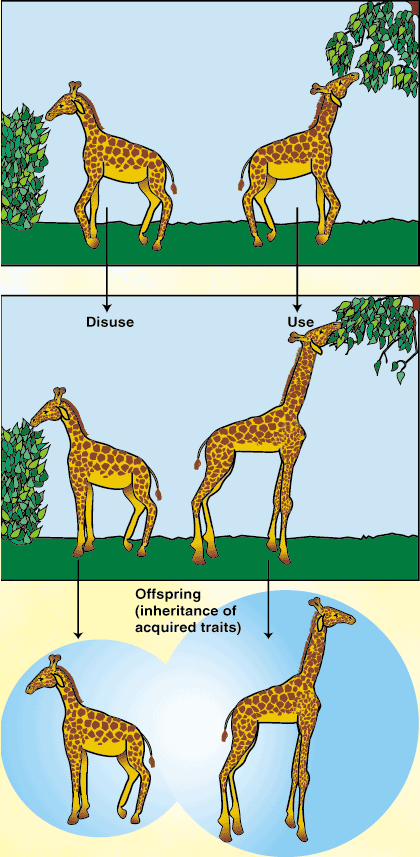
What evolutionary hypothesis and mechanism of phenotypic change are illustrated in this diagram?
The hypothesis of the inheritance of acquired characteristics (Lamarckism), demonstrating how environmental use (stretching necks to reach high tree foliage) or disuse causes elongation or shrinkage within an individual's lifetime, which is then postulated to be passed to offspring.
What model organism did Gregor Johann Mendel use, and what fundamental discovery did he make regarding inheritance?
Mendel used the garden pea (Pisum sativum) and discovered that offspring retain essential, particulate hereditary units from their parents without blending and without direct environmental modification.
In cytogenetics, how are a gene, a genome, a locus, and alleles formally defined?
- Gene: A specific segment of DNA that carries instructions to build a functional protein or RNA molecule.
- Genome: The complete set of all genetic instructions and DNA in an organism.
- Locus: The specific physical location of a gene on a chromosome.
- Alleles: Alternative versions of the same gene found at the same locus.
Distinguish between homozygous, heterozygous, dominant alleles, and recessive alleles.
- Homozygous: Having two identical alleles for a gene (such as PP or pp).
- Heterozygous: Having two different alleles for a gene (such as Pp).
- Dominant allele: An allele that masks the presence of a recessive allele and determines the physical trait in a heterozygote.
- Recessive allele: An allele whose trait is hidden by a dominant allele and only appears when two copies are present (pp).
How do genotype and phenotype relate, and what are homologous chromosomes?
Genotype is the specific allelic constitution, whereas phenotype is the observable physical, biochemical, or physiological characteristics generated by genotype and environment (Phenotype=Genotype+Environment). Homologous chromosomes are pairs exhibiting identical lengths, centromere placement, and staining bands carrying loci for identical traits.
What are the haploid (1n) and diploid (2n) chromosome counts in human cells?
Human gametes are haploid (1n=23 chromosomes), containing a single complete set of unpaired chromosomes; human somatic cells are diploid (2n=46 chromosomes), containing two complete sets.
What underlying genotypic ratio corresponds to Mendel's classic 3:1 phenotypic ratio in the F2 generation of a monohybrid cross?
A 1:2:1 genotypic ratio:
- 1/4 homozygous dominant (PP)
- 2/4 heterozygous dominant (Pp)
- 1/4 homozygous recessive (pp)
State Mendel's Principle of Segregation and Principle of Dominance.
- Principle of Segregation: The two alleles for each gene separate during gamete formation (meiosis), so each egg or sperm receives only one allele.
- Principle of Dominance: In a heterozygote, the dominant allele masks the recessive allele and dictates the visible phenotype.

Based on the provided Punnett square, what phenotypic ratio and combinations are produced in the F2 generation of a dihybrid cross (RrYy×RrYy)?
A 9:3:3:1 phenotypic ratio:
- 9/16 round, yellow (both dominant traits)
- 3/16 round, green
- 3/16 wrinkled, yellow
- 1/16 wrinkled, green (both recessive traits)
What is the physical cellular mechanism that drives Mendel's Principle of Independent Assortment?
The independent, random alignment of different homologous chromosome pairs along the metaphase plate during Meiosis I (metaphase I).

What type of experimental cross is shown in this diagram, and how do its alternative outcomes deduce an unknown genotype?
A testcross (crossing an individual showing a dominant trait with a homozygous recessive tester, pp):
- If 100% of the offspring show the dominant trait, the unknown parent is homozygous dominant (PP).
- If the offspring show a 1:1 ratio of dominant to recessive traits (50% dominant and 50% recessive), the unknown parent is heterozygous (Pp).
What is polygenic inheritance, and what kind of phenotypic distribution does it produce in populations?
Polygenic inheritance occurs when multiple independent genes influence a single phenotypic character in an additive manner, producing continuous phenotypic variation that follows a bell-shaped, normal Gaussian distribution (e.g., human height, skin pigmentation, and eye color).
What is pleiotropy, and how do lethal yellow in mice and cystic fibrosis demonstrate it?
Pleiotropy occurs when a single gene locus influences multiple, seemingly unrelated phenotypic traits. In mice, the Y allele yields a yellow coat when heterozygous (Yy) but causes embryonic lethality when homozygous (YY). In cystic fibrosis, a single CFTR mutation causes thick mucus leading to lung infections, pancreatic/liver duct blockages, and salty sweat.
How do multiple alleles and codominance function in the human ABO blood group system?
The ABO blood system is determined by three alleles (IA, IB, and i):
- Dominance: Both IA and IB are dominant over i.
- Codominance: IA and IB are codominant with each other, meaning a person with genotype IAIB produces both A and B sugar antigens on their red blood cells.
Which ABO blood types act as the universal donor and the universal recipient, and why?
Type O (ii) expresses neither galactose nor galactosamine antigens, making it the universal donor to A, B, AB, and O. Type AB (IAIB) produces both antigens and lacks ABO antibodies, making it the universal recipient from A, B, AB, and O.

What genetic phenomenon is demonstrated in this cross of Japanese four o'clock flowers (Mirabilis jalapa)?
Incomplete dominance; crossing true-breeding red (CRCR) with white (CWCW) flowers yields an intermediate pink phenotype (CRCW) in the F1, which upon self-crossing produces a 1:2:1 phenotypic and genotypic ratio (1/4 red, 2/4 pink, 1/4 white) in the F2.
How does environmental temperature influence coat color in Siamese cats and Himalayan rabbits?
Coat color is governed by an allele encoding a temperature-sensitive variant of tyrosinase. In warm body regions (>33∘C), tyrosinase is thermally denatured and inactive (producing light fur); in cooler peripheral extremities (<33∘C), it remains active to synthesize dark melanin.
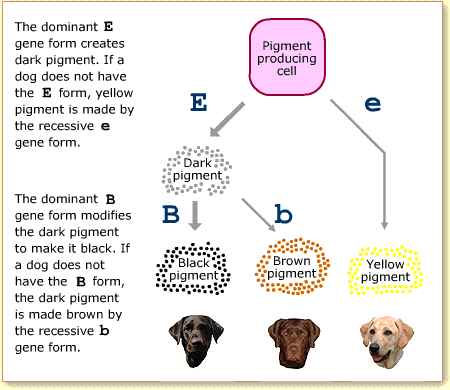
How do the E/e and B/b gene loci interact in this epistatic model to determine Labrador retriever coat colors?
Gene E governs pigment deposition (dominant E permits dark pigment; homozygous recessive ee prevents deposition, yielding yellow coats). Gene B modifies dark pigment to black (B) or brown (bb). Genotypes E_B_ are black, E_bb are brown/chocolate, and eeB_ or eebb are yellow.

What biochemical and genetic mechanisms cause the 9:7 purple-to-white kernel ratio shown in this corn cross?
Duplicate recessive epistasis in a two-step linear pathway; two functional dominant enzymes (Enzyme A from dominant A and Enzyme B from dominant B) are sequentially required to convert a colorless precursor into purple pigment. Homozygosity for either recessive null allele (A_bb, aaB_, aabb) halts synthesis, causing a white phenotype.
How does chromosomal sex determination differ between Drosophila melanogaster and Homo sapiens?
In Drosophila, sex is determined by the ratio of X chromosomes to autosomes (2X=female, 1X=male regardless of Y). In humans, sex is determined by the presence or absence of the Y chromosome containing the SRY gene (XX=female, XY=male).

What do the reciprocal crosses conducted by Thomas Hunt Morgan in Drosophila demonstrate about eye color inheritance?
They demonstrate X-linked inheritance; eye color alleles reside on the X chromosome (XW red, Xw white). Crossing a white-eyed male with a red-eyed female yields all red-eyed F1, whereas crossing a white-eyed female with a red-eyed male yields red-eyed females and white-eyed males in the F1.

What molecular mechanism is depicted in this female calico cat, and how does it generate a mosaic coat pattern?
Dosage compensation via X-chromosome inactivation (Lyonization); early in development, one X chromosome is randomly and stably condensed into a heterochromatic Barr body, creating patches expressing either orange or black fur alleles, alongside an independent autosomal gene controlling white fur patches.

How does crossing over during prophase I of meiosis alter the gametic outcomes of linked genes, as illustrated?
Without crossing over, all resulting gametes retain parental combinations (ab and AB); with crossing over between non-sister chromatids, novel recombinant gametes (aB and Ab) are generated alongside parental gametes.

Based on this testcross between a dihybrid female (b+bvg+vg) and a tester male (bbvgvg), how is the genetic map distance calculated?
Recombination frequency=total progenyrecombinant progeny=100092+88=1000180=0.18 (18%). Because 1% recombination equals 1cM, the distance between the black body (b) and vestigial wing (vg) loci is 18cM.
What are the genetic causes and clinical presentations of Cystic Fibrosis, Tay-Sachs Disease, and Sickle-Cell Anemia?
Cystic Fibrosis (1/2,500 Caucasians) is autosomal recessive from CFTR defects causing thick mucus. Tay-Sachs (1/3,500 Ashkenazi Jews) is autosomal recessive from HEXA deficiency causing neurotoxic ganglioside accumulation. Sickle-Cell (1/600 African Americans) is autosomal recessive from an HBB mutation causing hemoglobin sickling and tissue ischemia.
What are the inheritance patterns and frequencies of Phenylketonuria (PKU), Hemophilia, Huntington Disease, and Duchenne Muscular Dystrophy (DMD)?
PKU (1/12,000) is autosomal recessive (PAH gene). Hemophilia (1/10,000 males) is X-linked recessive (F8 gene). Huntington Disease (1/24,000) is autosomal dominant (expanded CAG repeat in HTT). DMD (1/3,700 males) is X-linked recessive (DMD gene).

What trend does this graph illustrate regarding Down syndrome (Trisomy 21) incidence and maternal age?
The risk of Down syndrome rises exponentially with advanced maternal age: minimal at age 20 (<0.1%) and 30 (≈0.1%), accelerating at age 35 (≈0.3%) and 40 (≈1.2%), and reaching approximately 3.0% (2.95%) by age 45.
How do Turner Syndrome, Klinefelter Syndrome, and Jacob Syndrome differ cytogenetically and phenotypically?
Turner syndrome (45,XO) is a sterile female monosomy with short stature, webbed neck, and no Barr bodies. Klinefelter syndrome (47,XXY) is a male trisomy with tall stature, reduced fertility, and one Barr body. Jacob syndrome (47,XYY) is a tall male who is usually fertile and largely asymptomatic.

How does genomic imprinting explain the differing phenotypic outcomes of the reciprocal mouse crosses shown?
The maternal allele is transcriptionally silenced by imprinting; when a normal female is crossed with a mutant dwarf male, offspring are dwarf because only the mutant paternal allele is active. In the reciprocal cross (normal male × dwarf female), offspring are normal because the normal paternal allele is active.

What experimental strains and primary discovery are associated with Frederick Griffith's 1928 experiment?
Griffith used virulent Smooth (S) and nonvirulent Rough (R) strains of Streptococcus pneumoniae; injecting heat-killed virulent S mixed with live nonvirulent R killed mice, demonstrating transformation wherein genetic virulence information transferred from dead S to live R cells.
How did Avery, MacLeod, and McCarty (1944) demonstrate that DNA was the chemical transforming principle?
They systematically treated heat-killed S-strain extracts with selective enzymes; destroying proteins with proteinases or RNA with RNases did not abolish transforming capability, whereas destroying DNA with DNases completely eliminated all transforming activity.

How did the Hershey-Chase blender experiment (1952) confirm that DNA is the genetic material in bacteriophages?
T2 bacteriophages were labeled with 32P (labeling DNA) or 35S (labeling protein coats). After infection, mechanical shearing in a blender, and centrifugation, 35S remained in the supernatant fluid, while 32P entered the bacterial pellet and was passed to progeny phages.
State Chargaff's rules regarding base composition in double-stranded DNA.
In double-stranded DNA, the amount of adenine equals thymine (A=T) and the amount of guanine equals cytosine (G=C); consequently, the total purine fraction (A+G) always equals the total pyrimidine fraction (T+C).

What structural dimensions of the DNA double helix were revealed by Rosalind Franklin's Photo 51?
Photo 51 established that DNA has uniform helical symmetry with a constant diameter of 2nm, completing one full revolution every 3.4nm, representing 10 nucleotide residues per turn (0.34nm vertical distance per base residue).

What are the structural components of a nucleotide, and how are purines distinguished from pyrimidines?
A nucleotide consists of a pentose sugar (2-deoxyribose in DNA lacking a 2′ oxygen; ribose in RNA with 2′-OH), a phosphate group attached to the 5′ carbon, and a nitrogenous base attached to the 1′ carbon. Purines (Adenine, Guanine) are double-ringed; pyrimidines (Cytosine, Thymine, Uracil) are single-ringed.

How does a phosphodiester bond form, and what polarity does it establish along a nucleic acid strand?
A phosphodiester bond forms between the 5′ phosphate of an incoming dNTP and the free 3′-OH group of the preceding nucleotide (cleaving pyrophosphate, PPi), imparting strict intrinsic polarity from the 5′ end (free phosphate) to the 3′ end (free hydroxyl).

What specific hydrogen-bonding patterns and rules govern complementary base pairing in DNA as shown?
Guanine pairs exclusively with Cytosine via three hydrogen bonds (G≡C), and Adenine pairs exclusively with Thymine via two hydrogen bonds (A=T). A two-ring purine always pairs with a single-ring pyrimidine, maintaining a constant 2nm duplex diameter.

Differentiate between the three competing DNA replication models illustrated in this diagram.
- Conservative: parental duplex remains intact, producing a completely new daughter duplex. 2. Semiconservative: parental strands unwind and serve as templates; each daughter duplex contains one parental and one new strand. 3. Dispersive: parental strands fragment, yielding mosaics of parental and newly synthesized DNA.
What did the Meselson-Stahl experiment observe across generations in CsCl density gradients to prove semiconservative replication?
Generation 0 formed a single dense heavy band (15N); Generation 1 yielded an intermediate-density hybrid band (15N–14N); Generation 2 produced two distinct bands (one intermediate hybrid band and one light 14N–14N band).
What are the molecular functions of Helicase, Primase, Single-Strand-Binding Protein (SSB), and DNA Gyrase in E. coli replication?
- Helicase: Unwinds and unzips the two strands of the DNA double helix.
- Primase: Synthesizes short RNA primers to provide a starting point for DNA synthesis.
- Single-Strand-Binding Protein (SSB): Binds to unwound single strands to prevent them from snapping back together.
- DNA Gyrase: Relieves torsional strain and prevents supercoiling ahead of the replication fork.
Contrast the catalytic roles of DNA Polymerase III, DNA Polymerase I, and DNA Ligase in E. coli.
- DNA Polymerase III: The primary replication enzyme that builds new DNA strands in the 5′→3′ direction.
- DNA Polymerase I: Removes RNA primers and fills the gaps with DNA nucleotides.
- DNA Ligase: Seals nicks in the sugar-phosphate backbone, joining adjacent Okazaki fragments into a continuous strand.

Explain the difference between leading and lagging strand synthesis at the replication fork shown in this diagram.
- Leading strand: Built continuously in the direction toward the opening replication fork from a single RNA primer.
- Lagging strand: Built discontinuously away from the replication fork in short segments called Okazaki fragments, each requiring its own RNA primer.
What is the end-replication problem on linear eukaryotic chromosomes, and how does telomerase resolve it?
Degradation of the terminal RNA primer on the lagging strand leaves a gap with no upstream 3′-OH group for DNA polymerase to elongate, shortening chromosomes each mitotic cycle. Telomerase, a ribonucleoprotein reverse transcriptase with an internal RNA template, extends terminal repeated sequences (telomeres) to protect genomic DNA.
How do thymine dimers form, and how are they repaired by photolyase?
Ultraviolet (UV) light irradiation cross-links adjacent thymines into covalent cyclobutane rings (thymine dimers), blocking replication and transcription. Photolyase absorbs visible light photons to cleave the cyclobutane cross-link and restore normal thymine residues.
What is the Central Dogma of molecular biology, and what viral exception reverses its standard direction?
Genetic information flows unidirectionally from DNA to RNA to protein (DNA→RNA→Protein). Retroviruses (such as HIV) violate this dogma using reverse transcriptase to synthesize double-stranded DNA from an RNA genome (RNA→DNA).
What are the cellular functions of snRNA, SRP RNA, and miRNA/siRNA?
snRNAs are structural and catalytic components of spliceosomes that excise introns from pre-mRNA; SRP RNA directs ribosomes translating secretory or membrane proteins to dock at the rough ER; miRNAs and siRNAs are non-coding regulatory RNAs that mediate post-transcriptional gene silencing and translational repression.
What three post-transcriptional modifications are required to produce mature eukaryotic mRNA from pre-mRNA?
- Addition of a 5′ cap: A modified guanine nucleotide is attached to the 5′ end to protect the transcript and help ribosomes attach.
- Addition of a 3′ poly-A tail: A string of adenine residues is attached to the 3′ end to prevent degradation and facilitate export from the nucleus.
- Splicing: Spliceosomes remove non-coding introns and join coding exons together.

How is the genetic code organized, and what functions are served by the start codon and stop codons?
The code consists of 43=64 non-overlapping triplet codons. 5′-AUG-3′ acts as the universal start codon (specifying Methionine), while 5′-UAA-3′, 5′-UAG-3′, and 5′-UGA-3′ serve as stop codons that terminate translation. Most amino acids are degenerate (specified by multiple synonymous codons).

Identify the two essential functional regions on the transfer RNA (tRNA) molecule shown in this diagram.
The anticodon loop (a three-nucleotide sequence that base-pairs antiparallel to the complementary mRNA codon) and the amino acid accepting end (3′ terminal −CCA), which is covalently charged with a specific amino acid by an aminoacyl-tRNA synthetase.

What are the molecular compositions and primary functions of the small and large ribosomal subunits shown?
The small subunit (≈1,900 RNA bases, ≈33 proteins) decodes mRNA transcripts and aligns initiator tRNAs; the large subunit (≈5,080 RNA bases, ≈49 proteins) houses peptidyl transferase ribozyme activity within its rRNA core to catalyze peptide bond formation.

What macromolecular arrangement is depicted in this electron micrograph and diagram, and what is its functional significance?
Polyribosomes (polysomes), wherein multiple ribosomes simultaneously translate a single mRNA transcript in the 5′→3′ direction, maximizing translational efficiency by producing multiple identical polypeptide copies concurrently.
Distinguish between silent, missense, and nonsense point mutations.
- Silent mutation: A base substitution that changes a codon to a synonymous one, resulting in the same amino acid and no change to the protein.
- Missense mutation: A base substitution that causes one amino acid to be replaced by a different amino acid.
- Nonsense mutation: A base substitution that converts an amino acid codon into a premature stop codon, causing translation to stop early and producing a truncated protein.
How do transitions differ from transversions, and what defines a frameshift mutation?
Transitions exchange a purine for a purine (A↔G) or pyrimidine for pyrimidine (C↔T); transversions exchange a purine for a pyrimidine or vice versa (A/G↔C/T). Frameshift mutations insert or delete base pairs in numbers not divisible by three, shifting the reading frame.
What molecular mechanism underlies Huntington disease at the genetic sequence level?
An expanding 5′-CAG-3′ triplet repeat tract in the coding region of the HTT gene produces an abnormally long polyglutamine tract that renders the huntingtin protein toxic, with longer repeats correlating with earlier onset and increased disease severity.
What steps are required to set up and complete a monohybrid Punnett square?
- Identify the genotypes of both parents (e.g., Pp×Pp).
- Determine the possible gametes each parent can make by separating their alleles.
- Write one parent's alleles across the top and the other parent's alleles down the left side of a 2×2 grid.
- Combine the corresponding row and column alleles in each box to predict offspring genotypes and phenotypic ratios.
What are the three main stages of DNA replication?
- Initiation: Proteins bind the origin of replication, and helicase unwinds the double helix.
- Elongation: Primase lays down RNA primers, and DNA polymerase builds complementary leading and lagging strands in the 5′→3′ direction.
- Termination: RNA primers are removed, gaps are filled with DNA, ligase seals the backbone, and replication complexes detach.