Circadian rythms
 Call Kai
 Learn
 Practice Test
 Spaced Repetition
 Match
 Flashcards
 Knowt Play
1/15

There's no tags or description
Looks like no tags are added yet.
16 Terms
Circadian Rhythms
about & day
24 hr cycles
Present in eucaryotes and photosynthetic bacteria
present even if the environmental conditions are kept constant
What does it mean that a plant's timing mechanism is endogenous?
It originates internally, within the plant.
At what level do circadian clocks occur?
At the cellular level.
Can multicellular organisms have multiple circadian clocks?
Yes. Different cells and tissues can have their own circadian clocks.
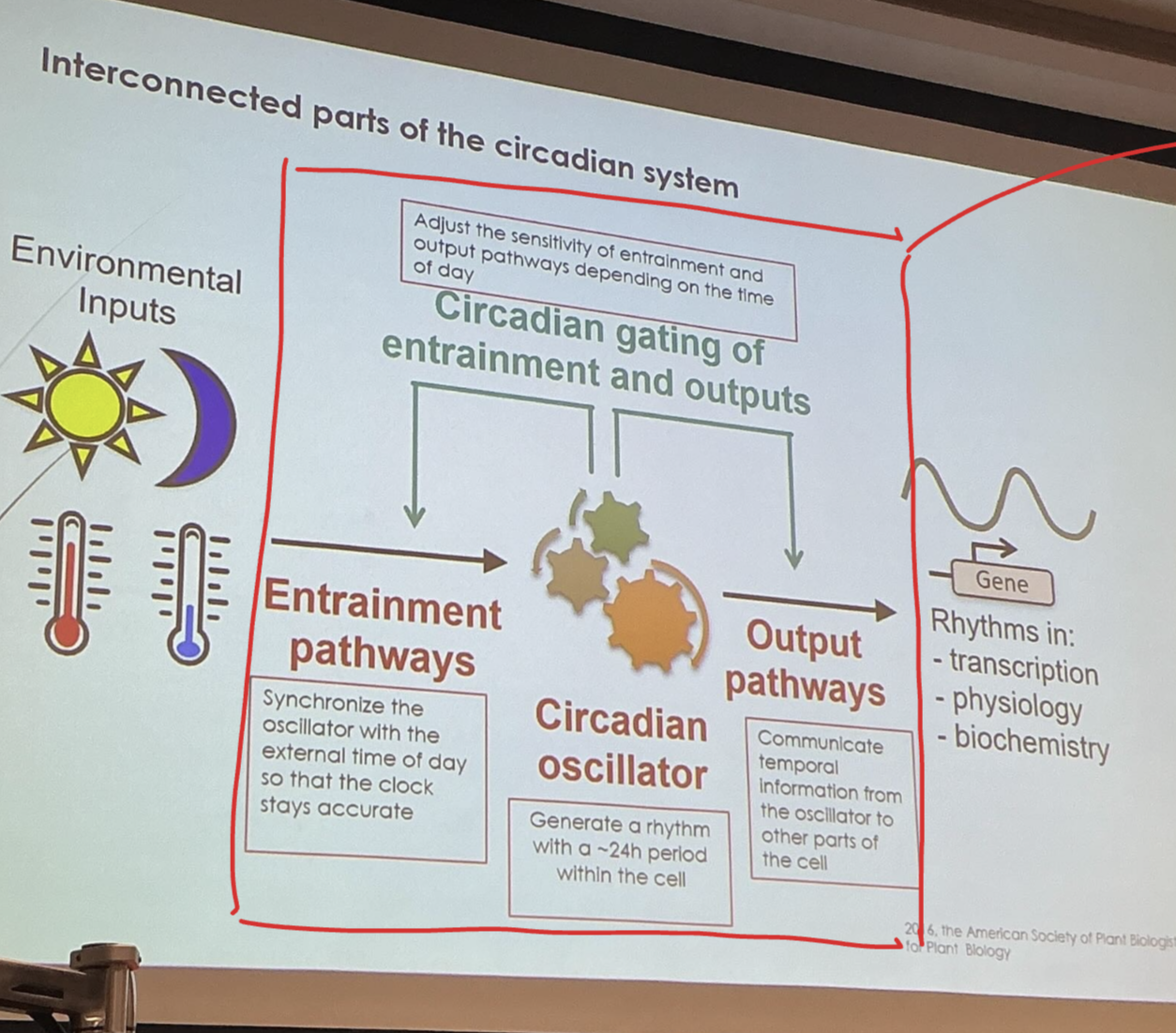
Entrainment
Refers to the process by which the internal circadian clock aligns or synchronizes with external environmental cues.
Process by which a periodic repetition of light and dark causes a circadian rhythm to synchronize with the same cycle as the entrainment factor.
Entrainment —main factors
light-dark cycles and temperature cycles are the principal.
Entrainment—temperature compensation
Compensatory mechanism that allows the circadian clock to maintain a stable rhythm over a range of physiological temp. at 12 - 27 C.
Entrainment—Gating
The circadian clock controls how strongly a plant responds to a stimulus depending on the time of the day.
A light pulse given at night may cause a strong shift in the clock, while the same light pulse during the day might have a minimal effect or none at all.
Circadian rhythms have a number of measurable properties.
Period = time to complete one full cycle
Phase = the time at which a particular point of cycle occurs (peak)
Amplitude = the displacement of the oscillation from the center point

Environmental signals entrain (align) the circadian oscillator (generate a rhythm with a 24 hr period within the cell).
red light (phytochrome photoreceptors)
blue light (cryptochrome photoreceptors)
Sugars produced by photosynthesis
Temperature
What do phytochrome (Pr) and cryptochrome (Pfr) provide to the circadian clock?
light input

phytochrome (Pr) and cryptochrome (Pfr)
morning vs afternoon

Many metabolic pathways have physiologically appropriate phases of:
maximal transcript abundance
Large number of genes associated with what are under circadian clock?
Large number of genes associated with metabolism are under circadian clock
Chlorophyll biosynthesis genes peak just before dawn to anticipate:
Chlorophyll biosynthesis genes peak just before dawn to anticipate: light availability

When do starch catabolism genes peak?
around dusk
