Create a New Flashcard Set
 Call Kai
 Learn
 Practice Test
 Spaced Repetition
 Match
 Flashcards
 Knowt Play
1/54

There's no tags or description
Looks like no tags are added yet.
55 Terms
When a neurotransmitter like acetylcholine is acting in an excitatory manner, which of the following is likely a result of the acetylcholine acting on the postsynaptic cell?
A. Chemically gated sodium channels will be closed
B. Chemically gated chloride channels will open
C. Chemically graded potassium channels will open
D. Chemically graded sodium channels will open
D. Chemically gated sodium channels will open
What does the central nervous system use to determine the strength of a stimulus?
A. type of stimulus receptor
B. Size of action potentials
C. Origin of the stimulus
D. Frequency of action potentials
D. Frequency of action potentials
Loss of function in the enzyme acetylcholine esterase would result in which of the following?
A. inability to destroy and remove acetylcholine from the synaptic cleft
B. stimulation of the production of acetylcholine
C. amplify or enhance the effect of ACh
D. inability to release acetylcholine
A. Inability to destroy and remove acetylcholine from the synaptic cleft
Saltatory conduction is made possible by ________.
A) erratic transmission of nerve impulses
B) diphasic impulses
C) large nerve fibers
D) the myelin sheath
D. The myelin sheath
These cells in the CNS have cilia that move in order to circulate cerebrospinal fluid.
A. astrocytes
B. ependymal cells
C. oligodendrocytes
D. Schwann cells
B. ependymal cells
Rigor mortis occurs because ________.
A. no atp is available to release attached actin and myosin molecules
B. the cells are dead
C. Proteins are beginning to break down, preventing a flow of calcium ions
D. Sodium ions leak into the muscle causing continued contractions
A. no ATP is available to release attached actin and myosin molecules
Which of the following is not a function of astrocytes?
A. guides the migration of young neurons, synapse formation, and helping to determine capillary permeability
B. anchor neurons to blood vessels
C. Support and brace neurons
D. Provide the defense for the CNS
D. Provide the defense for the CNS
Which of the following is not a function of the autonomic nervous system?
A. innervation of smooth muscle of the digestive tract
B. innervation of glands
C. innervation of cardiac muscle
D. innervation of skeletal muscle
D. innervation of skeletal muscle
What structure in skeletal muscle functions in calcium storage?
A. sarcoplasmic reticulum
B. intermediate filament network
C. myofibrillar network
D. mitochondria
A. sarcoplasmic reticulum
The period after an initial stimulus when a neuron is not sensitive to another stimulus is the ________.
A. absolute refractory period
B. depolarization
C. resting period
D. repolarization
A. absolute refractory period
A neuron that has as its primary function the job of connecting other neurons is called a(n) ________.
A. interneuron
B. afferent neuron
C. efferent neuron
D. glial cell
A. interneuron
Which of the following is an excitatory neurotransmitter secreted by motor neurons innervating?
A. norepinephrine
B. cholinesterase
C. acetylcholine
D. gamma aminobutyric
C. acetylcholine
Like all cells, the neurons' internal organization dictates their function. Neurons have relatively many mitochondria, an extensive network of rough endoplasmic reticulum, and many clusters of ribosomes. These cellular features indicate all the following EXCEPT ________
A. Neurons have stable, relatively unchanging internal environments
B. Neurons have a relatively high consumption of oxygen
C. Neurons produce many proteins
D. Neurons must meet a high demand for ATP
A. Neurons have stable, relatively unchanging internal environments
The effect of acetylcholine can be stimulating or inhibiting. Which of the following gives the best explanation for why this is so?
A. acetylcholine has many different forms
B. Postsynaptic cells have a dynamic and changing metabolism and respond differently at different times
C. Different postsynaptic cells will have different receptors
D. Acetylcholine has a dose effect. Larger doses are stimulating, while small doses inhibit
C. Different postsynaptic cells will have different receptors
An action potential is regarded as an example of positive feedback. Which of the following examples below best illustrates the positive feedback aspect of an action potential?
A. The sodium potassium pump consistently moves ions as long as ATP is available, and regardless of membrane potential changes
B. A threshold stimulus will cause the opening of voltage-gated sodium ion channels, which will cause further depolarizing stimuli. This stimulus will open still more voltage-gated sodium ion channels
C. Voltage-gated potassium channels open slowly and remain open long enough to cause hyperpolarization
D. Potassium permeability is about 25 times greater than sodium ions
B. A threshold stimulus will cause the opening of voltage-gated sodium ion channels, which will cause further depolarizing stimuli.
Bipolar neurons are commonly ______
A. Found in the retina of the eye
B. Found in ganglia
C. called neuroglial cells
D. motor neurons
A. found in the retina of the eye
The term central nervous system refers to the ______
A. brain and spinal cord
B. the somatic nerves
C. the spinal nerves
D. sensory nerves
A. brain and spinal cord
When a neurotransmitter like glycine is acting in an inhibitory manner, which of the following is likely a result of the glycine acting on the postsynaptic cell
A. hyperpolarization of the postsynaptic cell membrane
B. opening of chemically gated sodium channels
C. depolarization of the postsynaptic cell membrane
D. influx of positively charged ions into the postsynaptic cell
A. hyperpolarization of the postsynaptic cell membrane
Myoglobin _______
A. produces the end plate potential
B. is a protein in the direct phosphorylation of ADP
C. stores oxygen in muscle cells
D. breaks down glycogen
C. stores oxygen in muscle cells
If a postsynaptic neuron is stimulated to threshold by spatial summation, that implies that_______.
A. The postsynaptic cell has many voltage-gated channels
B. The postsynaptic cells has many synapses with many presynaptic neurons
C. The postsynaptic cell is slow to repolarize
D. The postsynaptic cell has a lower-than-normal threshold
B. The postsynaptic cells have many synapses with many presynaptic neurons
The depolarization phase of an action potential is punctuated by the closing of inactivation gates in the voltage-gated sodium channels. All of the following are consequences of this inactivation except_______
A. This allows for the one-way transmission of an action potential down the axon
B. This stops the depolarization of the axon membrane
C. This limits the frequency of action potentials down the axon
D. This allows for the efflux (diffusion out) of potassium ions, resulting in the repolarization of the cell
D. This allows for the efflux (diffusion out) of potassium ions, resulting in the repolarization of the cell
Which ion channel opens in response to a change in membrane potential and participates in the generation and conduction of action potentials.
A. ligand-gated channel
B. mechanical-gated channels
C. Voltage-gated channels
D. Leakage channels
C. voltage-gated channels
During the relative refractory period of an action potential, a larger-than-normal stimulus is needed to cause another action potential. This is due to the fact that ______
A. The sodium potassium pump will stop working during the relative refractory
B. The inactivation gates on voltage-gated sodium ion channels are closed
C. The voltage-gated potassium ion channels remain open long enough to hyperpolarize the axon membrane
D. The membrane is now impermeable to all ions
C. The voltage-gated potassium ion channels remain open long enough to hyperpolarize the axon membrane
Which of the choices below describes the ANS
A. sensory neurons that convey information from somatic receptors in the head, body wall, and limbs, from receptors from the special senses of vision, hearing, taste, and smell to the CNS
B. sensory and motor neurons that supply the digestive tract
C. motor fibers that conduct nerve impulses from the CNS to smooth muscle, cardiac muscle, and glands
D. motor fibers that conduct nerve impulses from the CNS to skeletal muscles
C. motor fibers that conduct nerve impulses from the CNS to smooth muscle, cardiac muscle, and glands
If a postsynaptic cell is stimulated to threshold by temporal summation this implies that ________.
A. The postsynaptic cell is sending a frequent action potential
B. The presynaptic neuron is sending frequent IPSP
C. The postsynaptic cell can be influenced by only one presynaptic cell
D. A presynaptic neuron is sending frequent EPSP
D. A presynaptic neuron is sending frequent EPSP
True or False: In myelinated axons, the voltage-gated sodium channels are concentrated at the nodes of Ranvier
True
True or False: Axon diameter and degree of myelination determine nerve impulse conduction velocity
True
True or False: reflexes are rapid, automatic responses to stimuli that will produce the same effect every time
True
True or False: A postsynaptic potential is a graded potential that is the result of a neurotransmitter released into the synapse between two neurons
True
True of False: Strong stimuli cause the strength of action potentials generated to increase
False
True or False: The effect of a neurotransmitter on the muscle cell membrane is to modify its ion permeability properties temporarily
True
True or False: The action potential is caused by permeability changes in the plasma membrane
True
True of false: cell bodies of sensory neurons may be located to ganglia lying outside the central nervous system
True
True or false: The thin filaments (actin) contain a polypeptide, subunit G actin that bears active sites for myosin attachment
True
True or False: During depolarization, the inside of the neuron's membrane becomes less negative.
True
True or False: A stimulus traveling toward a synapse appears to open calcium ion channels at the presynaptic end, which in turn promotes fusion of synaptic vesicles to the axonal membrane.
True
TRUE OR FALSE
Unipolar neurons have axons structurally divided into peripheral and central processes
True
True or false: smooth muscles relax when intercellular calcium levels drop but may not cease contractions
True
True or false the all-or-none phenomenon as applies to the nerve conduction states that the whole nerve must be stimulated for conduction to take place
False
True or False: Enkephalins and endorphins are peptides that act like morphine.
True
True or False: A resting potential is caused by a difference in the concentration of certain ions inside and outside the cell.
True
True or false: an increase in the calcium ion level in the sarcoplasm starts the sliding of the thin filaments. When the level of calcium ions declines, sliding stops
True
Individual Muscle Fiber
c. myofibril

Connective tissue surrounding muscle fiber bundles
e. Perimysium
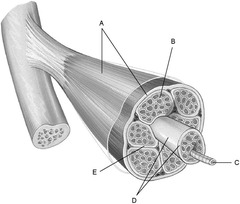
connective tissue sheath surrounding individual muscle fibers
B

Connective tissue covering the entire muscle organ
A

I band
C
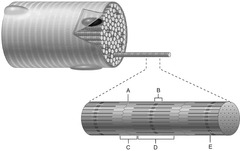
A band
D

Z disc
A

M line
E

Describe the major events that unfold during excitation-contraction coupling within a skeletal muscle
Nerve impulse → ACh release → Muscle action potential Action potential → T-tubules → SR calcium release Ca²⁺ binds troponin → Tropomyosin shifts → Actin sites exposed Myosin-actin cross-bridge cycling → Contraction Ca²⁺ reuptake → Tropomyosin blocks → Relaxation

Compare and contrast the location of graded potentials and action potentials on a neuron versus a muscle
In neurons, graded potentials occur on the dendrites and soma, while action potentials start at the axon hillock and travel down the axon. In skeletal muscle, the graded potential is the end-plate potential at the motor end plate, and the action potential spreads across the sarcolemma and T-tubules to trigger contraction.
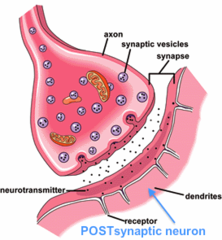
Sketch out and describe the events of depolarizing graded potentials and why that leads to excitation. Include: changes in voltage, trigger zone + how it leads to action potential.
-
Describe and sketch the major events that unfold during the sliding filament mechanism of muscle contraction
-
Describe the major steps involved in any action potential. Why action potential and not graded potential that can propogate??
Sketch a graph.
-