Chem 1 Exam 2 knowledge
 Call Kai
 Learn
 Practice Test
 Spaced Repetition
 Match
 Flashcards
 Knowt Play
1/28

There's no tags or description
Looks like no tags are added yet.
29 Terms
AX5
trigonal bipyramidal, bond angles: 120, 90 (non polar)

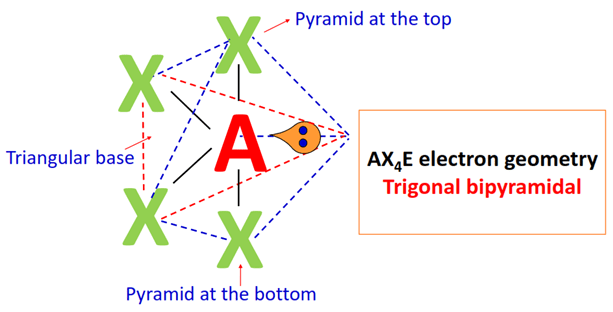
AX4E
see-saw, bond angles: <120, <90 (polar)
AX3E2
t- shaped, bond angles: <90 (polar)

AX2E3
linear, bond angle: 180 (nonpolar)

AX6
octahedral, bond angle: 90 (nonpolar)

AX5E
square pyramidal, bond angle: <90 (polar)

AX4E2
square planar, bond angle: 90 (nonpolar)

structures with no lone pairs on central atom
all non polar
structures with more than one type of outer atom
mostly polar
structures with 1 lone pair on the central atom
always polar (all bent molecules are polar)
structures with >1 lone pair
may or may not be polar
sp hybridization (steric #: 2)
linear geometry
sp² hybridization (steric #: 3)
trigonal planar geometry
sp³ hybridization (steric #: 4)
tetrahedral geometry
sp³d hybridization (steric #: 5)
trigonal bipyramidal geometry
sp³d² hybridization (steric #: 6)
octahedral geometry
sigma (J) bonds
bonds formed by end-to-end overlap of atomic or hybrid orbitals, electron density is greatest in between the nuclei along bond axis
Pi bonds
side-to-side overlap of orbitals, results regions of e- density above and below the bond axis
Diamagnetic
weakly repelled by a magnetic field, no unpaired e-
Paramagnetic
attracted to a magnetic field, one or more unpaired electrons
strong acids that dissolve completely into ions, strong electrolyte (aq, soluble)
HCl, HBr, HI, HNO3, HCLO4, H2SO4
strong bases that dissolve completely into ions, strong electrolyte (aq, soluble)
LiOH, NaOH, RbOH, CsOH, Ca(OH)2, Sr(OH)2, Ba(OH)2
weak acids that dont completely dissociate, most of the molecules remain intact (insoluble)
HF, H3PO4, CH3COOH
weak bases that dont completely dissociate (insoluble)
NH3
oxidation number (O.N) rules
sum of oxidation numbers=overall charge
Monoatomic ion O.N=charge
Metal in ionic compounds: + O.N equal to charge
Atom in a neutral=0
H- +1 when bonded to nonmetal, -1 when bonded to a metal or metalloid
F: always -1 in compounds
O: -2 except when bonded to O or F
Cl,Br,I: -1 except when central atom or bonded to O/F
Category A: Always soluble
Cations: Group 1A (Li+, Na+, K+, Rb+, Cs+) and NH4+
Anions: NO3-, CLO4-, CH3COO-/C2H3O2- (acetate)
Category B: Always insoluble, unless paired with category a
Cations: Ag+, Pb2+
Anions: CO3 2-, PO4 3-, S2-, CrO4 2-
Category C: usually insoluble, unless paired with category B
Halides: Cl-, Br-, I-
Other exceptions: Cu+ and Hg2 2+ are insoluble halides
Category D; the in-between annoying ones
SO4 2-, soluble except with category B, and Ca2+, Sr2+, Ba2+
OH-: usually insoluble except with Category A or Ca2+, Sr2+, Ba2+